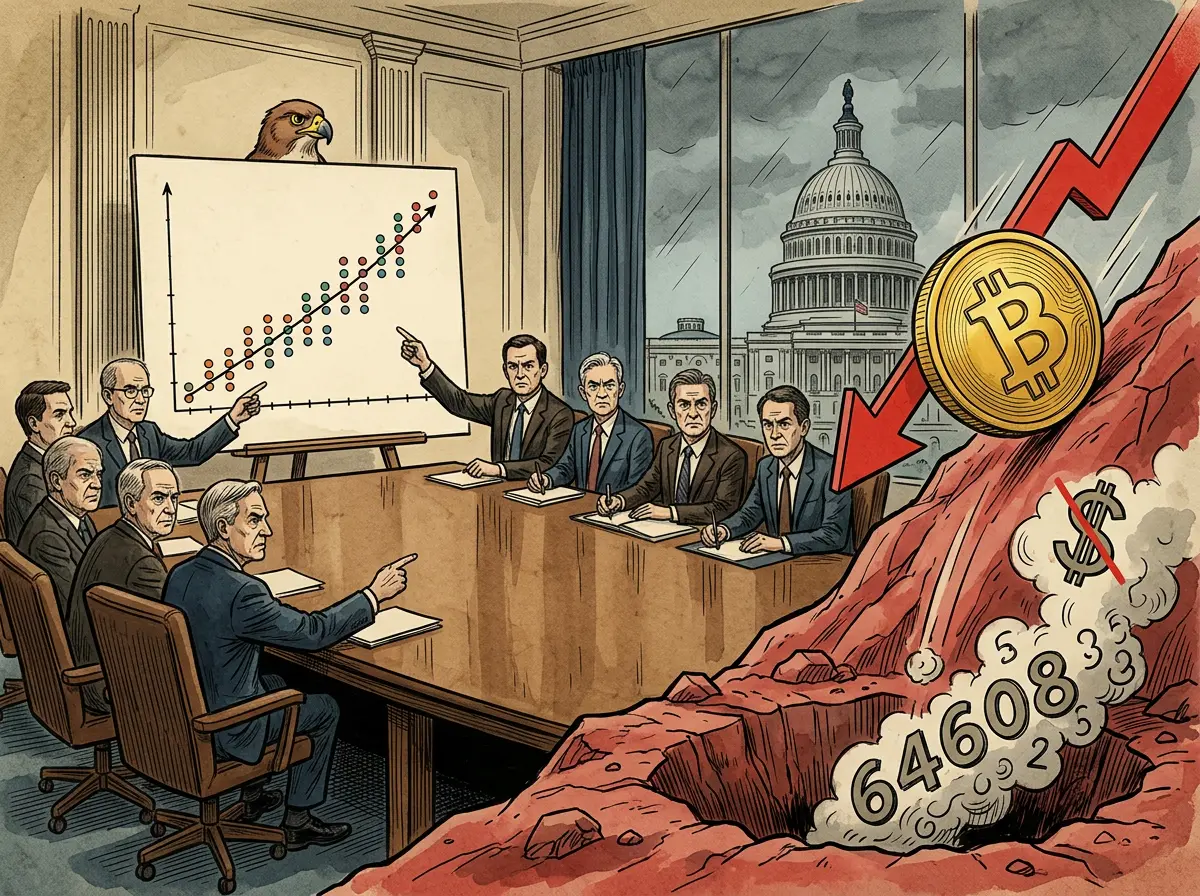
Bitcoin fell to $64,608 on June 18, after the FOMC unanimously decided on Wednesday to keep the federal funds rate unchanged at 3.50%-3.75%. However, the latest dot plot shows a major shift: nine officials are expected to raise rates at least once within the year (no officials supported a rate hike in March). The CME “FedWatch” tool shows the probability of a December rate hike rising to 78%. Waller said at the press conference that he did not submit his rate dot-plot forecast.
Dramatic shift in the FOMC dot plot from March to June
The latest dot plot shows the specific changes in FOMC officials’ stances from March to June: the number of officials supporting a rate hike within the year rose from 0 to 9; the number supporting rate cuts fell from 12 to 1; and the median interest-rate forecast for end-2026 rose from 3.4% to 3.8%, indicating FOMC officials currently expect there is still room for one 25-basis-point rate hike this year.
WSJ chief economics reporter Nick Timiraos—known in the market as the “Fed’s mouthpiece”—said on Wednesday that the first rate-setting meeting led by Waller delivered the clearest hawkish signals so far, adding that the next policy move may no longer be rate cuts, but instead reconsidering rate hikes.
Waller refuses to submit rate forecasts; policy statement cut from 340 words to about 130 words
Waller said at the press conference: “I encourage committee members to continue submitting forecasts, but based on my longstanding view of the current structure of the SEP, I choose not to submit my own forecast.” He is the only missing “dot” in the dot plot. The policy statement was trimmed from more than 340 words in April to about 130 words, nearly deleting all forward guidance; Waller explained that “so-called forward guidance is not suitable for the current policy environment.”
After Waller’s remarks, the yield on the 2-year U.S. Treasury briefly jumped by more than 14 basis points. Waller mentioned “Price Stability” about 12 times during the press conference.
Waller announces five reform working groups; CME hike odds rise to 78%
Waller announced the formation of five dedicated working groups to study: communication mechanisms, balance-sheet management, data sources, research on productivity and the labor market, and an assessment of how disruptive technologies such as AI affect the economic and inflation target framework.
Waller said, “Each working group serves the same goal—building a Fed with clear objectives and that is fit for the future.” Most working groups are expected to submit reports by the end of this year. CME “FedWatch” shows the probability of a December rate hike rising from 61% before the decision to 78%.
Assessments from multiple analysts: from Bloomberg and Goldman Sachs to BlackRock
Anna Wong (Bloomberg Economics chief economist): “The Waller era arrives in a highly impactful way,” saying she no longer expects the Fed to cut rates by 25 basis points this year
Kay Haigh (Global Head of Fixed Income Research, Goldman Sachs Asset Management): This meeting shows the Fed’s hawkish shift is not driven solely by energy prices; even though oil prices have fallen, about half of the FOMC participants still expect possible rate hikes this year
Krishna Guha (Global Head of Central Bank Strategy, Evercore ISI): “What Waller sounds like today is more like that past hawkish Fed governor, rather than the rate-cut driver the market had expected.”
Rick Rieder (Head of Fixed Income, BlackRock): “Today, the Fed is effectively opening a new era for U.S. monetary policy.”
Dario Perkins (Global Co-Head of Global Macro, TS Lombard): “From here on, tracking the Fed will become more difficult.”
FAQ
Why did Waller refuse to submit a dot-plot rate forecast?
Waller said at the press conference that he chose not to submit based on his long-held critical stance toward the current structure of the SEP (Summary of Economic Projections). He said he encourages other committee members to continue submitting forecasts, but believes forward guidance is not suitable for the current policy environment. He is the only missing “dot” in the dot plot, making this dot plot include forecasts from 18 officials rather than the usual 19.
What are the scope of responsibilities for the five reform working groups?
The five working groups announced by Waller will study areas including: communication mechanisms, balance-sheet management, data sources, research on productivity and the labor market, and assessments of the impact of disruptive technologies such as AI on the economic and inflation target framework. Most working groups are expected to submit reports by the end of this year; specific timelines and member rosters have not been announced.
What is the connection between Bitcoin falling to $64,608 and the FOMC decision?
Based on market data from June 18, Bitcoin fell to $64,608, and the timing corresponds to market repricing after the release of the FOMC’s hawkish signal. The CME rate-hike probability rose from 61% to 78%, reflecting increased market expectations that the Fed may restart rate hikes. Rate-hike expectations are often viewed as one of the macro factors that compress valuations of risk assets, including cryptocurrencies.


