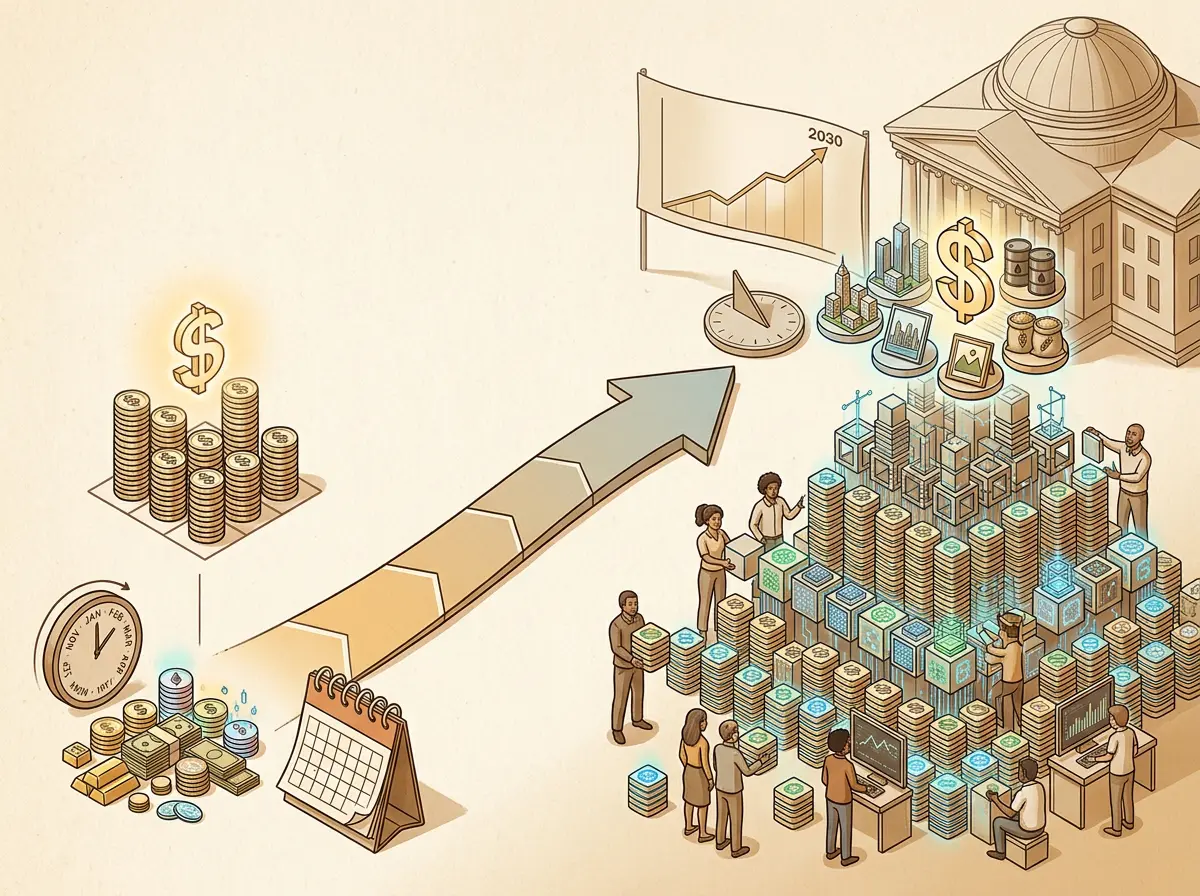
Citigroup said the tokenized real-world assets (RWA) market is expected to reach $5.5 trillion by 2030 under a base-case scenario, and up to $8.2 trillion under a more bullish market-adoption scenario; Citigroup believes tokenization is moving from experimental projects toward mainstream financial infrastructure. Token Terminal data shows the current market capitalization of tokenized assets has already surpassed $4.3 billion, growing about 37% over the past 180 days.
Citigroup’s Two Scenario Forecasts for Tokenized Assets
Based on Citigroup’s analysis, the forecast range for the tokenized market by 2030 is as follows: the base scenario is $5.5 trillion, and the optimistic scenario is $8.2 trillion.
Citigroup lists DTCC, the New York Stock Exchange, and Nasdaq as key participants in the tokenization process, and said adoption by these institutions can accelerate the use of blockchain infrastructure in asset issuance and settlement.
Token Terminal’s Current Market Size and Breakdown by Category
According to Token Terminal data, the current confirmed breakdown of the tokenization market is as follows:
· Tokenized funds account for about 80% of the industry’s total market cap, commodity tokenization for 16.6%, and tokenized stocks for about 3.8%.
· By network distribution, Ethereum accounts for 57.8% of the tracked Token Terminal data, BNB Chain for 8.5%, zkSync Era for 7.5%, XRP Ledger for 5.8%, and Stellar for 5.4%.
· By issuer ranking, Sky holds the largest scale of tokenized assets at $6.1 billion, while Securitize and Ondo Finance each manage about $3.6 billion.
The Bitwise/VettaFi Survey and Standard Chartered’s Market Expansion Data
Bitwise Chief Investment Officer Matt Hougan said that conversations with teams representing more than 40 financial advisory firms show advisors’ interest in tokenization and stablecoins is increasing, with their focus shifting more toward blockchain’s real-world applications in payments, markets, and real-world assets rather than Bitcoin itself.
Earlier this week, Standard Chartered published an analysis of Uniswap for the first time and predicted that the DeFi industry’s size could reach $2.7 trillion by 2030, saying tokenized assets could become a major driver for mainstream DeFi adoption. A report earlier this month from Binance Research Institute also confirmed that tokenization has expanded from being mainly focused on U.S. Treasuries to an ecosystem covering multiple asset classes.
Frequently Asked Questions
Where do Citigroup’s two scenarios of $5.5 trillion and $8.2 trillion differ?
According to Citigroup’s analysis, $5.5 trillion is the base-case forecast, while $8.2 trillion corresponds to a more bullish market-adoption scenario; the specific differences depend on how quickly regulatory transparency improves and the pace at which major financial institutions integrate blockchain technology into operations.
Why do the Token Terminal and RWA.xyz data differ?
As explained in the article, Token Terminal’s current valuation is over $4.3 billion, while RWA.xyz’s valuation is less than $3.3 billion; the difference may come from the two platforms using different classification methods for tokenized financial products, rather than one of the platforms having incorrect data.
Why does Ethereum account for more than half of tokenized-asset share?
Based on Token Terminal data, Ethereum currently accounts for 57.8% of the tokenized assets being tracked, which is related to Ethereum having the most mature DeFi infrastructure and the broadest institutional adoption. BNB Chain (8.5%) and zkSync Era (7.5%) rank second and third.


