SpaceX attracted over $250 billion in investor subscription demand for its initial public offering, according to a report on June 9, nearly four times the company's planned $75 billion raise. Sources familiar with the matter told media outlets that institutional investors have placed large subscription orders while SpaceX continues its IPO roadshow. The offering represents the largest IPO in history, with SpaceX set to list on the Nasdaq Stock Exchange on June 12 under ticker symbol SPCX at a fixed share price of $135 per share for approximately 555.6 million shares.
SpaceX Sets $135 Share Price for Nasdaq Listing on June 12
SpaceX filed its IPO prospectus in April and updated the document in early June, finalizing the offering at $135 per share for approximately 555.6 million shares. The company is scheduled to begin trading on the Nasdaq Stock Exchange on June 12 under the ticker symbol SPCX. Upon completion of the listing, SpaceX will rank among the world's highest-valued publicly traded companies.
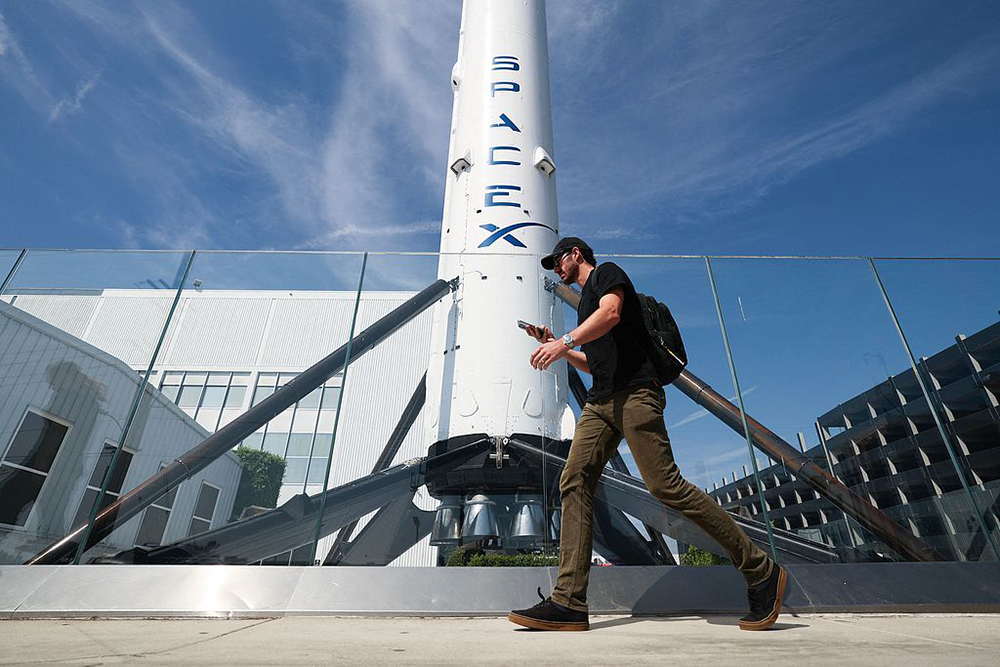 A SpaceX Falcon 9 rocket displayed at a SpaceX facility in Hawthorne, California, on March 26, 2026. Image source: Visual China
Starlink, Reusable Rockets, and xAI Acquisition Drive Valuation
Analysts attribute the capital market's premium valuation and oversubscription to SpaceX's comprehensive business portfolio and industry barriers. First, SpaceX's Starlink satellite internet service has achieved global deployment with stable cash flow and expanding market scale. Second, SpaceX dominates the commercial space launch sector through self-developed reusable launch vehicles that significantly reduce orbital payload launch costs and reshape the commercial space business model. Third, the company completed a full acquisition of artificial intelligence company xAI in February, integrating core AI assets.
Valuation Surges from $350 Billion to $1.77 Trillion in 18 Months
SpaceX was valued at approximately $350 billion in internal transactions at the end of 2024. After 18 months of development, the company's IPO valuation reached $1.77 trillion, representing a substantial increase that reflects strong capital market recognition.
Nasdaq and Bitcoin Decline as IPO Draws Capital
The Nasdaq Composite Index and Bitcoin prices both declined on Tuesday. Analysts suggested that selling by SpaceX IPO buyers raising funds for the offering was a significant factor in the market pullback. Other analysis noted that the IPO's 30% retail allocation ratio allows ordinary retail investors to participate, further amplifying cross-market capital flow effects.
SpaceX Allocates 30% of IPO Shares to Retail Investors
SpaceX's IPO breaks traditional U.S. stock issuance allocation conventions by opening up to 30% of offering shares to retail investors, who can participate through compliant retail trading platforms. In traditional large-scale IPOs, retail allocation ratios are typically far below this standard, with shares primarily allocated to institutional investors.
FAQ
What is the subscription demand for SpaceX's IPO?
According to a report on June 9, SpaceX attracted over $250 billion in investor subscription demand, nearly four times the company's planned $75 billion raise.
When will SpaceX list on the Nasdaq?
SpaceX is scheduled to begin trading on the Nasdaq Stock Exchange on June 12 under the ticker symbol SPCX at a fixed share price of $135 per share for approximately 555.6 million shares.
How much of the SpaceX IPO is allocated to retail investors?
SpaceX allocated up to 30% of the offering shares to retail investors, who can participate through compliant retail trading platforms — a significantly higher ratio than traditional large-scale IPOs.


