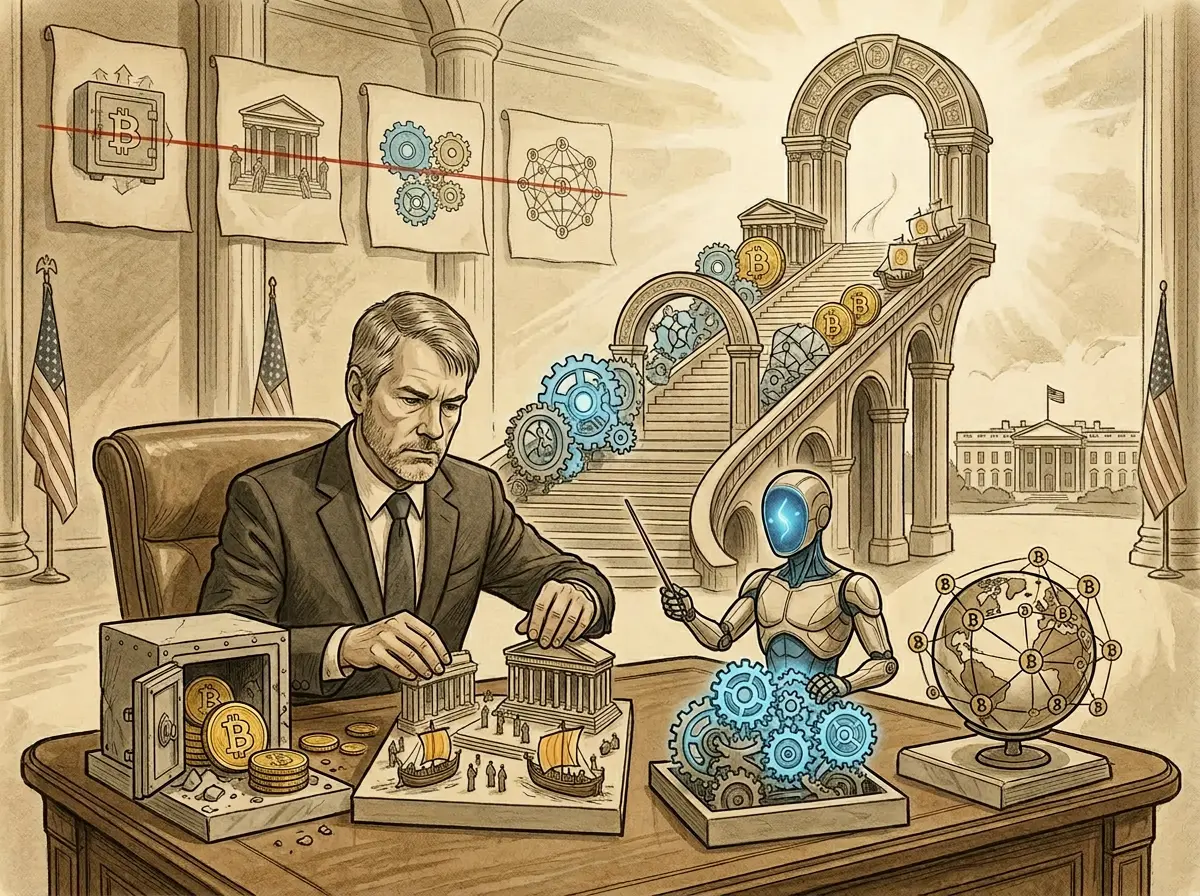
As reported by BlockTempo on June 10, Michael Saylor, the founder of Strategy, proposed a set of four ideological frameworks to analyze the Bitcoin community. He categorizes Bitcoin holders and advocates into minimalists, capitalists, technologists, and fundamentalists. Saylor summarizes that Bitcoin’s path forward is “disciplined expansion,” which requires the disciplined fusion of the four schools of thought.
Core beliefs of the four ideologies (Saylor’s framework definition)
Bitcoin Minimalists: They view Bitcoin as the leading digital currency network, representing moral, technical, and economic breakthroughs that provide superior property rights and monetary integrity. Saylor explains that minimalism defines the destination, while other ideologies debate the route.
Bitcoin Capitalists: They believe Bitcoin must integrate with the global economy, viewing Bitcoin as “digital capital” that should be embedded on the balance sheets of individuals, enterprises, banks, capital markets, and sovereign nations. Saylor notes that the capitalist stance is pragmatic, inclusive, and expansionary.
Bitcoin Technologists: They believe Bitcoin needs continuous improvements to the base layer, including scalability, privacy, security, functionality, and defenses against new threats such as quantum computing. Saylor points out that technologists see protocol improvements as “stewardship,” not corruption.
Bitcoin Fundamentalists: They are committed to protecting Bitcoin’s core principles, including self-custody, personal nodes, decentralization, and immutability, resisting institutional capture, leverage, and poorly conceived protocol upgrades. Saylor says fundamentalists are guardians of Bitcoin’s soul.
Each school’s natural advantages and natural risks (Saylor’s analysis)
In his framework, Saylor highlights each school’s inherent structural advantages and risks:
Minimalists: The advantage lies in providing moral clarity and the strongest identity alignment; the risk is that if they can’t distinguish between “Bitcoin has already won” and “the world adopting it in different ways,” the accuracy may fall short.
Capitalists: The advantage lies in pragmatic inclusiveness and explaining how Bitcoin can be embedded in the existing world; the risk is that integration may introduce complexity, leverage, centralized custody, and institutional influence. If designed poorly, it could recreate the vulnerabilities Bitcoin intended to solve.
Technologists: The advantage lies in bringing engineering discipline and urgency; the risk is that changes to the base layer may introduce unintended consequences (Saylor draws an analogy using the medical term “iatrogenic harm”). The burden of proof for base-layer changes should be set very high.
Fundamentalists: The advantage lies in protecting Bitcoin’s core attributes, preventing capture and dilution; the risk is that if they refuse all institutional integration and technical improvements, they may exclude billions of potential adopters from the benefits of Bitcoin.
Saylor emphasizes that whenever any single ideology moves to extremes, danger arises: minimalists may become dismissive, capitalists may become reckless, technologists may over-intervene, and fundamentalists may become exclusionary.
Saylor’s core framework of “disciplined expansion”
Saylor’s “disciplined expansion” includes the following stated positions: the base layer should be treated as sacred infrastructure, changes to it should be rare and cautious, and require overwhelming consensus; most innovation should occur at higher layers, including applications, custody systems, capital markets, credit instruments, and global financial infrastructure; individuals must always retain the right and ability to self-custody, run nodes, and personally verify the network.
He also establishes the core questions each of the four schools answers on its own: minimalists ask “What has Bitcoin already proven?” capitalists ask “How do we integrate with the global economy?” technologists ask “How do we improve it?” fundamentalists ask “How do we protect the core principles?” Saylor’s conclusion is that Bitcoin needs these four schools to respectively preserve beliefs, drive adoption, solve technical challenges, and defend protocols—none can be missing.
FAQ
How does Michael Saylor’s four-ideology framework distinguish each group?
According to Saylor’s framework, the four groups share the belief that “Bitcoin matters,” but differ in how Bitcoin should evolve, integrate, expand, and be protected. Minimalists focus on mission and identity, capitalists focus on integration with the global economy, technologists focus on ongoing protocol improvements, and fundamentalists focus on protecting core principles.
What does Saylor mean by “disciplined expansion” specifically?
Based on Saylor’s framework definition, “disciplined expansion” means expanding Bitcoin’s application scope through higher-layer uses, credit instruments, and capital market deployment, while keeping the base layer sacred and unchanged—at the same time ensuring that individuals always retain the right to self-custody. Saylor defines this path as superior to “reckless changes, institutional capture, or isolationist purity.”
Why does Saylor think the fusion of the four groups is more important than any single stance?
Based on Saylor’s framework analysis, each ideology protects an important aspect of Bitcoin, while also carrying its own risk of going to extremes. He argues that a healthy Bitcoin ecosystem needs all four forces—belief, integration, innovation, and preservation—to exist together. While preserving keeps it unique, and Bitcoin being useful to everyone are not an either-or choice.


