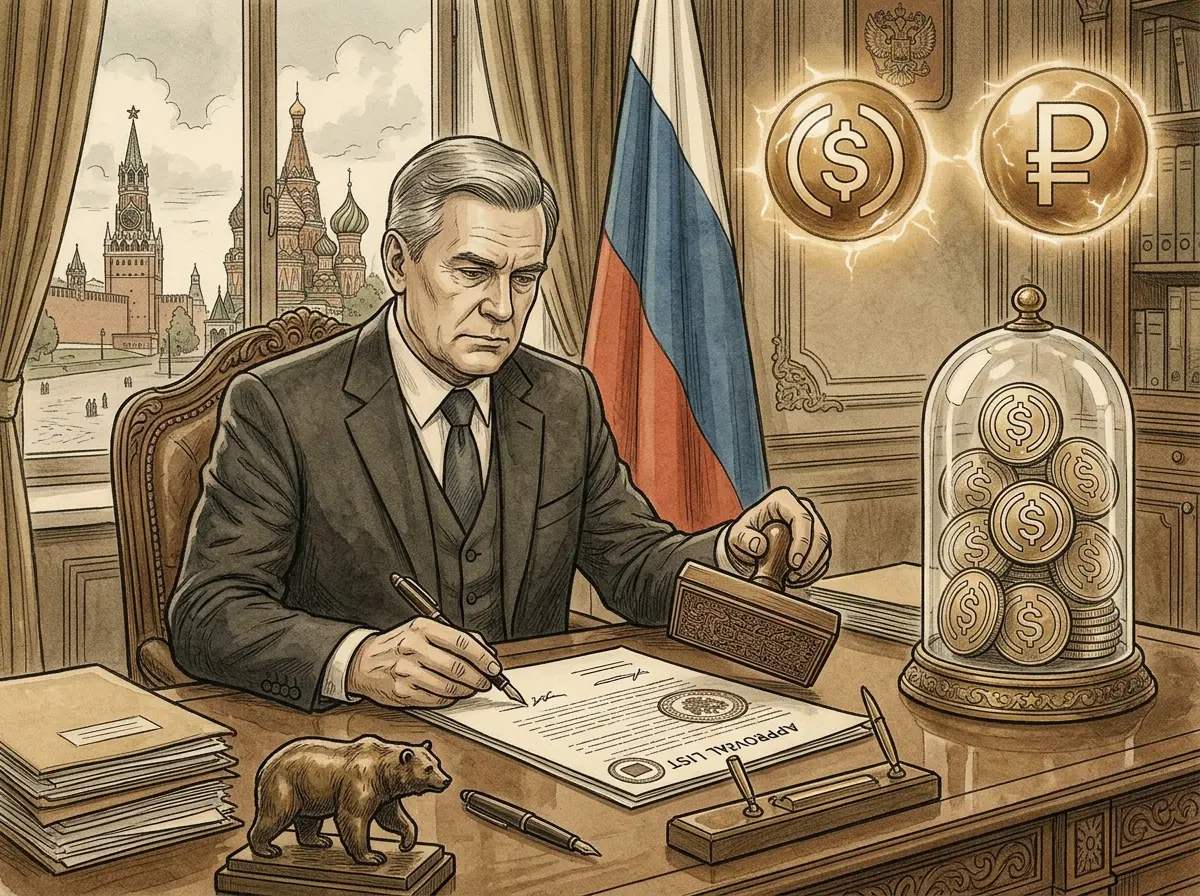
Russia’s Deputy Minister of Finance Ivan Chebeskov confirmed in an interview during the St. Petersburg International Economic Forum (SPIEF 2026) in June that USDC will be included in Russia’s approved list of cryptocurrency trading tokens. Previously, the Russian Central Bank had explicitly opposed adding more tokens. Chebeskov said that stablecoins supported by small amounts of fiat currency from “friendly jurisdictions,” including ruble-pegged stablecoins, may also be allowed.
Four approved cryptocurrencies confirmed by Chebeskov
According to Chebeskov’s confirmation to Expert.ru, Russia’s approved list of cryptocurrencies for trading by non-accredited investors includes Bitcoin (BTC), Ethereum (ETH), Tether (USDT), and Circle (USDC).
Digital asset thresholds for non-accredited investors: the average market cap over the past two years must exceed 5 trillion rubles (about $70 billion). Russia’s daily cryptocurrency trading volume is about 50 billion rubles (about $695 million), a figure Chebeskov disclosed at a banking industry meeting in February.
Confirmation cases for stablecoins from “friendly jurisdictions”
Chebeskov confirmed that stablecoins issued in “friendly jurisdictions” may also be approved to enter the Russian market even if their market cap has not yet reached the 5 trillion ruble threshold, citing examples including the ruble-pegged stablecoin and the UAE dirham (AED) stablecoin.
The crypto A7A5, which is pegged to the ruble, was recognized as a digital financial asset under Russia’s existing DFA law (Digital Financial Assets Law) in September 2025, enabling Russian companies to use it for cross-border payments in foreign trade. Because it had been used to evade financial restrictions imposed on Russia due to the war in Ukraine, A7A5 has faced multiple sanctions. CertiK, a blockchain security firm, confirmed that this cryptocurrency issued by Kyrgyzstan has processed over $11 billion in transfers since it launched in early last year, making it the largest non-USD stablecoin in the world.
Regulatory legislation confirmation timeline and key provisions
According to reports, Russia’s cryptocurrency legislation draft (the “Law on Digital Currencies and Digital Rights”) passed the first reading in parliament in April 2026 and must be formally passed by July 1, 2026. Key provisions of the bill include: legalizing cryptocurrency-related activities (investment and trading); setting an annual investment cap for non-accredited investors of 300,000 rubles (about $4,000). The bill is still being finalized with the joint participation of regulators, other government agencies, and representatives from the financial and crypto industries, and banking professionals have proposed recommendations to relax some clauses.
Frequently asked questions
Why was USDC approved despite the Russian Central Bank previously opposing adding more tokens?
According to reports, the Russian Central Bank said it would not temporarily add more tokens, but Deputy Finance Minister Chebeskov explicitly confirmed during St. Petersburg International Economic Forum (SPIEF 2026) that USDC would also be approved. The two agencies’ positions differ, and the decision was ultimately driven by the Ministry of Finance’s policy orientation.
How is the annual 300,000 ruble cap for non-accredited investors calculated?
Under the bill’s terms, Russian non-accredited investors will first have access to a channel for legally investing in cryptocurrencies, with an annual total investment limit of 300,000 rubles, roughly $4,000 based on the June 2026 exchange rate. Investments above this limit require qualifying investor status.
Why is the A7A5 ruble stablecoin both sanctioned and potentially usable in Russia’s market?
According to reports, A7A5 was sanctioned internationally because it was used to evade financial restrictions imposed on Russia due to the war in Ukraine. However, in September 2025, Russian financial authorities recognized it as a digital financial asset under the country’s DFA law, allowing Russian companies to use it for cross-border payments in foreign trade. This indicates a discrepancy between Russia’s domestic regulatory framework and international sanctions.


