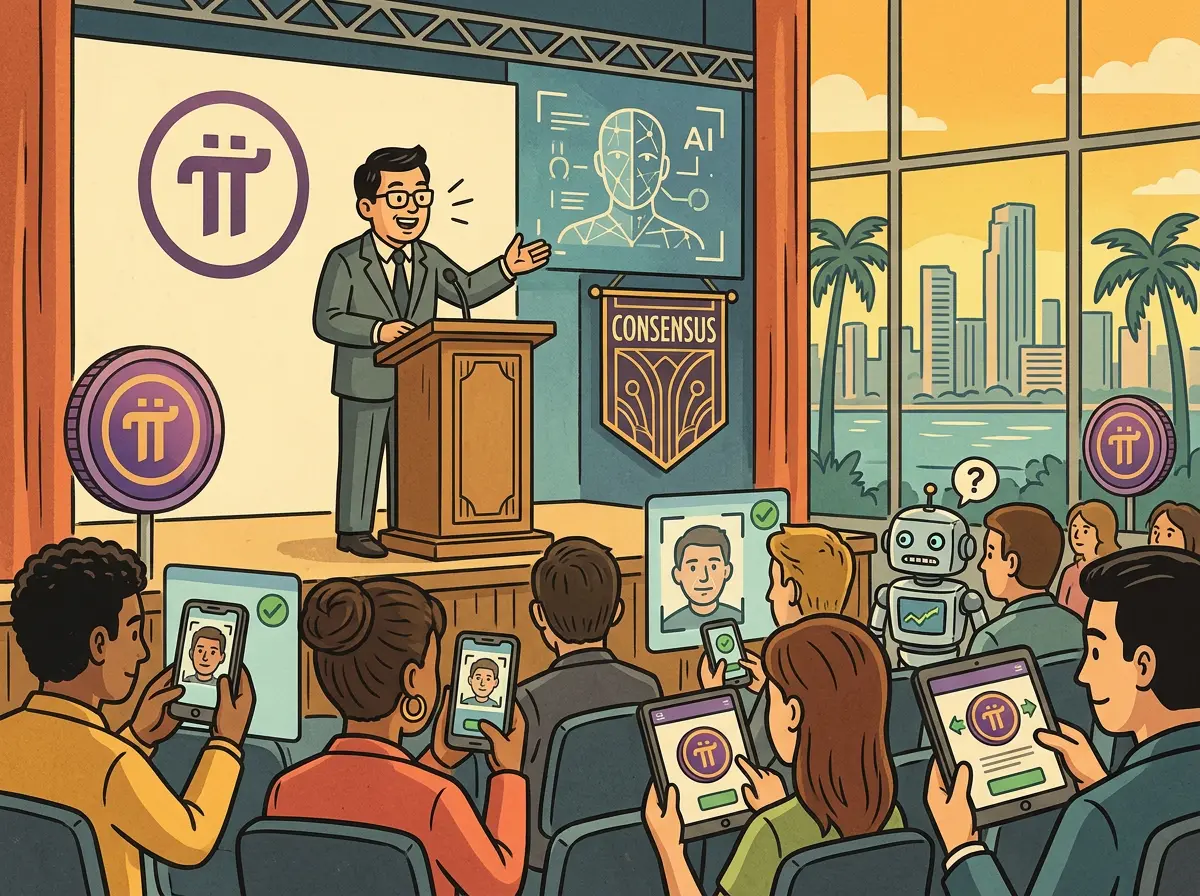
Pi Network said on May 20 on its official website that Pi founders Dr. Fan Chengdiao and Dr. Nicolas Kokkalis (Dr. Nicolas Kokkalis) gave a talk at the 2026 Miami Consensus conference, where Fan Chengdiao focused on how tokens should serve real users rather than being used only for fundraising. Kokkalis discussed, in a panel discussion, how to verify human identity in the AI era while protecting privacy.
Dr. Fan Chengdiao: Tokens should be tools for users, not for fundraising or exit
Dr. Fan Chengdiao’s talk title was “Bringing Web3, AI, and Blockchain Together for Practical Use,” directly responding to a widespread industry problem: tokens are often used mainly for fundraising or quick exits, rather than supporting actual products. She argued that tokens should be designed as tools that help products acquire real users, promote ongoing engagement, and be used in real product experiences. Dr. Fan cited Pi Launchpad as a concrete example of this token-design approach, explaining how Pi’s ecosystem tokens and issuance mechanisms are designed to serve real users, and covering Pi’s blockchain infrastructure, identity verification system, and the role of its global participation network in supporting practical product development in the AI era.
Dr. Kokkalis: Human verification must vary by context, and privacy protection is the premise
Dr. Kokkalis joined a panel discussion titled “How to Prove You’re a Human in an AI World (Without Leaking Personal Information).” The core issue is the challenge of maintaining trust and verifying genuine human participation as AI systems can generate convincing bots at scale, synthesize personal data, and perform agent interactions.
He proposed that human verification methods must be adjusted according to specific contexts: some scenarios require confirming a user’s exact identity, while others only need to confirm whether the operation is carried out by a real person, or whether a sequence of actions behind it is performed by different users. He emphasized that privacy-preserving verification design must avoid disclosing personal information beyond what the context needs, and must remain usable for real users. Dr. Kokkalis also noted that distinguishing between “AI agents that help real users” and “fake activity that disguises itself as humans” is an important issue in building digital trust today.
FAQ
What different views did the Pi founder propose on token design?
Dr. Fan Chengdiao believes that the core function of tokens should shift from being a fundraising tool to supporting real users’ acquisition and long-term product interaction, and she uses Pi Launchpad’s issuance mechanism as an example to explain how to design tokens to serve real users. This stance targets the issue of token design and product innovation being disconnected in the industry at large.
What exactly does Dr. Kokkalis mean by “contextualized human verification”?
Dr. Kokkalis believes that the need for human verification varies by context: in some situations, it is necessary to confirm specific identities; in others, it is only necessary to confirm whether operations are performed by a real person, or that different users each perform their respective operations. He emphasized that verification design must protect privacy and should not require disclosing personal information beyond what the context needs.
How does Pi Network’s existing infrastructure address the identity verification challenges of the AI era?
According to a Pi official website summary, Pi’s Layer 1 blockchain, identity verification system, payment infrastructure, non-custodial wallets, smart contracts, and global community together form a foundation-building set to address digital trust challenges in the AI era. The official summary did not provide specific technical implementation timelines or upgrade plans for the functions mentioned above.


