The Korea Internet & Security Agency (KISA) and the Ministry of Science and ICT launched a deposit token-based payment infrastructure expansion project on the 22nd, aiming to extend the Bank of Korea's central bank digital currency (CBDC) pilot program 'Project Hangang' into the private payment sector. The project was selected as the 2026 Blockchain Innovation Leading Project with a total budget of 9.6 billion won, led by the Korea Financial Telecommunications & Clearings Institute in consortium with 9 commercial banks, 8 payment gateway companies, and 2 major users. The initiative held a joint launch ceremony at KISA headquarters in Seoul to officially commence operations, with the primary objective of reducing payment fee burdens for small merchants through blockchain-based payment infrastructure.
KISA Holds Joint Launch Ceremony for Deposit Token Payment Project
KISA and the Ministry of Science and ICT held a joint launch ceremony at KISA headquarters in Seoul on the 22nd for the deposit token-based payment infrastructure expansion project. The Blockchain Innovation Leading Project is a large-scale pilot program that discovers and expands blockchain-based innovative services in sectors with significant effects on supporting the people's economy and creating new markets. This year's project was selected through an open-topic competition with the goal of alleviating payment fee burdens for small merchants.
Korea Financial Telecommunications Institute Leads Consortium Infrastructure Development
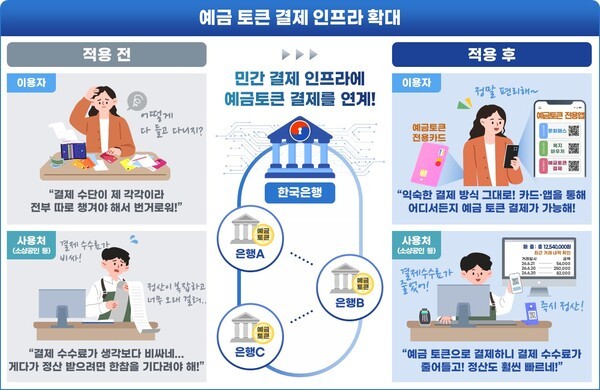
The Korea Financial Telecommunications & Clearings Institute serves as the lead institution, with the project proceeding as a private consortium involving 9 commercial banks, 8 payment gateway companies, and 2 major users. The Institute will link existing payment infrastructure with the Bank of Korea's Project Hangang system to enable deposit token payments, and will oversee service development and pilot testing by participating institutions. The project will be promoted by establishing a cooperative system with relevant institutions.
The core objective is to expand the institutional CBDC-based deposit token pilot experience accumulated through Project Hangang into private payment services usable by the general public. A key feature of the project is utilizing existing payment systems rather than building new payment infrastructure. Users can make payments through banks' deposit token electronic wallet applications using existing offline payment terminals and online payment networks, with physical card introduction also under review. Merchants can accept deposit token payments without replacing terminals.
Government Plans Public Finance Applications for Deposit Tokens
The government will apply deposit tokens to a pilot program for business promotion expenses. The government plans to prepare a treasury management model linked with dBrain and expand to various fiscal execution areas. The concept involves using blockchain technology to set usage conditions aligned with policy objectives and transparently manage the execution process to prevent fraudulent use.
Ministry Allocates 3 Billion Won to SMEs and Startups
The Ministry of Science and ICT stated the project will expand tangible use cases of blockchain technology for citizens and foster the domestic blockchain industry ecosystem. Of the total project budget of 9.6 billion won, approximately 3 billion won will be invested in development, operation, and promotion tasks involving small and medium-sized enterprises, startups, and IT companies. Participating banks will separately pursue linked projects worth approximately 4.5 billion won.
Shin Dae-gyu, head of KISA's Digital Infrastructure Division, stated: "This project is the first step in fully implementing a deposit token payment environment, and will serve as an opportunity for various IT SMEs and startups to create innovative services and new business models based on the infrastructure built through this project. KISA will support the implementation of safe and reliable services based on expertise in blockchain and information security, and actively support the spread of results nationwide."
FAQ
What did KISA and the Ministry of Science and ICT launch on the 22nd?
KISA and the Ministry of Science and ICT launched a deposit token-based payment infrastructure expansion project on the 22nd, selected as the 2026 Blockchain Innovation Leading Project with a total budget of 9.6 billion won. The project is led by the Korea Financial Telecommunications & Clearings Institute in consortium with 9 commercial banks, 8 payment gateway companies, and 2 major users.
How does the deposit token payment project utilize existing infrastructure?
The project uses existing payment systems rather than building new infrastructure. Users can make payments through banks' deposit token electronic wallet applications using existing offline payment terminals and online payment networks, with physical card introduction under review. Merchants can accept deposit token payments without replacing terminals.


