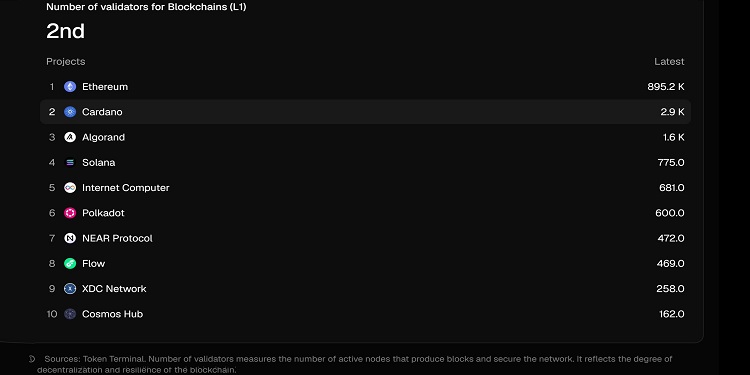
Cardano has become the second-largest Layer 1 blockchain network by validator count, according to data shared by Token Terminal and highlighted by Cardano community member Mintern. The proof-of-stake blockchain now operates with nearly 2,900 validators, reinforcing its position as one of the most decentralized blockchain ecosystems. Cardano has surpassed several prominent Layer 1 projects in active validator numbers, including Algorand, Solana, Polkadot, and Near Protocol.
Validator Comparison Across Layer 1 Networks
According to Token Terminal data cited in the source, Ethereum continues to dominate the sector with approximately 895,200 validators. Cardano's validator count of nearly 2,900 places it ahead of competing networks: Algorand operates with around 1,600 validators, Solana has roughly 775, Polkadot maintains approximately 600, and Near Protocol has 472 validators.
Within proof-of-stake blockchain systems, validators play a critical role in transaction verification, consensus maintenance, and overall network security. A broader validator base is often viewed as an important indicator of decentralization because it distributes operational control across a larger number of participants rather than concentrating influence among a limited group of entities.
Decentralization as Competitive Advantage
Cardano's expanding validator structure has strengthened arguments from supporters who consider decentralization a defining advantage within the blockchain sector. Industry participants frequently regard validator distribution as a core measure of a network's resilience, censorship resistance, and long-term sustainability.
Staking provider Everstake responded to criticism often directed at Cardano regarding transaction speed and ecosystem growth, arguing that the network's expanding validator structure demonstrates a highly decentralized foundation capable of supporting future blockchain adoption. Everstake emphasized that maintaining a blockchain network supported by nearly 3,000 validators requires extensive participation and commitment from the community.
Everstake suggested that such a decentralized structure could position Cardano favorably as Web3 adoption accelerates globally. The company indicated that widespread validator participation creates the type of infrastructure necessary for sustainable decentralized applications and blockchain services. As institutional and retail interest in decentralized finance and Web3 technologies continues to grow, networks with strong decentralization metrics are increasingly being viewed as better equipped to support large-scale activity.
Layer 1 Competition and Validator Participation
Cardano's ranking highlights the growing competition among Layer 1 blockchain ecosystems seeking to attract developers, validators, and users. Validator participation has become an increasingly important metric as blockchain networks attempt to balance scalability, security, and decentralization.
Although Ethereum continues to maintain a dominant lead in validator numbers, Cardano's position above several major competitors demonstrates the network's ability to sustain a broad base of independent operators. This development reinforces Cardano's standing as one of the crypto industry's most decentralized proof-of-stake blockchain networks.


