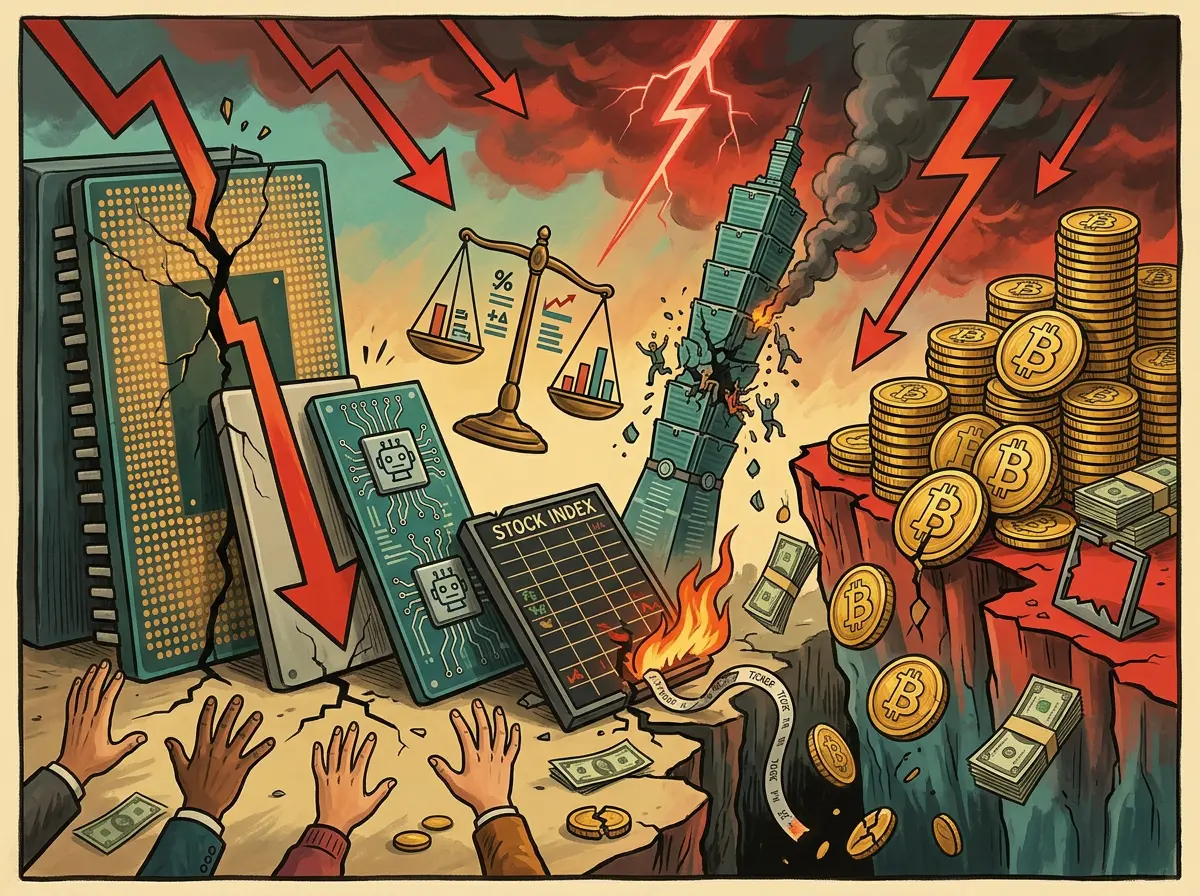
Broadcom, a US semiconductor company, released its financial results, which fell short of Wall Street expectations, causing the stock price to drop by more than 12%. This triggered a rotation of funds into and out of AI-related stocks, and selling pressure spread rapidly to global markets. On June 5, Taiwan’s weighted index hit a morning low of 44,685 points, falling by nearly a thousand points and breaking below the 45,000-point level; Bitcoin briefly dropped below $63,000 before rebounding slightly.
Performance of Taiwan and Asian stock markets: confirmed market data
According to CNBC and market data, the market figures confirming the chain reaction selling pressure triggered by Broadcom’s earnings are as follows: the VanEck semiconductor ETF fell by more than 1%; Arm Holdings fell by over 4%; Micron fell by nearly 8%; Korean Samsung Electronics was down by nearly 7% at one point in intraday trading (then rebounded slightly); and Japan’s Tokyo Electron fell by more than 6%. Taiwan’s Delta Electronics, Hon Hai, and MediaTek all opened lower and weakened.
Ortus Advisors equity strategist Andrew Jackson said that recently strong stocks do need a correction wave, and he holds a relatively positive interpretation of this downturn.
Macroeconomic negative factors: confirmed economic data
This round of selling pressure was layered with three macroeconomic negative factors:
· US April job openings rose to 7.62 million, far exceeding market expectations, pushing the yield on 10-year US Treasuries above 4.45%;
· The market has repriced the probability of the Federal Reserve raising rates again by year-end to 50% or higher;
· Stalled US-Iran nuclear talks led to higher oil prices, bringing inflation risk back into focus for the market.
These three factors, together with the impact of Broadcom’s earnings, form the macro backdrop for this cross-market decline.
Glassnode on-chain data: confirmed late-stage bear market indicators
The numbers confirmed in Glassnode’s report include: Bitcoin down about 13% on a weekly cumulative basis; holders’ daily realized losses spiked to $1.35 billion, of which $770 million came from long-term holders taking stop-loss sales and realizing losses; and the cost basis of short-term holders falling below the actual market average price.
Bitwise’s head of European research, Andre Dragosch, said that the sentiment index has triggered a contrarian buy signal, and historically extreme sentiment often marks potential bottoms. Strategy’s move to sell a small amount of coins has hit investors’ confidence.
Grayscale’s research head Zach Pandl said that while this draws criticism, having the chips distributed across institutions with diverse business models is beneficial for long-term price development.
Lekkar Capital’s investment director Quinn Thompson noted that Strategy’s strategy of raising and purchasing coins through issuing preferred shares has imposed dilution burdens on ordinary shareholders.
FAQ
How did Broadcom’s earnings miss expectations transmit to a near-thousand-point drop in Taiwan’s market within a few hours?
The AI concept stock rotation triggered by Broadcom’s earnings led to sharp declines in AI semiconductor-related stocks such as Arm Holdings and Micron. Market sentiment quickly spread to Taiwan’s semiconductor sector centered on TSMC and MediaTek. Since these Taiwan large-cap weighted stocks have higher weight in the Taiwan index, the overall market fell rapidly by nearly a thousand points after the open.
What is the basis for Glassnode’s “late-stage bear market” judgment in its “unrealized recovery” report?
According to Glassnode’s report, the basis includes three confirmed indicators: daily realized losses spiked to $1.35 billion (showing the market is locking in losses on a large scale); $770 million came from stop-loss sales and realized losses by long-term holders (long-term holders typically sell only when the market drawdown is deep enough); and short-term holders’ cost basis falling below the actual market average price (showing most recent entrants are in a loss situation). Historically, this combination of the three usually appears in the later stage of market downturn cycles.
What impact does the US April job openings number of 7.62 million have on Bitcoin?
Job openings higher than expected means the labor market is still strong, which squeezes the Fed’s near-term room to cut rates. The market has reset the probability of rate hikes again to 50% or higher by year-end. A tightening interest rate environment typically creates negative pressure on risk assets, including Bitcoin, and this is one of the combinations of macro negative factors in this episode.


