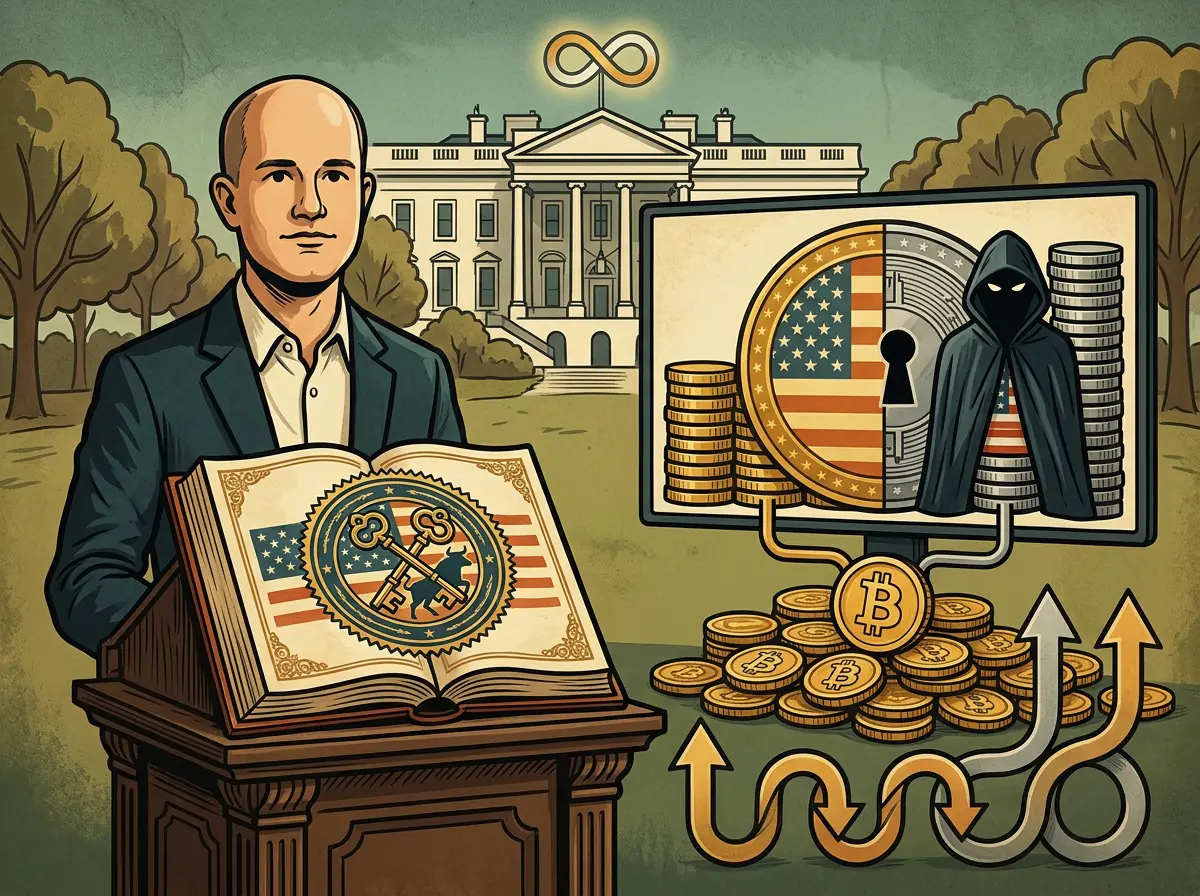
Coinbase CEO Brian Armstrong announced on X on June 11 that Coinbase has been approved to offer global cryptocurrency perpetual contracts to users in the United States. In the same post, Armstrong estimated that about half of the global trading volume in perpetual futures comes from U.S. users using offshore platforms via VPN, and called it an “open secret in the industry.”
Coinbase Gets Approved for Perpetuals: Armstrong Confirms Its U.S. Market Position
According to what Armstrong confirmed in his X post:
Confirmed approval facts: Coinbase has been approved to offer global cryptocurrency perpetual contracts in the United States; Armstrong said Coinbase is the first company to provide such global liquidity to U.S. users; Armstrong also specifically thanked Selig, the chairperson, and Atkins for recognizing the importance of this initiative to U.S. capital markets.
Armstrong’s market context explanation for perpetual contracts: He said that previously, the U.S. lacked clear rules, causing cryptocurrency trading to shift offshore; perpetual futures are a product that traders want but are “not allowed in the U.S.” Armstrong said that after this approval, the U.S. and international markets would be connected rather than fragmented, and could build network effects around global liquidity.
Armstrong’s Personal Estimate on VPN Trading Volume: Attribution Explanation
Armstrong’s wording in the post is: “Honestly, about half of perpetual futures trading volume is from Americans using offshore products via VPN, with loose KYC controls—this is an open secret in the industry. There’s little enforcement against it, which is frustrating for U.S. companies like ours that follow the rules.”
Attribution explanation: “About half” is Armstrong’s personal assessment, and he did not provide specific data sources, research reports, or regulatory statistics in the post to support the figure. This number is the CEO’s personal statement, not a published industry research conclusion.
Armstrong’s AI Cost Assessment
According to Coin Edition reported on June 8, Armstrong said:
Coinbase’s currently confirmed actions: Coinbase has been routing multiple AI prompts to lower-cost models; amid an exponential increase in token usage, the company has managed to keep AI costs relatively stable.
Armstrong’s personal assessment (not official Coinbase financial guidance): He personally estimates that within the next 12 to 18 months, about 80% of AI workloads will shift to models that are 99% cheaper; the remaining roughly 20% of workloads will continue to use the latest powerful models (for performance-priority scenarios such as advanced research and scientific discovery).
Relevant background: Delphi Digital co-founder Tommy Shaughnessy previously said that DeepSeek V4 performs close to Anthropic Opus on software engineering benchmark tests, priced at about 1/30 of the latter. Armstrong believes the industry’s ultimate limiting factors will be energy and compute capacity, rather than the model quality itself.
FAQ
What product is Coinbase’s newly approved “global cryptocurrency perpetual contracts”?
Based on Armstrong’s X post, perpetual contracts are crypto derivatives with no expiration date. This approval enables Coinbase to offer perpetual futures with access to global liquidity to U.S. users, instead of the limited local version U.S. users could use previously. Armstrong did not publish the specific regulator or provide a link to an official announcement among the post’s approval materials.
Armstrong said about half of perpetual trading volume comes from VPN users—does this number come from confirmed industry data?
No. This is Armstrong’s personal estimate presented in his X post, which he called an “open secret in the industry.” Armstrong did not provide specific research reports, regulatory data, or data sources to support the figure. When citing this number, it should be noted that it is the CEO’s personal statement, not published industry statistical data.
What is the time frame for Armstrong’s “80% AI workload to low-cost” assessment?
According to Coin Edition’s report, Armstrong said on June 8, 2026 that the time frame is “the next 12 to 18 months.” This is Armstrong’s personal industry assessment, not official Coinbase financial guidance, nor an industry consensus forecast.


