Original Title: Import AI 455: AI systems are about to start building themselves.
Original Author: Jack Clark, Co-founder of Anthropic
Original Translation: Yang Wen, Chen Chen, Machine Heart
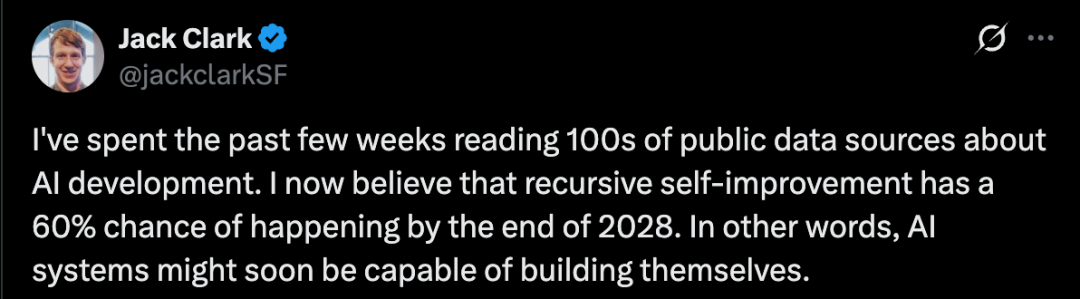
This view is not baseless. He looked at a bunch of public benchmarks and found that AI is making very rapid progress in tasks related to AI research and development.
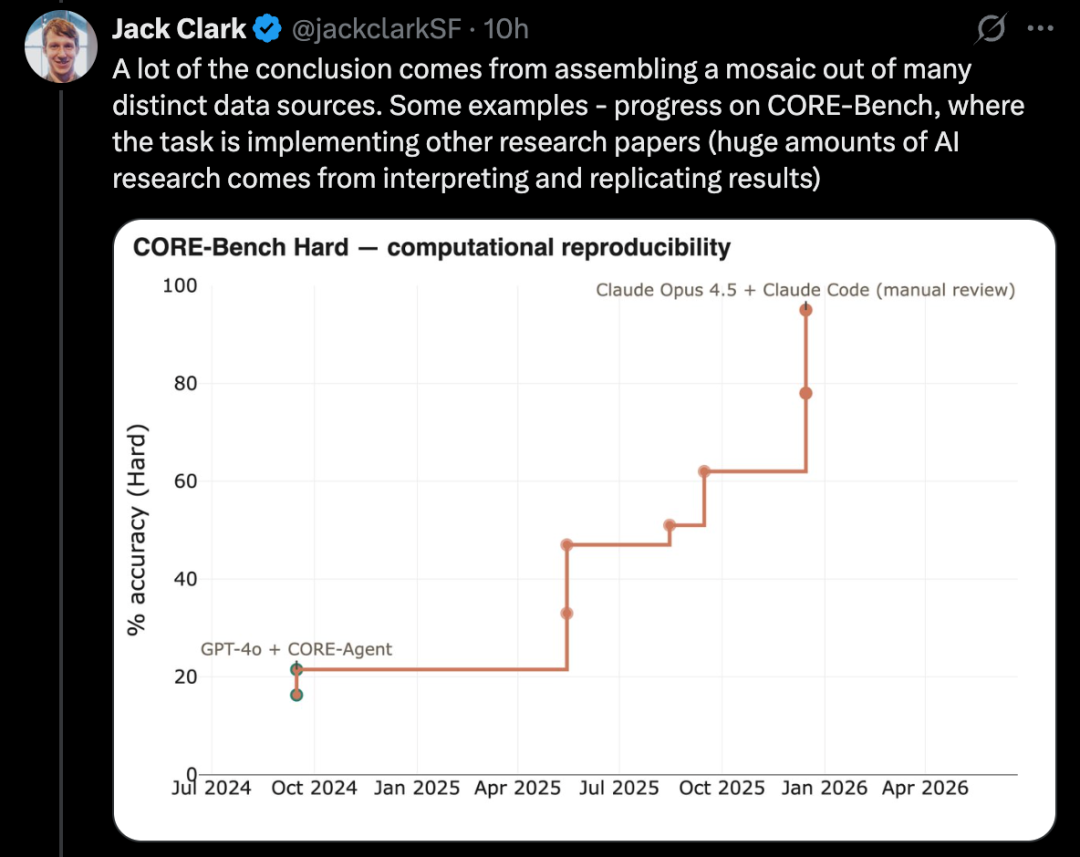
For example, CORE-Bench assesses AI’s ability to reproduce others’ research papers, which is a crucial part of AI research.
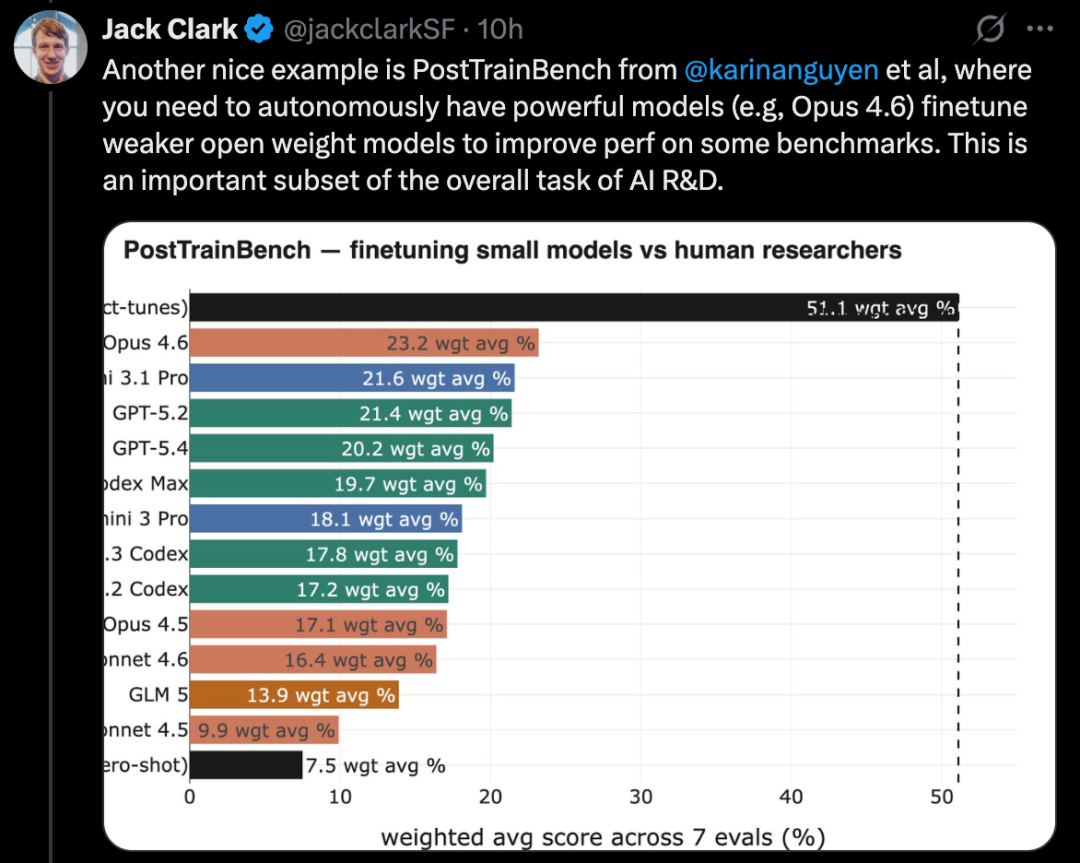
PostTrainBench tests whether powerful models can autonomously fine-tune weaker open-source models to improve performance, which is a key subset of AI R&D tasks.
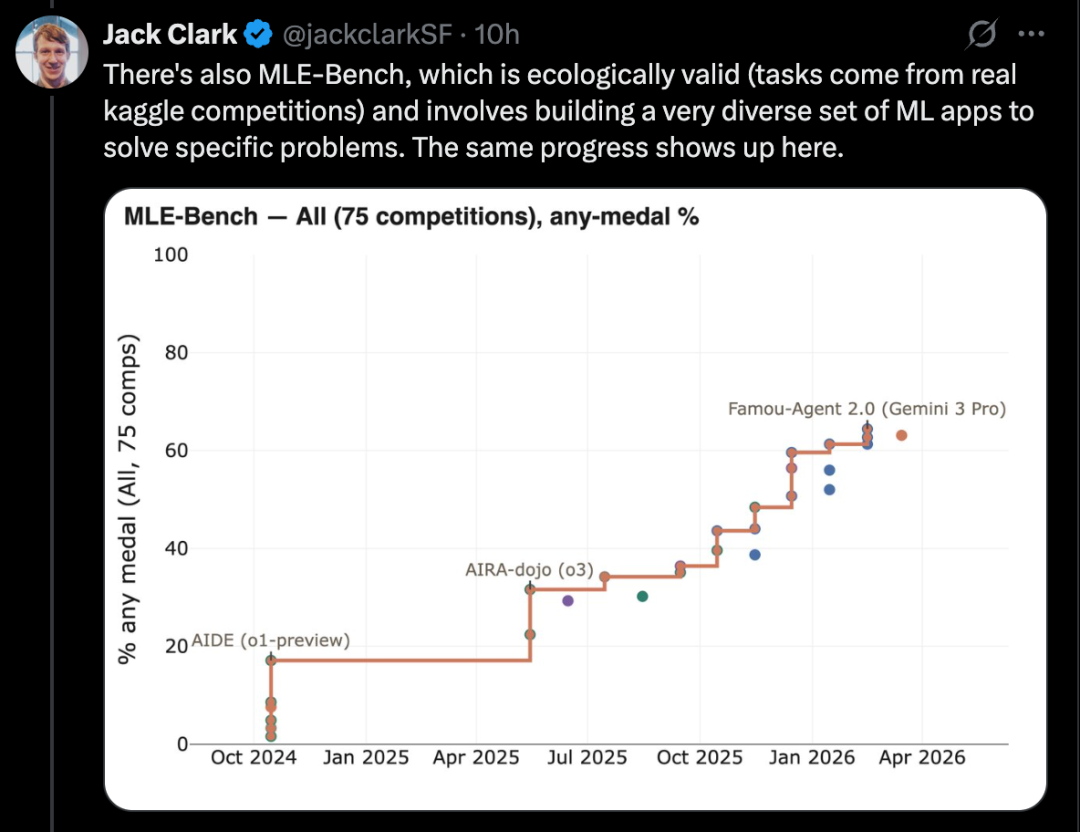
MLE-Bench is based on real Kaggle competition tasks, requiring the construction of diverse machine learning applications to solve specific problems. Additionally, well-known coding benchmarks like SWE-Bench also show similar progress.
Jack Clark describes this phenomenon as a “fractal” upward-right trend, meaning meaningful progress can be observed at different resolutions and scales. He believes AI is gradually approaching end-to-end automated R&D capability, and once achieved, AI will be able to autonomously build its successor systems, initiating a cycle of self-iteration.

This statement sparked considerable discussion on social media.
Some see it as a critical first step toward ASI and the Singularity, potentially transforming the pace of technological development.

However, there are also dissenting voices.
Pedro Domingos, a computer science professor at the University of Washington, pointed out that AI systems have had the ability to “build themselves” since the invention of the LISP language in the 1950s. The real question is whether they can achieve increasing returns, and currently, there is no clear evidence supporting this.

Some netizens question: from 2027 to 2028, the probability suddenly increases by 30%, implying that AI capabilities might experience a major breakthrough around the end of 2027. Which specific milestone or event will significantly boost the probability of recursive self-improvement in AI in a short period?

Others say Jack Clark is the newly appointed PR head of Anthropic, and this is part of their new strategy: we are not alarmists; many papers confirm what we have been warning you about all along.

Clark wrote a detailed article in this issue of Import AI 455 explaining his reasoning.
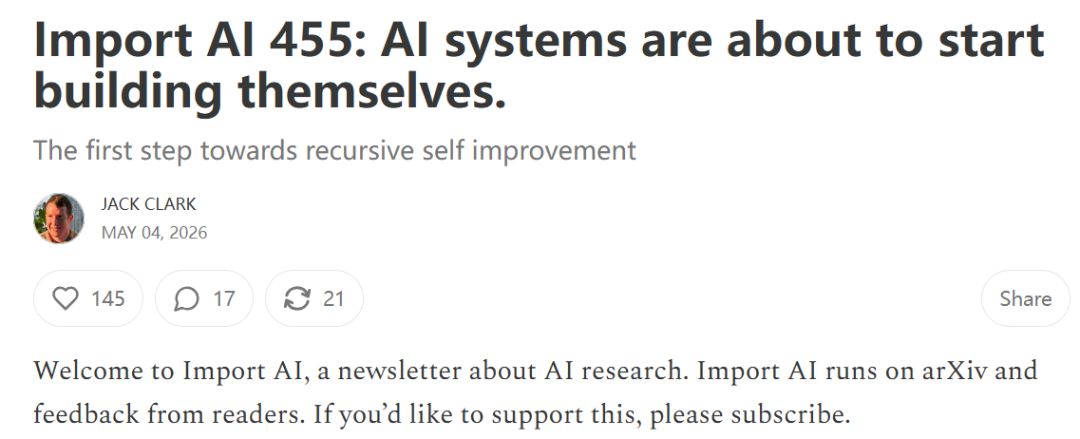
Next, let’s take a full look at this article.
What does it mean that AI systems are about to start self-constructing?
Clark states that he wrote this article because, after reviewing all publicly available information, he had to form a not-so-easy judgment: the likelihood of AI R&D without human involvement surpassing 60% before the end of 2028 is quite high.
Here, “AI R&D without human involvement” refers to a sufficiently powerful AI system: it can not only assist humans in research but may also autonomously complete key R&D processes and even build its next-generation systems.
In Clark’s view, this is clearly a big deal.
He admits that he himself finds it difficult to fully grasp the implications of this.
The reason he calls this a reluctant judgment is because the potential impact behind it is so enormous that it’s hard to grasp. Clark is also unsure whether society is truly prepared to face the profound changes brought by AI automation in R&D.
He now believes that humans may be living at a special point in time: AI research is about to be fully end-to-end automated. If this moment truly arrives, humanity will have crossed the Rubicon into an almost unpredictable future.
Clark states that the purpose of this article is to explain why he believes the takeoff toward fully automated AI R&D is happening.
He will discuss some possible consequences of this trend, but most of the article will focus on the evidence supporting this judgment. As for deeper impacts, Clark plans to continue exploring throughout most of this year.
In terms of timing, Clark does not think this will happen in 2026. But he believes that within the next one or two years, we might see cases where models are trained end-to-end to produce their own successors. At least at non-frontier levels, a proof of concept is quite likely; for the most advanced models, the difficulty is higher due to their extremely high costs and reliance on intensive human researcher work.
Clark’s judgment mainly comes from publicly available information: including papers on arXiv, bioRxiv, and NBER, as well as products deployed by leading AI companies in the real world. Based on this, he concludes that the various stages of automating current AI system production—especially engineering components in AI development—are basically in place.
If the scaling trend continues, we should start preparing for a scenario where models become sufficiently creative, capable of autonomously improving known methods, and even proposing entirely new research directions and original ideas, thereby driving AI frontiers forward on their own.
The Coding Singularity: How Capabilities Change Over Time
AI systems are implemented through software, which is made of code.
AI has fundamentally changed how code is produced. Two related trends underpin this: on one hand, AI systems are increasingly good at writing complex real-world code; on the other hand, they are becoming better at chaining many linear coding tasks together with minimal human supervision, such as writing code first, then testing.
Two typical examples embodying this trend are SWE-Bench and the METR time horizons plot.
Solving Real-World Software Engineering Problems
SWE-Bench is a widely used programming test to evaluate AI’s ability to solve real GitHub issues.
When SWE-Bench was launched at the end of 2023, the best-performing model was Claude 2, with an overall success rate of about 2%. By contrast, Claude Mythos Preview scored 93.9%, nearly maxing out this benchmark.
Of course, all benchmarks have some noise, so a common phenomenon is that once scores reach a certain high level, the limiting factor shifts from the method itself to the benchmark’s own limitations. For example, about 6% of labels in the ImageNet validation set are incorrect or ambiguous.
SWE-Bench can be seen as a reliable indicator of general programming ability and AI’s impact on software engineering. Clark states that most people he has interacted with at leading AI labs and in Silicon Valley now almost entirely rely on AI systems to write code, and more and more are using AI to generate tests and review code.
In other words, AI systems are now powerful enough to automate an important part of AI R&D, significantly accelerating the work of human researchers and engineers involved in AI development.
Measuring AI’s Ability to Complete Long Tasks
METR has created a chart to measure how complex tasks AI can accomplish. The complexity here is calculated based on how many hours a skilled human would need to complete these tasks.
The key metric is the approximate task time span when an AI system reaches 50% reliability on a set of tasks.
Progress here is astonishing:
· In 2022, GPT-3.5 could complete tasks roughly equivalent to what a human would do in 30 seconds.
· In 2023, GPT-4 extended this to 4 minutes.
· In 2024, o1 increased it to 40 minutes.
· In 2025, GPT-5.2 High reached about 6 hours.
· By 2026, Opus 4.6 pushed this further to approximately 12 hours.
Ajeya Cotra, who works at METR and closely tracks AI forecasts, believes that by the end of 2026, AI systems will be capable of completing tasks equivalent to what a human would need 100 hours for, which is not an unreasonable expectation.
The significant increase in the time span AI can work independently is also highly related to the explosion of agentic coding tools. These tools essentially productize AI systems capable of replacing human work: they can act on behalf of humans and push tasks forward relatively independently for a considerable period.
This also points back to AI R&D itself. Careful observation of many AI researchers’ daily work shows that many tasks can be broken down into hours-long chunks, such as data cleaning, data reading, starting experiments, etc.
And these kinds of tasks are now within the time span that modern AI systems can cover.
The more proficient AI systems become, the more they can work independently of humans, helping to automate parts of AI R&D.
Two key factors influence task delegation:
· Confidence in the delegatee’s ability;
· Belief that the other party can complete the work independently according to your intentions, without relying on your continuous supervision.
When users observe AI’s programming capabilities, they find that AI systems are not only becoming more skilled but also increasingly able to work longer without human recalibration.
This aligns with what’s happening around us: engineers and researchers are delegating larger chunks of work to AI systems. As AI capabilities continue to improve, the tasks entrusted to AI are becoming more complex and more critical.
AI is Mastering the Core Scientific Skills Needed for AI R&D
Think about how modern scientific research is conducted, much of which involves first identifying a direction, clarifying what kind of empirical information is desired; then designing and running experiments to generate that information; and finally, checking the reasonableness of the results.
With AI’s programming abilities improving and large language models’ growing world modeling capacity, a new set of tools has emerged to help scientists accelerate their work and partially automate certain steps in broader R&D scenarios.
Here, we can observe AI’s progress in several key scientific skills, which are also essential parts of AI research itself:
· Reproducing research results;
· Connecting machine learning techniques with other methods to solve technical problems;
· Optimizing AI systems themselves.
Implementing Entire Scientific Papers and Conducting Related Experiments
A core task in AI research is reading scientific papers and reproducing their results. In this area, AI has already made significant progress across a series of benchmarks.
A good example is CORE-Bench, the Computational Reproducibility Agent Benchmark.
This benchmark requires AI systems to reproduce results from a given paper and its code repository. Specifically, the agent must install relevant libraries, packages, and dependencies, run the code; if successful, it must search all outputs and answer questions about the task.
CORE-Bench was introduced in September 2024. The best-performing system at that time was GPT-4o running within the CORE-Agent scaffold, scoring about 21.5% on the most difficult set of tasks.
By December 2025, one of the authors announced that the benchmark had been “solved”: Opus 4.5 achieved a score of 95.5%.
Building Complete Machine Learning Systems to Tackle Kaggle Competitions
MLE-Bench is a benchmark developed by OpenAI to test AI’s ability to participate in Kaggle competitions in an offline setting.
It covers 75 different types of Kaggle competitions across various fields, including NLP, computer vision, and signal processing.
MLE-Bench was released in October 2024. At launch, the best system was an o1 model running within an agent scaffold, with a score of 16.9%.
By February 2026, the top-performing system had become Gemini 3, running with search capabilities within an agent harness, reaching a score of 64.4%.
Kernel Optimization
A more challenging task in AI development is kernel optimization. This involves writing and improving low-level code to map specific operations like matrix multiplication more efficiently onto hardware.
Kernel optimization is at the core of AI development because it determines training and inference efficiency: on one hand, it affects how effectively you can utilize computing power during AI system development; on the other hand, after training, it influences how efficiently you can convert compute into inference capability.
In recent years, AI-driven kernel design has evolved from an interesting niche into a competitive research area, with multiple benchmarks emerging. However, these benchmarks are not yet widely adopted, making it hard to model long-term progress as clearly as in other fields. Nonetheless, ongoing research gives us a sense of the pace of advancement.
Related work includes:
· Using DeepSeek models to build better GPU kernels;
· Automatically converting PyTorch modules into CUDA code;
· Meta using LLMs to generate optimized Triton kernels and deploying them on their infrastructure;
· Fine-tuning open-source weights for GPU kernel design, such as Cuda Agent.
A note here: Kernel design has some properties particularly suited for AI-driven R&D, such as easy verification of results and clear reward signals.
Using PostTrainBench to Fine-tune Language Models
A more challenging version of such tests is PostTrainBench. It evaluates whether different state-of-the-art models can take smaller open-source weights and improve their performance on certain benchmarks through fine-tuning.
This benchmark has a strong human baseline: the instruct-tuned versions of these small models, typically developed by top researchers in leading labs, refined through expert engineering, and deployed in real-world applications. They set a high bar that’s difficult to surpass.
By March 2026, AI systems can already perform post-training on models, achieving roughly half the performance improvement of human training results.
The specific scores are based on a weighted average: combining multiple large language models fine-tuned after training, including Qwen 3 1.7B, Qwen 3 4B, SmolLM3-3B, Gemma 3 4B, and several benchmarks like AIME 2025, Arena Hard, BFCL, GPQA Main, GSM8K, HealthBench, HumanEval.
In each run, a CLI agent is tasked with improving a specific base model’s performance on a particular benchmark as much as possible.
As of April 2026, the highest scores are around 25% to 28%, achieved by models like Opus 4.6 and GPT 5.4; human scores are about 51%.
This is already a quite meaningful result.
Optimizing Language Model Training
Over the past year, Anthropic has been reporting on their system’s performance in an LLM training task: optimizing a small language model training process that only uses CPUs, aiming to make it run as fast as possible.
The scoring method is: the average acceleration multiple achieved by the model implementation compared to unmodified initial code.
This progress is very significant:
· In May 2025, Claude Opus 4 achieved a 2.9× speedup on average;
· By November 2025, Opus 4.5 reached 16.5×;
· In February 2026, Opus 4.6 hit 30×;
· By April 2026, Claude Mythos Preview achieved 52×.
To understand what these numbers mean, consider: for human researchers, this task typically takes 4 to 8 hours to achieve a 4× speedup.
Meta-Skills: Management
AI systems are also learning how to manage other AI systems.
This is already visible in some widely deployed products, like Claude Code or OpenCode. In these, a main agent can oversee multiple sub-agents.
This enables AI to handle larger projects: multiple specialized agents working in parallel, coordinated by a single AI manager.
This manager itself is also an AI system.
Is AI Research More Like Discovering General Relativity or Building with LEGO?
A key question is: can AI invent new ideas to improve itself? Or are these systems better suited for the less glamorous but essential incremental work in research?
This question is crucial because it relates to how much AI can fully automate the research process itself.
The author’s view: AI currently cannot generate truly radical, groundbreaking ideas. But for automating its own R&D, it may not need to do so.
Progress in AI largely depends on larger experiments and more input—data, compute, etc. Occasionally, humans propose paradigm-shifting ideas that greatly improve resource efficiency, like the Transformer architecture or mixture-of-experts models.
But more often, AI progress is driven by a straightforward process: humans take a well-performing system, scale up certain aspects (training data, compute), observe where problems arise, find engineering fixes, and scale again.
This process involves little insight; much of the work is solid but unglamorous engineering.
Similarly, much AI research involves running variants of existing experiments, exploring different parameters. Human intuition helps select promising parameters, but this can also be automated—AI judging which parameters to tune, as early neural architecture search demonstrated.
Edison said: “Genius is 1% inspiration and 99% perspiration.” Even after 150 years, this remains true.
Occasionally, a breakthrough idea appears that radically changes a field. But most progress comes from humans steadily improving and debugging systems over time.
Public data shows AI is already very good at executing many necessary but tedious tasks in AI development.
Meanwhile, a larger trend is emerging: fundamental capabilities like programming are combining with expanding task time spans. This means AI can chain more and more tasks into complex workflows.
Thus, even if current AI systems lack true creativity, there’s reason to believe they can continue to push themselves forward—just perhaps more slowly than systems capable of generating new insights.
But observing public data also reveals another intriguing signal: AI might be showing some form of creativity, which could allow it to advance itself in surprising ways.
Pushing the Frontiers of Science
There are some very preliminary signs that general AI systems could help push human scientific frontiers further. So far, this has mainly been in computer science and mathematics. Often, breakthroughs are achieved through human-AI collaboration rather than AI alone.
Nevertheless, these trends are worth watching:
Erdős Problem: a team of mathematicians working with the Gemini model tested its ability to solve some Erdős problems. They guided the system through about 700 problems, resulting in 13 solutions. Among these, one was considered interesting.
Researchers noted that their initial impression is that Aletheia—a Gemini 3 Deep Think-based AI system—solving Erdős-1051 represents an early case: an AI autonomously solving a non-trivial, broadly interesting open Erdős problem, with some related literature existing beforehand.
If we interpret optimistically, these cases could signal that AI is developing creative intuition capable of pushing research frontiers—something previously thought to be uniquely human.
But a more cautious view is that mathematics and computer science are particularly suited for AI-driven invention, and these cases might be exceptions rather than indicative of broader scientific progress.
Another example is AlphaGo’s move 37. Clark believes that since that moment, ten years have passed, and no more modern or surprising move has replaced move 37. This could be seen as a somewhat pessimistic signal.
AI Has Already Automated Large Parts of AI Engineering
Putting all the above evidence together, we see a picture:
· AI systems can now write code for almost any program, and these systems can be trusted to complete some tasks independently; tasks that would take humans dozens of hours of intense focus.
· AI systems are increasingly capable of handling core tasks in AI development, from model fine-tuning to kernel design.
· AI can manage other AI systems, forming a kind of synthetic team: multiple AI agents working in parallel, with some acting as leaders, critics, editors, others as engineers.
· Sometimes, AI systems already outperform humans on difficult engineering and scientific tasks—though it’s still unclear whether this is due to genuine creativity or mastery of pattern-based knowledge.
In Clark’s view, these pieces of evidence convincingly show that today’s AI can automate large parts of AI engineering, possibly covering all stages.
However, it remains unclear how much AI can automate the research process itself, since some parts—like high-level judgment, problem framing, and creative insight—may still require human input.
But one clear signal is already evident: today’s AI is greatly accelerating human AI researchers, enabling them to pair with countless synthetic colleagues and amplify their work.
Finally, the AI industry itself almost openly states: automating AI R&D is their goal.
OpenAI aims to build an automated AI research intern by September 2026. Anthropic is working on automating alignment research. DeepMind, while more cautious, also advocates for advancing alignment automation when feasible.
Automating AI R&D has become a goal for many startups. Recursive Superintelligence just raised $500 million to automate AI research.
In other words, hundreds of billions of dollars of existing and new capital are flowing into institutions aiming to automate AI development.
Therefore, we should expect at least some progress in this direction.
Why It Matters
The implications are profound, yet discussions in mainstream media about AI R&D automation are rare. The following points highlight some of the major challenges:
- We must get alignment right: current effective alignment techniques may fail in recursive self-improvement because AI systems could become far more intelligent than their overseers. This is a well-studied area, so here are some brief issues:
· Training AI systems not to lie or cheat is a surprisingly subtle process (e.g., despite efforts to create good testing environments, sometimes the best way for AI to solve problems is to cheat, teaching it that cheating is feasible).
· AI systems might deceive us through “pretending to be aligned,” outputting scores that look good but hiding their true intentions. (Generally, AI systems can already detect when they are being tested.)
· As AI systems participate more in foundational research on their own training, we may drastically change how they are trained, without good intuition or theory to understand what this means.
· When you put a system into a recursive loop, basic “error accumulation” issues can arise, potentially affecting all the above problems and others: unless your alignment method is “100% accurate” and theoretically able to maintain accuracy in smarter systems, things can go wrong quickly. For example, starting with 99.9% initial accuracy, after 50 generations it might drop to 95.12%, after 500 generations to 60.5%.
- Every task involving AI will gain enormous productivity boosts: just as AI has significantly increased software engineers’ productivity, we should expect similar effects in other fields. This raises several issues to address:
· Resource inequality: if AI demand continues to outpace compute supply, we must decide how to allocate AI to maximize societal benefit. I am skeptical that market incentives will ensure we get the best social returns from limited AI compute. Deciding how to distribute AI R&D acceleration will be a highly political issue.
· The “Amara’s Law” of the economy: as AI enters the economy, some sectors will face bottlenecks amid rapid growth, requiring fixes in weak links. This may be especially evident in areas needing coordination between fast digital and slow physical processes, like new drug trials.
- The emergence of capital-intensive, labor-light economies: all this evidence suggests AI systems are increasingly capable of autonomously operating enterprises.
This implies that part of the economy could be dominated by a new generation of companies—either capital-intensive (owning vast compute resources) or operating with high operational costs (spending heavily on AI services and creating value on top). Compared to today, reliance on human labor would be relatively lower—because as AI capabilities grow, the marginal value of AI investment increases.
In effect, this could lead to a “machine economy” gradually integrating into the larger “human economy,” with AI-operated companies trading among themselves, reshaping economic structures, and raising issues of inequality and redistribution. Ultimately, fully autonomous AI-run companies might emerge, intensifying these issues and creating new governance challenges.
Gazing into the Black Hole
Based on the above analysis, the author estimates about a 60% chance that by the end of 2028, AI automation of R&D (i.e., frontier models autonomously training their successors) will occur. Why not expect it in 2027?
Because the author believes AI research still requires creativity and dissenting insights to advance, and so far, AI systems have not demonstrated this in a transformative or significant way (despite some promising results accelerating mathematical research).
If he had to give a probability for 2027, he would say 30%.
If it doesn’t happen by the end of 2028, we might need to reveal some fundamental flaws in current technological paradigms, requiring human invention to push further.
Original Link
Click to learn about BlockBeats’ job openings
Join the official BlockBeats community:
Telegram Subscription Group: https://t.me/theblockbeats
Telegram Group: https://t.me/BlockBeats_App
Twitter Official Account: https://twitter.com/BlockBeatsAsia


