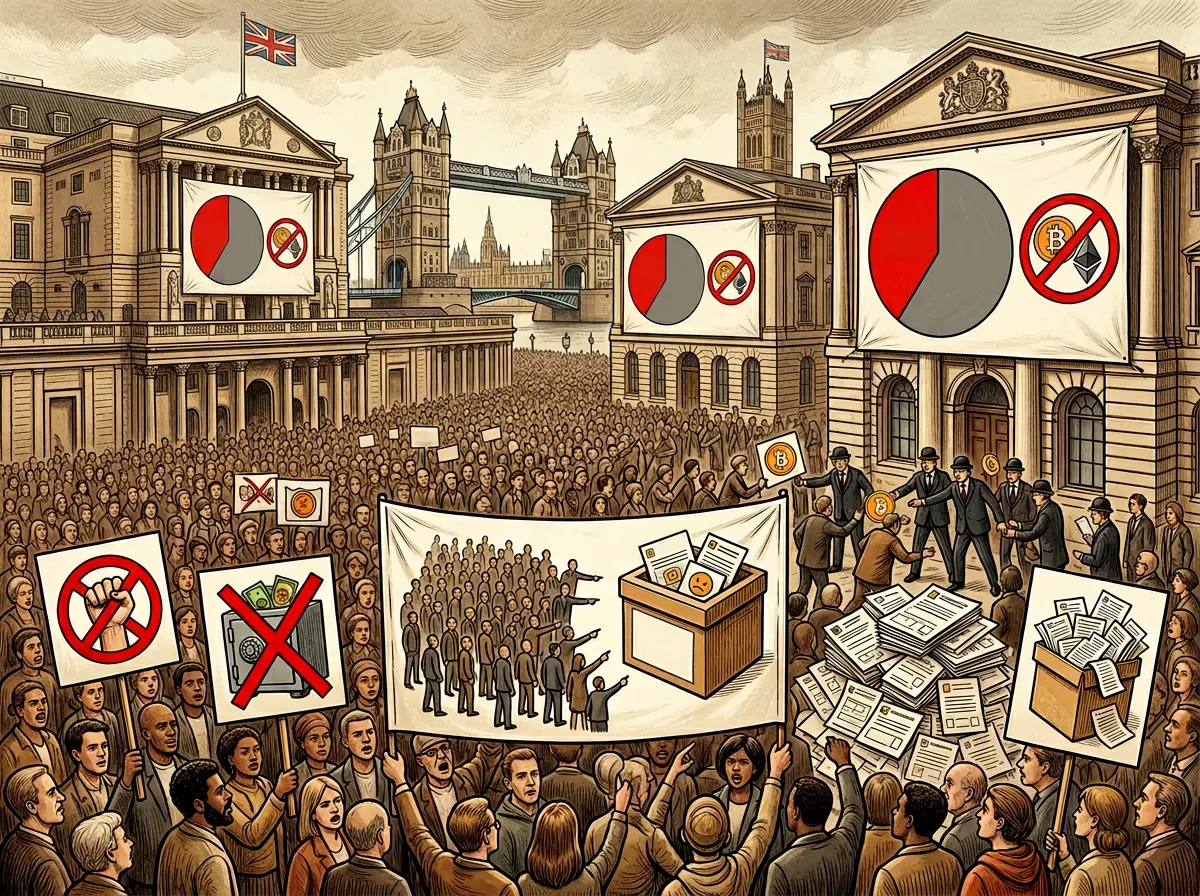
According to Cryptopolitan on June 11, the advocacy group Stand With Crypto UK instructed its 286,000 members to file complaints over UK banks’ blanket restrictions on payments to crypto exchanges, launching the “Your Money, Your Choice” campaign. Data from the UK Crypto Assets Business Council shows that UK banks currently intercept or delay about 40% of domestic crypto exchange transactions.
Positions confirmed by each bank: complete ban or set amount limits
In accordance with Stand With Crypto UK’s public statement, eight of the ten commercial banks have imposed either a complete ban or amount limits on transfers to crypto asset exchanges, including exchanges that are already authorized by the UK Financial Conduct Authority (FCA).
Banks implementing a complete ban: Chase UK, Starling, TSB, Virgin Money, Metro Bank
Banks that allow transfers but with amount limits: Barclays, HSBC, Nationwide, Monzo
Each bank claims that the reasons for delays or refusals are to mitigate fraud and financial crime risks, and that these are business decisions based on independent risk assessments.
Confirmed data from two official reports
The “Locked Out” report released in January 2026 shows that, among 10 crypto platforms, 8 said that the number of rejected bank transfers increased over the past 12 months; one exchange confirmed that banks rejected up to £1 million in customer transactions within one year. UKCBC data also confirmed that the share of UK adults holding crypto assets has doubled since four years ago to 8%.
Legal framework: the Treasury’s position and the 2017 Payment Services Regulations
A spokesperson for the UK Treasury publicly confirmed that the government “will not impose account or transaction restrictions on [crypto] companies simply because they belong to a particular industry category,” and said it hopes that “all businesses can receive fair treatment.” Under the 2017 Payment Services Regulations, banks have an obligation to execute payments that meet the account requirements.
In a statement, Coinbase Europe policy director Katie Harris pointed out that restricting retail customers’ transfers to crypto exchanges contradicts the UK government’s previously stated goal of building a global digital asset hub. Stand With Crypto UK also raised questions: some banks that have implemented restrictions are simultaneously setting up internal digital asset teams—whether the restriction measures are for business purposes aimed at excluding potential competition.
UK situation versus the US “choke point 2.0” comparison
There are key differences in the root causes between the UK and the US. In the US, during “choke point 2.0,” advocates accused federal regulatory bodies under the Biden administration (including the Federal Deposit Insurance Corporation, FDIC) of using informal pressure to push banks to cut ties with digital asset companies. At a February 2025 hearing of the House Financial Services Committee, a subcommittee chair, Dan Meuser, confirmed that the FDIC had threatened to take formal regulatory action. In the UK, banks claim that their restriction measures are independent business decisions based on fraud and money-laundering risk assessments, with the pressure coming from the banks themselves rather than informal pressure from regulators.
Frequently asked questions
What specific actions does Stand With Crypto UK’s complaint campaign ask members to take?
Stand With Crypto UK instructed its 286,000 members to file formal complaints with their respective banks about bank restrictions on transfers to crypto asset exchanges. A formal complaint is a statutory procedure under the UK financial services complaints mechanism, and the bank being complained about must provide an official response within the specified timeframe.
Are UK banks’ actions restricting crypto trading compliant with current law?
The UK’s 2017 Payment Services Regulations state that banks have an obligation to execute payments that meet the account requirements. The UK Treasury has publicly said it does not support account restrictions based on industry categories. Banks cite fraud prevention as the reason; the legality dispute is still ongoing, and no regulator has issued a formal ruling.
What are the main differences between the UK situation and the US “choke point 2.0”?
In the US, the core controversy is whether federal regulators (such as the FDIC) apply informal pressure to banks; in the UK, banks say their restriction measures are independent business decisions based on their own risk assessments, and regulators have not confirmed taking any similar informal pressure actions at present.


