Vertiv is a global leader specializing in critical data center infrastructure. Vertiv delivers power management, thermal management, modular infrastructure, and intelligent O&M solutions for AI data centers, ensuring high-performance computing equipment operates reliably and efficiently. As generative AI, large model training, and high-performance computing (HPC) accelerate, data centers are undergoing a major infrastructure upgrade. Historically, data centers focused on increasing compute density, but today, AI GPU clusters drive demands for high power, intense heat, and robust reliability—making power supply and cooling architectures central to efficient hashrate deployment. Going forward, AI competition will hinge not only on chip performance, but also on the strength of supporting infrastructure for compute resources.
Within the AI industry chain, Vertiv connects the critical links between chips, servers, and data center operators. By examining AI’s impact on data center infrastructure, the evolution of power and cooling technologies, and Vertiv’s strategic differentiation from competitors, we can better understand the trajectory of the AI infrastructure market.
Why AI Is Driving Data Center Infrastructure Upgrades
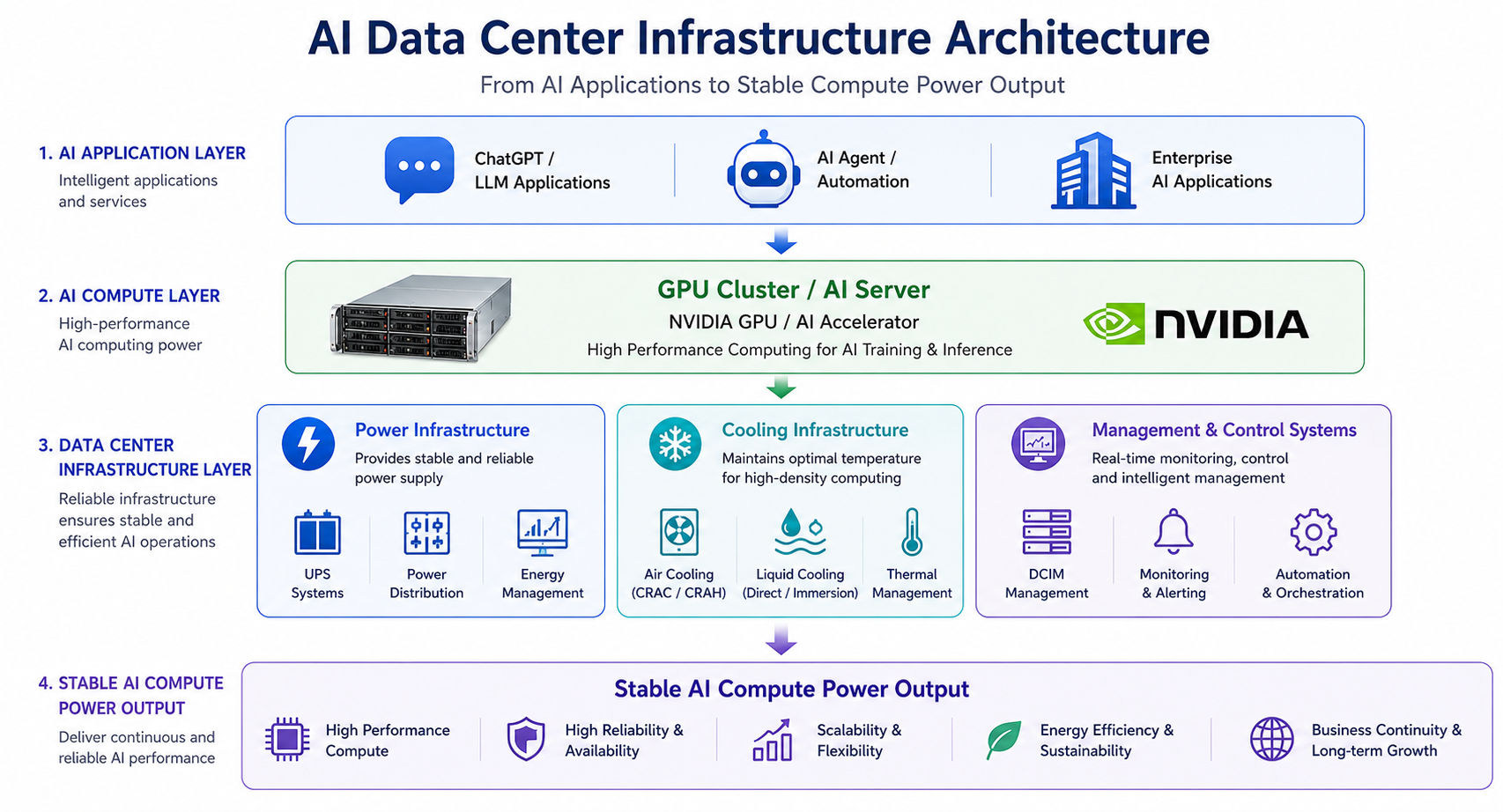
Artificial intelligence is reshaping the fundamentals of data center design. Previously, data centers served internet applications, enterprise software, and cloud storage, with relatively stable growth in compute density and energy demand. Now, with the rise of generative AI, large language models, and high-performance computing, data centers are shifting from traditional compute environments to high-power, high-density hashrate infrastructure.
AI model training and inference require massive GPU resources, and GPU clusters generate significantly higher energy consumption and heat. This transforms data center competition from simply server count and chip performance to a comprehensive contest that includes power supply capacity, cooling efficiency, and infrastructure management.
Vertiv sits at the heart of this industry shift. Rather than producing AI chips, Vertiv delivers the energy and environmental infrastructure needed for stable AI compute, including power systems, thermal management, and integrated data center solutions.
Rapid advancements in AI GPUs are transforming data center power architectures. Traditional data centers were designed for lower power density, but AI servers equipped with multiple GPU accelerators require much greater power. As NVIDIA and others release more advanced AI chips, power requirements per server cabinet continue to rise, forcing data centers to rethink their power systems.
Stable power is now critical in AI data centers. Large model training often runs for hours or weeks, and any power disruption can reduce efficiency and waste significant resources.
UPS (uninterruptible power supply), distribution systems, and energy management devices have become essential elements of AI infrastructure. Vertiv delivers power protection, energy conversion, and intelligent management solutions to boost power reliability and optimize energy efficiency in data centers.
Why Liquid Cooling Is Emerging as a Key Trend
As AI chip power consumption rises, cooling is becoming a major constraint for data center expansion. Traditionally, data centers relied on air cooling to reduce server temperatures. But as GPU clusters move to high-density deployment, air cooling alone is increasingly insufficient.
Liquid cooling is gaining traction. Liquids have superior thermal conductivity compared to air, allowing faster heat removal from chips and enabling higher compute density. Liquid cooling also lowers energy consumption for cooling systems and enhances overall energy efficiency.
For AI data centers, liquid cooling is not just a cooling method—it’s a strategic direction for infrastructure upgrades. As next-generation AI chips deliver even greater performance, liquid cooling will become increasingly vital.
How Vertiv Delivers Power Management Solutions
Vertiv’s core strength lies in comprehensive solutions for data center energy needs. Its portfolio spans UPS systems, power distribution equipment, power conversion, modular data centers, and intelligent monitoring platforms. Together, these products form the backbone from power input to server operation. AI data centers demand advanced energy management—ensuring stable power for compute equipment while minimizing waste and maximizing operational efficiency.
Vertiv integrates hardware and digital management to help data center operators monitor energy consumption, equipment status, and performance in real time. This holistic capability positions Vertiv as a key player in the AI infrastructure supply chain.
Technical Paths for Data Center Cooling Systems
Data center cooling solutions today include air cooling, liquid cooling, and hybrid approaches.
Air cooling remains the most widespread, suitable for standard compute environments. However, as AI server power increases, air cooling’s limitations are becoming evident.
Liquid cooling is better suited for high-performance computing. Direct liquid cooling uses cold plate technology to lower chip temperatures; immersion cooling envelops servers in specialized liquids for maximum heat dissipation.
Future data centers will likely adopt a mix of technologies, tailored to compute density, cost, and operational requirements.
Vertiv continues to invest in liquid cooling and thermal management to meet the rising cooling demands of AI data centers.
Vertiv vs. Schneider Electric and Eaton in Data Center Infrastructure
The data center infrastructure market is fiercely competitive, with Vertiv’s main rivals including Schneider Electric and Eaton.
Vertiv distinguishes itself by focusing exclusively on critical digital infrastructure, with business centered on data center power, cooling, and facility solutions.
Schneider Electric offers broader energy management, with strengths in comprehensive solutions spanning industrial, construction, and data center markets.
Eaton has deep expertise in power management, excelling in distribution, secure energy, and industrial electrical equipment.
Vertiv’s differentiation lies in its specialized focus on data center applications. As demand for AI data centers grows, Vertiv is positioned to benefit directly from high-density compute infrastructure upgrades.
Challenges Facing AI Data Center Construction
Despite AI driving infrastructure upgrades, the industry faces several challenges:
-
Energy supply pressure. AI data centers require massive power, and some regions are concerned about the impact of rising data center energy use on broader systems. Future construction must consider both compute capacity and sustainable energy sourcing.
-
Rising construction costs. High-performance AI data centers need advanced power and cooling equipment, raising upfront investment.
-
Rapid technology change. AI chips evolve quickly, requiring infrastructure providers to continuously upgrade products or risk falling behind.
Future Trends in Data Center Infrastructure
AI data center infrastructure will advance toward greater efficiency, intelligence, and sustainability. Liquid cooling will become more widespread to support higher-power AI chips. Intelligent energy management systems will gain importance, optimizing power usage through data analytics and boosting operational efficiency. Modular data centers will also trend upward, enabling faster deployment and rapid expansion of AI compute capacity.
Long-term, AI industry growth will drive not only chip demand but also upgrades in power, cooling, and infrastructure supply chains. Vertiv and similar firms will play increasingly pivotal roles.
Summary
Vertiv is a key player in the AI data center infrastructure upgrade cycle, providing stable power and efficient cooling for high-performance computing.
As AI models scale and GPU cluster power consumption rises, data centers face new infrastructure challenges. Traditional power and cooling solutions require upgrades, and UPS, liquid cooling, power management, and intelligent O&M systems are set to become core components of future data center builds.
With deep expertise in data center infrastructure, Vertiv is well positioned to benefit from increased AI investment. However, industry competition, energy constraints, and rapid technology change remain critical factors to monitor going forward.