As AI large model training, generative artificial intelligence, and high-performance computing (HPC) advance rapidly, data centers are entering a new era of high-density computing power. Unlike traditional server environments, AI GPU clusters require significantly more electricity and generate more heat, fueling market demand for advanced power management, liquid cooling technology, and intelligent infrastructure solutions. Today, the core of data center competition goes beyond server performance—it's about the ability to deliver stable, reliable, and highly efficient energy and environmental management.
Vertiv’s business growth is closely aligned with the global expansion of AI infrastructure. By examining Vertiv’s corporate evolution, product ecosystem, sources of AI data center demand, competitive landscape, and future growth strategies, investors can gain a comprehensive understanding of the company’s role in the global computing power infrastructure value chain, as well as the opportunities and risks associated with investing in VRT stock.
What Is Vertiv (VRT)? Company Background and Development
Vertiv is a critical digital infrastructure provider headquartered in Ohio, USA, with roots in early power management and data center equipment. The company originated from Emerson’s network power division and was acquired by a private equity firm in 2016, which rebranded it as Vertiv. Since then, Vertiv has evolved into an independent data center infrastructure supplier.
In 2020, Vertiv went public on the New York Stock Exchange via a merger with a special purpose acquisition company (SPAC), trading under the ticker VRT. The company has since benefited from surging global demand for cloud computing, 5G networks, and data center construction, driving sustained business growth.
Vertiv does not manufacture server chips or AI models. Instead, it delivers the infrastructure that powers and cools these compute resources. Simply put, NVIDIA provides the AI compute engines, server vendors handle hardware integration, and Vertiv ensures these systems have the power supply and cooling environment they need for reliable operation.
Data centers must operate around the clock, making power stability, energy efficiency, and equipment reliability absolutely critical. Any power outage or cooling failure can interrupt massive computing tasks and cause significant losses. Vertiv’s solutions are designed to address these mission-critical challenges.
As the AI industry accelerates, data center investment continues to rise, and Vertiv has transitioned from a traditional infrastructure supplier to a key player in the AI computing value chain.
Vertiv’s Core Business Segments
Vertiv’s business centers on data centers and critical digital infrastructure, with core segments including power management, thermal management, data center infrastructure, and service support.
Power Management Systems
Power systems are foundational to any data center. Vertiv offers UPS (Uninterruptible Power Supply), power distribution systems, power conversion equipment, and backup energy management solutions.
AI data centers demand far greater power stability than traditional facilities. Large GPU clusters require continuous, stable current—any voltage fluctuation can disrupt computing. High-reliability UPS and power distribution are therefore essential for AI data center builds.
Thermal Management Solutions
As AI chip power consumption rises, cooling has become a central challenge for data centers. Traditional air cooling loses efficiency with high-power GPU servers, making liquid cooling technology increasingly vital. Vertiv provides liquid cooling systems, cooling distribution units (CDUs), cooling equipment, and intelligent environmental controls.
These solutions help data centers reduce energy use and improve server reliability.
IT Cabinets and Modular Infrastructure
Vertiv also supplies cabinet systems, prefabricated modular data centers, and edge computing infrastructure. Modular data centers shorten deployment cycles, allowing enterprises to quickly scale computing capacity. For AI and cloud providers, rapid deployment of new compute resources is a key competitive edge.
Beyond hardware, Vertiv delivers equipment monitoring, maintenance services, and digital management platforms.
With these software solutions, customers can monitor energy consumption, equipment status, and operational efficiency in real time, enhancing data center management.
Why AI Data Centers Are Driving Vertiv’s Growth
Artificial intelligence is fundamentally reshaping data center infrastructure needs. Historically, data centers supported website traffic, enterprise applications, and cloud storage, with relatively stable power density. But AI model training requires massive GPU parallelism, dramatically increasing the power density per rack. For example, a traditional server rack might need just tens of kilowatts, while an AI HPC cluster can require hundreds of kilowatts or more. This forces a redesign of power and cooling systems.
AI data center growth brings three major demands:
- Increased power requirements. AI workloads need vast amounts of energy, so operators require advanced power architectures to boost supply efficiency and minimize waste.
- Upgraded cooling needs. GPU chips generate enormous heat—traditional cooling can’t keep up, making liquid cooling and advanced thermal management the new standard.
- Accelerated deployment. Leading cloud companies want to scale AI compute rapidly, increasing the importance of modular data centers and fast deployment solutions.
These trends directly fuel demand for Vertiv’s products, positioning the company as a key beneficiary in the AI infrastructure investment cycle.
How Power, Cooling, and Infrastructure Enable Computing Power Growth
AI computing doesn’t just depend on advanced chips—it also relies on robust data center infrastructure. As AI models scale, compute clusters are shifting from traditional CPU servers to GPUs, AI accelerators, and high-density architectures, raising the bar for data center energy and environmental controls.
In this context, power, cooling, and infrastructure management are decisive factors for AI data center efficiency.
Power Systems: Ensuring Stable AI Cluster Operation
AI servers often run for hours or days to train models—any power interruption can cause tasks to fail. High-reliability power architectures are therefore essential.
Vertiv’s UPS systems instantly switch to backup power during main supply issues, preventing server outages from voltage fluctuations or blackouts. Vertiv also offers medium- and low-voltage distribution gear, power conversion systems, and energy management solutions to boost data center energy efficiency.
As AI data centers scale, a single campus may consume hundreds of megawatts or more. Delivering stable power while controlling energy costs is a major challenge for cloud and AI providers.
Cooling Systems: Tackling High Power Density
Cooling is another critical factor in AI data center evolution.
Traditional data centers rely on air cooling, but as GPU power consumption rises, air cooling is reaching its limits. Liquid cooling is emerging as the future of data center thermal management.
Vertiv’s portfolio includes direct-to-chip cooling, cold plate liquid cooling, and liquid distribution systems.
Liquid cooling removes chip heat more efficiently, enabling higher power operation and greater stability. Compared to traditional air cooling, liquid cooling also cuts energy use and boosts overall data center efficiency.
Integrated Infrastructure: Enhancing Data Center Operations
Modern data centers focus on integrated infrastructure management, not just standalone power and cooling.
Vertiv’s intelligent monitoring platforms aggregate data on power, temperature, and equipment status, enabling operators to optimize resource allocation in real time.
For large cloud providers, greater energy efficiency means lower operating costs and aligns with global sustainability goals.
Vertiv’s reach extends far beyond AI data centers—its solutions are widely used in cloud computing, edge computing, telecom networks, and enterprise IT infrastructure.
Cloud Computing Data Centers
Cloud service providers are among Vertiv’s largest customer groups. Major internet firms, cloud platforms, and AI service providers all require large-scale data centers to support growing data needs. As Microsoft, Google, Amazon, and others ramp up AI infrastructure investment, data center buildout cycles are accelerating, creating new opportunities for Vertiv. These customers demand highly reliable, scalable infrastructure, and Vertiv’s track record gives it a competitive edge.
Edge Computing
Edge computing is another strategic focus for Vertiv. By deploying compute closer to users and devices, edge computing reduces network latency. With the rise of autonomous vehicles, industrial IoT, smart manufacturing, and the Internet of Things, more enterprises need local compute nodes.
Vertiv’s modular edge data center solutions help customers quickly build distributed compute environments.
Communications Infrastructure
5G network rollouts require substantial infrastructure. Base stations, network nodes, and data exchange centers all need stable power and environmental control. Vertiv’s long-standing service to telecom operators positions it to benefit from global communications infrastructure upgrades.
How Vertiv Differs from Schneider Electric, Eaton, and Dell Technologies
The AI data center infrastructure market is highly competitive. Vertiv faces rivals such as Schneider Electric, Eaton, and Dell Technologies, each with distinct strategic focuses.
Vertiv: Specialized in Critical Digital Infrastructure
Vertiv’s core strength is its focus on data center infrastructure—power, cooling, cabinets, and management systems—making it highly responsive to AI data center trends.
Unlike diversified industrial conglomerates, Vertiv’s business is concentrated, allowing it to benefit more directly from data center investment cycles.
Schneider Electric: Energy Management Leader
Schneider Electric is a global powerhouse in energy management and automation, with data center offerings spanning energy management, power distribution, and automation. Its business is more diversified than Vertiv’s, covering industrial, building, and energy sectors.
Eaton: Power Management Expertise
Eaton focuses on power management products, including distribution systems, electrical equipment, and industrial solutions. Its long experience in power infrastructure gives it an edge in data center energy management.
Dell Technologies: IT Hardware and Solutions
Dell Technologies is primarily an IT hardware and solutions provider. While it offers AI servers and data center solutions, its core business is servers, storage, and enterprise computing. Vertiv, by contrast, specializes in the underlying infrastructure supporting these devices.
In summary, Vertiv’s competitive advantage lies in its specialization in data center infrastructure, not in spanning the entire IT value chain.
How to Invest in Vertiv (VRT) via Gate Stock Trading
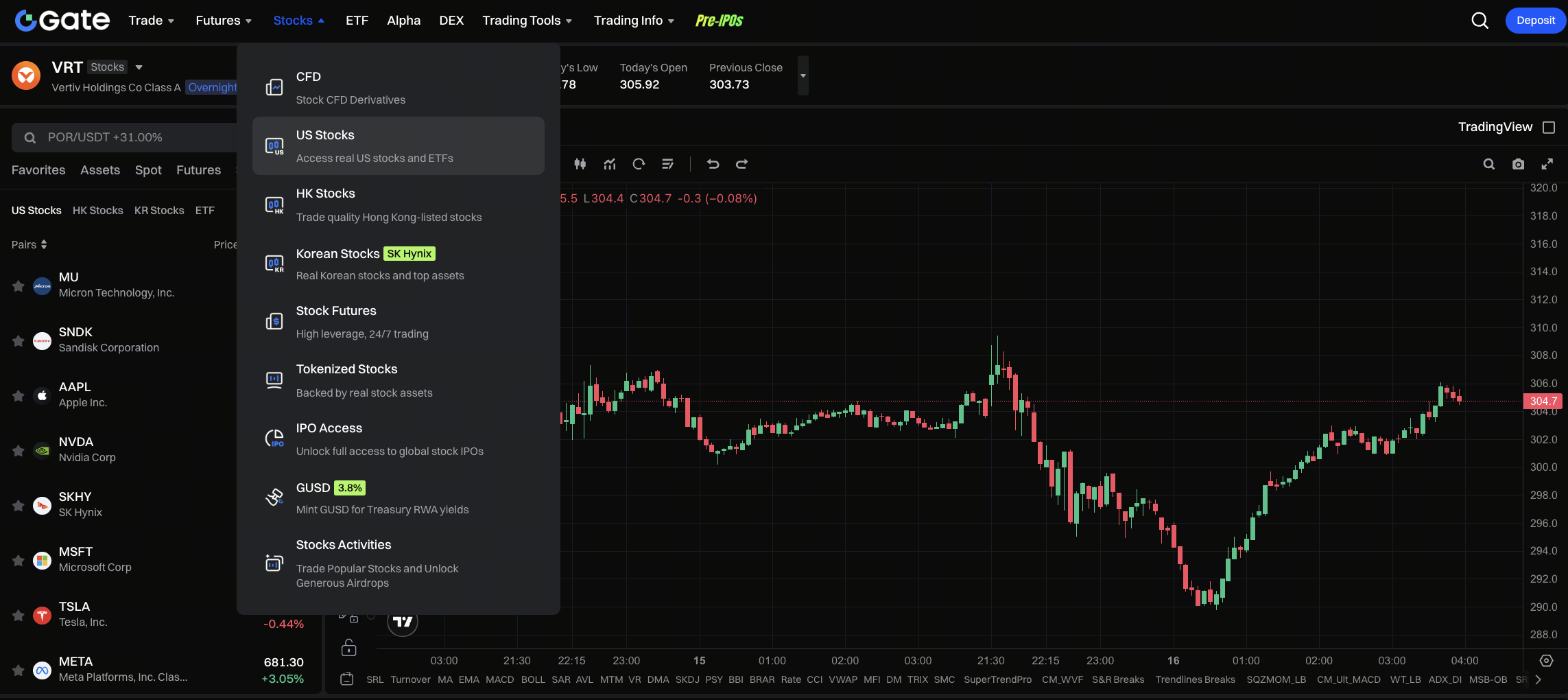
As global interest in AI infrastructure grows, Vertiv (VRT) stock has become a popular target for data center industry investors. Gate Stock Trading enables users to easily access global equities, including US and Hong Kong stocks.
Gate Stock Trading offers access to over 11,000 stocks and ETFs, including more than 10,000 US-listed stocks and ETFs and 1,000+ Hong Kong stocks, covering the NYSE, Nasdaq, NYSE Arca, NYSE American, and other major markets. For investors seeking exposure to AI infrastructure, semiconductors, cloud computing, and global tech trends, Gate Stock Trading provides opportunities to invest in companies like Vertiv (VRT).
Unlike traditional brokerage platforms, Gate Stock Trading allows users to trade using USDT, lowering the entry barrier for digital asset investors. The platform also supports fractional trading, with a minimum order size of 0.01 shares, enabling flexible allocation of high-quality assets without buying whole shares.
Gate Stock Trading also offers unified account management, allowing users to seamlessly allocate assets between digital and traditional financial markets. For those focused on the AI value chain, researching infrastructure leaders like Vertiv (VRT) and aligning investments with individual risk tolerance and market outlook can unlock opportunities in the global technology innovation cycle.
Note that stock investing carries market volatility risks. While AI infrastructure offers long-term growth potential, factors such as valuation, industry cycles, macroeconomic conditions, and market sentiment can all impact stock performance. Investors should make independent decisions based on their own circumstances.
Key Risks to Consider When Investing in VRT Stock
While the AI data center trend creates growth opportunities for Vertiv, investors should be aware of several key risks.
Data Center Capital Expenditure Cycles
Vertiv’s growth is highly dependent on data center construction spending. If cloud providers cut capital expenditures or slow AI infrastructure investment, Vertiv’s order growth may be affected.
The data center industry is cyclical—periods of rapid buildout can be followed by demand slowdowns that impact revenue.
Customer Concentration
Large cloud providers account for a significant portion of data center equipment purchases. If a few major customers reduce orders, Vertiv’s performance could suffer.
Investors should monitor changes in Vertiv’s customer mix and order stability.
Intensifying Competition
With rapid AI infrastructure growth, more players are entering the field. Schneider Electric, Eaton, and other traditional energy companies are expanding their data center businesses, and new tech entrants may also increase competition.
Vertiv must continue investing in R&D to maintain its technological edge.
Valuation Volatility
AI-related stocks have seen rapid valuation expansion in recent years. If expectations for AI infrastructure growth are tempered, related stocks could face valuation corrections.
Investors should assess Vertiv’s profitability, cash flow, and long-term competitiveness.
Vertiv’s Future Directions and Long-Term Growth Potential
Vertiv’s long-term growth is closely tied to global digitalization and AI infrastructure expansion. Key future strategies include:
Deepening AI Data Center Solutions
AI compute demand will continue to drive data center upgrades. Vertiv must keep optimizing high-power supply systems, liquid cooling, and modular infrastructure to meet next-generation AI cluster needs. As AI models grow more complex, demands for energy efficiency and thermal management will intensify.
Scaling Liquid Cooling Adoption
Liquid cooling is poised to become foundational for high-performance computing. If AI chip power consumption keeps rising, more data centers will adopt liquid cooling. Vertiv’s early investments in this space could expand its market share.
Expanding Globally
Data center construction is spreading to new regions, including Asia, Europe, and the Middle East. AI, electric vehicles, cloud computing, and industrial digitalization are all driving local compute demand. Vertiv’s global supply chain and service network position it to capture this long-term growth.
Advancing Software Capabilities
The future of data centers is not just hardware—it’s intelligent management. Software platforms that optimize energy use, predict equipment failures, and boost operational efficiency will become essential for infrastructure providers.
Summary
Vertiv (VRT) is a specialist in critical data center infrastructure, with core offerings spanning power systems, cooling solutions, modular data centers, and IT management platforms. As AI, large models, high-performance computing, and cloud computing accelerate, data centers are entering a high-density computing era—driving demand for stable power and efficient cooling. Vertiv’s deep expertise positions it as a key player in the AI infrastructure value chain.
However, VRT stock faces risks from data center capital cycles, competition, customer concentration, and valuation swings. Investors should weigh AI sector growth, Vertiv’s financials, and long-term competitiveness. If global AI infrastructure investment continues to expand, Vertiv stands to benefit from the digital economy’s infrastructure upgrade—but future performance will depend on innovation, competition, and the pace of AI industry development.
FAQs
What kind of company is Vertiv (VRT)?
Vertiv (VRT) is a global data center infrastructure provider specializing in power management, cooling systems, cabinet equipment, modular data centers, and IT management solutions for AI data centers, cloud enterprises, and telecom operators.
Why is Vertiv in the spotlight amid the AI wave?
AI model training and inference require massive GPU resources, resulting in higher power and cooling needs. Vertiv’s power and thermal management solutions enable enterprises to build high-performance AI infrastructure, drawing strong market interest.
Who are Vertiv’s main competitors?
Vertiv’s primary competitors include Schneider Electric and Eaton in energy management, as well as Dell Technologies in IT infrastructure.
Is VRT stock considered an AI concept stock?
Vertiv is not an AI software company, but its business is closely linked to AI data center construction, making it recognized as an AI infrastructure stock.
What drives Vertiv’s growth?
Key drivers include AI data center investment, cloud expansion, high-performance computing demand, liquid cooling adoption, and global digital infrastructure upgrades.
What is the biggest risk in investing in Vertiv stock?
Major risks include data center capital expenditure cycles, rising industry competition, customer concentration, and valuation volatility driven by AI market expectations.