What Is Space and Time?
 (Source: spaceandtime)
Space and Time (abbreviated as SXT) is a decentralized data platform that integrates blockchain technology with data computation. Its main purpose is to let Web3 applications securely access, verify, and use data.
Unlike traditional databases, Space and Time doesn't just store information—it focuses on:
- Data verifiability
- Decentralized management
- On-chain and off-chain data integration
- Smart contract accessibility
This means developers no longer have to fully rely on centralized data providers for their smart contracts to use external data.
Why Does Web3 Need a Decentralized Data Warehouse?
In many DeFi, GameFi, or on-chain financial applications, data is often scattered across different sources, such as:
- Transaction records on the blockchain
- Centralized exchange data
- External financial information
- Off-chain business data
The problem is that smart contracts can't safely read this data on their own.
The traditional approach involves relying on third-party services to feed data, but that introduces:
- Data trust issues – If the data source is tampered with, the entire protocol could be affected.
- Verification challenges – Users often can't confirm whether the data is authentic.
- Centralization risk – If the service provider goes down, the whole system may be impacted.
Space and Time's core goal is to build a verifiable data layer that lets smart contracts safely use external data.
How Does Space and Time Work?
Space and Time first indexes data from multiple blockchains, such as Ethereum, Base, and other major networks. It then stores and verifies that data through a decentralized verifier network.
Developers can query data using SQL and leverage the platform's core technology, Proof of SQL, to generate zero-knowledge proofs (ZK proofs) that confirm the query results haven't been altered.
In simple terms, this technology queries data, verifies it, and securely returns the results to smart contracts—without needing to trust a middleman.
What Is Proof of SQL?
Proof of SQL is a key technology from Space and Time. It's a zero-knowledge proof system designed specifically for data queries, allowing users to prove that the data came from the correct database and hasn't been modified.
Its key features include:
- Fast query support – The team claims sub-second response times.
- ZK proof generation – Query results can include cryptographic proofs.
- Smart contract compatibility – Contracts can verify data correctness before executing actions.
This model is especially important for DeFi, on-chain credit markets, and institutional finance.
What Are Virtual Vaults From Space and Time?
 (Source: spaceandtime)
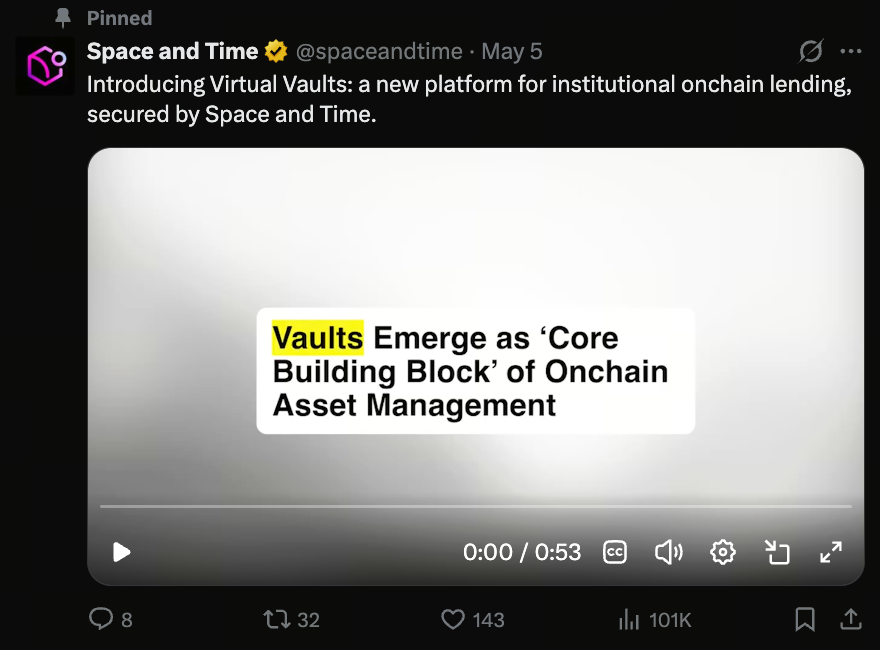
Beyond data services, Space and Time recently launched Virtual Vaults, entering the institutional on-chain lending market.
This feature tackles a key question in institutional lending: How can lenders verify a borrower's collateral status in real time?
Many institutional lending platforms previously relied on:
- Periodic reports
- Centralized audits
- Simple repayment metrics
But these approaches often fail to capture real-time risk accurately.
How Do Virtual Vaults Improve On-Chain Lending?
Space and Time's Virtual Vaults let lenders set specific conditions, such as:
- Which assets qualify as collateral
- Which trading platforms to monitor
- When to trigger risk alerts
- Collateral ratio thresholds
The system continuously tracks the borrower's on-chain and off-chain asset positions and provides real-time data through cryptographic verification.
This means:
- Greater transparency – Lenders can clearly see if collateral is sufficient.
- Reduced information asymmetry – Both lenders and borrowers see the same data.
- Better suited for large institutions – More granular risk controls can be implemented.
Why Is the Institutional Market Focusing on On-Chain Data Verification?
As RWA (Real World Assets) and on-chain finance grow rapidly, institutions demand higher data reliability.
This is especially true in areas like:
- On-chain lending
- Stablecoin finance
- Asset tokenization
- Institutional DeFi
Without verifiable data sources, building large-scale financial markets becomes difficult.
Space and Time positions itself as the trusted data infrastructure behind these applications.
Microsoft and Space and Time Partnership
Space and Time received investment from M12, Microsoft's venture capital arm, and integrated with Microsoft Fabric—Microsoft's intelligent data platform for enterprise-grade analytics and cloud data management. Through this partnership, Space and Time aims to help enterprises more easily integrate blockchain data into their existing systems. Additionally, SXT continues expanding educational and enterprise use cases, such as working with Southeast Asian companies to store course completion certificates on-chain.
Use Cases of the SXT Token
SXT is the native token of the Space and Time ecosystem, currently deployed on Ethereum, Base, and other blockchain networks.
Token use cases include:
- Paying data query fees
- Network verification and security
- Ecosystem incentives
- Protocol interaction
As data demand grows, SXT becomes a vital operational asset within the ecosystem.
Summary
Space and Time's core focus is solving the data trust problem in the Web3 world. It's not just a blockchain project—it's more like:
- A decentralized data infrastructure
- A verifiable computation layer
- An on-chain financial data network
Through technologies like Proof of SQL and Virtual Vaults, Space and Time aims to let smart contracts handle more than token transactions—they can also securely use real-world and on-chain data.
As institutions enter the on-chain financial market, verifiable data systems like this may become a cornerstone of Web3 financial infrastructure.







