OpenAI is an artificial intelligence research company that offers advanced AI models to organizations and individuals for language processing, coding, and problem-solving tasks. Its mission is to make AI tools more accessible and effective while driving forward the development of AI research. Founded in 2015 by a group of co-founders, OpenAI is headquartered in San Francisco, California, and operates within the enterprise software and data intelligence sector. In the crypto and digital asset community, OpenAI garners frequent attention due to the broad application of generative AI, though the company remains private—meaning access to its equity and exposure to its valuation differ fundamentally from trading publicly listed shares.
To understand OpenAI, it is essential to separate the company’s business narrative, unlisted equity structure, and platform product rules: the first addresses “what the company does,” while the latter clarifies “what rights holders actually obtain.”
What Is OpenAI? Understanding Its Business and Unlisted Status
OpenAI’s public profile highlights the capabilities of its models and their application scenarios: it provides advanced AI models to organizations and individuals, covering language processing, coding, and problem-solving tasks, with the aim of helping users increase efficiency, build smarter systems, and advance research. Commonly disclosed founders and executives include Greg Brockman, Sam Altman, and Brad Lightcap, whose information can be verified in the management team section of the project page.
As a privately held company, the general public cannot directly buy or sell OpenAI common shares on exchanges as they would with publicly traded stocks. The financing and post-investment valuation timeline on the project page illustrates the capital structure but should not be interpreted as the platform product’s settlement price or delivery obligation.
What Does “Investing in OpenAI” Typically Mean?
In the context of a private company, “participating in OpenAI” can refer to several distinct arrangements. Direct equity typically requires share issuance or transfer documents and shareholder registers; private placements or fund investments rely on private placement agreements and fund units. The source of rights in both cases is company documentation and transaction contracts, not trading platform product pages.
Platforms may also offer value-mapping or certificate-based products. A product labeled “Pre-IPO” does not confer shareholder status. Does OPENAI equal actual equity? distinguishes between “reference value” and “ownership”; Differences between mirror notes and traditional Pre-IPO analyzes rights source, transfer, and settlement. Classify the investment path first, then review product parameters to avoid structural confusion.
| Path Type |
Primary Source of Rights |
Common Restrictions |
| Direct Equity |
Shares, company documents, applicable law |
Transfer restrictions, share class differences |
| Private Placement/Fund |
Private placement or fund contracts |
Lock-up period, information rights, look-through structure |
| Platform Mapping Product |
Platform-disclosed product terms |
Eligibility, region, settlement, reference basis |
This classification is for mechanism comparison only and does not guarantee the availability or outcome of any path.
What Are Gate Pre-IPOs OPENAI Asset Certificates?
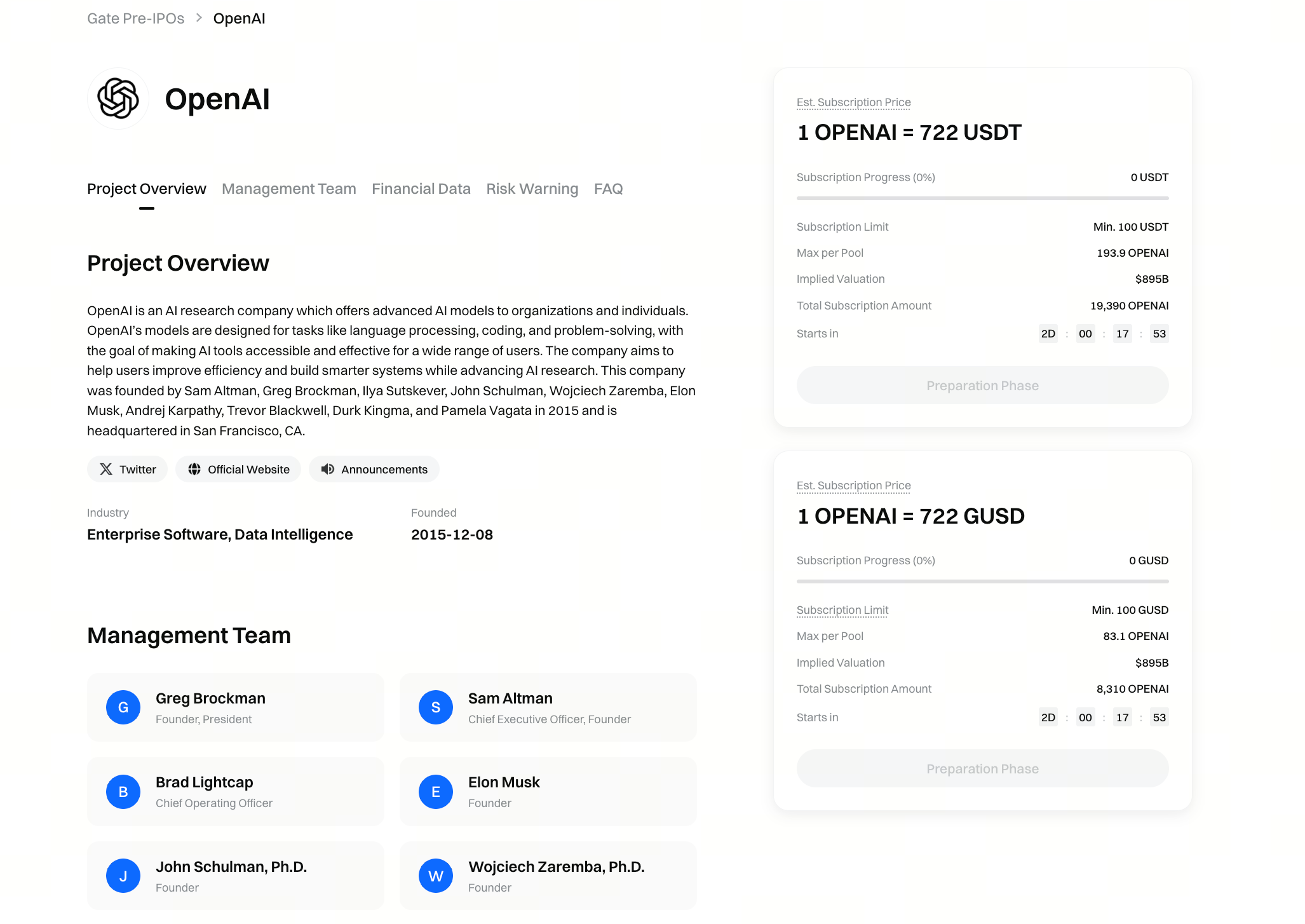
When discussing exposure to OpenAI via Gate, the product should be defined per the official documentation. Gate’s project page and announcements specify: OpenAI Asset Certificates are mirror notes issued before OpenAI’s IPO, designed to track the company’s market value before and after listing, and are classified as contingent payout notes. The platform indicates it will provide users with various exit or long-term holding options linked to the target company’s reasonable market value, including hedging exposure through market acquisition of OpenAI shares.
Key boundaries are also emphasized: this product does not represent actual OpenAI shares or stock, nor does it establish a legal relationship between investors and OpenAI; holders have no voting, dividend, or other shareholder rights. The disclaimer further states: this offering is unrelated to OpenAI; OpenAI has not participated in, authorized, or endorsed the product or related materials; OpenAI will not receive any proceeds and has not provided any information to Gate. PANews’ Chinese terminology for “mirror note / contingent payout note” can be cross-referenced, but Gate’s official project page and announcements prevail.
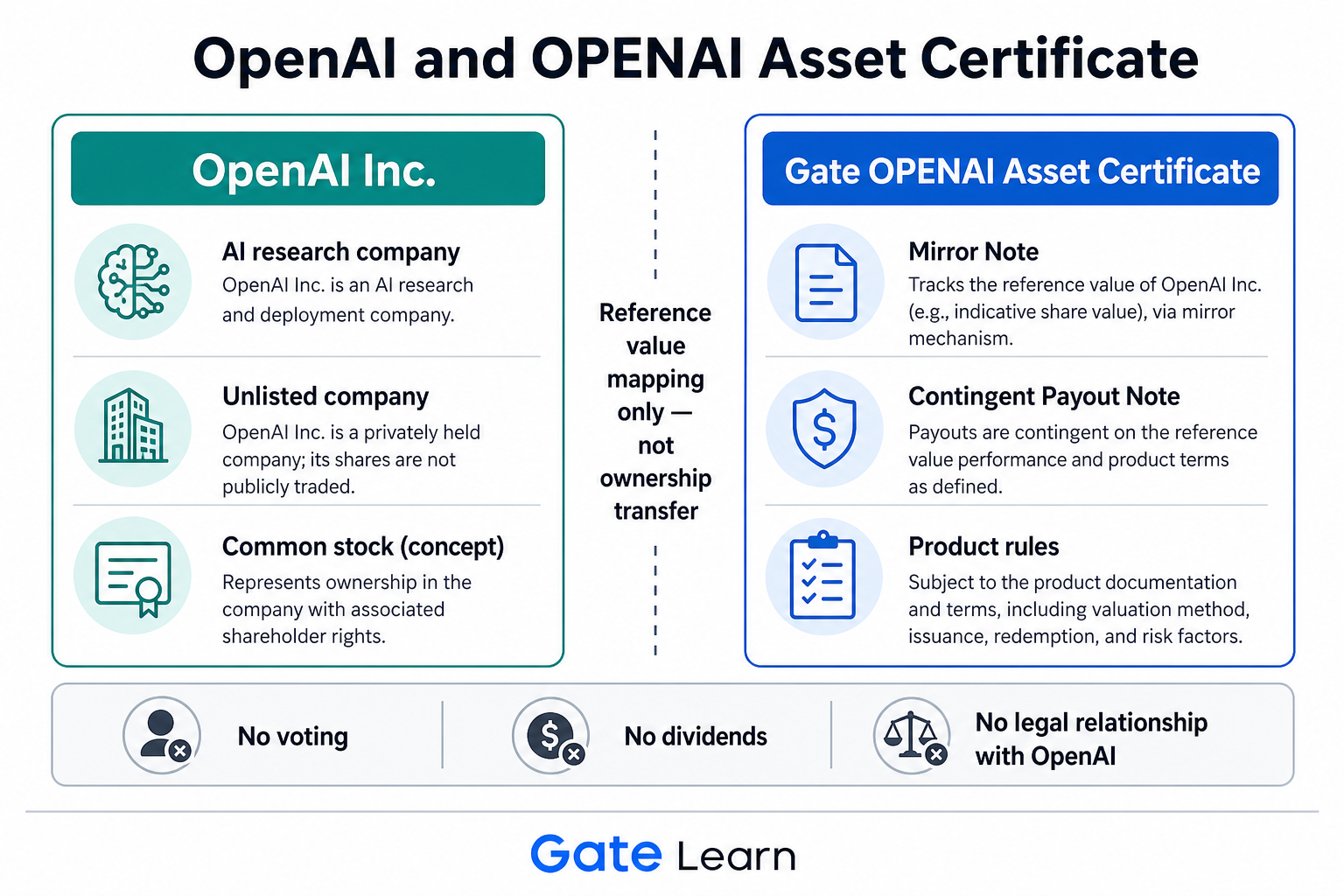 Image: The relationship between the OpenAI entity and Gate OPENAI Asset Certificate is based on reference value mapping, not equity transfer.
How Do OPENAI Subscription, Allocation, and Vesting Work?
Gate’s announcement on July 13, 2026, disclosed parameters for this issuance: asset token symbol OPENAI; committed price 1 OPENAI = 722 USDT/GUSD; total subscription volume 27,700 units, with 19,390 units in the USDT pool (70%) and 8,310 units in the GUSD pool (30%); minimum subscription 100 USDT or 100 GUSD; individual cap 277 units, with pool caps of 193.9 and 83.1 units, respectively. The subscription window runs from July 15, 2026, 07:00 to July 17, 2026, 07:00 (UTC). OPENAI subscription allocation and vesting clarifies that allocations are based on the average hourly locked amount during the subscription period, not simply the submitted amount.
| Item |
Official Disclosure (Current Issuance) |
| Committed Price |
1 OPENAI = 722 USDT / GUSD |
| Total & Pool Sizes |
27,700; USDT 19,390; GUSD 8,310 |
| Thresholds & Caps |
Minimum 100; pool 193.9 / 83.1; total ≤277 |
| Allocation Logic |
Average hourly locked amount during subscription period |
| Vesting Schedule |
25% / 35% / 40% (see announcement for details) |
After allocation, vesting occurs in three phases for transferability: July 17, August 17, and September 17, 2026, 11:00 (UTC), corresponding to 25%, 35%, and 40%, respectively. The first vesting and unallocated fund refunds are processed before the initial vesting date. Restrictions on institutional accounts, sub-accounts, and the use of borrowed funds are also detailed in the announcement.
How Are Pre-Market Trading, Post-IPO Exit, and Maturity Settlement Arranged?
The announcement specifies that trading is conducted in the Pre-IPOs Zone Pre-Market, starting at 08:00 (UTC) on July 20, 2026. Since OpenAI is not yet publicly listed, pre-market trading uses a temporary trading code and corresponding circulating volume, which may be adjusted after listing. OPENAI pre-market trading and settlement distinguishes between pre-market transfers and post-IPO settlement options.
For this asset, the lock-up period after OpenAI’s actual listing is six months; after the lock-up, Gate provides a dedicated exit page where holders can convert their assets into stock assets, tokenized stocks, or USDT at the real-time post-listing market price. If as of the maturity date—December 31, 2035—OpenAI is still not listed, or has been acquired, merged, or gone bankrupt, settlement is based on the fair market value of OpenAI common stock in USDT. In bankruptcy reorganization, the reference value is adjusted according to the actual disposition of the common stock; if liquidation reduces the value of common stock to zero, the product’s reference value may also be zero.
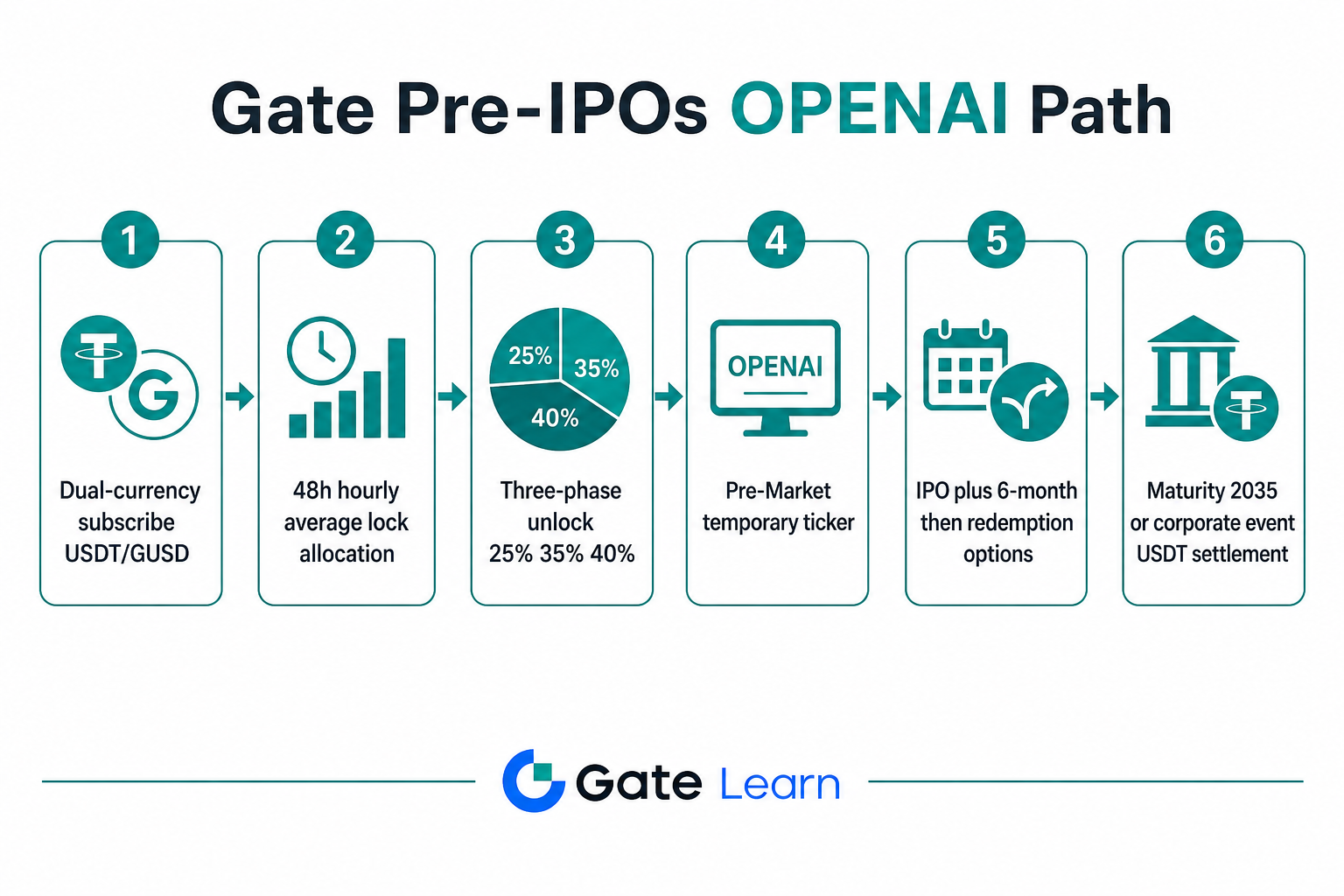 Figure 2. Official process overview from dual-currency subscription, hourly average allocation, phased vesting to pre-market trading and settlement options.
How Do the Rights of OPENAI Holders Differ from Actual OpenAI Equity?
The rights of actual equity holders depend on share class, company bylaws, and applicable law; OPENAI holders are governed by the allocation, transfer, adjustment, and settlement arrangements defined in Gate’s product terms. The project page FAQ summarizes this as “contractual claims / beneficial or economic interests, rather than direct equity ownership.” OPENAI implied valuation and dilution further explains: the approximate $895 billion implied valuation is calculated from the committed price and a reference total share count of about 1.23 to 1.24 billion shares, serving as the value mapping input for this issuance—not an official OpenAI valuation.
Corporate actions such as new share issuance, cancellations, stock splits, reverse splits, or common stock reclassification may alter the reference basis; announcements specify that holdings will be adjusted and disclosed accordingly. No adjustment should be construed as registration as an OpenAI shareholder.
Private companies face risks such as uncertain listing timelines, changes in valuation and capital structure, M&A, or bankruptcy. For platform mapping products, additional risks include non-equity nature, pre-market liquidity, price volatility, temporary trading parameter adjustments, regional and account eligibility, and settlement terms for maturity or events. Announcements specify: borrowed funds may not be used; institutional and sub-accounts are ineligible; users in restricted regions may not access services; in case of translation discrepancies, the English version prevails. OPENAI risks and product checklist provides a step-by-step guide. The risk section only describes mechanisms and terms, without making participation recommendations.
Summary
As a private AI research company, OpenAI’s business capabilities and company equity are distinct matters. Gate Pre-IPOs’ OPENAI is officially characterized as a mirror note and contingent payout note: it tracks market value before and after listing but does not represent actual shares or establish any legal relationship with OpenAI. Subscription, vesting, pre-market trading, post-IPO conversion, and 2035 maturity settlement are all governed by the Gate project page and current announcements.
FAQ
What kind of company is OpenAI?
OpenAI is an artificial intelligence research company providing advanced AI models for language processing, coding, and problem-solving to organizations and individuals. Headquartered in San Francisco, it operates in the enterprise software and data intelligence sector and remains privately held.
Is Gate’s OPENAI the same as OpenAI stock?
No. Gate has disclosed that OPENAI Asset Certificates are mirror notes and contingent payout notes, which do not represent actual OpenAI shares or stock and do not establish any legal relationship between holders and OpenAI.
Do OPENAI holders have voting or dividend rights?
No. The official FAQ clarifies that holders do not own actual OpenAI shares and have no rights to claim shareholder privileges, including voting or dividends.
How should the approximate $895 billion implied valuation for OPENAI be understood?
This figure is derived from the committed price for this issuance (1 OPENAI = 722) and a reference total share count of about 1.23 to 1.24 billion shares, serving as the value mapping input for the mirror note. It does not represent an OpenAI-confirmed company valuation and is not equivalent to the pre-market transaction price.
How are OPENAI subscriptions and vesting handled?
Official disclosures state that subscriptions are split between USDT and GUSD pools, with allocations based on the average hourly locked amount during the 48-hour subscription period; allocated certificates vest in three phases: 25%, 35%, and 40%. The submitted amount does not equal the final allocation.
How is settlement handled if OpenAI remains unlisted or until 2035?
The maturity date is December 31, 2035. If OpenAI is still not listed at maturity or has been acquired, merged, or gone bankrupt, Gate discloses that settlement will be based on the fair market value of OpenAI common stock in USDT; if liquidation reduces the value of common shares to zero, the product’s reference value may also become zero.