Traditional centralized exchanges typically combine trading, finance, and custody within a single platform. In contrast, most perpetual DEXs, while retaining on-chain self-custody, often separate margin, yield, and investment layers across multiple protocols. Grvt’s objective is to allow funds within a single account to function simultaneously as margin and for yield generation, eliminating the need to choose between the two.
In terms of product positioning, Grvt is best understood as an account system that merges the trading terminal, yield gateway, and on-chain wealth management interface—going beyond the scope of a standard derivatives platform.

What is Grvt? What problems in on-chain trading does it aim to solve?
Grvt positions itself as an on-chain trading and investment app, with the core principle that "Every Dollar Does More." This product structure enables a single balance to serve as trading collateral, earn yield when idle, and act as the funding source for investment products. The unified margin mechanism is essential for understanding this approach.
| Issue |
Common On-Chain Experience |
Grvt’s Approach |
| Fragmented Funds |
Trading, earning, and investing are typically spread across different protocols |
Connect trading and yield layers with a single balance |
| Idle Margin |
Funds usually stop earning yield after opening a position |
Unified margin emphasizes continuous utilization of balances |
| RWA Access Barriers |
Yield products and trading interfaces are often separated |
Integrate investment products within the same application |
Grvt’s primary focus is not just enabling trading, but ensuring that funds in trading accounts remain continuously productive. This is why it addresses trading, yield, and investment in a unified narrative.
How does Grvt operate? What is the relationship between unified margin, non-custodial accounts, and the matching structure?
Grvt’s architecture consists of three layers: non-custodial accounts for asset control, unified margin for risk and collateral management, and a matching and settlement structure for order execution and position updates. Together, these layers transform the account from isolated wallets into a capital pool that continuously calculates NAV and risk.
Unified margin is more than just “multiple positions sharing a balance.” Critically, BTC, ETH, stablecoins, and certain tokenized assets are evaluated as available margin from a unified perspective, eliminating the need for separate collateral locks per position. The practical order flow can be further understood via the trading process.
| Structure Layer |
Main Component |
Function |
| Non-Custodial Account |
User balances and permissions |
Minimize full asset custody by the platform |
| Unified Margin |
Account-wide collateral |
Enable a single fund to serve multiple positions and purposes |
| Matching & Settlement |
Orders, positions, risk engine |
Handle execution, margin checks, and position updates |
This means the matching structure is simply the execution layer for the unified account, not the entirety of the platform’s offering.
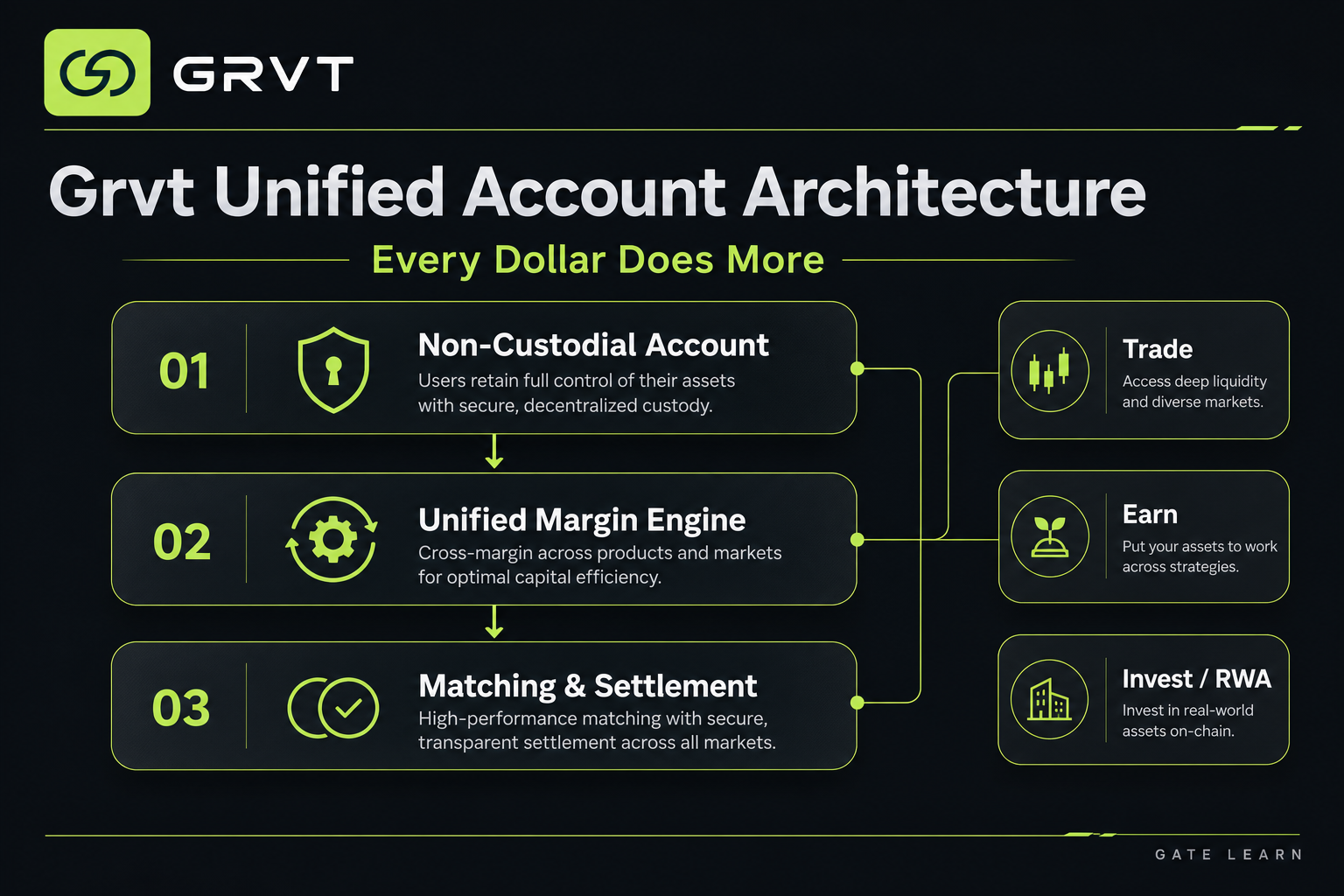 Fig 1. Grvt unified account architecture: the layered structure of non-custodial accounts, unified margin engine, and matching settlement.
Grvt’s public roadmap includes perpetual trading, multi-market exposure, yield, and investment layers. Perpetual trading is the entry point, but the platform’s vision extends beyond simply opening long or short positions—placing trading, earning, and institutional RWA holdings within the same account context.
Typical use cases fall into three categories: (1) trading scenarios, using unified margin to manage multiple exposures; (2) fund management scenarios, ensuring idle balances remain productive; and (3) allocation scenarios, allocating a portion of funds to on-chain yield portfolios or tokenized real-world asset products. The platform comparison provides insight into Grvt’s distinctions in custody, capital efficiency, and product boundaries.
As a result, Grvt is best described as a combination of “account system + trading interface + investment gateway,” rather than a platform defined solely by contract trading volume.
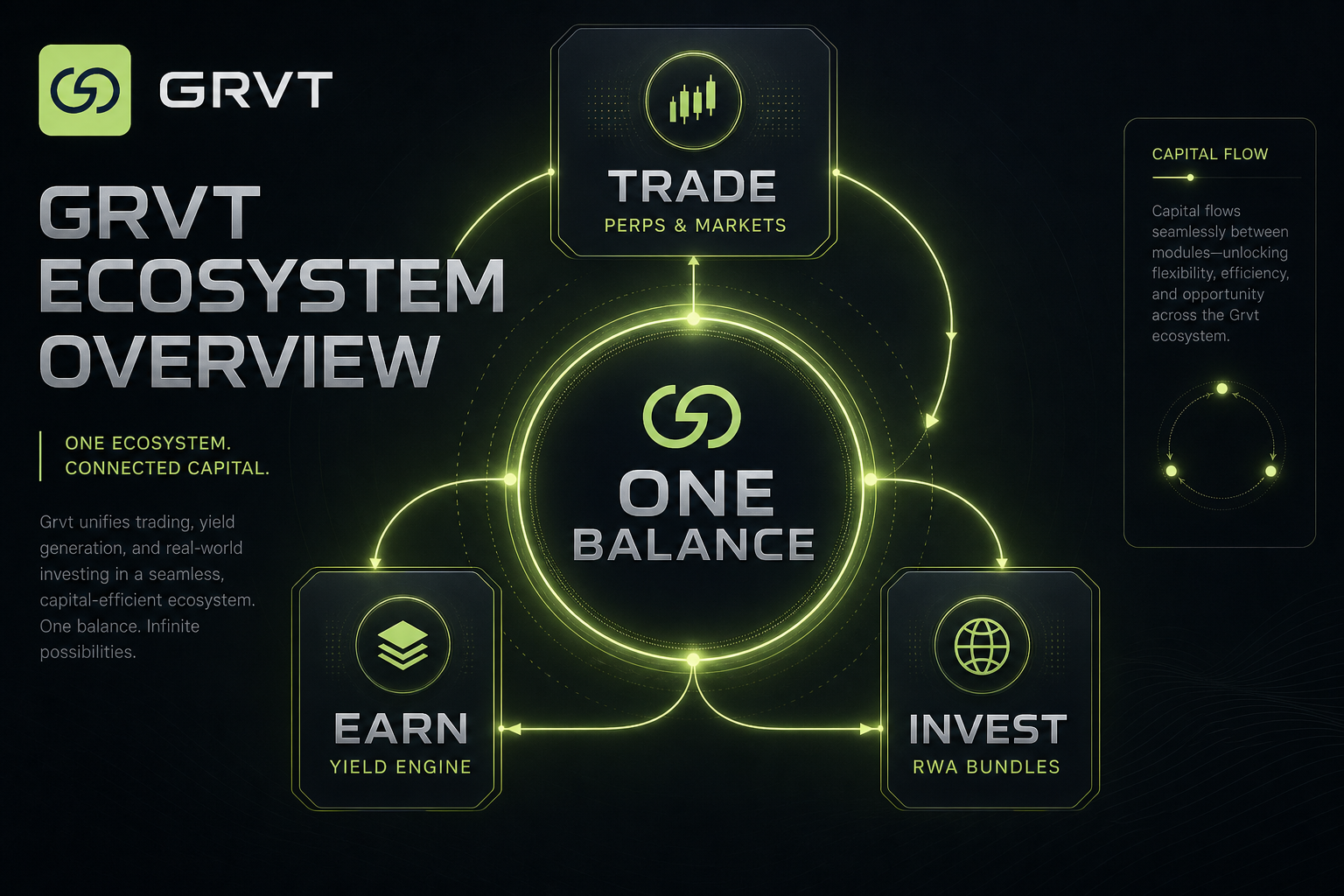 Fig 2. Grvt ecosystem overview: a single balance connects Trade, Earn, and Invest/RWA modules.
How do Grvt’s yield layer and RWA gateway integrate with the unified account?
Grvt’s yield and RWA gateways serve as account expansion layers. The focus is not to require users to leave the trading account to open separate finance positions, but instead to access products with different risk-yield profiles using the same non-custodial balance. Public information indicates the platform emphasizes tokenized RWA yield funds, yield bundles, and yield layers built by integrating with external protocols.
The capital flow can be summarized in two steps: first, available funds are added to the unified account; then, the investment gateway maps part of the balance to specific yield strategies or tokenized fund shares. Users experience a unified asset allocation view within the same application, rather than multiple disconnected custody layers. The yield layer can also connect to on-chain lending infrastructure, expanding yield sources through sGHO yield engine, Aave, and similar components. The key innovation is embedding yield generation directly within the account itself.
What are the advantages, risks, and limitations of using Grvt?
Grvt’s core advantage is integrating non-custodial management, unified margin, and yield layers within a single account, reducing friction from moving funds across protocols. For users who need to trade and manage idle funds concurrently, this structure delivers a more seamless experience than single-function DEXs.
However, risks are equally present. Unified margin increases capital efficiency but also concentrates risk at the account level; integrating yield layers with external protocols introduces smart contract, strategy, and liquidity risks; RWA products add complexity around issuance structure, asset mapping, exit liquidity, and compliance. The main limitation is higher product complexity, requiring users to understand NAV, margin, and the interplay among multiple asset types.
How does Grvt differ from traditional centralized exchanges and typical perpetual DEXs?
Grvt’s primary distinction from centralized exchanges lies in asset control and the account trust model. Compared to standard perpetual DEXs, the difference is not just the presence of an order book, but whether yield and investment layers are integrated as part of a unified account.
| Dimension |
Traditional Centralized Exchange |
Standard Perpetual DEX |
Grvt |
| Asset Control |
Platform custody |
User self-custody |
Emphasizes non-custodial accounts |
| Margin Model |
Centralized in trading account, but platform-custodied |
Typically protocol-specific trading margin |
Unified margin connects trading and yield |
| Yield Gateway |
Usually a separate finance section |
Often requires switching to external protocols |
Yield layer embedded in the same balance |
| RWA Investment |
Depends on platform product line |
Usually limited coverage |
Emphasizes investment layer within the same account |
This comparison highlights Grvt’s focus on account integration. It leverages the unified experience of centralized platforms while retaining the core features of on-chain self-custody and composability.
Grvt is positioned as an on-chain trading and wealth management platform, built on non-custodial accounts, unified margin as its core, and yield and RWA investment layers as extensions. Its differentiation is not found in a single trading function, but in whether trading, earning, and investing are truly unified within a single account structure.
FAQ
What is Grvt?
Grvt is an integrated non-custodial platform for on-chain trading and investment, with unified margin and a single balance at its core. Users can manage trading margin, yield sources, and select investment products within the same account, without splitting assets across multiple applications.
Is Grvt an exchange or a DeFi platform?
Grvt combines the features of a trading platform and a DeFi account system. It provides an integrated interface and matching experience similar to an exchange, but emphasizes on-chain non-custody and composability in asset management and capital allocation. Therefore, it is not the same as a traditional centralized exchange.
What does Grvt’s unified margin mean?
Unified margin refers to an account-wide margin mechanism, where different assets and positions are calculated as available margin within a single risk pool. This enables one pool of funds to simultaneously support multiple trading exposures and continue generating yield when idle.
Is Grvt a non-custodial platform?
Grvt explicitly adopts a self-custodial or non-custodial account structure, prioritizing user asset control over traditional centralized custody. Non-custodial does not eliminate protocol, strategy, or market risk, but it does reduce reliance on centralized intermediaries for asset control.
What are RWA yield products on Grvt?
Grvt’s RWA yield products are tokenized real-world asset yield gateways provided within the same account system, such as yield funds or bundles for varying risk preferences. The emphasis is not on a single coupon rate, but on integrating trading accounts and investment allocations into a unified capital flow.
What are the main risks of using Grvt?
Key risks include account-level contagion from unified margin, risks from external yield protocols and smart contracts, and liquidity, mapping, and structural risks associated with RWA products. Users should clearly distinguish the sources of trading risk, yield strategy risk, and underlying asset risk before using the platform.