Gate Stocks is a traditional financial stock trading service that allows eligible users to buy, sell, manage positions, and view transaction records for supported US stocks and ETFs using USDT settlement. Product access depends on identity verification, regional eligibility, platform rules, and the latest information shown in the Gate interface.
This model reflects a broader connection between digital assets and traditional finance. Stablecoins such as USDT are increasingly used as settlement tools for non-crypto assets, while platforms build interfaces that allow users to manage crypto assets and securities-related exposure in one place.
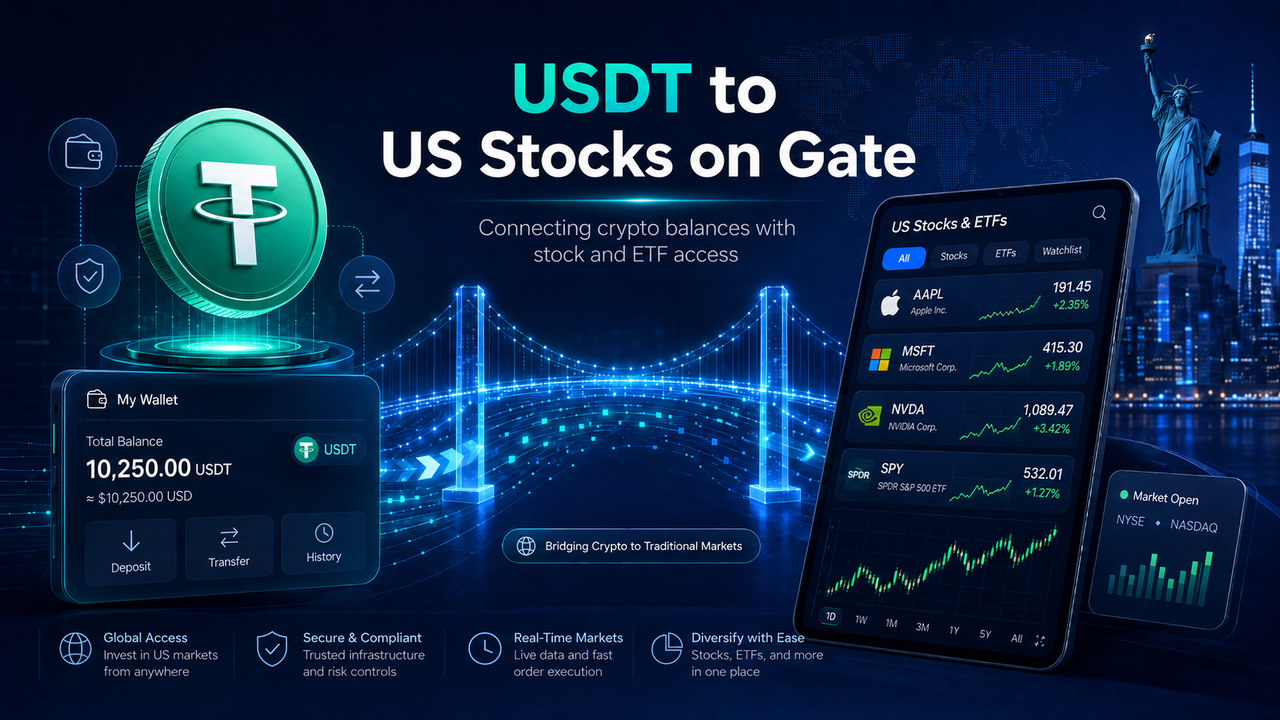
What does trading US stocks with USDT on Gate mean?
Trading US stocks with USDT on Gate means using USDT as the settlement currency for supported US stock and ETF transactions inside the Gate Stocks product.
In a traditional brokerage workflow, a user usually opens a brokerage account, deposits fiat currency, converts or settles funds in USD, and then buys shares. On Gate, the stock trading account is connected to a crypto-native account structure. Users transfer USDT into the Stock Account and place buy or sell orders for supported assets.
According to Gate’s stock overview, Gate Stocks supports buying, selling, position management, and transaction record queries. It also allows trading by share or by amount, while short selling and margin trading are not currently available for this stock spot product.
It is important to distinguish Gate Stocks from other stock-related products. Gate also offers products such as tokenized stocks, stock CFDs, and stock-related derivatives. These products may differ in ownership structure, trading hours, settlement, leverage, and user rights.
Why trade US stocks with USDT instead of using a traditional brokerage account?
Trading US stocks with USDT may appeal to users who already hold stablecoins and want a more direct route from crypto assets to US equity exposure.
| Point |
Traditional Brokerage Account |
Gate Stocks with USDT |
| Funding path |
Usually requires fiat deposits, bank transfers, and USD settlement. |
Uses USDT to trade supported US stocks and ETFs. |
| Account setup |
Requires opening a separate brokerage account. |
Eligible users can trade through their Gate account. |
| Operational steps |
Funds may need to move from crypto platform to bank, then to brokerage. |
USDT funding can be managed inside Gate’s account system. |
| Fractional access |
Depends on the brokerage’s rules. |
Supports fractional share trading from 0.01 shares. |
However, simpler access does not remove investment risk. US stock prices can rise or fall, execution prices can differ during volatile periods, and platform access depends on eligibility and local restrictions.
What should users prepare before trading US stocks on Gate?
Before trading US stocks with USDT on Gate, users should prepare four things: a verified Gate account, eligible regional access, sufficient USDT, and a basic understanding of the product structure.
First, users need a Gate account with identity verification completed. Gate’s USDT guide explains the general account process: create an account, complete verification, and deposit USDT through a supported network.
Second, users must meet regional eligibility requirements. Gate states that Gate Stocks is available only to users who meet the platform’s eligibility requirements, and services may be restricted in certain jurisdictions.
Third, users need USDT available for transfer into the Stock Account. Gate’s stock overview states that users transfer USDT from the Spot Account or Unified Account into the Stock Account before placing stock orders.
Fourth, users should understand what they are trading. Gate Stocks is not the same as stock tokens, CFDs, or perpetual contracts. Stock tokens track real stock prices but do not represent direct ownership of the actual stock and generally do not provide shareholder rights.
How to trade US stocks with USDT on Gate: step-by-step process
The basic trading process begins with account access and ends with position management.
-
Create and verify a Gate account Register on Gate and complete identity verification. Verification and regional eligibility are required before accessing supported stock trading functions.
-
Deposit or hold USDT in the Gate account Deposit USDT from an external wallet or another platform. When depositing, users should select the correct network and confirm that the withdrawal network matches the Gate deposit network.
-
Enter the Stocks section Users can access the Stocks page through the TradFi category, market entry, or search function, according to Gate’s stock guide.
-
Transfer USDT to the Stock Account Move USDT from the Spot Account or Unified Account into the Stock Account. This separates stock trading funds from other trading balances.
-
Choose a supported stock or ETF Search for the desired stock or ETF. Supported assets are subject to platform listings and may change over time.
-
Place an order during supported trading hours Select the asset, review the displayed price and order information, and submit a market order to buy. Gate’s stock overview states that users can place orders during market hours and buy or sell by share or amount.
-
Confirm the position record After execution, the purchased position can be viewed on the stock homepage or stock trading page. Transaction records should be checked for executed price, quantity, settlement amount, and fees.
How to manage or sell US stock positions on Gate
After buying a supported US stock or ETF, users can view and manage the position from the Stock Account interface.
Position management generally includes checking the current market value, reviewing unrealized gains or losses, viewing transaction history, and deciding whether to continue holding or sell. Gate states that purchased stocks can be managed on the stock homepage or the candlestick trading page.
To sell a position, users select the asset, choose the amount or share quantity to sell, review the order details, and submit the sell order during supported trading hours. After execution, the proceeds are settled in USDT within the stock account structure.
Corporate actions are another management factor. Gate states that cash dividends, stock splits, and reverse splits are processed according to platform rules and reflected in the stock account and transaction history. Users do not hold shares in their own name in the traditional stock registration system and do not receive voting or other traditional shareholder privileges.
What fees, trading rules, and trading hours should users know?
Gate Stocks trading fees are charged as a percentage of the transaction amount and are based on the user’s VIP level. Gate’s stock overview states that the fee rate is the same as spot trading, while the official Gate fee page shows the platform’s VIP fee structure and allows users to view their account-specific rates.
The standard fee calculation is:
Trading fee = transaction amount × fee rate
Gate’s fee guide uses this same general structure for spot trading fee calculation. For example, if a transaction amount is 4,000 USDT and the applicable fee rate is 0.1%, the fee would be 4 USDT.
Trading rules also matter. Gate’s stock overview states that Gate Stocks supports buying and selling, but short selling and margin trading are not currently available for the stock spot product. Settlement is in USDT, and direct stock withdrawals are not currently supported.
Trading hours may vary by product status and platform updates. Gate’s stock overview states that stock orders are placed during regular US stock market trading hours, while a June 2026 Gate announcement states that pre-market and after-hours stock trading expanded supported stock trading hours to 16×5 for users on the required app version. Users should always check the current trading session, asset availability, and platform notices before placing an order.
What are the risks of trading US stocks with USDT on Gate?
Trading US stocks with USDT involves both market risks and product-structure risks.
| Risk Type |
Explanation |
Why It Matters |
| Price volatility |
US stocks and ETFs can move sharply due to earnings reports, interest-rate expectations, macroeconomic data, sector news, or company-specific events. |
Easier access does not reduce the risk of investment losses. |
| Execution risk |
During high market volatility, the execution price may differ from the price shown when the order is placed. |
Price differences may occur when liquidity changes quickly or markets react to news. |
| Rights and registration structure |
Users do not hold shares in their own name within the traditional stock registration system and do not receive voting or other traditional shareholder privileges. |
Corporate actions are handled according to platform rules rather than direct shareholder registration. |
| Stablecoin and settlement risk |
Since settlement is in USDT, users are exposed to stablecoin liquidity, redemption, regulatory, and operational risks. |
Stock price movement and USDT-related risks may affect account value and settlement separately. |
| Product confusion |
Gate Stocks, tokenized stocks, CFDs, and perpetual contracts are different products with different structures. |
Users should confirm which product interface they are using before trading, because rights, risks, and settlement rules may differ. |
Summary
Trading US stocks with USDT on Gate is a crypto-native way to access supported US stocks and ETFs using USDT settlement, without opening a separate traditional brokerage account.
The process generally includes completing account verification, preparing USDT, transferring funds into the Stock Account, selecting a supported stock or ETF, placing an order during supported trading hours, and managing the position through the stock account interface.
The key point is product understanding. Gate Stocks is designed for buying, holding, and selling supported US stocks and ETFs, while tokenized stocks, CFDs, and perpetual contracts follow different structures. Users should review eligibility, fees, trading hours, shareholder rights, settlement rules, and risk warnings before trading.
FAQs
Can users trade US stocks on Gate without opening a brokerage account?
Yes, eligible users can trade supported US stocks and ETFs with USDT through Gate Stocks without opening a separate traditional brokerage account. Access depends on KYC, regional eligibility, and current platform rules.
Do users need USD to trade US stocks on Gate?
No. Gate Stocks uses USDT for settlement, so users do not need to manually convert funds into USD before trading supported US stocks and ETFs.
Is Gate Stocks the same as tokenized stocks?
No. Gate Stocks, tokenized stocks, CFDs, and stock perpetual contracts are different products. Tokenized stocks are digital tokens that track the price of real stocks, but owning a stock token does not mean owning the actual stock or receiving traditional shareholder rights.
Can users receive dividends from US stocks on Gate?
Gate states that corporate actions such as cash dividends, stock splits, and reverse splits are processed according to platform rules and reflected in the stock account and transaction history. Users should check the latest product rules for each asset.
Can users vote as shareholders?
No. Gate states that users do not hold shares in their own name within the traditional stock registration system and do not enjoy voting or other traditional shareholder privileges.
Can users short US stocks on Gate Stocks?
Not currently for the Gate Stocks spot product. Gate’s stock overview states that only buy and sell are supported, while short selling and margin trading are not currently available.
Where can users check current fees?
Users can check the official Gate fee page and their account interface for VIP-level fee information. Actual fees and transaction results are subject to transaction history records.