The core distinction between QQQB stock tokens, traditional QQQ ETFs, and other tokenized stocks centers on their underlying structures and trading infrastructures. QQQB maps the economic interests of the Invesco QQQ Trust to a BEP-20 token on BNB Chain, circulating within the Binance ecosystem. Traditional QQQ ETFs are traded as ETF shares issued by Invesco on regulated securities exchanges. Tokenized stocks such as gStocks on the Gate platform are anchored 1:1 by physical shares and circulate within the platform’s order book.
QQQB stock tokens have been thoroughly explained in terms of mechanism, reserve structure, and trading path. All three solutions provide exposure to the Nasdaq 100, but differ in account structure, settlement standards, reserve verification, and on-chain composability. This comparison is not about which is “better,” but about establishing a framework for mechanism-based evaluation.
What Is QQQB?
QQQB (Invesco QQQ Trust Tokenized bStocks), issued by BTech Holdings Limited, is a bStocks tokenized security within the Binance ecosystem. Each BEP-20 token represents the underlying economic interest in the Invesco QQQ Trust (which tracks the Nasdaq 100 QQQ ETF) and is fully backed 1:1 by physical shares held with a regulated US broker.
QQQB’s primary access point is on Binance: spot trading, 1:1 fee-free conversion with QQQ through Token Conversion, or withdrawal to a BSC wallet for self-custody. Reserve transparency is ensured through Proof of Collateral disclosures, with corporate actions adjusted via Multiplier rebasing. QQQB 1:1 Reserve and Corporate Action Mechanism details reserve correspondence and rebasing triggers; QQQB vs. QQQ ETF Underlying Structure compares basket composition and rights boundaries.
What Is a Traditional QQQ ETF?
A traditional QQQ ETF refers to the Invesco QQQ Trust (ticker: QQQ), an ETF listed on US exchanges that tracks the Nasdaq 100 Index. Investors buy and sell shares through licensed brokers during regular trading hours, with holdings recorded in brokerage accounts and settlement and fees governed by US market rules.
The QQQ ETF is issued and managed by Invesco, with share creation and redemption typically available to Authorized Participants (APs). Holders receive dividends and other economic benefits in proportion to their shares, with shareholder rights governed by the ETF’s structure and US securities regulations. The relationship to QQQB is “same underlying trust, different vehicle”: QQQ is traded as ETF shares in the securities market, while QQQB maps equivalent economic interests to tokens circulating on Binance and BNB Chain.
What Are Other Tokenized Stocks (Such as gStocks)?
Beyond bStocks, tokenized stocks and ETFs are available through various platform solutions. gStocks, launched by Gate, are tokenized securities anchored 1:1 with fully-backed native shares, traded via the Gate order book, and supporting fractional shares and unified account management. Both gStocks and QQQB are tokenized securities backed by physical share reserves, but differ in issuer, trading venue, on-chain standard, and conversion mechanisms.
gStocks are designed for the order book experience within the Gate ecosystem, with dividends settled automatically and plans for 1:1 bidirectional conversion between stocks and gStocks. Compared to QQQB, gStocks emphasize unified account coordination within Gate, rather than BSC-based BEP-20 self-custody and DeFi composability. Compared to QQQ ETF, gStocks use tokenized units to provide exposure, with rights governed by Gate’s product terms.
Core Differences at a Glance
| Comparison Dimension |
QQQB (bStocks) |
Traditional QQQ ETF |
gStocks and Gate Tokenized Stocks |
| Underlying Asset |
Invesco QQQ Trust economic interest |
Invesco QQQ Trust itself |
Varies by asset |
| Vehicle |
BEP-20 token |
Exchange-listed ETF share |
Platform tokenized unit |
| Main Trading Venue |
Binance Spot |
Securities exchange / broker |
Gate order book |
| Trading Hours |
24/7 (platform rules) |
Regular exchange hours |
24/7 (platform rules) |
| Settlement Path |
Binance account / on-chain transfer |
Broker T+ rules |
Gate unified account |
| Reserve Verification |
Proof of Collateral |
ETF holding disclosures / AP mechanism |
Platform reserve disclosures |
| Securities↔Token Conversion |
Token Conversion 1:1 fee-free |
AP creation/redemption (institutional) |
Planned 1:1 bidirectional conversion |
| On-chain Composability |
Supports BSC DeFi integration |
No on-chain standard |
Platform ecosystem-centric |
| Shareholder Rights |
As per bStocks product terms |
Full ETF shareholder rights |
As per Gate product terms |
| Dividend Handling |
Multiplier rebasing + account allocation |
Paid per ETF rules |
System automatic settlement |
This table compares the three solutions across ten dimensions. Trading hours directly impact liquidity: QQQB and gStocks enable extended trading under platform rules, while QQQ ETF is limited to exchange hours. For reserve verification, QQQB’s Proof of Collateral checks on-chain circulation, QQQ ETF relies on fund manager disclosures, and gStocks depend on platform reserve transparency—each approach solves for transparency differently, and none eliminates underlying asset volatility risk. For conversion, QQQB supports 1:1 fee-free switching with QQQ; QQQ ETF share creation/redemption is AP-based; gStocks’ conversion rules depend on the underlying asset. In terms of on-chain composability, QQQB can integrate with BSC protocols such as Venus and PancakeSwap, traditional QQQ ETFs lack this capability, and gStocks focus on extending unified account functions within Gate.
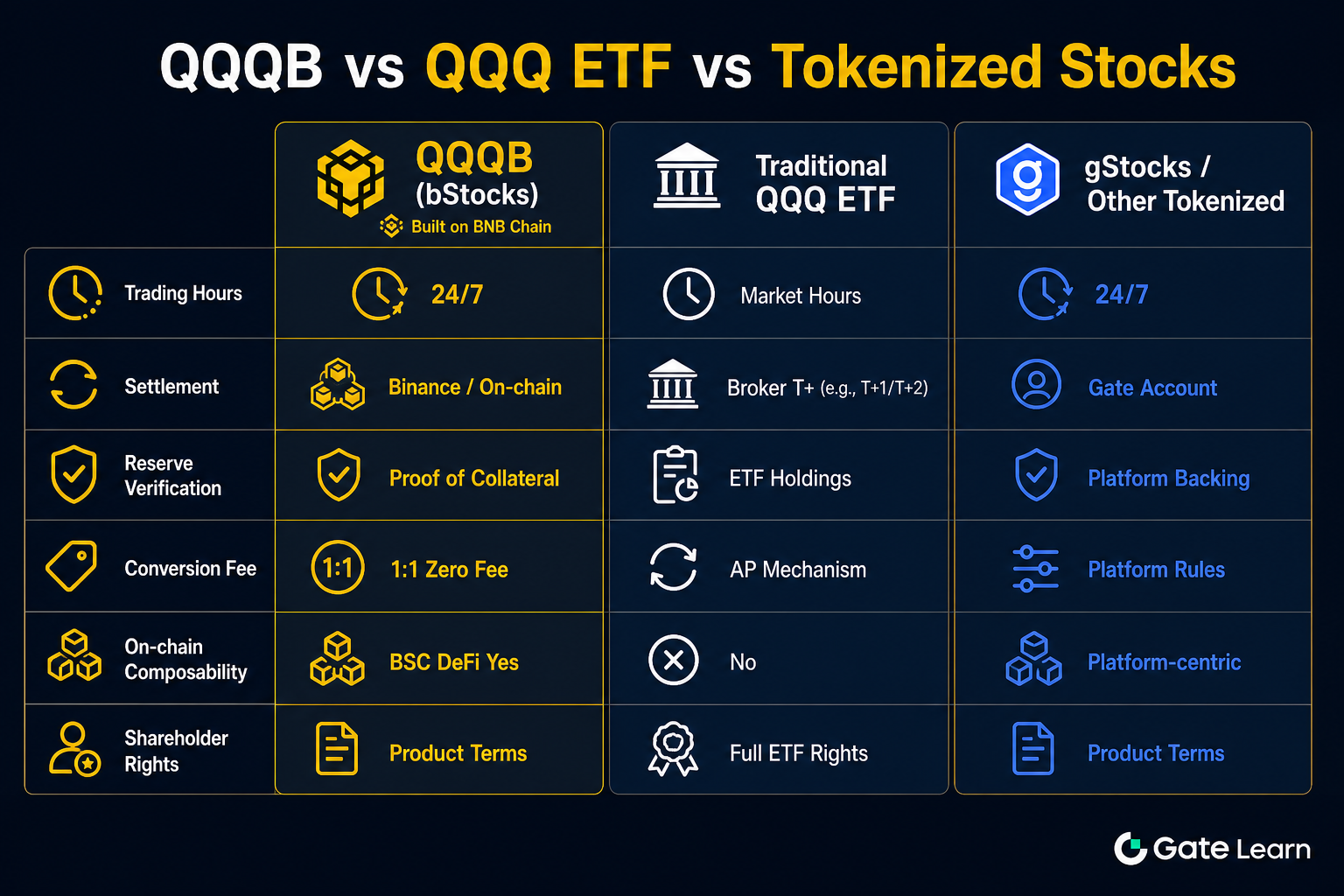 Figure 1. Comparison of QQQB, traditional QQQ ETF, and gStocks tokenized stocks across trading hours, settlement, reserve verification, and on-chain composability.
What Are the Limitations in Comparison?
There are three main structural limitations in horizontal comparison. Scope of underlying assets: QQQB and QQQ ETF are both anchored to the Invesco QQQ Trust, making comparison straightforward; gStocks covers multiple individual stocks and ETFs, so comparisons with QQQB should be limited to “Nasdaq 100 exposure.” Disclosure mechanism limitations: Proof of Collateral, ETF holding reports, and Gate reserve disclosures differ in standard, so cross-product reserve verification requires understanding each product’s disclosure frequency and granularity. Rights and compliance limitations: Tokenized forms do not automatically grant the full shareholder rights of traditional brokerage accounts; each jurisdiction has different rules for Token Conversion, on-chain withdrawal, and platform trading. QQQB Risk and Compliance Boundaries summarizes common misunderstandings and a verification checklist.
Additionally, liquidity varies by trading hours and venue; QQQB’s on-chain path introduces smart contract, private key self-custody, and protocol settlement risks, which should be evaluated separately from Nasdaq 100 constituent volatility.
| Limitation Type |
Typical Manifestation |
Key Verification Points |
| Asset mismatch |
Treating all gStocks as equivalent to QQQB |
Restrict comparison to same underlying exposure |
| Disclosure standard mixing |
Applying a single metric across reserves |
Understand disclosure frequency and granularity per product |
| Rights expectation deviation |
Assuming tokenization equals full shareholder rights |
Continuously verify against product terms |
What Dimensions Should You Consider When Choosing a Path?
Selection should be based on your needs, verified dimension by dimension, not on which is “better.”
Exposure goal: For Nasdaq 100 exposure via Invesco QQQ Trust, QQQB and QQQ ETF share the same logic; for other individual stocks in the Gate ecosystem, gStocks provides broader coverage.
Account and operational habits: If you already hold crypto on Binance and prefer BSC DeFi integration, QQQB aligns with Binance and on-chain strategies. If you prefer traditional broker-registered holdings and mature ETF rights, QQQ ETF is closer to securities market practice. If you manage both crypto and stock tokenized securities in a Gate unified account, gStocks offers integrated platform coordination.
Trading hours and liquidity: For extended trading hours, consider QQQB or gStocks. For ETF liquidity during exchange hours, QQQ ETF aligns with traditional market structure.
On-chain composability: For BEP-20 collateral use or BSC DeFi participation, QQQB provides on-chain support. gStocks focuses on unified account extension within Gate; QQQ ETF has no on-chain programmable interface.
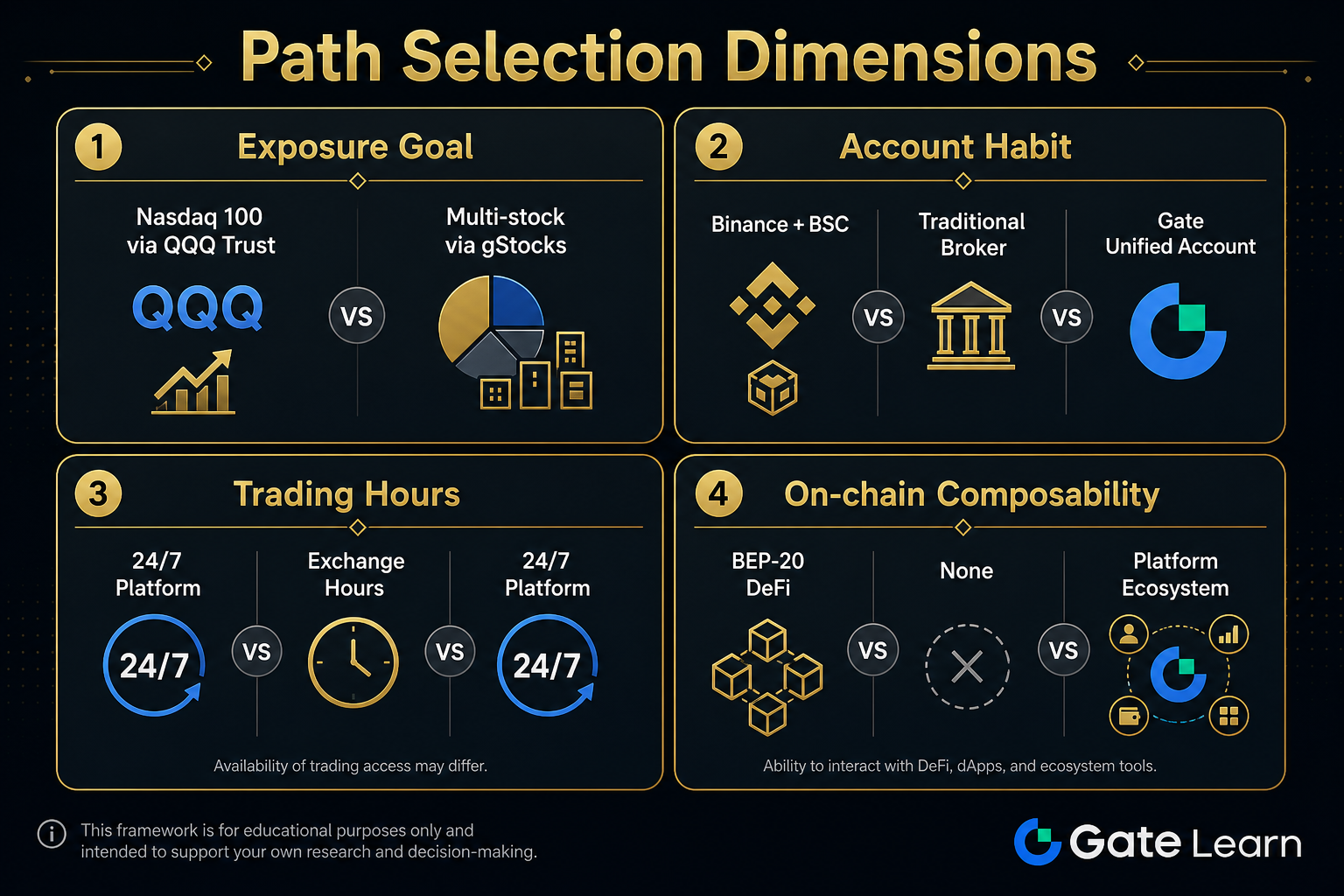 Figure 2. Four-dimensional framework for choosing QQQB, traditional QQQ ETF, or gStocks tokenized stock paths.
All three paths can coexist in a portfolio, but holding forms and rights should not be confused.
Summary
QQQB stock tokens, traditional QQQ ETFs, and tokenized stocks like gStocks represent three frameworks: bStocks on-chain mapping, securities market ETF shares, and Gate platform physical share anchoring. The core differences lie in vehicle, trading hours, settlement and reserve verification, conversion mechanisms, on-chain composability, and shareholder rights. Before choosing a path, clarify your exposure goal, account preferences, trading hour needs, and rights expectations, then verify each mechanism accordingly.
FAQ
What Is the Difference Between QQQB and QQQ ETF?
Both are based on the Invesco QQQ Trust, but differ in structure: QQQ ETF is an exchange-listed share traded through brokers during regular market hours; QQQB is a BEP-20 token on BNB Chain, tradable on Binance 24/7, convertible 1:1 via Token Conversion, and withdrawable on-chain for DeFi. They differ in account structure, settlement, and rights execution.
How Does QQQB Differ from Traditional Stock Trading?
QQQB is a tokenized security circulating on Binance Spot and BSC, emphasizing 1:1 physical share reserves and Proof of Collateral verification. Traditional stocks are recorded and held via brokers on the securities market, with full shareholder rights and trading limited to exchange hours. QQQB enables 24/7 trading and on-chain self-custody, while traditional paths are closer to mature securities accounts and governance participation.
What Is QQQB?
QQQB (Invesco QQQ Trust Tokenized bStocks) is a BEP-20 tokenized security issued by BTech Holdings Limited, granting holders economic exposure to the Invesco QQQ Trust (tracking the Nasdaq 100 QQQ ETF). Each token is fully backed 1:1 by physical shares with a regulated US broker, tradable on Binance, and supports Token Conversion and on-chain withdrawal.
How Does QQQB Differ from gStocks and Other Tokenized Stocks?
QQQB is part of the Binance bStocks product line, anchored to the Invesco QQQ Trust, traded on Binance, and supports BSC DeFi composability. gStocks are Gate platform tokenized stocks, covering a range of individual stocks and ETFs, traded on the Gate order book, and emphasizing unified account coordination. Both are backed by physical share reserves but differ in issuer, trading venue, on-chain standard, and conversion mechanism.
What Are the Risks of Trading QQQB?
Key risks include volatility of Nasdaq 100 constituents, liquidity differences on Binance Spot and BSC DEX, DeFi smart contract and settlement risks, private key self-custody risks, and compliance restrictions on conversion and trading rights across jurisdictions. 1:1 reserve anchoring describes asset correspondence but does not eliminate these risks.
Should I Choose QQQB, QQQ ETF, or gStocks?
It depends on your needs: for BSC on-chain composability and Binance ecosystem, choose QQQB; for full ETF shareholder rights and traditional market practices, choose QQQ ETF; for multi-asset tokenized stocks within the Gate unified account, choose gStocks. Each framework is distinct—match to your exposure goals, account preferences, and rights expectations, rather than simply comparing for superiority.