Over the past decade, global investors have mainly bought assets such as US stocks, Hong Kong stocks, ETFs, and gold through traditional brokerages. Yet as cross-border account opening requirements, regional restrictions, deposit and withdrawal processes, and regulatory changes have continued to increase, more users have started looking for more flexible ways to trade global assets. This demand has become especially clear after some online brokers scaled back their cross-border services, with more people asking how they can still buy US stocks or use USDT to invest in traditional assets.
At the same time, the crypto industry is rapidly expanding into traditional finance. The development of stablecoins, RWAs(real world assets), tokenized stocks, and on-chain ETFs means crypto platforms no longer only offer digital asset trading. They are also becoming a new financial gateway that connects global asset markets. Today, users can trade BTC and ETH on crypto platforms while also gaining access to traditional assets such as the Nasdaq index, gold, crude oil, US Treasuries, and stock prices.
At present, crypto platforms mainly provide exposure to traditional asset prices through three structures: CFDs(contracts for difference), tokenized stocks, and RWA products.
Among them, CFDs are one of the most common approaches today. Users can trade price movements without actually holding the underlying stocks or commodities. For example, they can trade the price trends of Nvidia, Apple, Tesla, gold, or crude oil through CFDs. CFDs typically support both long and short positions, as well as leverage, which makes them more suitable for short to medium term price trading.
Another structure that is attracting growing attention is tokenized stocks. The basic idea is to map real world stocks onto on-chain assets. A custodian holds the actual shares and issues corresponding tokens on the blockchain. Users can then trade these stock tokens in a similar way to crypto assets, creating more flexible liquidity across markets.
As the RWA sector develops, traditional assets such as US Treasuries, ETFs, gold, and fund shares are also gradually moving on-chain. This means blockchain is expanding beyond the digital currency market into the broader global financial system.
What Is the Difference Between Stock CFDs and Real Stocks?
This is one of the questions many users care about most. A stock CFD is essentially a derivative. Users are trading the price movement itself, not the actual stock. As a result, they generally do not have shareholder voting rights, and they may not receive the rights and benefits attached to real shares.
Real stocks, by contrast, represent actual share ownership and are usually more suitable for long term investors. CFDs place greater emphasis on trading flexibility, such as short selling, leverage, and a lower capital threshold. Because of this, the two serve very different use cases.
For many users who access traditional markets through crypto platforms, CFDs are closer to a price trading tool than traditional securities ownership.
Why Are More TradFi Assets Moving On-Chain?
Asset tokenization is becoming an important trend in global financial markets. More institutions are experimenting with mapping real world assets such as stocks, bonds, gold, real estate, and ETFs onto blockchain networks.
The core logic behind this trend is that blockchain can improve asset liquidity, reduce cross-border friction, and enable around the clock trading. Traditional financial markets usually have limits around trading hours, geography, and complex clearing processes. On-chain assets, by comparison, can support more open global liquidity.
At the same time, the growth of DeFi has further accelerated the development of RWAs. On-chain assets can not only be traded, but also used as collateral, yield generating assets, or liquidity infrastructure, creating new types of financial structures.
How Can You Use USDT to Trade Global Assets?
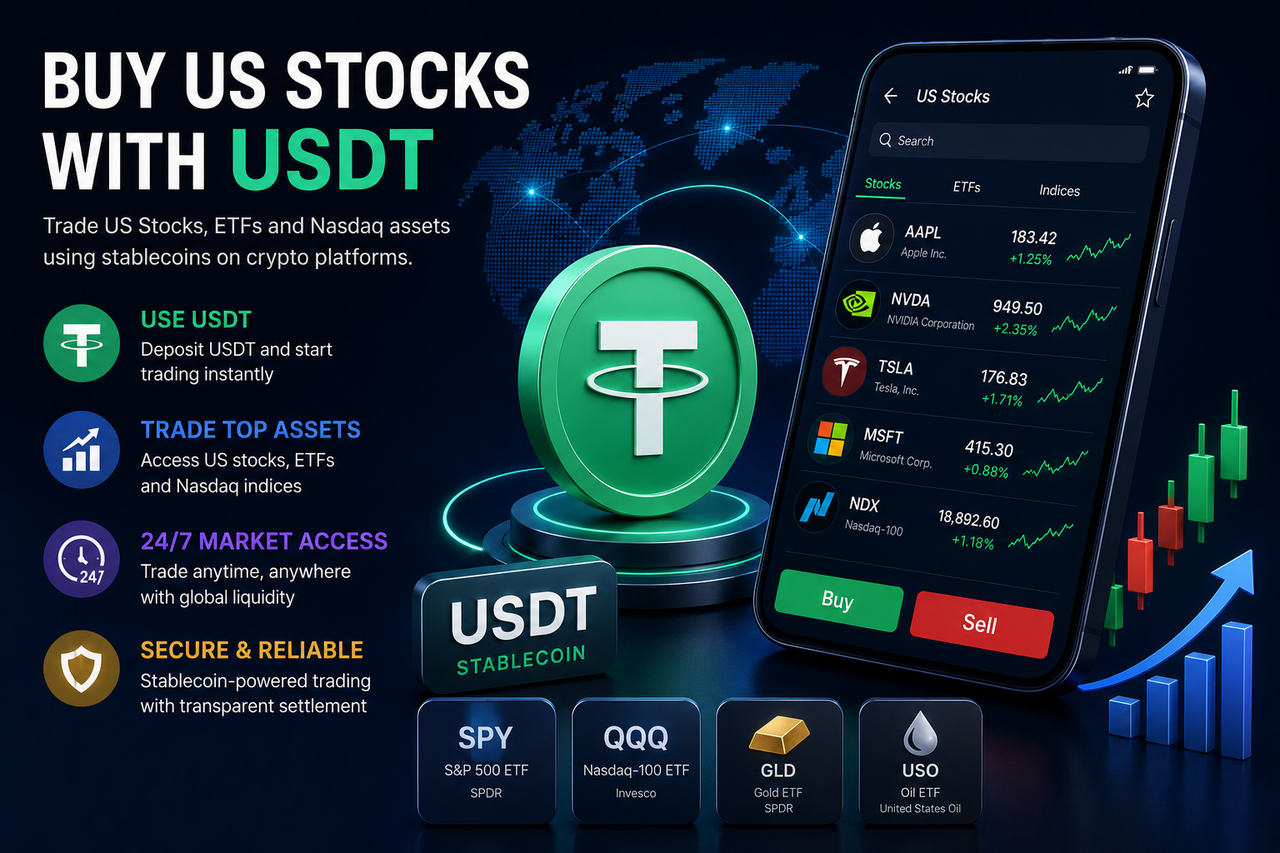
At present, crypto platforms including Gate already allow users to use stablecoins to participate in stock, ETF, and commodity price trading. In general, users need to register an account, complete KYC, and deposit stablecoins as margin before accessing the relevant TradFi product markets.
In actual trading, a platform may offer:
-
US stock CFDs
-
Hong Kong stock CFDs
-
Gold CFDs
-
Crude oil CFDs
-
Nasdaq index products
-
ETF price trading
The biggest shift in this model is that stablecoins are replacing traditional bank accounts as a unified settlement medium for global asset allocation.
Conclusion
Crypto platforms are gradually evolving from digital currency exchanges into gateways for global asset trading. Through CFDs, tokenized stocks, and RWA products, users can now use stablecoins to access traditional financial asset markets such as US stocks, Hong Kong stocks, gold, crude oil, and ETFs.
For users who want to use USDT for global asset allocation and lower the barriers of cross-border finance, the combination of stablecoins and on-chain financial infrastructure may be redefining how assets are traded in the future. As TradFi and Crypto continue to converge, global capital markets are also entering a new stage that is more open, more digital, and increasingly on-chain.
FAQs
Some platforms provide real stock services, but most crypto platforms currently offer price exposure mainly through CFDs or tokenized stocks, which does not necessarily mean users actually hold the underlying shares.
Are Stock CFDs the Same as Real Share Ownership?
No. Stock CFDs are price derivatives. Users do not own the actual shares, voting rights, or shareholder interests.
What Are Tokenized Stocks?
Tokenized stocks are on-chain mapped versions of real stock assets. In most cases, a custodian holds the actual shares and issues corresponding tokens on-chain.
Is It Legal to Buy US Stocks with USDT?
Legality depends on the jurisdiction where the platform operates, the regulatory rules in the user’s location, and the platform’s compliance structure. Regulatory requirements for these products vary across countries and regions.