Data center infrastructure is a comprehensive physical and digital framework that enables the continuous operation of servers, network devices, and computing systems. It primarily encompasses power supply systems, cooling systems, cabinet equipment, monitoring platforms, and security management facilities. In essence, servers perform computational tasks, while infrastructure ensures servers operate reliably.
Traditionally, data center infrastructure served a supporting function—ensuring uninterrupted power, maintaining optimal room temperature, and enhancing operational reliability. However, with the rapid advancement of artificial intelligence, large-scale models, and high-performance computing, the role of data center infrastructure is evolving.
AI servers deliver greater computational power than traditional servers, which leads to increased power consumption and heightened cooling requirements. Large GPU clusters demand highly stable power supplies and efficient cooling systems. As a result, competition among data centers has expanded beyond computing power to include energy management, cooling efficiency, and construction speed.
Historically, market focus centered on GPUs, servers, and AI models. Today, the power equipment, liquid cooling systems, and data center infrastructure providers that support these computing resources have become integral components of the AI industry chain.
Why AI Hashrate Growth Drives Infrastructure Investment
The rise of artificial intelligence is ushering global data centers into a new era of construction. In recent years, generative AI, large language models, and AI Agents have developed rapidly, driving increased demand for training and inference Hashrate among enterprises. Whether for model training, content generation, or intelligent enterprise applications, substantial computing resources are essential.
AI Hashrate growth has significantly boosted demand for GPU servers. Unlike traditional CPU servers, GPU clusters can process numerous computing tasks in parallel, but they also consume more energy.
For data centers, this necessitates a redesign of infrastructure.
Conventional data centers are typically designed for lower power density, while AI data centers must accommodate higher-power server deployments. As energy demand per cabinet rises, power supply systems require greater capacity and enhanced stability.
Additionally, the substantial heat generated by AI chips is accelerating advancements in cooling technology. Air cooling was once sufficient, but high-density GPU clusters are pushing traditional methods to their limits, making liquid cooling and other innovations increasingly relevant.
The rapid pace of AI industry growth is also transforming data center construction models. Enterprises seek faster deployment of computing resources, increasing the importance of modular data centers, prefabricated infrastructure, and rapid delivery capabilities.
Collectively, these trends are fueling increased investment in data center infrastructure, placing Vertiv at the center of this industry transformation.
Vertiv's Role in the AI Server Ecosystem
Within the AI server ecosystem, Vertiv serves as the backbone of infrastructure support. A complete AI computing system comprises AI chips, server systems, data center deployment, power supply, cooling management, and ongoing operations. Companies like NVIDIA supply core computing chips, server manufacturers handle hardware integration, and Vertiv ensures these devices operate reliably within data center environments.
As AI server deployments scale up, infrastructure becomes increasingly critical.
Large AI clusters require uninterrupted, stable power. If the power system falls short, even the most advanced GPUs cannot reach their full potential. High-density computing environments generate significant heat, and inadequate cooling can compromise server performance and longevity.
Therefore, AI data centers require comprehensive infrastructure solutions, including:
- High-reliability UPS systems
- Power distribution equipment
- Efficient cooling solutions
- Modular data center components
- Intelligent operations and maintenance platforms
Vertiv's strength lies in its extensive experience serving the data center market and deep expertise in mission-critical environments. As AI computing expands, Vertiv is positioned to drive industry growth through its infrastructure offerings.
From an industry chain perspective, AI is shifting value from pure computational power to integrated infrastructure systems. In the future, the ability to efficiently deploy and manage Hashrate will be a key competitive advantage.
How the Data Center Power Chain Works
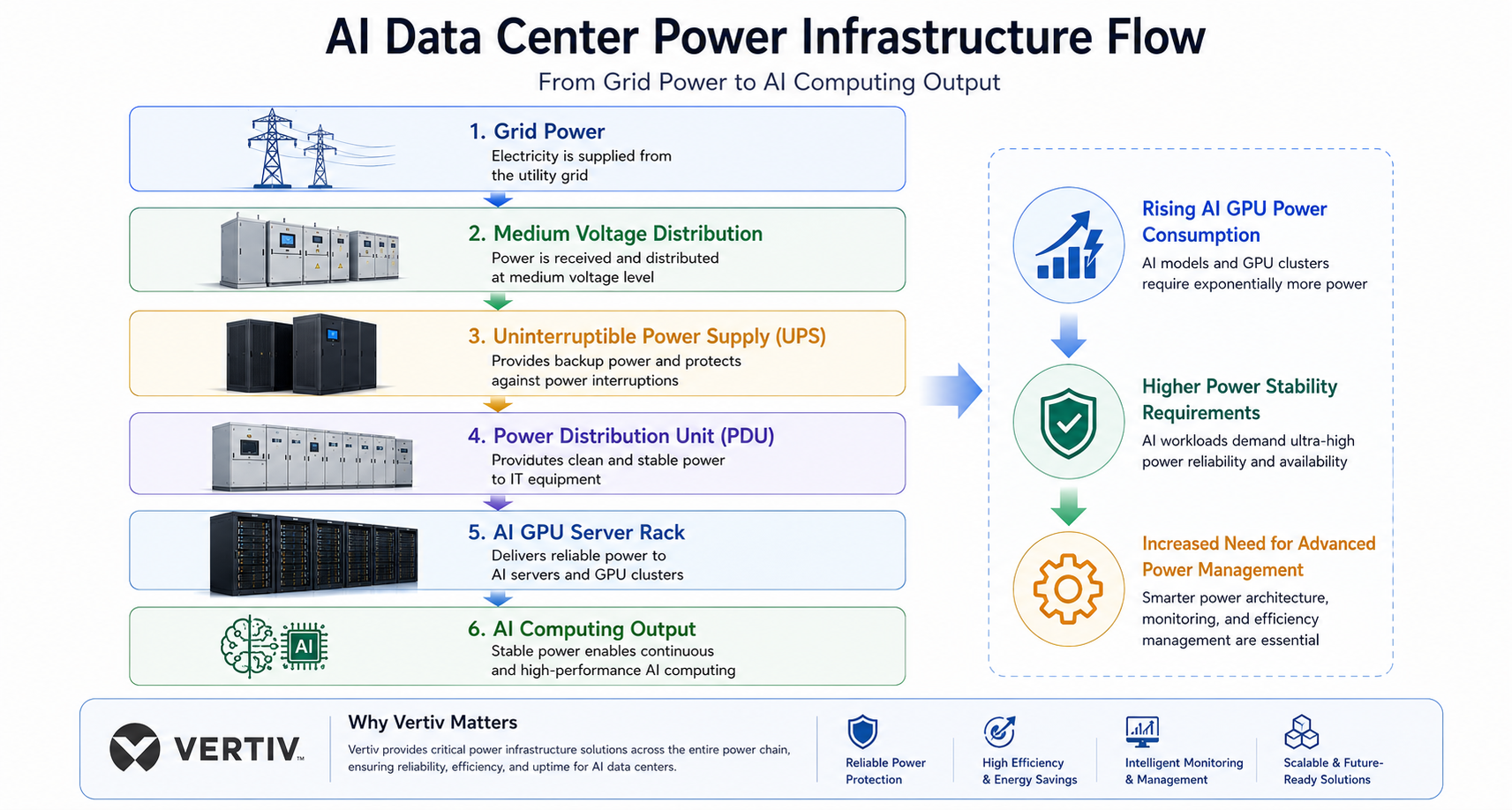
The power system is one of the most vital components of data center infrastructure.
A complete data center power chain typically includes grid input, distribution systems, power conversion, UPS protection, and server power supply. Because data centers operate continuously year-round, their requirements for power stability far exceed those of ordinary buildings.
The external power grid delivers energy to the data center, which is then converted and distributed through multiple stages to ensure appropriate power supply to various zones and server equipment. UPS (Uninterruptible Power Supply) systems play a crucial role—providing backup power during fluctuations or outages, allowing servers to seamlessly transition to backup supply.
For AI data centers, power stability is even more critical. Large AI model training tasks may run for days or longer. Interruptions due to power issues not only reduce computational efficiency but also waste significant Hashrate resources.
Vertiv delivers comprehensive power solutions for data centers via UPS, power management devices, and intelligent energy systems. As global data centers prioritize energy efficiency, reducing losses and maximizing utilization have become central to infrastructure competition.
Why Modular Data Centers Are Gaining Attention
As AI Hashrate demand surges, traditional data center construction faces efficiency challenges. Building large data centers has historically required lengthy timelines—including land planning, construction, equipment installation, and system commissioning. The fast pace of AI industry development means enterprises want rapid access to new computing capabilities, making modular data centers increasingly attractive.
Modular data centers are prefabricated infrastructure models, with standardized components produced in advance and deployed quickly as needed.
Compared to conventional construction, modular solutions offer several advantages:
- Accelerated construction. Enterprises can launch data centers faster and deploy AI computing resources sooner.
- Flexible expansion. As computing demand grows, organizations can add modules without rebuilding entire facilities.
- Enhanced standardization. Prefabricated designs improve efficiency and reduce operational complexity.
For cloud computing and AI companies, rapid deployment is a key competitive differentiator.
Vertiv's modular data center solutions enable clients to quickly build infrastructure tailored to AI computing requirements.
How Vertiv Serves Cloud Providers and Enterprise Clients
Vertiv's client base spans large cloud computing firms, internet companies, telecom operators, financial institutions, and industrial enterprises. While each has distinct infrastructure needs, their core objective is to maximize computing resource efficiency and reliability. For cloud providers, data centers are typically large-scale, supporting extensive server and GPU cluster operations over the long term. As a result, they prioritize infrastructure stability, energy efficiency, and scalability.
With the expansion of AI business, cloud providers are constructing more AI-dedicated data centers. These facilities require not only traditional server environments, but also solutions to meet the power and cooling demands of high-density computing. Vertiv supports cloud providers with power systems, cooling equipment, modular infrastructure, and intelligent management platforms.
Enterprise clients have more diverse requirements. Industries like finance, manufacturing, and healthcare are building private clouds and AI application environments, demanding secure and stable data center solutions. Vertiv delivers infrastructure support tailored to specific business scenarios.
Edge computing is also emerging as a growth area. With advancements in autonomous driving, industrial IoT, and smart manufacturing, more computing tasks must be performed near the data source. While edge data centers are smaller, they require greater reliability and rapid deployment—opening new opportunities for Vertiv.
Changing Competitive Dynamics in the Data Center Industry
The AI boom is reshaping the competitive landscape in data center infrastructure. Previously, the industry chain was dominated by server manufacturers, network equipment providers, and cloud computing companies. As demand for AI Hashrate rises, power and cooling infrastructure have become increasingly important.
Vertiv faces competition from multiple directions. Schneider Electric is a major player in energy management and automation, with broad coverage in the data center market and strengths in energy management, distribution systems, and industrial automation.
Eaton, with a longstanding focus on power management, excels in electrical equipment, energy distribution, and secure power supply. Compared to these diversified energy firms, Vertiv specializes in data center applications—focusing on critical digital infrastructure, including power, cooling, cabinets, and management systems.
As AI data center construction accelerates, competition may shift from single device offerings to integrated solutions. In the future, companies capable of addressing computing deployment, power supply, cooling efficiency, and operational management holistically will enjoy greater market advantage.
Vertiv's Future Opportunities and Challenges
The AI infrastructure wave presents Vertiv with significant long-term growth opportunities.
- AI data center investment cycles may continue expanding. As AI applications penetrate more industries, demand for computing power will likely drive ongoing data center expansion.
- High-power computing will necessitate infrastructure upgrades. As AI chip performance improves, data centers will require more advanced power and cooling solutions—boosting demand for Vertiv products.
- Liquid cooling technology is poised for growth.
As GPU power consumption rises, liquid cooling is transitioning from niche applications to widespread commercial adoption. More AI data centers are expected to implement liquid cooling architectures, and Vertiv's expertise in thermal management positions it to benefit.
However, Vertiv faces challenges. Data center construction is closely tied to cloud provider capital expenditures. If AI investment slows, infrastructure demand may decline; competitors like Schneider Electric and Eaton are strengthening their data center portfolios, intensifying market competition; energy supply remains a persistent challenge. AI data centers require substantial power, and some regions may face grid capacity constraints and rising energy costs.
Vertiv's future growth will depend not only on the pace of AI development, but also on its ability to innovate and compete effectively within the industry.
Summary
Vertiv stands at the forefront of the AI infrastructure revolution. As artificial intelligence, large models, and high-performance computing advance, data centers are shifting from traditional IT facilities to high-power, high-density computing platforms. AI is driving demand for GPUs, servers, and cloud computing, while also redefining power supply, cooling systems, and construction approaches.
Vertiv delivers essential support for AI data centers through power management, thermal management, modular data center solutions, and intelligent operations platforms. While Vertiv does not manufacture AI chips, its infrastructure capabilities are crucial for stable operation of large-scale computing resources. As AI applications expand, the importance of data center infrastructure will continue to grow. Energy efficiency, liquid cooling, modular construction, and intelligent management will be central to industry progress.
Nonetheless, Vertiv must navigate industry cycles, competitive pressures, energy constraints, and technological shifts.
In the long run, AI is driving upgrades across the computing ecosystem. Power, cooling, and data center construction are becoming indispensable segments of the AI era's industry chain, and Vertiv is a leading representative in this transformation.