For sophisticated retail crypto traders, investors, and institutions trying to read macro-driven price moves, the key point is that market expectations often matter more than the actual FOMC decision. Prices tend to react to the gap between the outcome and what investors had already priced in—not simply to whether the Federal Reserve raises, cuts, or holds rates. If a cut is fully expected, the announcement may add little support, and both Bitcoin and gold can still fall if the policy statement, target rate path, or press conference sounds more hawkish than expected.
Understanding the relationship means looking at policy rates, real yields, the dollar, liquidity conditions, risk appetite, and the economic outlook together so you can better interpret price swings, manage portfolio risk, and spot opportunities around FOMC meetings. Bitcoin and gold can rise together when the dollar weakens, but they can also diverge because they respond differently to safe-haven demand, leverage, and broader market sentiment. The FOMC meets eight times a year to set the target federal funds rate.
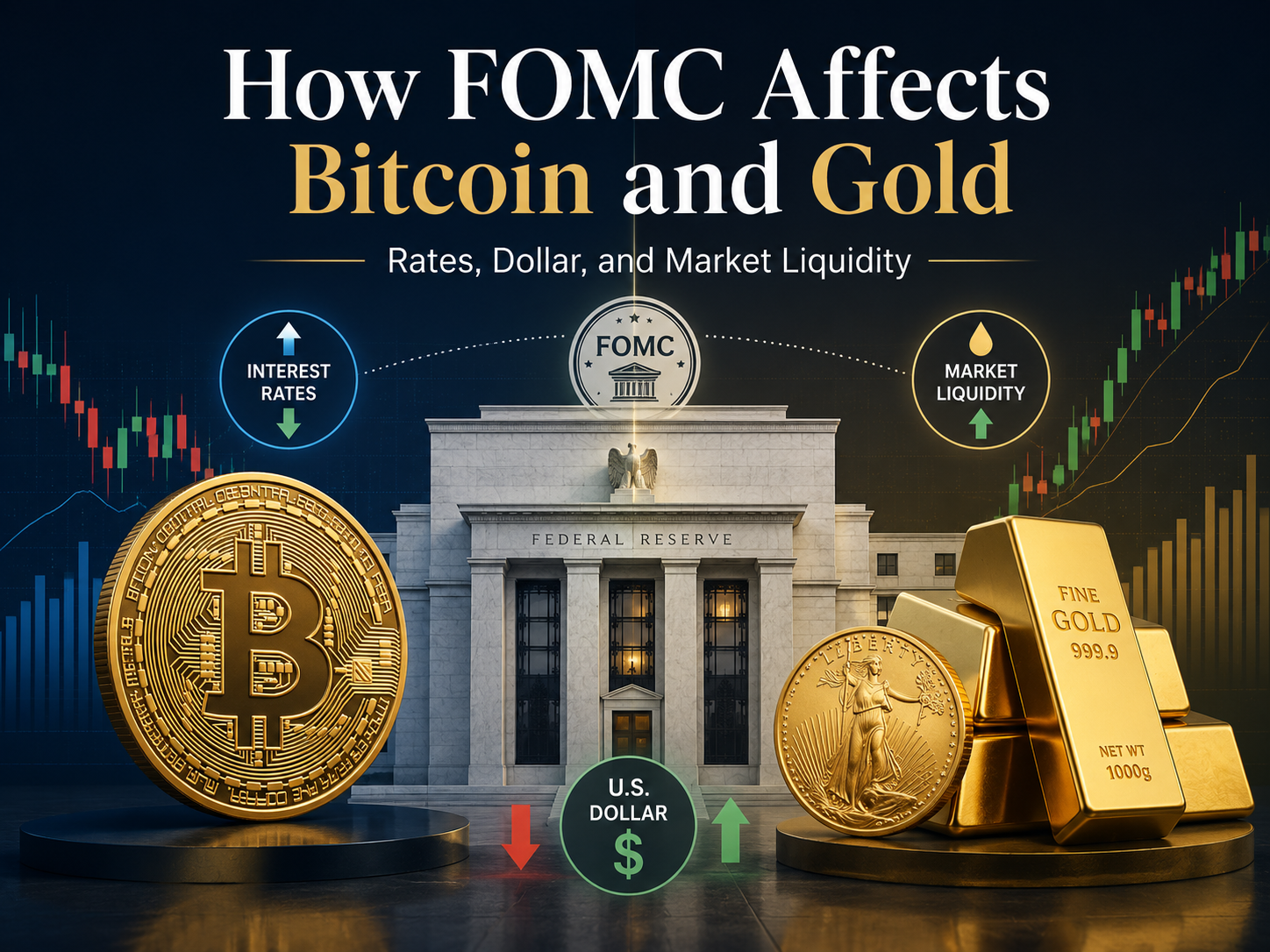
Why Does the Federal Open Market Committee (FOMC) Affect Bitcoin and Gold?
The Fed sets interest rates through the Federal Open Market Committee, which affects Bitcoin and gold by determining the direction of U.S. monetary policy and influencing the most important short-term interest-rate benchmark in the dollar financial system. The federal funds rate is the key benchmark the committee targets, shaping how banks lend and broader borrowing rates. Changes in interest-rate expectations can alter the returns available on dollar assets, borrowing costs, and global financial conditions.
Neither Bitcoin nor gold generates fixed interest income in the way that a bond or bank deposit does. When Treasury bills, money market funds, and other cash-like instruments offer higher inflation-adjusted returns, the opportunity cost of holding non-yielding assets may increase. When interest rates or real yields decline, that opportunity cost may fall.
The two assets do not respond through exactly the same channels. Bitcoin is generally more sensitive to market risk appetite, leveraged positioning, and crypto-market liquidity as one of the market’s higher-risk speculative assets. Gold is influenced by real yields, the U.S. dollar, central-bank demand, inflation concerns, and safe-haven flows as an alternative store of value.
| Transmission Channel |
Main Effect on Bitcoin |
Main Effect on Gold |
| Policy rates |
Changes funding costs and demand for risk assets |
Changes the opportunity cost of holding a non-yielding asset |
| U.S. dollar |
Affects global liquidity and dollar-denominated demand |
Affects the relative price of dollar-denominated gold |
| Real yields |
Influences the appeal of high-volatility assets |
A major measure of gold’s opportunity cost |
| Market liquidity |
Affects crypto funding, leverage, and trading activity |
Influences investment demand and portfolio allocation |
| Risk appetite |
Stronger risk appetite is often supportive |
Safe-haven demand may also provide support |
How Do Interest Rates Affect Bitcoin Valuation and Demand?
Interest rates affect Bitcoin by changing risk-free returns, financing costs, and investors’ willingness to hold volatile assets. When interest rates are high, cash, money market funds, and short-term government bonds can offer more competitive yields, increasing the opportunity cost of holding Bitcoin, which does not produce a contractual cash flow.
Higher rates can also increase the cost of leverage. Institutions, market makers, and active traders compare the expected return on risky positions with their cost of funding. When dollar financing becomes more expensive, they may reduce exposure to high-volatility assets.
Lower interest rates can ease financial conditions and potentially increase demand for Bitcoin and other risk assets. However, Bitcoin does not have a conventional cash-flow valuation model like a stock or bond, so its price cannot be explained solely through a lower discount rate.
Bitcoin demand also depends on spot-market inflows, stablecoin liquidity, derivatives positioning, regulatory developments, and crypto-specific events. Even after a dovish FOMC decision, Bitcoin may remain weak if the crypto market is experiencing deleveraging, regulatory pressure, security incidents, or persistent capital outflows.
How Does the U.S. Dollar Affect Bitcoin and Gold Prices?
The U.S. Dollar Index measures the dollar against a basket of major currencies. Because international gold and Bitcoin markets are commonly priced in U.S. dollars, changes in the dollar can affect the purchasing cost for investors using other currencies and influence global asset allocation.
When the dollar strengthens, purchasing the same amount of Bitcoin or gold becomes more expensive in other currencies. A stronger dollar is also frequently associated with higher U.S. yields or tighter financial conditions, which may create pressure on both risk assets and non-yielding assets.
A weaker dollar may reduce the cost for non-U.S. buyers and can reflect expectations for lower U.S. rates or easier global dollar conditions. Gold has historically shown a tendency to move inversely to the dollar, although the relationship is not stable in every market environment.
Bitcoin’s relationship with the dollar is less consistent. Bitcoin may benefit when the dollar weakens and risk appetite improves, but there can also be periods when both the dollar and Bitcoin rise—for example, when crypto-specific demand or concerns about parts of the banking system become the dominant market driver.
Why Are Real Interest Rates Important for Gold?
Real interest rates represent the return on an interest-bearing asset after accounting for expected inflation. They matter to gold because gold does not pay interest, making real yields an important measure of the return investors give up by holding it.
When real yields rise, inflation-protected bonds and other fixed-income instruments may offer a more attractive real return. This can reduce gold’s relative appeal. When real yields fall or become negative, the opportunity cost of holding gold declines, which may support investment demand.
Nominal interest rates alone do not provide the complete picture. If nominal yields rise while inflation expectations rise even faster, real yields may still decline. In that environment, gold can remain supported despite higher headline interest rates.
Real yields are not the only driver of gold prices. Gold can rise during periods of geopolitical stress, banking instability, sovereign-risk concerns, or strong central-bank demand, even when real interest rates are elevated. Investors therefore need to consider real yields alongside the dollar and safe-haven demand.
How Do Liquidity Changes Affect Crypto Assets?
Liquidity can refer to the availability of money and credit in the financial system, the funding available to market participants, or the ability to trade an asset without causing a large price change. FOMC decisions can affect all three dimensions.
When financial conditions become easier and dollar funding costs decline, investors may have greater capacity and willingness to hold volatile assets. Stablecoin supply, market-making activity, and demand for leverage may expand as confidence improves, potentially supporting Bitcoin and the broader crypto market.
When monetary policy becomes more restrictive, capital may shift toward cash, government bonds, and other yield-bearing dollar assets. Leveraged crypto positions may become more vulnerable as funding costs rise and risk budgets decline. If prices begin to fall, liquidations can amplify the move.
The strength and speed of this transmission vary across market cycles. An easier policy stance does not automatically translate into immediate crypto inflows, especially if investors are concerned about recession, regulation, credit stress, or crypto-specific risks.
The statement that “more central-bank liquidity means Bitcoin must rise” is therefore too simplistic. Policy rates, the Federal Reserve’s balance sheet, dollar funding conditions, stablecoin liquidity, market leverage, and investor sentiment should be assessed together.
Why Do Bitcoin and Gold Sometimes Rise or Fall Together?
Bitcoin and gold may rise together when both benefit from a weaker dollar, declining real yields, or concerns about the purchasing power of fiat currencies. A clearly dovish FOMC outcome can reduce the opportunity cost of holding non-yielding assets and improve liquidity conditions.
The two assets may also attract demand during periods of heightened inflation concerns or uncertainty about government debt and monetary credibility, and gold tends to benefit from rising macroeconomic uncertainty. Gold has a much longer history as a reserve and defensive asset, while Bitcoin attracts some investors through its predetermined supply and digital-transfer characteristics.
Bitcoin and gold may fall together after a hawkish FOMC surprise. A stronger dollar and higher real yields can increase pressure on gold, while tighter financial conditions and weaker risk appetite can weigh on Bitcoin compared with traditional assets.
However, their correlation is not stable. Bitcoin is more sensitive to equity-market sentiment, derivatives leverage, and crypto-native capital flows. Gold is more sensitive to real yields, central-bank purchases, and safe-haven demand. When the dominant market driver changes, the two assets can quickly diverge.
Does a Rate Cut Always Benefit Bitcoin and Gold?
A rate cut does not always benefit Bitcoin and gold because markets often price policy changes in advance. If investors have already fully anticipated the cut, the announcement may not provide a new reason to buy.
The economic reason for the rate cut also matters. A cut prompted by lower inflation and resilient economic growth may ease financial conditions; lower rates mean cheaper money and can support higher risk investments. That environment can be supportive for risk appetite and Bitcoin, while lower real yields and a weaker dollar may support gold.
A cut prompted by a sharp economic slowdown, financial crisis, or rapid deterioration in employment can produce a different result. Lower rates can push some investors toward higher reward assets, but stress-driven cuts can still hurt Bitcoin first as investors reduce risk and seek liquidity. Gold may outperform because of safe-haven demand, although it can also decline temporarily if investors sell liquid assets to raise cash.
The size and tone of the policy move are equally important. A rate cut accompanied by a warning that inflation remains persistent may be less dovish than investors expected. Conversely, an unchanged rate accompanied by clear guidance toward future easing can be interpreted as supportive.
When assessing a rate cut, investors should ask three questions:
-
Was the rate cut larger or smaller than expected?
-
Was it driven by improving inflation or worsening economic conditions?
-
How did the dollar and real yields react after the announcement?
What Does a Hawkish FOMC Mean for Bitcoin and Gold?
A hawkish FOMC outcome generally means policymakers are more concerned about inflation and may raise rates, delay cuts, or keep policy restrictive. Even when the policy rate is unchanged, a hawkish statement, dot plot, or press conference can change market expectations.
For Bitcoin, a hawkish surprise may increase the relative appeal of cash and interest-bearing dollar assets, tighten liquidity, and reduce investors’ willingness to hold high-volatility positions, while tighter policy can also pull capital back toward stocks, bonds, and other traditional markets when those offer better risk-adjusted returns than crypto. If leverage is elevated, falling prices may also trigger liquidations.
For gold, a hawkish result can create pressure through higher real yields and a stronger dollar. However, if restrictive policy increases concerns about recession, debt sustainability, or financial instability, safe-haven demand may offset part of that pressure.
A hawkish outcome does not guarantee that Bitcoin or gold will fall. The important question is how much more hawkish the result is than the market expected and whether Treasury yields, the dollar, and broader risk assets confirm that interpretation.
What Does a Dovish FOMC Mean for Bitcoin and Gold?
A dovish FOMC outcome generally means policymakers are placing more emphasis on weaker economic growth or employment risks and are more willing to cut rates, end tightening, or provide easier financial conditions.
For Bitcoin, a dovish signal may reduce dollar funding costs, improve risk appetite, and encourage investors to reconsider exposure to crypto assets. It can also help crypto investors when liquidity improves and the market reacts positively. The effect may be stronger when the dollar weakens, equities rise, and crypto traders see crypto-market liquidity improve at the same time.
For gold, a dovish policy stance may reduce real yields and weaken the dollar, lowering the opportunity cost of holding the metal. If the dovish shift is caused by greater economic uncertainty, gold may also receive additional support from defensive demand.
A dovish result still does not guarantee a sustained rally. If the policy shift is less accommodative than expected, if the Federal Reserve Chair continues to emphasize inflation risks, or if the market interprets easing as evidence of a severe downturn, the initial move in Bitcoin and gold can reverse. Retail traders may still get caught by reversals if that first move misreads the statement or press conference.
How Should Investors Interpret Different Bitcoin and Gold Reactions After an FOMC Meeting?
When Bitcoin and gold respond differently after an FOMC meeting, it usually means that investors are trading different macroeconomic themes. During fomc events, markets often react quickly but not always accurately. Bitcoin rising while gold falls may indicate improving risk appetite and liquidity, while real yields or the dollar remain unfavorable for gold.
Gold rising while Bitcoin falls can signal that recession risk, financial instability, or defensive demand has become the dominant theme. Investors may reduce exposure to volatile assets while increasing allocations to traditional safe havens.
If both assets rise, investors should examine whether the dollar is weakening and real yields are falling. Concerns about inflation, fiscal sustainability, or monetary credibility may also support both markets.
If both decline, the move may reflect a stronger dollar, rising yields, tighter liquidity, or a broad demand for cash. Crypto-specific deleveraging can deepen Bitcoin’s decline, while reduced safe-haven demand may create additional pressure on gold.
On fomc days, sharp volatility is common, and Bitcoin’s volatility spikes around FOMC announcements; some studies show it can jump 50–100% on decision days. A practical framework for reading the post-FOMC reaction is:
-
Determine whether the rate decisions matched expectations.
-
Assess whether the statement, dot plot, and press conference were hawkish or dovish.
-
Watch two-year and ten-year Treasury yields.
-
Check real yields and the U.S. Dollar Index.
-
Observe whether equity markets are signaling stronger or weaker risk appetite.
-
Identify any Bitcoin liquidations or crypto-specific developments.
-
Check whether gold is receiving support from safe-haven or central-bank demand.
In 2025, Bitcoin dropped after 7 out of 8 FOMC meetings, but expectations and the broader macro context still mattered more than that count alone.
The first price move after the statement may not provide a reliable interpretation. The press conference, liquidity conditions, and position adjustments can create a second wave of volatility. A more complete reading requires confirmation across several markets rather than focusing on a single minute of price action.
Summary
The FOMC affects Bitcoin and gold through policy rates, real yields, the U.S. dollar, and market liquidity. Bitcoin is generally more sensitive to risk appetite, leverage, and crypto-market capital flows, while gold is more directly influenced by real yields, the dollar, and safe-haven demand.
A hawkish decision may strengthen the dollar and lift yields, potentially creating pressure on both assets. A dovish decision may lower funding costs and improve demand, but the actual reaction depends on how the outcome compares with expectations, and quantitative tightening can still drain liquidity even without a new rate hike.
Rate cuts do not automatically cause Bitcoin or gold to rise, just as rate increases do not guarantee a decline. The reason for the policy change, the degree of advance pricing, and the broader economic outlook all matter.
Investors interpreting post-FOMC price movements should monitor Treasury yields, the dollar, equity-market risk appetite, and crypto-specific conditions together. Divergence between Bitcoin and gold can often provide more information about the market’s macroeconomic interpretation than a simple rise or fall in either asset, though analyst projections can differ sharply, including Citi’s view that gold could slump 20% by autumn 2026.
FAQ
Is Bitcoin or Gold More Sensitive to FOMC Decisions?
Bitcoin usually experiences larger short-term price swings during FOMC meetings and is more sensitive to risk appetite and leverage because cryptocurrency markets are generally more reactive to shifts in liquidity and risk sentiment. Gold tends to respond more directly to real yields, the U.S. dollar, and safe-haven demand.
Does Gold Always Fall After an FOMC Rate Hike?
No. Gold is influenced by real yields, the dollar, and safe-haven demand. If a rate hike increases concerns about recession or financial instability, gold may still receive support.
Why Can Bitcoin Fall After the Federal Reserve Cuts Rates?
The market may have already priced in the cut, or the decision may signal a rapidly weakening economy. Deleveraging, risk reduction, and crypto-specific developments can also outweigh the effect of easier policy.
Can Bitcoin Hedge Inflation Like Gold?
Bitcoin has a predetermined supply narrative, but its history is shorter and its volatility is much higher. Its performance as an inflation hedge has not been consistent enough to treat it as a direct substitute for gold, and in the short term, macro policy, regulation, and central banks can matter more for crypto prices than the inflation-hedge narrative alone.
Should Investors Watch the Dollar or Treasury Yields First After an FOMC Decision?
Both matter. Treasury yields show how the expected interest-rate path has changed, while the dollar reflects relative monetary policy and global demand for dollar liquidity. Looking at both provides a more complete signal.
Why Do Bitcoin and Gold Sometimes Rise and Then Fall After the FOMC Announcement?
Although the terminology sounds technical, the initial move may react only to the rate headline. The policy statement, press conference, Treasury yields, liquidity conditions, and position adjustments can later change the market’s interpretation.