The trading card market has long had a strong pack opening culture. Whether it involves Pokémon cards, sports cards, or other trading card products, random pack opening has always been an important part of the collecting experience. After users buy a card pack, they randomly receive cards of different rarity levels, and those rarity differences directly affect collectible value and market demand.
As NFTs and the real-world asset, or RWA, sector have developed, Collector Crypt has brought the traditional pack opening experience into the blockchain market through its Gacha Machine system. Gacha has become not only an important tool for attracting users and increasing trading activity, but also a core mechanism connecting physical collectibles, NFTs, and on-chain liquidity. Within the broader Collector Crypt ecosystem, the Gacha Machine plays an important role in asset distribution, market incentives, and user participation.
What Is the Collector Crypt Gacha Machine
The Collector Crypt Gacha Machine is a digital pack opening system that combines random rewards with NFT collectibles trading.
The word Gacha comes from Japan’s capsule toy culture. Its basic logic is that users pay a certain cost and receive rewards of different tiers through a random mechanism. Collector Crypt applies this model to the trading card market, allowing users to receive random collectible card NFTs by purchasing Gacha Packs.
Unlike conventional NFT issuances, the reward assets in the Gacha Machine correspond to real physical collectible cards held in custody. Each NFT is linked to an actual collectible, creating a mapping between digital ownership and real-world assets.
This design gives Collector Crypt three qualities at once: collecting, entertainment, and trading.
What Assets Are Included in a Gacha Pack
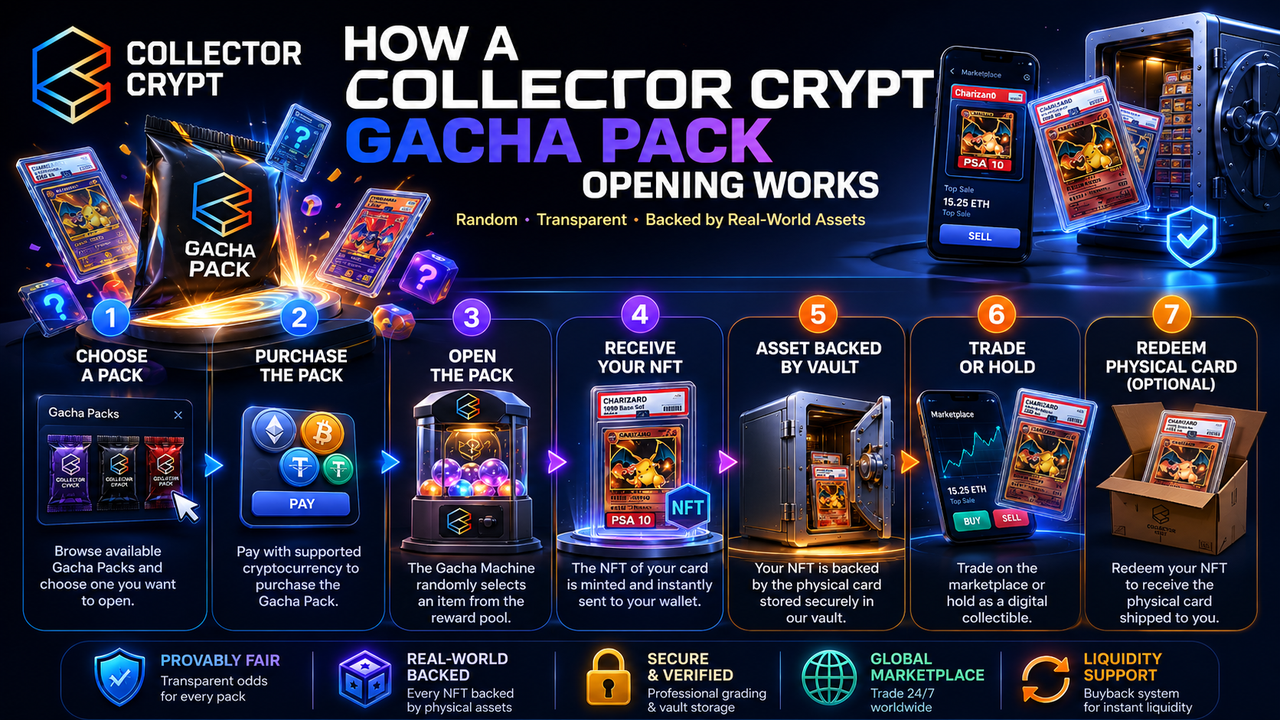
A Gacha Pack is essentially a digital card pack linked to a random reward pool.
The platform prepares a large number of authenticated and custodied physical collectible cards in advance, then builds reward pools based on different rarity tiers. Assets in the reward pool may include common cards, rare cards, limited-edition cards, and highly graded collectible cards.
Each Gacha Pack does not directly correspond to one specific card. Instead, it gives the user an opportunity to draw from the reward pool.
The structure of the reward pool usually determines the value distribution of pack opening results and forms an important foundation for how the Gacha system operates.
What Happens After a User Buys a Gacha Pack
After a user buys a Gacha Pack, the system records the purchase and triggers the random draw process.
Once the user confirms the pack opening, the platform draws an asset of the corresponding tier from the reward pool according to a preset probability model. The process is similar to opening traditional trading card packs, but the reward is delivered as an NFT.
After the draw is completed, the user’s account receives the corresponding collectible card NFT. The NFT contains card information, rarity level, and data records tied to the underlying physical asset.
From the user’s perspective, the entire process feels similar to opening loot boxes in an online game, but the reward asset is backed by a real collectible.
How the Random Reward Mechanism Works
The random reward mechanism is the core of the Gacha Machine.
The platform typically divides the reward pool into different rarity tiers, such as:
| Rarity Tier |
Features |
| Common |
Common collectible cards |
| Rare |
Rare collectible cards |
| Epic |
Highly graded collectible cards |
| Legendary |
Extremely rare collectible cards |
| Mythic |
Top-tier limited-edition collectible cards |
The system draws according to preset probabilities, and higher-tier cards usually have a lower chance of appearing than common cards.
This probability structure creates the scarcity mechanism commonly seen in collectibles markets, and it is one of the main reasons users participate in Gacha.
How NFTs Are Generated and Distributed to Users
After the draw is completed, the platform maps the corresponding asset to the user’s account.
NFT records include:
-
Collectible card name
-
Card grading information
-
Physical asset number
-
Vault custody record
-
Ownership data
The NFT itself is not just a digital image. It is an on-chain ownership certificate for the physical collectible card.
Because ownership information is stored on the blockchain, users can prove asset ownership and participate in later market trading at any time.
What Options Are Available After Receiving an NFT
After receiving an NFT, users usually have several options.
The first is to continue holding it. Some collectors prefer to hold rare cards over the long term in order to participate in the growth of the collectibles market.
The second is to sell it on the Marketplace. The NFT can be listed and traded directly without moving the physical card.
The third is to apply for physical redemption. Users can exchange the NFT for the corresponding physical collectible card according to the platform’s rules.
This flexibility is one of the key features that sets Collector Crypt apart from the traditional collectibles market.
What Is the Instant Buyback System
The instant buyback system is one of the distinctive features of the Collector Crypt Gacha Machine.
In some cases, users can immediately sell the NFTs they receive back to the system at prices set by the platform. Through the Buyback mechanism, the platform provides basic liquidity support for certain assets.
In the traditional collectibles market, holders often need to find buyers before they can complete a sale. The Buyback mechanism provides an additional exit channel.
This design helps increase user participation and reduces the problem of some low-liquidity assets remaining unsold for long periods.
How the Gacha Machine Improves Collectibles Liquidity
Traditional trading card transactions usually rely on auction platforms, card dealers, or collector communities.
Collector Crypt’s Gacha model continuously releases new assets into the market, increasing trading frequency and user activity.
The purchase, opening, trading, and buyback of Gacha Packs form a circular mechanism that keeps collectibles moving through the market.
Compared with traditional markets, this model can complete asset discovery, price formation, and ownership transfer in a shorter period of time.
As a result, the Gacha Machine is not only an entertainment feature, but also a tool for improving market liquidity.
Conclusion
Collector Crypt’s Gacha Machine combines traditional trading card pack opening culture with the NFT market, distributing NFTs tied to physical assets through a random reward mechanism. The entire process includes several stages, from reward pool construction and Gacha Pack purchases to random draws, NFT distribution, market trading, and physical redemption.
This mechanism gives collectors an experience similar to opening traditional card packs, while also improving collectibles market liquidity through on-chain trading and an instant buyback system. As an important part of the Collector Crypt ecosystem, the Gacha Machine shows a new path for combining collectibles tokenization with Web3 interaction models.
FAQs
Does a Gacha Pack correspond to a fixed card?
No. A Gacha Pack gives the user the right to draw an asset from the reward pool. The collectible card ultimately received is determined by the random mechanism.
Are Gacha rewards backed by real assets?
Yes. Collector Crypt NFTs usually correspond to physical trading cards stored in the Vault, so the reward assets are backed by real-world collectibles.
What is the Buyback System?
The Buyback System is an instant buyback mechanism provided by the platform. It allows certain NFTs to be sold back to the system under preset conditions, improving asset liquidity.
What is the biggest difference between the Gacha Machine and traditional pack opening?
The biggest difference is digital ownership. Collector Crypt uses NFTs to record ownership of physical collectible cards, allowing assets to be traded and transferred globally on-chain.