Grvt’s unified margin mechanism is designed to do more than just aggregate multiple positions into a single interface—it enables continuous, unified risk assessment of your entire account balance. For onchain trading accounts, this means funds no longer need to be fragmented into “for trading,” “idle,” or “yield” segments.
Traditional perpetual DEXs typically restrict a given collateral to serving a single market or product module. If users want to earn yield, they often have to transfer assets to another protocol. Grvt eliminates this fragmentation by creating an account-level capital pool, allowing a single balance to simultaneously support trading, earning, and holding functions.
Understanding unified margin is crucial to grasping Grvt’s platform boundaries. Grvt doesn’t just prioritize matching efficiency—it integrates trading accounts, yield entry points, and asset allocation logic into a single capital flow. The differences in custody models and product boundaries highlighted in our platform comparison stem directly from this unified approach.
What Is Grvt’s Unified Margin Mechanism?
Grvt’s unified margin is an account-wide margin framework. Rather than focusing solely on the collateral requirements for a single position, the system evaluates all assets in the account, determines their risk-adjusted contribution to available margin, and then decides whether new orders can be executed and whether existing positions remain secure.
| Dimension |
Traditional Isolated Margin |
Grvt Unified Margin Approach |
| Margin Perspective |
Calculated per position or product |
Calculated for the entire account |
| Collateral Usage |
Assets typically tied to a single use |
Assets can serve multiple purposes |
| Fund Status |
Idle balances are common |
Designed to minimize idle balances |
| Risk Management |
Weak linkage between positions |
Positions and assets interact within a unified risk pool |
This table highlights a shift in risk and capital perspective rather than just a streamlined interface. When margin management moves from the position level to the account level, the conversation expands from individual trades to how the entire balance sheet functions.
How Can Collateral Be Reused Across Multiple Products?
Unified margin means collateral is no longer locked within a single product. Stablecoins, major crypto assets, and even some tokenized positions are first converted into a risk-adjusted available margin, which can then be allocated to various trading or investment needs.
| Asset Status |
Typical Result in Segmented Structure |
Target in Unified Margin Structure |
| Pre-Trade Balance |
Requires manual transfer to trading module |
Instantly available as account-level funds |
| Remaining Balance After Opening Position |
Often left idle in sub-accounts |
Continues to count toward account-wide margin |
| Idle Funds |
Must be moved to separate yield protocols |
Can be directly linked to yield products within the account |
Not every asset can be reused unconditionally. Grvt applies different discounts based on asset volatility, liquidity, and liquidation complexity. Thus, “reusable” means “contributing margin under unified, risk-weighted rules,” not that all assets are interchangeable.
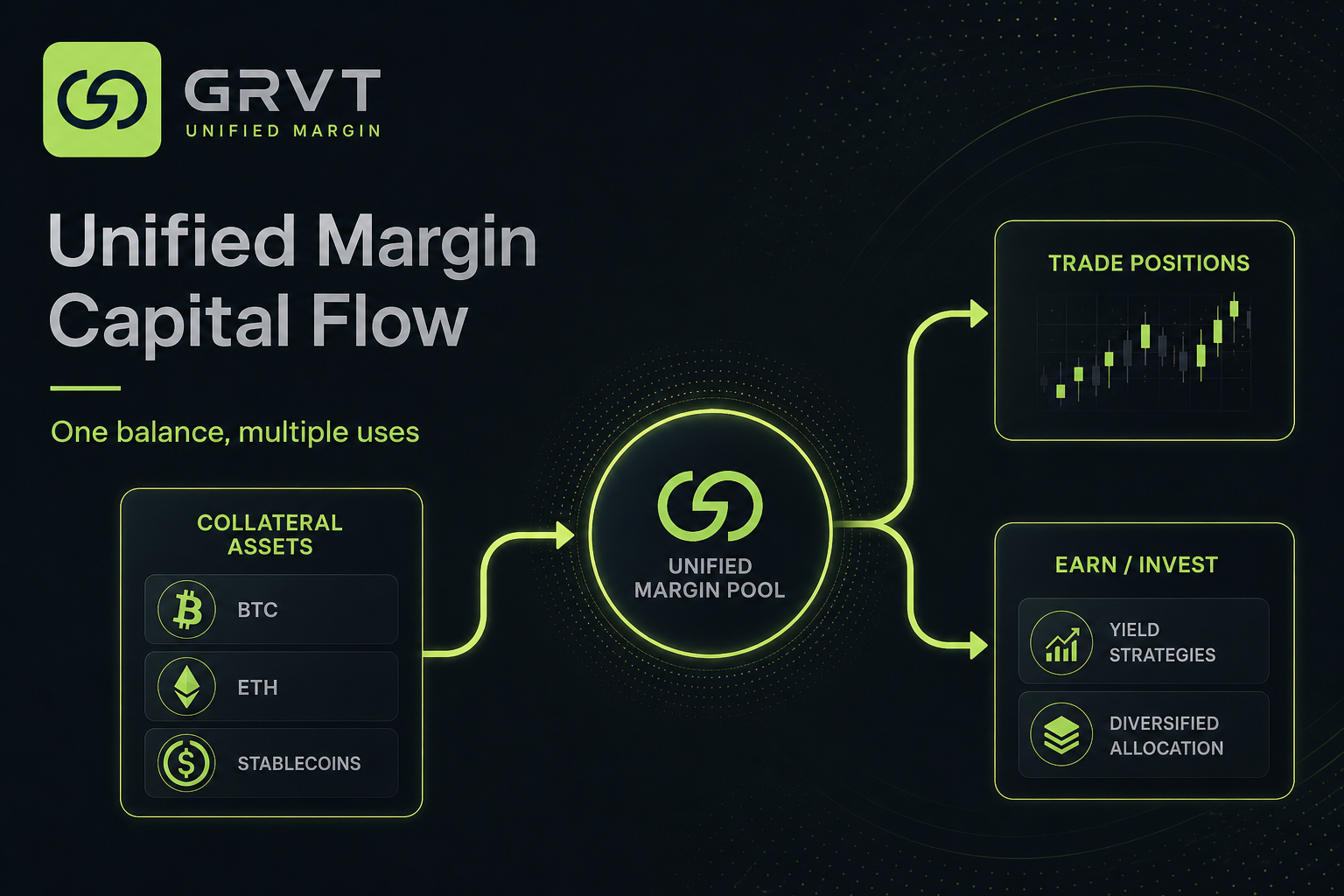 Figure 1. Grvt unified margin capital flow: once collateral enters the unified margin pool, it can simultaneously support trading positions and yield/investment modules.
How Does the Onchain Account Structure Enable Both Trading and Yield?
Grvt integrates non-custodial accounts, unified margin, and yield access within a single product architecture to ensure seamless capital flow. While users interact with a single account, the system manages asset control, available margin assessment, order execution, and yield mapping behind the scenes.
On the trading side, this structure connects directly to the trade workflow: the account first verifies available margin, then proceeds through order placement, matching, and position updates. From an asset management perspective, the same balance can also be linked to yield layers and tokenized RWA entry points within the account.
This structure comprises four key steps: non-custodial account manages asset control, the unified margin engine calculates net account value and available margin, the trading module handles order execution and position updates, and the yield/investment gateway allows unused balances to be deployed into onchain yield products or RWA allocations.
This continuous architecture shows that Grvt’s approach is not to keep “trading” and “finanzas” separate, but to have both share the same account infrastructure. As a result, capital efficiency is primarily determined by account-level design, not by optimizing individual products or interface elements.
Why Does Unified Margin Enhance Capital Efficiency?
Onchain users often face two inefficiencies: holding excess idle collateral for trading, and frequently transferring funds out of trading accounts to earn yield. Unified margin addresses both by allowing funds to remain both “ready to trade” and “minimally idle” within a single account structure.
For users with multiple strategies, unified margin is especially valuable. Managing multiple positions, assets, and yield products from one account eliminates the need to maintain separate margin pools and makes it easier to monitor overall risk exposure. For the platform, unified margin links trading activity and yield retention, reducing capital outflows to external protocols.
However, greater capital efficiency does not mean risk-free returns. Higher reusability increases account interdependence, and the connection between trading and yield layers deepens—efficiency and complexity rise together.
What Are the Limitations and Risks of Unified Margin?
The primary risk of unified margin is account-level contagion. If one position deteriorates, the system evaluates whether the account as a whole has sufficient risk buffer—volatility in one area can impact other positions previously considered independent.
A second risk arises from asset discounts and valuation methods. Not all collateral is counted at face value; assets with higher volatility or lower liquidity are assigned more conservative risk weights. A third risk comes from dependencies on external protocols in the yield layer. When balances are connected to lending protocols, strategy engines, or RWA products, smart contract, liquidity, structural, and exit risks all come into play.
| Risk Category |
Source |
Potential Impact |
| Account Linkage |
Multiple positions share a risk pool |
Losses can propagate across the account |
| Collateral Discount |
Volatile assets receive discounts |
Available funds may be less than nominal balance |
| Yield Layer Dependency |
Lending protocols, strategies, or RWA structures |
May affect liquidity, valuation, or redemption |
| Mechanism Complexity |
More comprehensive account rules |
Users may find it harder to assess true risk |
Unified margin is not just a “cheaper” solution—it builds capital utilization on more rigorous risk calculations. The key is understanding which assets count as margin, how discounts are applied, and when linked risk controls are triggered.
Summary
Grvt’s unified margin is fundamentally an account-level capital management system. By leveraging a unified risk engine, it links trading, holding, and yield entry points to a single non-custodial balance, minimizing collateral fragmentation and idle funds across products.
This design boosts onchain capital efficiency and sets Grvt apart from platforms limited to perpetual trading. However, increased efficiency comes with greater complexity from account linkage, discounting rules, and external yield dependencies. To truly understand Grvt, it’s not enough to know what products are supported—you need to understand how your funds are continuously evaluated and allocated within a single account.
FAQ
What Does Grvt’s Unified Margin Mean?
Grvt’s unified margin is an account-wide margin mechanism where all assets and positions are evaluated together under a single risk framework. This eliminates the need to split funds into separate, isolated margin pools.
Is Grvt a Non-Custodial Platform?
Grvt is built on a non-custodial (or self-custodial) account structure, giving users direct control over their assets—unlike typical centralized custodians. While non-custody doesn’t remove market, liquidation, or smart contract risks, it does change how assets are stored and permissions are managed.
Does Grvt Support Both Trading and Yield Generation?
Yes, Grvt is designed so that the same balance can be used for trading, earning, and holding simultaneously—an important extension of the unified margin mechanism. Trading and yield are not separated, but managed together within the same account.
What Is the Process for Placing a Trade on Grvt?
Before opening a position, Grvt checks your available account margin, then proceeds through order placement, matching, and position updates. For details on order submission, execution, and settlement, refer to the full trading workflow, including account checks, matching, and position updates.
What Are the Risks of Using Grvt?
Key risks include account linkage risk from unified margin, collateral discount and valuation risk, and external protocol risk from yield or RWA structures. While Grvt’s design improves capital efficiency, it also requires users to closely monitor overall account value and risk boundaries—not just individual positions.