Although traditional databases can store large volumes of data, they lack public verifiability, making it difficult for enterprises to prove whether data has been modified. Factom verifies data authenticity through hash structures and a Bitcoin anchoring mechanism, while Ethereum maintains on-chain state through nodes across the network.
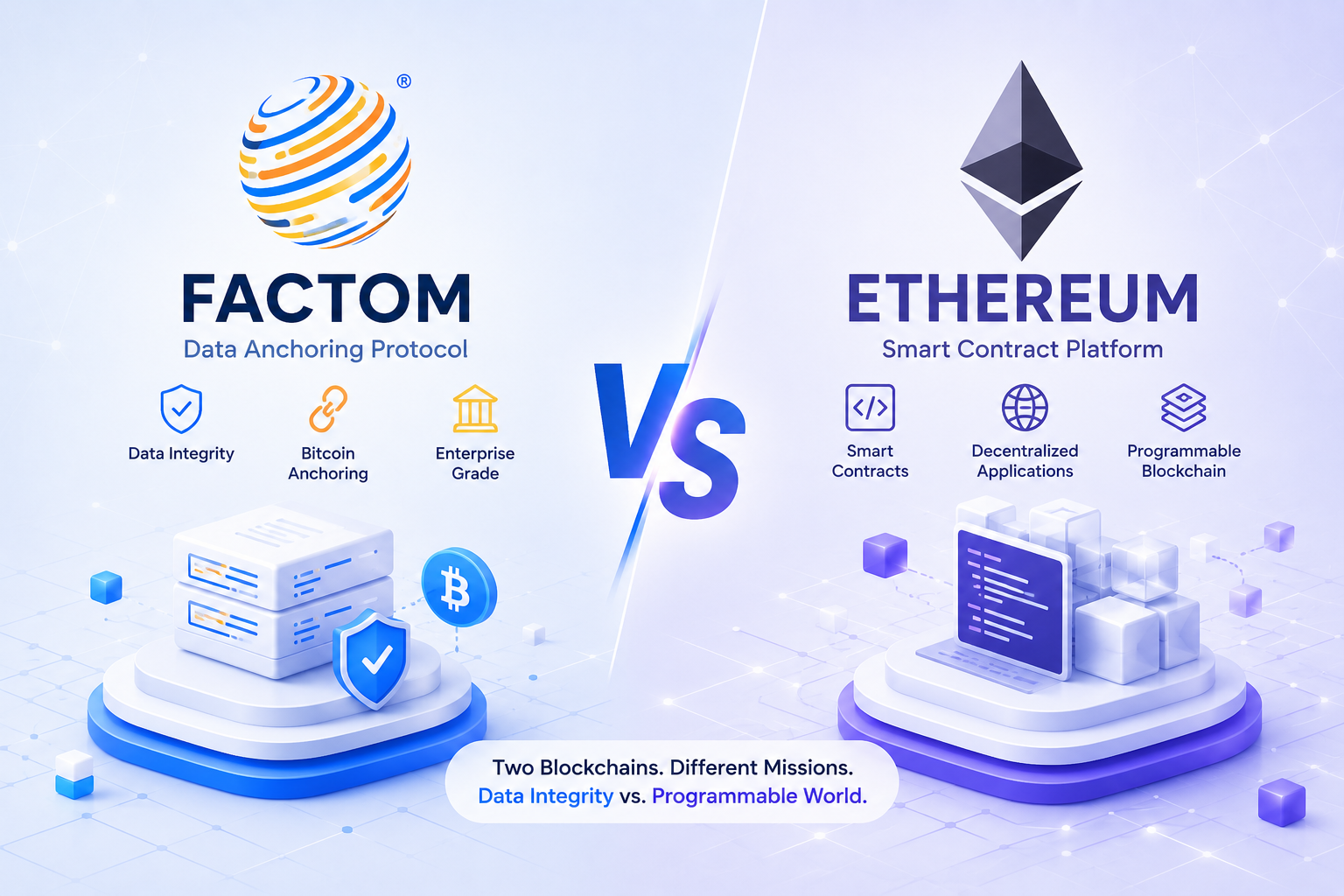
The differences between Factom and Ethereum mainly appear in network architecture, data processing methods, incentive logic, and application positioning. Factom places greater emphasis on data integrity and enterprise verification, while Ethereum emphasizes an open application ecosystem and on-chain programmability.
What Is Factom
Factom is a data attestation protocol based on a Bitcoin anchoring mechanism. It writes data hashes to the Bitcoin network, using Bitcoin’s security to verify data authenticity.
Factom does not store complete files directly on the Bitcoin blockchain. Instead, it first generates data hashes, organizes multiple hashes into a Merkle Root, and finally anchors the verification result to Bitcoin.
Factom’s data flow mainly revolves around data verification. First, users submit data records. Then, the Factom network generates hashes. Next, Factom organizes the data blocks. Finally, Bitcoin provides tamper resistant proof.
This mechanism means Factom places more emphasis on data integrity than on executing programs on-chain. The network is focused on building an enterprise-grade verifiable record system.
Official materials show that Factom’s main application areas include enterprise auditing, file verification, and data attestation.
What Is Ethereum
Ethereum is a blockchain network that supports smart contracts and decentralized applications. Ethereum executes on-chain programs through the EVM and nodes across the network, making it more suitable for open blockchain applications.
Ethereum is not only a data verification network. It allows developers to deploy smart contracts and lets different applications share a unified state layer.
Ethereum’s operating logic mainly revolves around smart contracts. First, users submit transaction requests. Then, Ethereum nodes execute contract code. Next, the network synchronizes on-chain state. Finally, Ethereum completes block confirmation.
This mechanism allows Ethereum to support:
-
DeFi
-
NFT
-
DAO
-
Layer 2
-
on-chain games
These application areas are clearly different from Factom’s enterprise data positioning.
Structurally, Ethereum places more emphasis on on-chain programmability, while Factom emphasizes data verification capability.
Architectural Differences Between Factom and Ethereum
The core architectural difference between Factom and Ethereum lies in their network goals and data organization methods. Factom manages data through a layered structure, while Ethereum maintains on-chain applications through a unified state layer.
Factom’s core modules include:
-
Entry Chain
-
Directory Block
-
Entry Credit
-
Bitcoin Anchoring
Ethereum’s core modules include:
-
EVM
-
Smart Contract
-
Validator Network
-
Global State
The Factom network prioritizes data records. First, Factom generates hashes. Then, the system organizes the data structure. Next, Factom anchors the result to Bitcoin. Finally, enterprises can verify the authenticity of records.
The Ethereum network continuously maintains on-chain state. First, users call contracts. Then, validators execute code. Next, the network synchronizes state changes. Finally, all nodes update the global state.
The table below shows the main architectural differences between Factom and Ethereum:
| Architecture Direction |
Factom |
Ethereum |
| Core positioning |
Data attestation protocol |
Smart contract platform |
| Security layer |
Bitcoin anchoring |
Ethereum itself |
| Data structure |
Layered data chains |
Global state tree |
| Network focus |
Data verification |
Application execution |
| Account logic |
Relatively weak |
Native support |
This difference means Factom is better suited to enterprise data scenarios, while Ethereum is better suited to open application ecosystems.
Differences in Data Processing Between Factom and Ethereum
Both Factom and Ethereum can process on-chain data, but their data processing logic is completely different. Factom emphasizes data proof, while Ethereum emphasizes state execution.
Factom does not store complete original files. It prioritizes hash generation and writes data proofs to Bitcoin, so its on-chain storage costs are relatively low.
Ethereum directly maintains on-chain state. Smart contracts, token balances, and application data are all synchronized by the Ethereum network, making Ethereum’s on-chain data structure more complex.
Factom’s data processing flow mainly revolves around verification. First, users submit data. Then, Factom generates hashes. Next, the system organizes data blocks. Finally, Bitcoin records the final verification result.
Ethereum’s processing flow revolves around state changes. First, users call contracts. Then, the EVM executes the logic. Next, the network synchronizes state changes. Finally, Ethereum updates the global state tree.
This mechanism means Factom is better suited to low cost data verification, while Ethereum is better suited to executing complex on-chain logic.
Factom and Ethereum Incentive Mechanisms Compared
Factom and Ethereum also differ clearly in their incentive mechanisms. Factom emphasizes stable data costs, while Ethereum emphasizes open network incentives.
Factom uses a dual token logic. In the Factom network, FCT mainly serves the role of value coordination, while Entry Credits are used to pay data writing fees.
Entry Credits cannot be freely traded, allowing enterprises to calculate data costs more predictably. Factom’s design focuses on reducing volatility in enterprise data costs.
Ethereum uses ETH as its unified gas asset. Users need to pay ETH to execute transactions and smart contracts.
Ethereum’s gas structure changes with network conditions. First, users submit transactions. Then, validators compete to include them in blocks. Next, gas prices change dynamically. Finally, Ethereum completes on-chain execution.
This mechanism means Ethereum has more flexible fees, but its costs can also fluctuate more noticeably.
The table below shows the difference in their incentive logic:
| Incentive Direction |
Factom |
Ethereum |
| Core asset |
FCT |
ETH |
| Usage fee |
Entry Credit |
Gas |
| Fee volatility |
Relatively stable |
Dynamic |
| Network focus |
Enterprise data |
On-chain applications |
Differences in Data Control Between Factom and Ethereum
Factom and Ethereum also differ clearly in how they control data. Factom emphasizes data proof, while Ethereum emphasizes public on-chain state.
Factom does not need to make complete data content public. It verifies data authenticity through hashes, allowing enterprises to complete verification without exposing file contents.
Ethereum smart contract data is usually publicly visible. Token states, contract logic, and on-chain interactions are synchronized to nodes across the network.
Factom’s verification process mainly revolves around hash checks. First, an enterprise submits data. Then, Factom generates a hash. Next, Bitcoin records the verification result. Finally, users can verify the file state.
Ethereum’s public logic is better suited to open application ecosystems. First, users execute transactions. Then, the network synchronizes data. Next, nodes verify state changes. Finally, the entire network can read the on-chain result.
This difference means Factom is better suited to enterprise-grade privacy preserving verification, while Ethereum is better suited to public on-chain applications.
Differences in Use Cases Between Factom and Ethereum
Factom and Ethereum have clearly different application directions. Factom leans toward enterprise-grade data verification, while Ethereum is closer to an open blockchain ecosystem.
Typical Factom use cases include:
Typical Ethereum use cases include:
-
DeFi
-
NFT
-
DAO
-
Layer 2
-
on-chain games
The Factom network focuses on improving data trustworthiness. First, enterprises submit data. Then, Factom synchronizes hashes. Next, Bitcoin provides the final audit layer. Finally, enterprises can confirm data authenticity.
Ethereum, by contrast, focuses on on-chain program execution. First, developers deploy contracts. Then, users interact with them. Next, the network synchronizes state. Finally, Ethereum keeps the application ecosystem running.
This difference means Factom is more like an enterprise data protocol, while Ethereum is more like an open blockchain operating system.
Conclusion
Factom and Ethereum both support on-chain data verification, but their network goals are completely different. Factom emphasizes data attestation and Bitcoin anchoring, while Ethereum emphasizes smart contracts and an open application ecosystem.
Factom’s core advantage lies in low cost data verification and enterprise-grade tamper resistant records. Ethereum’s core advantage lies in on-chain programmability and its large developer ecosystem.
Overall, Factom is better suited to enterprise data integrity scenarios, while Ethereum is better suited to building complex blockchain applications.
FAQs
What Is the Biggest Difference Between Factom and Ethereum?
Factom is more of an enterprise-grade data attestation protocol, while Ethereum is more of a smart contract and decentralized application platform.
Why Does Factom Anchor to Bitcoin?
Factom uses Bitcoin’s security and tamper resistant properties to verify data authenticity while avoiding the need to write complete data directly to Bitcoin.
Why Is Ethereum Better Suited to DeFi and NFTs?
Ethereum supports smart contracts and the EVM, allowing developers to build complex on-chain applications and open protocol ecosystems.
Does Factom Support Smart Contracts?
Official materials show that Factom focuses on data verification and enterprise attestation, so it does not support a full smart contract ecosystem in the same way Ethereum does.
Which Is Better for Enterprise Data Verification, Factom or Ethereum?
Factom is better suited to enterprise-grade data verification because its structure focuses on tamper resistant records and low cost data proofs.







