Compared to traditional software companies, CoreWeave operates with a distinctly infrastructure-driven business model. The company must continuously invest in GPUs, data centers, and energy resources, transforming computing power into cloud service revenue. As a result, investors typically monitor both the pace of growth and the trajectory toward improved profitability.
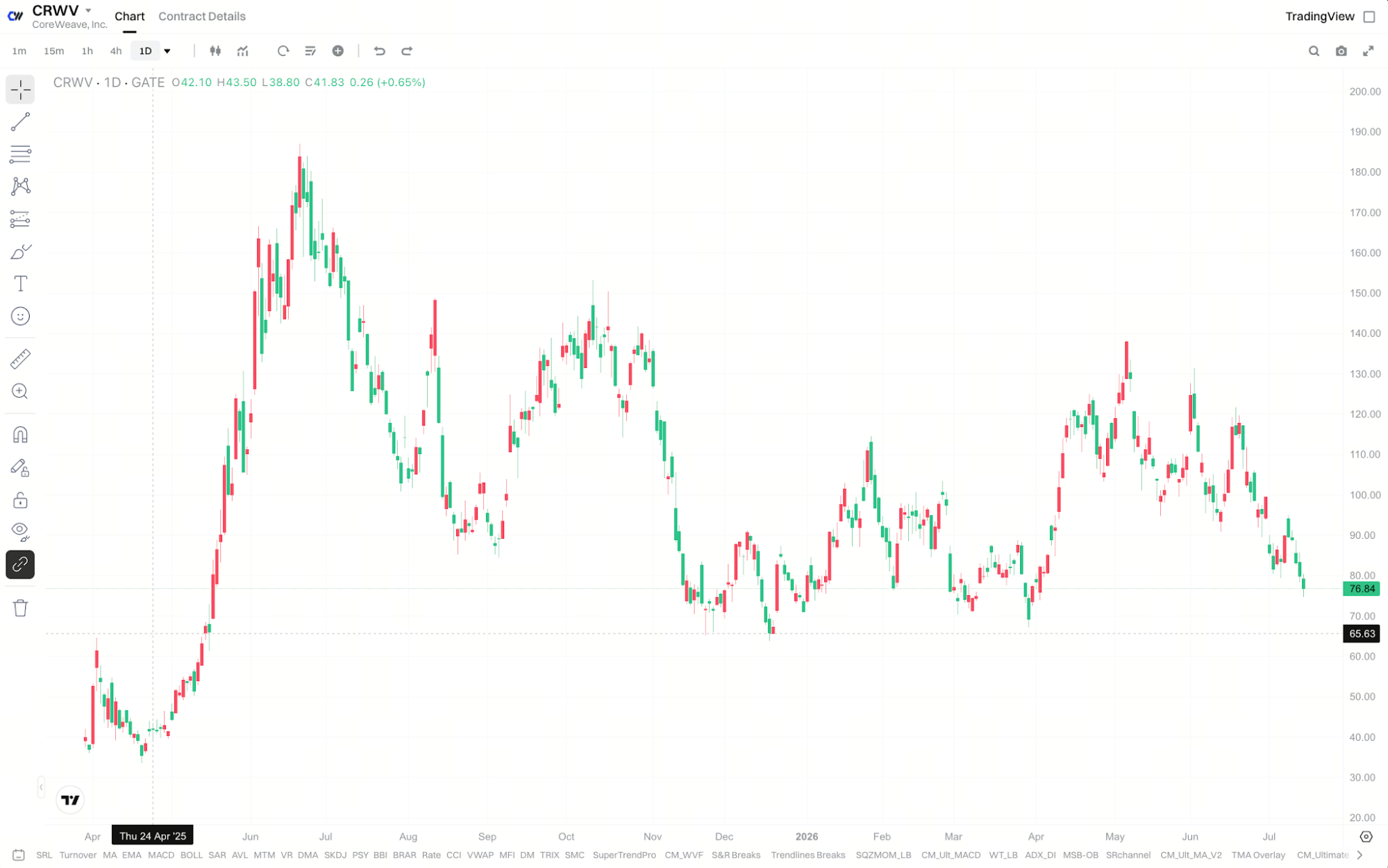
CoreWeave debuted on Nasdaq on March 28, 2025, with an IPO price of $40 per share. Following its listing, CRWV surged amid a wave of AI infrastructure investments, peaking at approximately $187 in June 2025—a gain of over 360% from its IPO price. At that time, the market was primarily trading on expectations for GPU cloud computing demand growth, NVIDIA ecosystem advantages, and the expansion of AI data centers.
Why AI Demand Impacts CRWV Stock Price
AI demand is a critical driver of CoreWeave’s stock valuation, as the company’s core business is centered on GPU cloud computing. Training large language models, deploying generative AI applications, and enterprise AI integration all require substantial GPU resources, positioning GPU cloud service providers as essential infrastructure suppliers.
CoreWeave’s market valuation largely reflects investor views on the sustainability of AI infrastructure demand. When AI companies expand model training or inference needs accelerate, the market typically raises its expectations for future revenue potential among GPU cloud service providers.
CRWV’s early stock rally was fueled by optimism about the scarcity of AI computing power. Investors focus not only on CoreWeave’s current supply of computing resources, but also on whether future growth in AI applications will sustain demand for GPU usage.
| AI Demand Shift |
Impact on CRWV Stock |
| Increased large model training |
Boosts market expectations for GPU computing power |
| Expanded AI inference scale |
Strengthens long-term demand outlook |
| Growth in enterprise AI applications |
Supports customer expansion narrative |
| Slower AI investment |
May lower market growth expectations |
Still, rising AI demand does not automatically translate into higher stock prices. The market weighs whether demand growth can offset GPU procurement, data center construction, and operating costs—and whether the company can leverage scale to enhance profitability.
Thus, CRWV’s stock price reflects a balance between “expected AI computing power demand” and “commercial execution capability,” rather than simply tracking overall AI industry growth.
How GPU Supply and NVIDIA Relationship Affect CoreWeave
GPU supply is a major determinant of CoreWeave’s business expansion and market valuation. AI cloud computing relies on large volumes of high-performance GPUs, so CoreWeave’s ability to secure advanced computing hardware directly impacts its data center growth and capacity to meet client demand.
NVIDIA GPUs are foundational to today’s AI computing infrastructure, and CoreWeave’s cloud services are built around the NVIDIA accelerated computing ecosystem. Accordingly, NVIDIA’s product supply, GPU upgrade cycles, and hardware cost fluctuations all influence market perceptions of CoreWeave.
For investors, GPUs are not just technical assets—they’re key variables affecting revenue growth and capital investment scale. If GPU supply is ample, CoreWeave can rapidly scale computing capacity; if supply is constrained, customer delivery and market expansion may suffer.
| Factor |
Impact on CoreWeave |
| NVIDIA GPU supply |
Determines pace of computing power expansion |
| Next-gen GPU architecture |
Affects computational efficiency and competitiveness |
| GPU procurement costs |
Drives capital expenditure pressures |
| GPU lifecycle |
Impacts asset depreciation and profit margins |
CoreWeave’s relationship with NVIDIA also shapes market views on its competitive moat. While a strong GPU ecosystem enables rapid AI computing delivery, reliance on a single hardware source exposes the company to supply chain and cost volatility.
How Data Center Capital Expenditures Affect Profitability
Data center capital expenditures are central to CoreWeave’s stock valuation. GPU cloud services are inherently capital-intensive; the company must invest heavily in GPU acquisition, data center construction, energy expansion, and network infrastructure optimization.
When evaluating CoreWeave, the market considers not only revenue growth, but also whether these investments yield adequate returns. Rapid expansion can enhance future service capacity, but if capital outlays outpace revenue and profit improvements, concerns about profitability intensify.
As CRWV’s stock price retreated from its highs, capital expenditure pressures became a focal point for market reassessment. Earlier, investors traded on AI infrastructure growth expectations; as valuations normalized, attention shifted to GPU asset utilization, depreciation costs, and timelines for profit recovery.
| Capital Expenditure Factor |
Impact on Stock Valuation |
| GPU procurement scale |
Sets future computing power supply |
| Data center build speed |
Determines revenue growth potential |
| Energy costs |
Affect operating profit margins |
| Asset depreciation |
Impacts profitability metrics |
CoreWeave’s core challenge is not the existence of AI computing power demand, but how to enhance capital efficiency while scaling infrastructure.
For AI infrastructure firms, the market often rewards growth premiums, but long-term valuations depend on revenue growth, profit improvement, and cash flow strength.
How Large Customer Orders Shape Market Expectations
Large customer contracts are a key influence on CoreWeave’s stock valuation, given the resource-intensive nature of AI cloud infrastructure. Unlike standard cloud services, large-scale GPU computing contracts require long-term resource planning, so major customer orders help the market gauge future revenue certainty.
For CoreWeave, establishing long-term partnerships with leading AI firms, tech companies, or cloud partners strengthens market confidence in future computing power demand. Investors assess not just contract size, but whether these deals translate into stable income and whether the company can deliver the necessary computing resources.
The market evaluates the impact of major orders on CRWV stock from three perspectives:
| Order Factor |
Impact on Market Expectations |
| Contract size |
Enhances revenue visibility |
| Contract duration |
Bolsters income stability |
| Customer quality |
Validates business model credibility |
| Fulfillment capability |
Shapes market views on growth execution |
While CoreWeave’s long-term contract model increases business certainty, it also raises customer concentration risks. If most revenue comes from a handful of large clients, the market scrutinizes whether their AI investments will continue and whether contracts cover infrastructure costs.
Thus, the effect of large customer orders on CRWV stock depends on order quality, profit contribution, and capital return—not simply on order volume.
How AI Cloud Competition Shapes CoreWeave’s Valuation
The competitive landscape in AI cloud is a crucial factor for CoreWeave’s long-term valuation. Today’s AI infrastructure market includes both specialized GPU cloud providers and global giants like AWS, Microsoft Azure, and Google Cloud.
CoreWeave positions itself as a dedicated GPU-accelerated computing provider, optimizing infrastructure for AI workloads to maximize training and inference efficiency. This specialization enables differentiation in the AI computing power market, but also means competing with large cloud firms on capital, client resources, and infrastructure scale.
From a valuation standpoint, the market focuses on whether CoreWeave can sustain a competitive edge in AI infrastructure.
| Valuation Factor |
Positive Impact |
Potential Pressure |
| Dedicated AI cloud positioning |
Gains AI growth premium |
Market scope remains focused |
| GPU resource strength |
Supports service expansion |
Relies on hardware supply |
| Long-term contracts |
Enhances revenue certainty |
Raises customer concentration risk |
| Data center scale |
Boosts service capabilities |
Heightens capital investment burden |
| Technical optimization |
Improves resource efficiency |
Faces competition from cloud giants |
Compared to AWS, Azure, and Google Cloud, CoreWeave’s strength lies in its focus on AI computing power, while the large cloud providers offer comprehensive ecosystems and global reach.
Ultimately, the market’s valuation of CoreWeave weighs two models: can a specialized AI infrastructure firm achieve superior growth through efficiency and focus, or will large cloud providers leverage their scale to dominate?
CoreWeave’s Operational Challenges
CoreWeave faces significant operational hurdles, including its capital-intensive model, hardware dependency, competitive pressures, and the need to validate profitability.
GPU cloud infrastructure demands ongoing capital investment. The company must continually procure GPUs, expand data centers, and boost energy supply to meet AI computing power needs. If capital spending outpaces resource utilization improvements, profitability may suffer.
CoreWeave is also heavily dependent on the GPU supply chain. While NVIDIA GPUs deliver robust computing power, supply cycles, procurement costs, and technology upgrades all impact operational plans.
| Challenge Factor |
Impact on CoreWeave |
| High capital expenditures |
Increases funding needs and profit pressure |
| GPU supply dependency |
Limits expansion speed |
| Cloud competition |
Narrows long-term profit margins |
| Customer concentration |
Heightens revenue volatility risk |
| AI cycle shifts |
Influence market growth expectations |
The AI infrastructure sector is rapidly evolving. Market focus is shifting from “can CoreWeave ride the AI wave” to “can it achieve stable profitability through scale.”
CRWV’s price pullback from early highs reflects this transition—from trading the AI growth narrative to emphasizing commercial execution.
Summary
CRWV stock price is shaped by multiple factors: AI demand, GPU supply, capital expenditures, customer contracts, and industry competition. As an AI cloud infrastructure provider, CoreWeave’s valuation hinges not only on current business scale, but also on market expectations for future computing power demand and profitability.
The initial post-IPO surge reflected optimism about AI infrastructure’s long-term growth; subsequent corrections signaled investor focus on capital investment, profit improvement, and competitive challenges.
To understand CoreWeave’s stock price dynamics, monitor both AI industry trends and the company’s operational capabilities. AI computing power demand fuels growth, while capital efficiency, customer mix, and competitive positioning define long-term valuation potential.
FAQ
Why does CoreWeave stock respond to the AI boom?
CoreWeave stock is sensitive to the AI boom because its business revolves around GPU cloud computing, and rising demand for AI model training and inference boosts market expectations for AI computing infrastructure.
Why does NVIDIA GPU supply affect CoreWeave?
NVIDIA GPUs are essential for CoreWeave’s AI cloud services. The speed and cost of acquiring GPUs impact the company’s ability to expand computing power and meet client needs.
Why is CoreWeave’s capital expenditure under scrutiny?
CoreWeave must invest heavily in GPU data centers, so the market closely watches whether capital spending translates into revenue growth and profit improvement.
Why do major customer contracts affect CRWV’s valuation?
Large customer contracts enhance future revenue certainty, but the market also considers customer concentration, contract profitability, and whether deals cover infrastructure investment.
Does competition with major cloud providers impact CoreWeave stock?
Yes. AWS, Azure, and Google Cloud have scale and ecosystem advantages. The market assesses whether CoreWeave can maintain competitiveness through its dedicated AI cloud focus.
What is CoreWeave’s biggest operational challenge?
CoreWeave’s primary challenges include high capital expenditures, GPU supply dependency, profitability improvement, and competition in the AI cloud market—all factors that shape its long-term valuation outlook.