As real-world assets, or RWA, and NFT technology continue to develop, more collectibles are moving into on-chain markets. Collector Crypt represents a new model for digital collectibles trading, while eBay remains an important player in the traditional collectibles market. These two models reflect different directions in the collectibles industry, one shaped by digitization and the other by established trading systems, which is why collectors often compare them.
A Brief Look at Collector Crypt and eBay
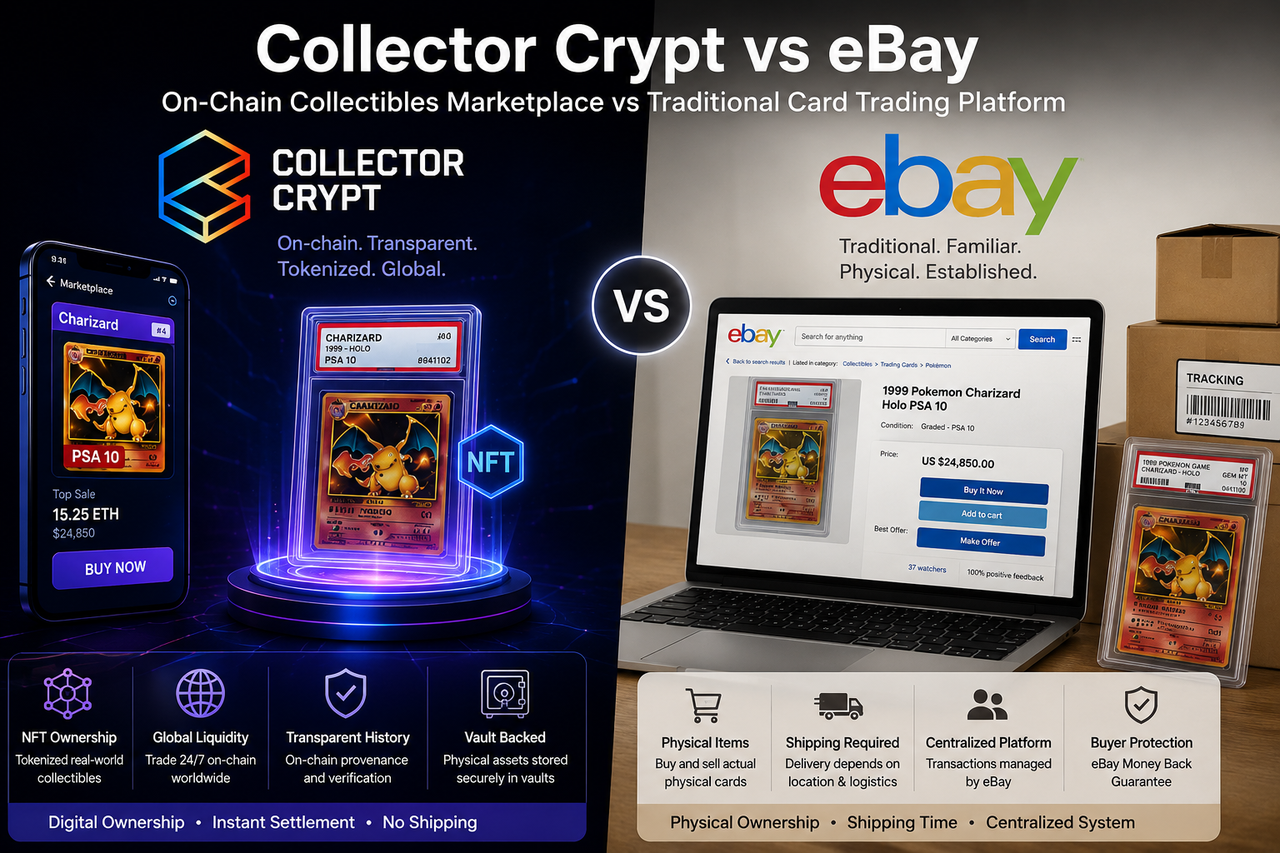
Collector Crypt is a platform focused on tokenizing physical collectible cards. It builds a collectibles trading ecosystem through its Vault custody system, NFT ownership mapping, and on-chain Marketplace.
Collector Crypt’s core logic is to link physical collectible cards with NFTs. The physical assets are stored in professional custodial warehouses, while the NFTs circulate in the market as digital ownership certificates.
eBay is a globally recognized online marketplace and one of the major trading venues for collectible cards.
On eBay, sellers directly list physical card products, and buyers receive the physical assets through logistics after completing payment. Once the transaction is completed, ownership is transferred along with physical delivery.
Over the years, eBay has become one of the important secondary markets for Pokémon cards, sports cards, and many other types of collectibles.
How Do Collector Crypt and eBay Differ in Ownership Management
The most fundamental difference between Collector Crypt and eBay comes from how ownership is recorded.
In Collector Crypt, NFTs represent digital ownership of collectibles. Each transaction leaves a record on the blockchain, making ownership changes publicly verifiable.
On eBay, ownership depends on physical delivery. Transaction records are stored in the platform’s database, but the asset itself does not have a unified digital ownership system.
As a result, the two platforms reflect two different models: digital ownership and traditional physical ownership.
How Do Collector Crypt and eBay Differ in Transaction Flow
Collector Crypt’s transaction flow is closer to a digital asset market.
After a user buys an NFT, ownership can be transferred almost instantly without waiting for shipping. Once the asset is traded, the physical card remains stored in the Vault.
eBay transactions follow a traditional e-commerce process, including product listing, order payment, seller shipment, logistics transportation, and buyer receipt.
For cross-border transactions, shipping time and transportation costs often extend the transaction cycle even further.
How Do Collector Crypt and eBay Differ in Liquidity Structure
Liquidity is one of the key differences between the two markets.
Collector Crypt NFTs can be listed for sale on the on-chain marketplace at any time. Since the physical asset does not need to be shipped repeatedly, this can theoretically increase trading frequency and market turnover efficiency.
Although eBay has a large user base, each transaction still involves physical delivery, so trading speed is limited by logistics and geography.
For high-frequency traders, on-chain markets usually offer a more flexible way to circulate assets.
How Do Collector Crypt and eBay Differ in Asset Custody
Collector Crypt uses a centralized custody model.
All tokenized collectible cards are stored in a professional Vault, where the custodian is responsible for safekeeping, verification, and management.
eBay uses a user-held model. Sellers are responsible for storing collectibles before sale, while buyers keep the assets themselves after the transaction is completed.
Both models have their own strengths. Custody can improve trading efficiency, while self-custody allows collectors to directly hold and display physical assets.
What Is the Difference in Market Transparency Between Collector Crypt and eBay
Collector Crypt uses blockchain technology to improve asset transparency.
An NFT’s historical transaction records, ownership changes, and asset provenance can all be checked on-chain. Market participants can trace how an asset has moved over time.
eBay provides a buyer and seller feedback system as well as product information display, but it cannot create the same kind of unified and tamper-resistant asset history that blockchain can provide.
For high-value collectibles, a verifiable history often matters greatly.
How Do Collector Crypt and eBay Differ in User Participation
In addition to ordinary trading, Collector Crypt introduces interactive mechanisms such as the Gacha Machine.
Users can not only buy specific assets, but also obtain collectible card NFTs through random pack openings. This model combines collecting with a gamified experience.
eBay’s core function remains buying and selling. Users usually acquire their target collectibles through search, auctions, or direct purchases.
Therefore, Collector Crypt is closer to a digital collectibles ecosystem, while eBay is closer to a traditional goods marketplace.
Core Differences Between Collector Crypt and eBay
| Comparison Dimension |
Collector Crypt |
eBay |
| Asset Form |
NFT linked to a physical asset |
Physical collectible |
| Ownership Record |
Blockchain record |
Platform order record |
| Physical Custody |
Vault custody |
User self-custody |
| Transaction Settlement |
On-chain transfer |
Logistics delivery |
| Global Circulation |
24/7 on-chain marketplace |
Depends on cross-border logistics |
| Liquidity |
Higher |
Relatively limited |
| Historical Tracking |
Verifiable on-chain |
Platform record |
| Gamified Mechanism |
Supports Gacha |
Not supported |
Collector Crypt vs eBay: Which Model Is Better Suited to the Collectibles Market
Collector Crypt and eBay are not in direct, complete competition.
Collector Crypt is better suited to users who care about digital ownership, market liquidity, and on-chain asset trading. For people who want to buy and sell collectibles quickly or participate in the NFT collectibles market, this model can be highly appealing.
eBay is better suited to traditional collectors. For those who want to directly hold physical cards, participate in auctions, or search for specific collectibles, traditional trading platforms still hold significant value.
Conclusion
Collector Crypt and eBay can both meet the needs of collectible card trading, but their underlying logic is completely different. Collector Crypt uses NFTs and blockchain technology to manage digital ownership, and it improves liquidity through Vault custody and an on-chain marketplace. eBay, on the other hand, relies on a mature e-commerce system to complete physical goods transactions.
From an industry development perspective, Collector Crypt represents the direction of the collectibles RWA and NFT markets, while eBay represents the traditional collectibles trading system.
FAQs
What is the biggest difference between Collector Crypt and eBay?
Collector Crypt uses NFTs and blockchain technology to record collectibles ownership, while eBay uses a traditional e-commerce model to complete the buying, selling, and delivery of physical goods. This is the most fundamental difference between the two.
Does Collector Crypt actually have physical collectible cards?
Yes. Collector Crypt NFTs usually correspond to physical collectible cards held in the Vault, and NFT holders have digital ownership of the corresponding assets.
Can collectible cards on eBay be tokenized?
eBay itself does not provide tokenization. Sellers on eBay sell physical collectibles, not corresponding NFTs or on-chain assets.
Why does Collector Crypt not need to ship cards frequently?
Collector Crypt uses a Vault custody mechanism. Physical cards remain stored in the warehouse over the long term, and users trade the ownership represented by NFTs, so physical shipping is not required for every transaction.
Why is Collector Crypt’s liquidity usually higher than that of traditional markets?
Because NFTs can be transferred on-chain instantly, Collector Crypt does not need to wait for logistics delivery or physical settlement. As a result, asset circulation is usually more efficient than in traditional collectibles markets.