



Over the past month, Oracle Corporation (NYSE: ORCL) has seen its share price surge by more than 30%, rebounding sharply from a low of around $171 in early May 2026 to above $225 by the end of the month. On several trading days, intraday gains exceeded 6%. This robust rally was not driven by a single event, but rather by a combination of multiple fundamental factors.
Previously, Oracle’s stock underwent a prolonged period of deep correction. After reaching a historic high of $302.14 in September 2025, ORCL pulled back by about 49%, hitting a cycle low of $153.97, impacted by macro interest rate changes, uncertainty around AI investment returns, and concerns about capital expenditures. The market widely debated the feasibility of Oracle’s aggressive borrowing to build out its data centers.
However, following a strong Q3 FY2026 earnings report and the release of several key partnerships and contract wins, the market narrative around Oracle is undergoing a structural transformation.
Notably, as of June 1, 2026, Gate has officially launched its US stock trading service. Users can now trade ORCL and other US equities and ETFs directly with USDT through the TradFi section of the Gate App, seamlessly connecting crypto assets with traditional financial markets. This provides a new access point for users interested in the AI infrastructure investment trend.
How Is Oracle’s Cloud Infrastructure Business Driving This Rally?
Oracle’s Q3 FY2026 earnings report (for the quarter ending February 28, 2026) was the direct catalyst for the stock’s rebound. After the report was released, shares jumped nearly 10% in after-hours trading.
Key financial highlights: Total revenue reached $17.2 billion, up 22% year-over-year—marking the first time in over 15 years that both total revenue and non-GAAP EPS grew by more than 20% in a single quarter. Cloud services revenue totaled $8.9 billion, up 44% year-over-year, now accounting for over 50% of total revenue. The standout segment was Oracle Cloud Infrastructure (OCI), which saw revenue soar 84% year-over-year to $4.9 billion.
Crucially, Oracle disclosed that its remaining performance obligations (RPO) reached $553 billion, up 325% year-over-year. This figure indicates that the company has secured long-term contract revenue for years to come, providing high visibility for medium- and long-term growth. Within these backlog orders, AI infrastructure-related revenue rose 243% year-over-year.
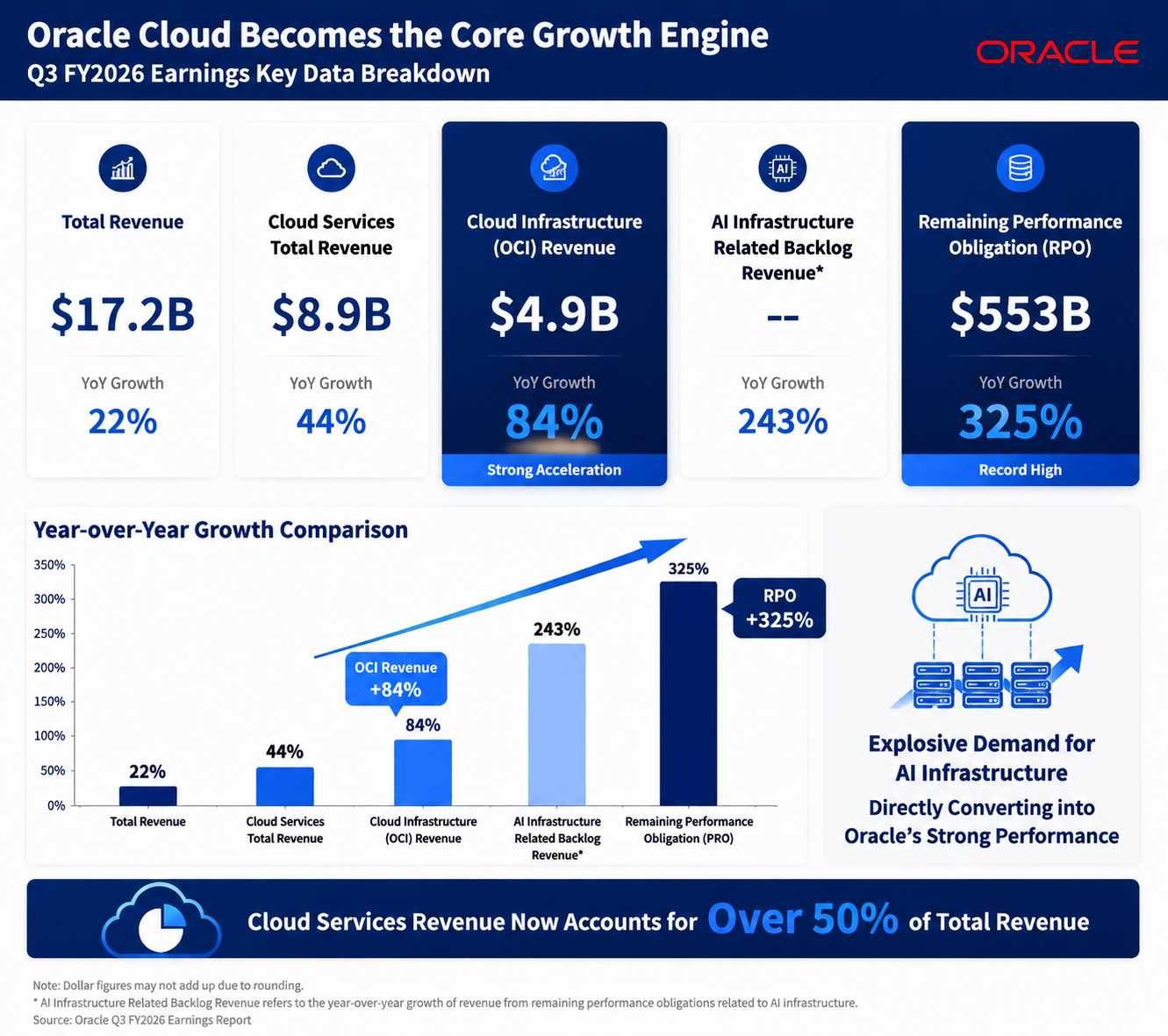
Cloud business emerges as the core growth engine—Key Q3 financial breakdown
Beyond the earnings report, several catalysts further propelled ORCL’s share price:
In early May, Oracle secured a classified AI contract with the US Department of Defense, sending shares up about 6% in a single day.
The company signed a six-year, $1.65 billion supply agreement with Australian data center manufacturer Datapod.
Oracle partnered with Michigan’s DTE Energy for a 1.4 GW data center facility, ensuring reliable power supply.
In mid-April, Oracle inked a fuel cell system procurement deal with Bloom Energy, totaling 2.8 GW, aimed at solving power bottlenecks for AI data centers.
These developments show that Oracle’s cloud infrastructure strategy is moving from vision to accelerated execution, prompting the market to reprice this transformation.
How Do Capital Expenditures and Debt Impact Valuation?
Oracle’s capital expenditure scale is attracting as much attention as its growth numbers. For FY2026, the company plans to invest $50 billion in data center and cloud infrastructure buildout. To support this massive investment, Oracle announced in February 2026 that it would raise $45–50 billion through a mix of debt and equity issuance, successfully securing about $30 billion that month via convertible preferred shares and bonds.
The expansion in capital spending has had a direct impact on financial metrics. As of the end of February 2026, Oracle’s non-current debt had climbed to $124.7 billion, with interest expenses up 32% year-over-year. Free cash flow over the past 12 months was negative $24.74 billion, mainly due to $48.3 billion in capital expenditures for data center construction.
To ease funding pressure, Oracle’s management has introduced a new expansion model. The CEO of the cloud infrastructure business noted that the company has secured more than 10 GW of power and data center capacity for the next three years, with "over 90% fully funded by partners." Additionally, by combining customer "bring your own hardware" (BYOH) and prepayment models, Oracle has signed over $29 billion in new contracts.
J.P. Morgan analysts highlighted in their research that this "customer pre-funding" expansion model partially decouples Oracle’s funding needs from supply, yet the sustainability of debt leverage remains a concern.
How Long Does It Take to Convert Backlog Orders Into Revenue?
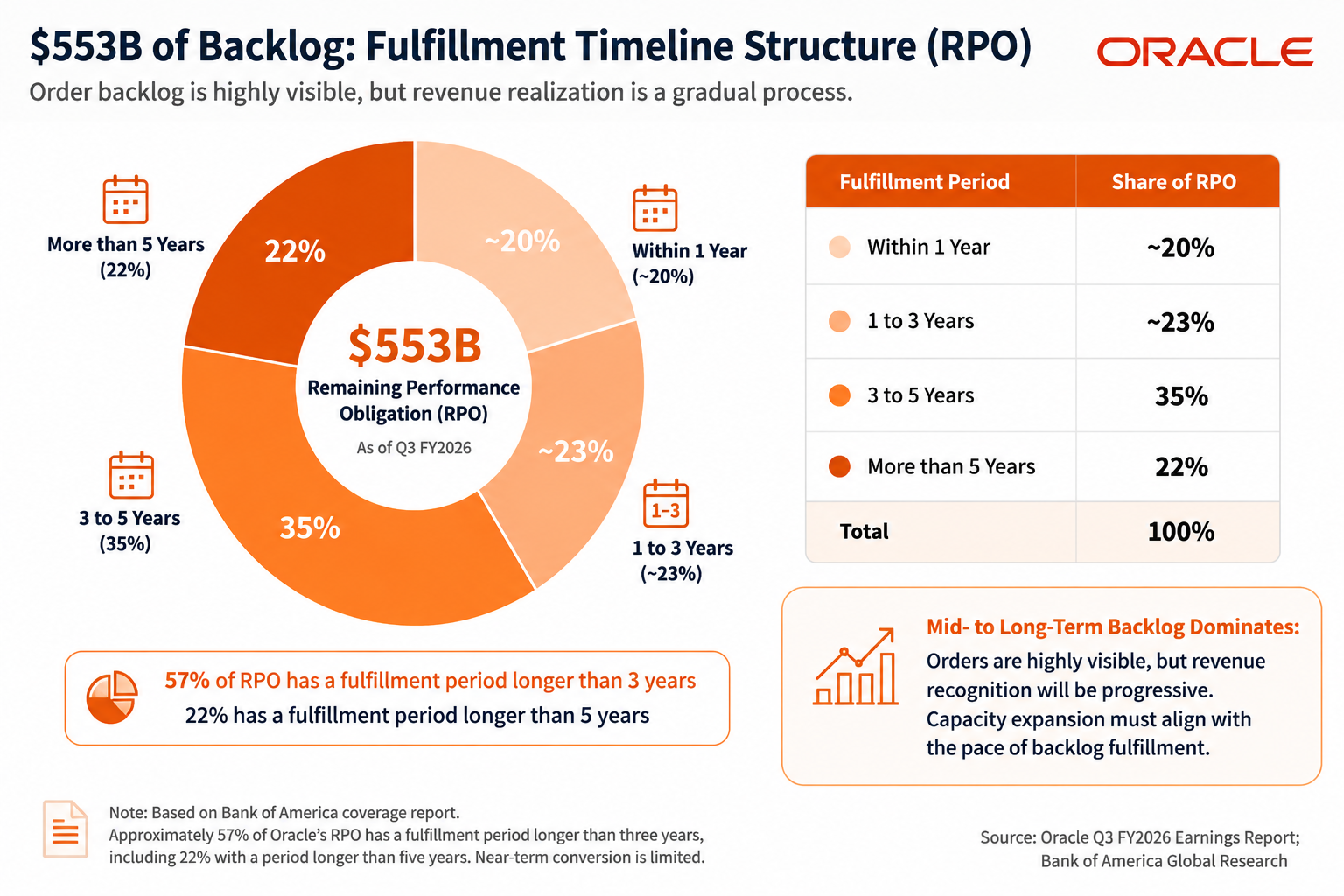
Conversion pace of $553 billion backlog—RPO fulfillment timeline structure
The $553 billion in remaining performance obligations is one of the most critical factors supporting market expectations for ORCL’s future. However, the value of these backlog orders cannot be converted into revenue all at once—the release pace is a key variable in valuation.
Structurally, according to Bank of America’s coverage report, about 57% of Oracle’s $553 billion RPO has a fulfillment period longer than three years, and 22% exceeds five years. This means that even with massive contract values, revenue recognition will be gradual. A significant portion of RPO is tied to a few major AI clients, so customer concentration poses fulfillment risk.
On the demand side, Oracle’s strategic partnership with OpenAI continues to deepen. At the end of April 2026, the two announced a strategic collaboration in cloud infrastructure and AI model deployment, aiming to optimize model training and inference services on OCI, accelerating generative AI adoption in finance, healthcare, and other industries. The partnership has entered the technical integration phase. Additionally, Oracle is working with SoftBank to build sovereign cloud and AI compute platforms in Japan. These collaborations form the foundation for converting backlog orders into sustainable revenue.
The market’s central concern regarding RPO conversion is whether capacity expansion can keep pace with contract fulfillment. Wedbush strategists noted that Oracle’s ability to expand AI data centers and accelerate order conversion to revenue will determine whether this rally can continue.
What Do Institutional Rating Disagreements Reveal About Pricing Contradictions?
Despite ORCL’s substantial rebound from its lows, Wall Street analysts remain divided—reflecting ongoing debate over ORCL’s valuation logic.
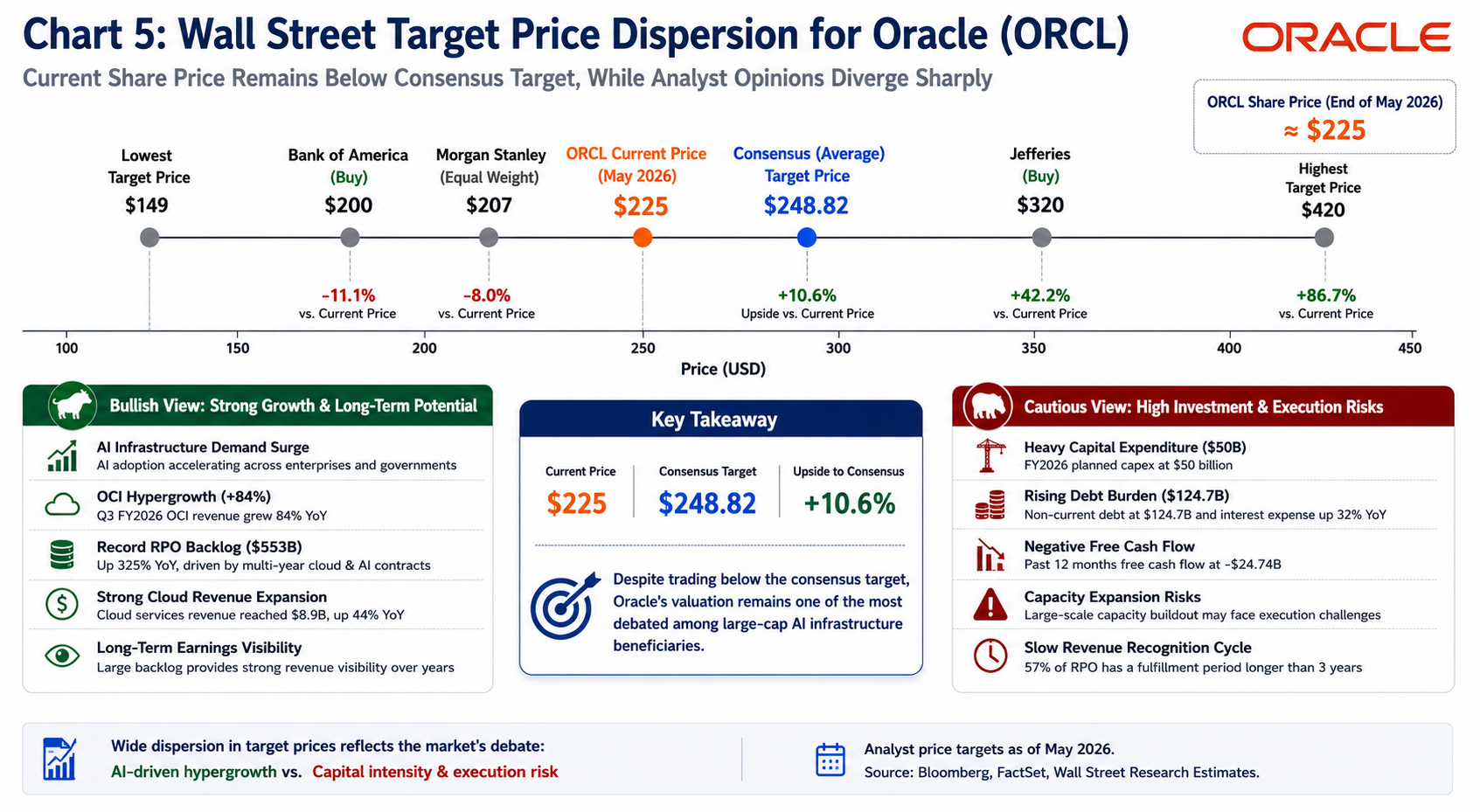
Pricing conflict—Wall Street target price range and institutional views (as of May 2026)
The bullish camp’s logic centers on the high visibility of backlog orders. Following the earnings report, Jefferies maintained a "Buy" rating with a $320 price target, citing a compound annual growth rate of over 20% for total revenue and EPS, with risk-reward still skewed positive. J.P. Morgan upgraded its rating from "Neutral" to "Overweight" in March, arguing that the post-high correction has greatly reduced valuation risk, and investor sentiment has shifted from "blind faith" to "general pessimism." Bank of America reinstated coverage with a "Buy" rating and a $200 target, emphasizing the $553 billion RPO as a major growth opportunity.
The more cautious camp focuses on capital spending and margin pressure. In late April 2026, Morgan Stanley’s research team noted that despite strong revenue and operating profit last quarter, gross margin fell about 590 basis points year-over-year, mainly due to cost pressures from capacity expansion. They maintained an "Equal-weight" rating and lowered their target from $213 to $207.
Additionally, at the end of March 2026, Oracle announced global layoffs of about 30,000 employees, part of a broader operational restructuring. This move indicates that the company is adjusting costs to offset cash flow pressures from massive capital expenditures.
Aggregating forecasts from major Wall Street institutions, as of mid-May 2026, ORCL’s target price range spans from $149 to $420, with an average target of about $248.82, highlighting considerable divergence in market outlook.
How Is the Integration of Traditional Finance and Crypto Assets Reshaping the Investment Landscape?
The discussion around ORCL’s rally is moving beyond single-stock analysis and into a broader structural theme: the accelerating integration of traditional finance (TradFi) and crypto assets.
On June 1, 2026, Gate officially launched its stock trading service. After completing KYC verification and meeting regional access requirements, users can transfer USDT, view market data, and trade stocks in the TradFi section of the Gate App, unifying crypto asset accounts with traditional stock trading capabilities. Gate’s stock trading business now covers over 10,000 stocks and ETFs, including assets from the NYSE, Nasdaq, and other major US markets.
Unlike common stock tokenization and RWA mapping models, Gate connects directly to US mainstream securities markets to provide stock and ETF trading services. Partner brokers are members of the Securities Investor Protection Corporation (SIPC), offering asset protection for clients under qualifying conditions. Spot stock trading on Gate does not involve funding rates from perpetual contracts or swap/overnight fees from CFD products, resulting in zero holding costs.
From an industry perspective, the integration of crypto assets and TradFi is unfolding across multiple dimensions. As of early 2026, derivatives trading accounted for over 70% of global crypto trading volume, with cross-market products like perpetual contracts rapidly expanding into traditional stocks and commodities. Gate’s stock trading initiative offers users a direct channel amid this integration wave—one account gives access to both crypto and traditional financial markets.
For users focused on the AI infrastructure investment theme, participating in US stock trades like ORCL via Gate TradFi adds a new dimension to crypto asset allocation. There’s no need to switch between different financial systems; asset allocation can be managed from a single account. As TradFi asset classes continue to expand on crypto platforms, the "crypto + traditional" dual-track allocation model is shifting from trend to norm.
Conclusion
Oracle’s more than 30% rally is driven by explosive AI infrastructure demand and the effective transformation of its cloud business strategy. The record $553 billion backlog provides high visibility for medium- and long-term growth, while expanding capital expenditures and changes in debt structure remain key risk factors under ongoing market scrutiny. Institutional pricing disagreements between growth potential and funding pressures make capacity execution and order conversion pace the critical variables for ORCL’s outlook. As crypto asset platforms open compliant access to US stock trading, the path for users to participate in TradFi assets is becoming much simpler. Gate’s stock trading service offers crypto-native users a direct way to invest in leading AI infrastructure companies like Oracle.
Frequently Asked Questions (FAQ)
What is the core driver behind ORCL’s latest rally?
The main driver is explosive growth in cloud infrastructure—OCI revenue grew 84% year-over-year, AI infrastructure revenue surged 243%, and Oracle secured a record $553 billion backlog. These figures show that Oracle’s AI cloud transformation strategy is steadily translating into performance gains.
Can the $553 billion backlog be fully converted into revenue?
Yes, but it will take time. About 57% of RPO has a fulfillment period longer than three years, and 22% exceeds five years. Revenue recognition is gradual, and the key is whether capacity expansion can match contract fulfillment pace.
Is Oracle’s capital spending sustainable?
This is the core of market debate. The FY2026 $50 billion capital expenditure plan does create pressure on free cash flow and debt, but the company has shifted much of the burden through customer prepayments, BYOH models, and partner funding.
How do I trade ORCL stock on Gate?
Update your Gate App to the latest version, complete KYC verification and meet regional access requirements. Then, go to the stock section in the TradFi area to view ORCL market data and trade using USDT.
What key variables should investors watch going forward?
Focus on: the pace of capacity expansion, the conversion rate of RPO to revenue, the impact of capital expenditures on cash flow, contract fulfillment by major clients (especially OpenAI), and trends in overall AI compute demand.


