



Overview
In the first half of 2026, the "compute capital market" rapidly evolved from a niche concept to a new battleground attracting both Wall Street and Silicon Valley. CME and Silicon Data announced the launch of the first compute futures; NYSE parent ICE partnered with Ornn and NATIVX to roll out GPU compute futures; Architect, founded by former FTX US president Brett Harrison, aims to bring the mature perpetual contract structure from crypto markets into regulated compute trading. Meanwhile, CoreWeave’s GPU-backed financing has surpassed $20 billion, marking the first investment-grade rating for GPU-backed financing.
Compute is following the classic path of commodity financialization: transitioning from a capital expenditure asset for enterprise use, to spot trading, price indices, futures hedging, and ultimately entering credit and structured finance markets.
Why Compute Matters: The Value Waterfall of the AI Industry
To understand the compute market, you first need to grasp where compute sits in the AI industry chain. The entire chain can be visualized as a nine-layer waterfall: from a business value and cash flow perspective, demand starts at the downstream application layer and flows upward. Compute sits in the middle, connecting the foundational hardware and data center infrastructure below with models and applications above.
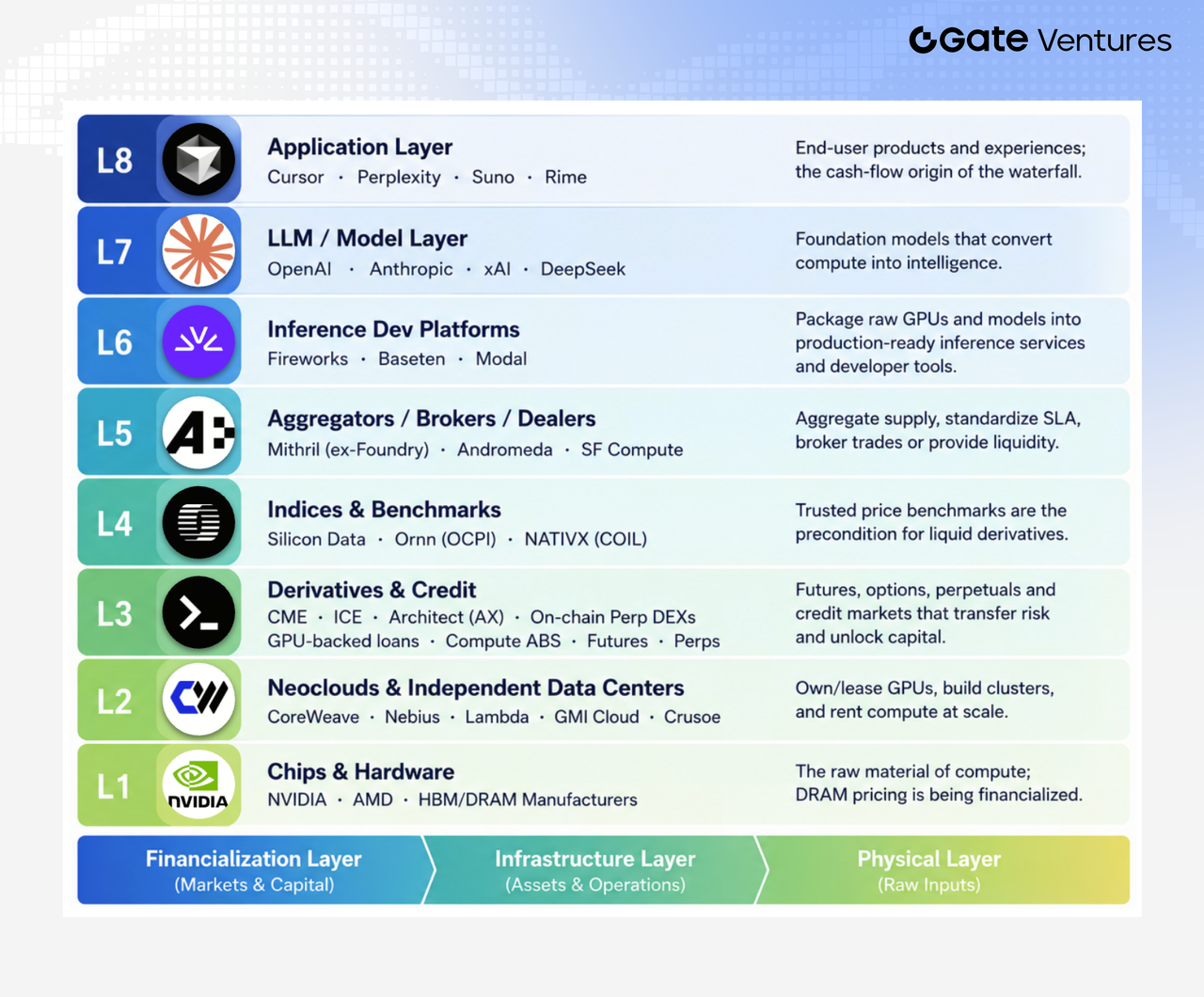
Layer 1 | Chips & Hardware: NVIDIA, AMD, HBM/DRAM manufacturers. This is the raw material at the base of compute. GPUs determine the fundamental supply of available compute, and storage resources like HBM/DRAM are now also being financialized.
Layer 2 | Power & Land: Building a data center isn’t just about having GPUs—it’s about securing suitable land and sufficient power access. A significant portion of compute’s marginal cost comes from electricity, making it more commodity-like to power than to oil.
Layer 3 | Neocloud & Independent Data Centers: CoreWeave, Nebius, Lambda, GMI Cloud, Crusoe, and others. These players purchase GPUs, build clusters, and rent compute to AI companies—essentially acting as the "mines" and "oil fields" of the compute market.
Layer 4 | Aggregators & Brokerage Platforms: Mithril, Andromeda, SF Compute, etc. These platforms may not own GPUs themselves but help buyers source supply, standardize SLAs, facilitate transactions, and sometimes act as market makers. They resemble commodity traders like Glencore and Vitol.
Layer 5 | Indices & Benchmarks: Silicon Data, Ornn (OCPI), NATIVX (COIL). Without reliable price benchmarks, futures and derivatives markets can’t develop. This layer turns opaque compute pricing into trackable, verifiable market prices.
Layer 6 | Derivatives & Credit: CME, ICE, Architect, on-chain perpetual DEXs, GPU-backed loans, compute ABS, and related tools. This layer enables hedging of compute price risk and transforms GPU capacity into a financeable asset.
Layer 7 | Inference Development Platforms: Fireworks, Baseten, Modal, etc. They package underlying GPUs, model deployment, and inference APIs, allowing developers to use model inference as easily as cloud services without managing complex compute infrastructure.
Layer 8 | LLM / Model Layer: OpenAI, Anthropic, xAI, DeepSeek, and others. These companies convert compute into model capabilities and intelligent outputs, serving as the core middle layer connecting infrastructure and application experience.
Layer 9 | Application Layer: Cursor, Perplexity, Suno, Rime, etc. This layer interfaces directly with end users, turning model capabilities into tangible products and use cases—serving as the main entry point for AI demand and user monetization.
This nine-layer waterfall highlights a key fact: compute is the intermediate commodity of the AI economy. Below, it connects chips, power, land, and capital expenditure; above, it links inference platforms, model companies, and applications.
Every AI application’s model call essentially consumes a small piece of upstream compute. Because compute sits in the middle of the value chain—with GPU and data center asset holders on one side and model companies, inference platforms, and application developers needing stable compute on the other—when price volatility grows and their risk exposures diverge, compute naturally begins to undergo financialization.
Why a Compute Market Is Needed: Hedging Demand & Market Structure
Who Needs Hedging
Source: X @0xfishylosopher
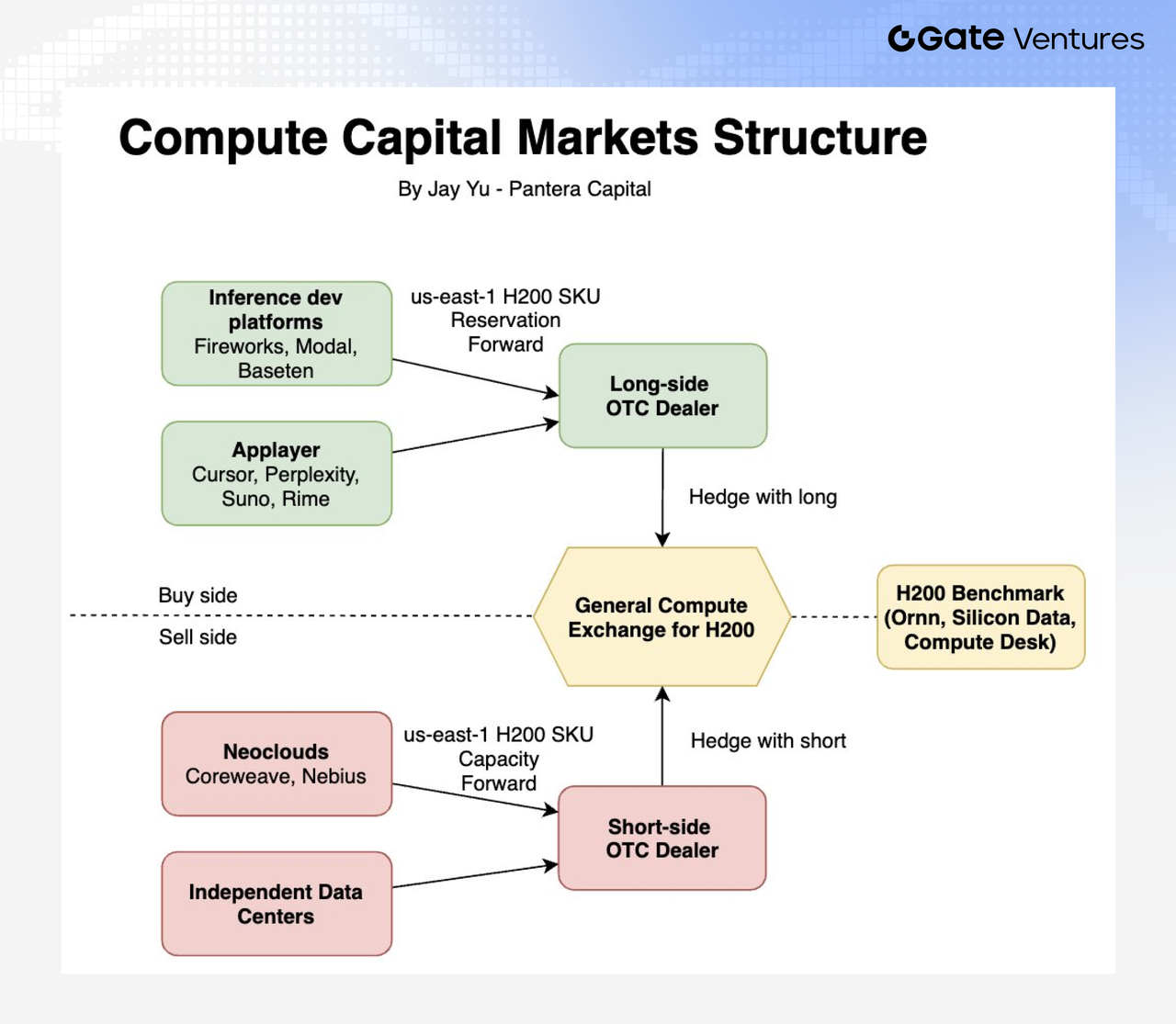
The primary hedging demand in the compute market comes from industry participants with real compute exposure—not financial institutions. This mirrors how airlines hedge fuel prices and power plants hedge electricity prices.
Neoclouds and independent data centers like CoreWeave, Nebius, and Lambda own physical GPU assets, earning revenue from future rental fees. They worry about GPU rental rates dropping, making them natural sellers/shorts who need to sell forwards to lock in income.
Inference development platforms such as Fireworks, Baseten, and Modal buy compute upstream and provide inference APIs and model deployment services downstream. Compute is a major cost for them.
Application companies like Cursor, Perplexity, Suno, and Rime also need to continually purchase inference capacity. Inference costs directly affect their gross margins. Thus, both middle and upper layers are natural buyers/longs, needing to buy forwards to lock in costs.
Hyperscale cloud providers like Google, Amazon, and Microsoft are unique. They own data centers, cloud platforms, models, and applications, and have built-in natural hedging within their operations.
Why Compute Resembles Power More Than Oil
Compute is not a fully fungible commodity.
Even an hour of H100/H200 capacity varies in value depending on chip specs, region, latency, network connectivity, cluster size, reservation window, SLA, data security, and specific workload.
More critically, compute cannot be stored. Unused GPU hours today can’t be stockpiled for sale next year like oil. Thus, compute’s commodity characteristics are closer to electricity: it’s temporal, regional, and highly dependent on local infrastructure.
This leads to three outcomes:
First, real compute transactions often require bilateral customization around specific SKUs and delivery conditions.
Second, the market currently lacks a unified, transparent price benchmark like WTI crude oil.
Third, indices and benchmarks become crucial. Teams like Silicon Data, Ornn, and Compute Desk focus on turning fragmented compute prices into trackable, hedgeable market signals.
Previous Generation Web3 Decentralized Compute vs. New Compute Dealers
The compute market isn’t entirely new. In the last cycle, Akash, io.net, Aethir, and other Web3 projects promoted the "decentralized compute market" narrative, connecting idle GPUs worldwide via token incentives.
But why did most of these earlier projects fail to become mainstream AI compute procurement layers, while new players like Andromeda and SF Compute quickly secured enterprise clients and dollar revenue?
Different Offerings: Decentralized Supply vs. Deliverable Capacity
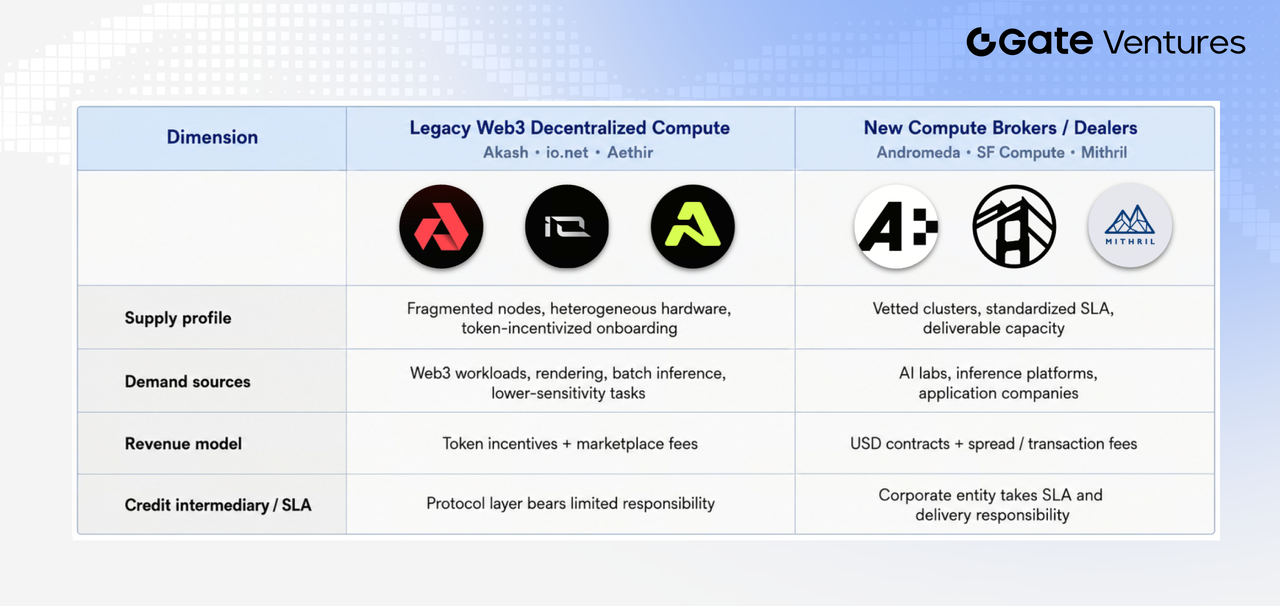
Earlier Web3 projects focused on connecting fragmented GPUs to a network and incentivizing supply with tokens, allowing users to buy compute at lower costs.
They solved the "where are GPUs" problem.
However, enterprise buyers care about a different set of questions: Is it H100/H200? Is there InfiniBand? Is the cluster big enough? Can it run stably for weeks or months? Who is responsible for the SLA? Who compensates for failures?
In other words, enterprise clients don’t buy "somewhere there is a GPU"—they buy deliverable, measurable, accountable GPU capacity.
Distributed, heterogeneous, cross-operator GPU supply can be useful for batch inference, rendering, or low-sensitivity tasks, but for large model training and production-grade inference, stability, network conditions, and delivery accountability are paramount.
Four Structural Issues of the Previous Generation
First, token incentives drive supply but not necessarily real demand.
Token subsidies can quickly inflate node counts, GPU numbers, and network scale, but if demand is mainly driven by token narratives rather than organic paying customers, utilization, revenue quality, and price discovery are easily distorted.
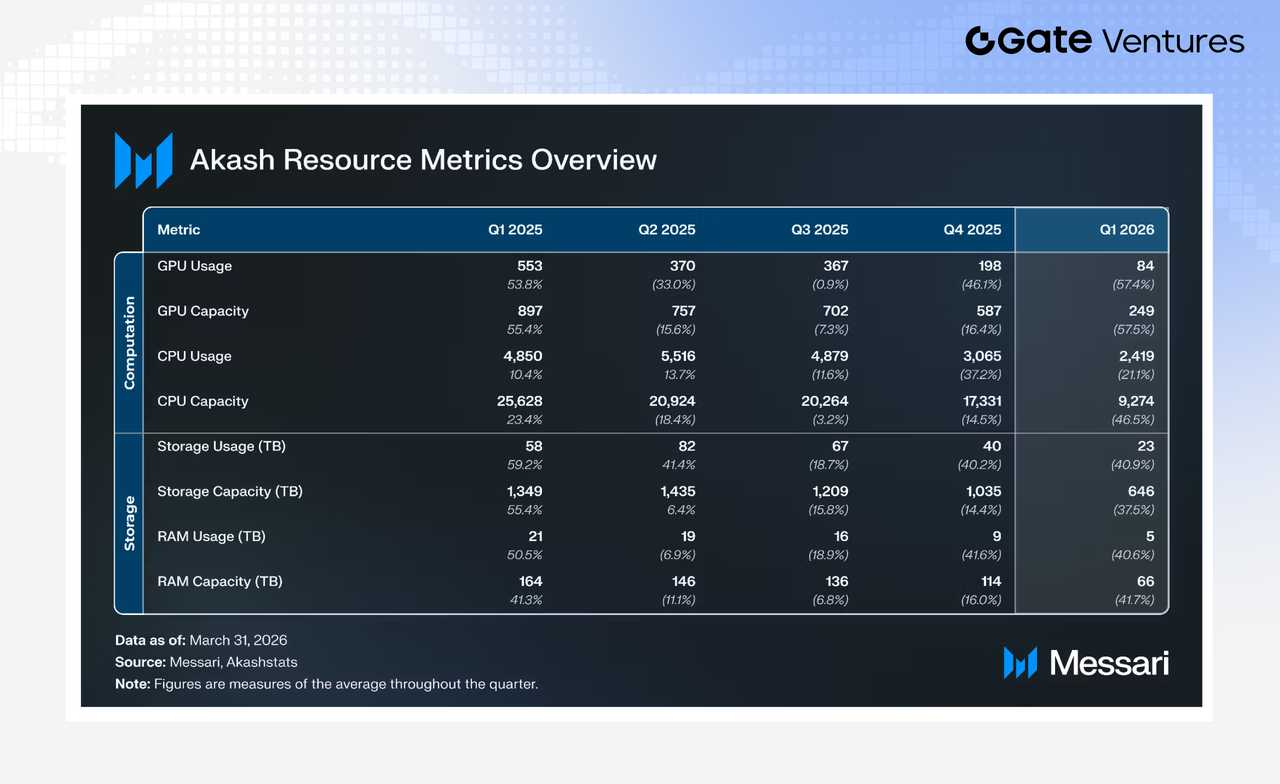
According to Messari’s "State of Akash Q1 2026," Akash’s average GPU usage dropped 57.4% quarter-over-quarter to 84 units, and average available GPU capacity fell 57.5% to 249 units, indicating significant contraction on both supply and demand sides. io.net’s early mechanism rewarded nodes for being online regardless of whether their GPUs performed real work; its token price has fallen sharply from historical highs, only launching a more demand-driven incentive model in June 2026.
Second, enterprise-level SLAs are hard to guarantee with just protocols.
Enterprise clients need invoices, support channels, standard SLAs, refund mechanisms, compliance checks, and legal accountability—all requiring a clear commercial entity, not just protocol-layer reliance.
Third, AI workloads and decentralized supply are inherently mismatched.
Large-scale synchronous training and production inference require high standards for GPU interconnects, NVLink/InfiniBand, cluster scheduling, fault recovery, and data security. Geographically dispersed, hardware-heterogeneous networks struggle to meet these demanding workloads.
Fourth, token pricing doesn’t align with enterprise procurement processes.
Enterprises prefer dollar contracts, invoices, budget approvals, and vendor management, and are reluctant to take on token price volatility, accounting complications, and compliance uncertainties.
Notable Exception: Aethir
Aethir stands out as an exception.
In 2025, Aethir generated over $127 million in revenue, serving more than 150 paying enterprise clients and managing 430,000 GPU containers, covering high-end GPUs like H100, H200, B200, and B300. By self-reported metrics, its revenue exceeds Andromeda’s $100 million run-rate and far outpaces SF Compute.
Aethir’s approach is to leverage Web3’s tokens and network effects at the capital structure and ecosystem incentive layer, while making the customer-facing side more centralized, standardized, and enterprise-grade: centralized or semi-centralized clusters, clear service commitments, dollar-denominated contracts, enterprise support, and delivery responsibility.
Tokens can help with early-stage financing, incentivizing supply, and organizing the network, but shouldn’t be the primary interface for enterprise compute procurement.
What’s New About the Next Generation of Dealers
The new generation doesn’t start with "build a decentralized network"—they directly address the pain points of AI buyers.
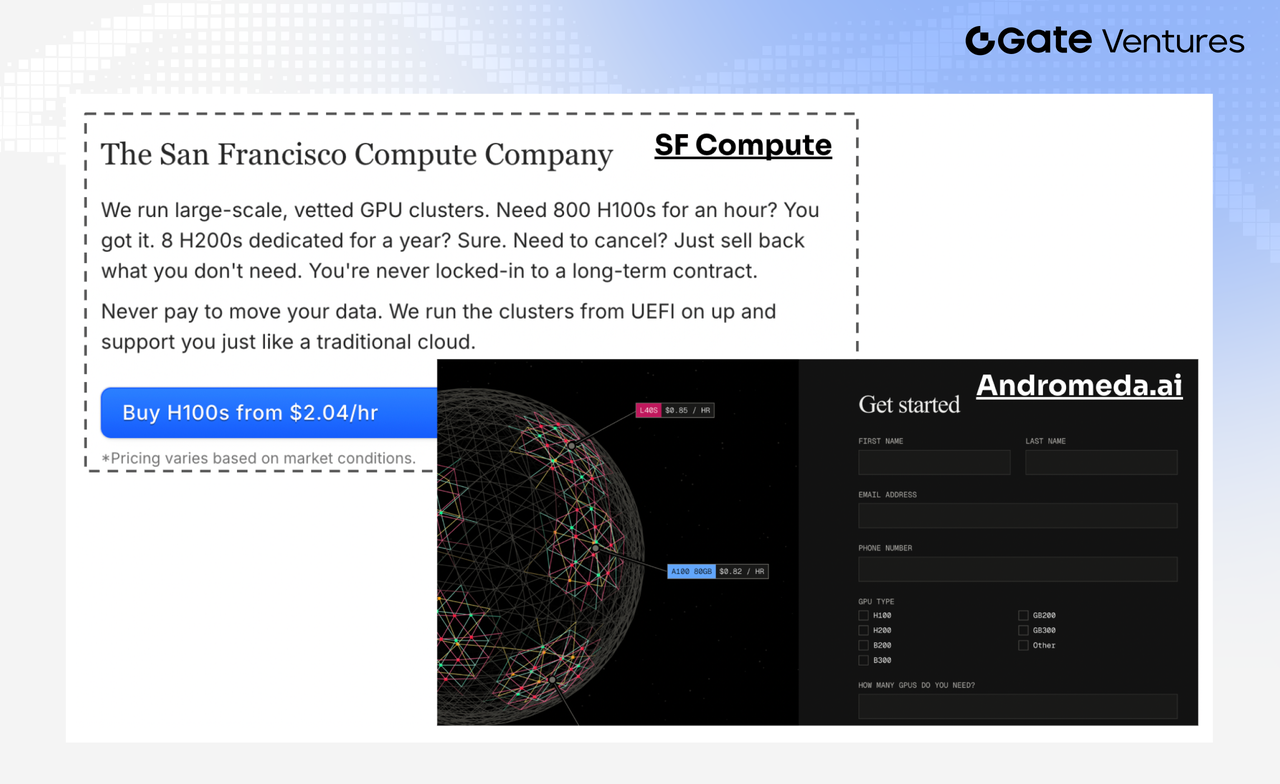
AI companies often need to sign long-term compute contracts, but real demand fluctuates. SF Compute’s approach lets customers buy long-term compute capacity financed by third parties, then resell or sublease unused portions via an order book. SF Compute doesn’t own GPUs itself, acting more like a secondary liquidity market built around compute contracts.
Andromeda is closer to a compute dealer: it compares prices across 100+ suppliers in real time, verifies performance, standardizes SLAs, and acts as the sole contract counterparty for clients. Its value isn’t just matchmaking—it takes on procurement, delivery, and partial credit intermediary roles, calling itself a "market maker for compute."
Andromeda trades principal, holds or controls inventory, earns spreads, and assumes SLA and delivery responsibility. SF Compute is more like an exchange/broker hybrid: it focuses on agency matchmaking and secondary liquidity, may not hold underlying GPUs, and earns transaction fees and network effects.
GMI Cloud is a special case. It’s not a typical broker/dealer but more of a neocloud: it builds its own data centers, owns assets, and sells GPU cloud capacity. It’s also a user of GPU debt financing, with most of its Series A funding in debt, making it closer to a compute producer in layer 3.
What the market needs most now is not a more decentralized ideal cloud, but a trading layer that can deliver H100/H200 capacity today, guarantee SLAs, and help buyers reduce long-term contract risk.
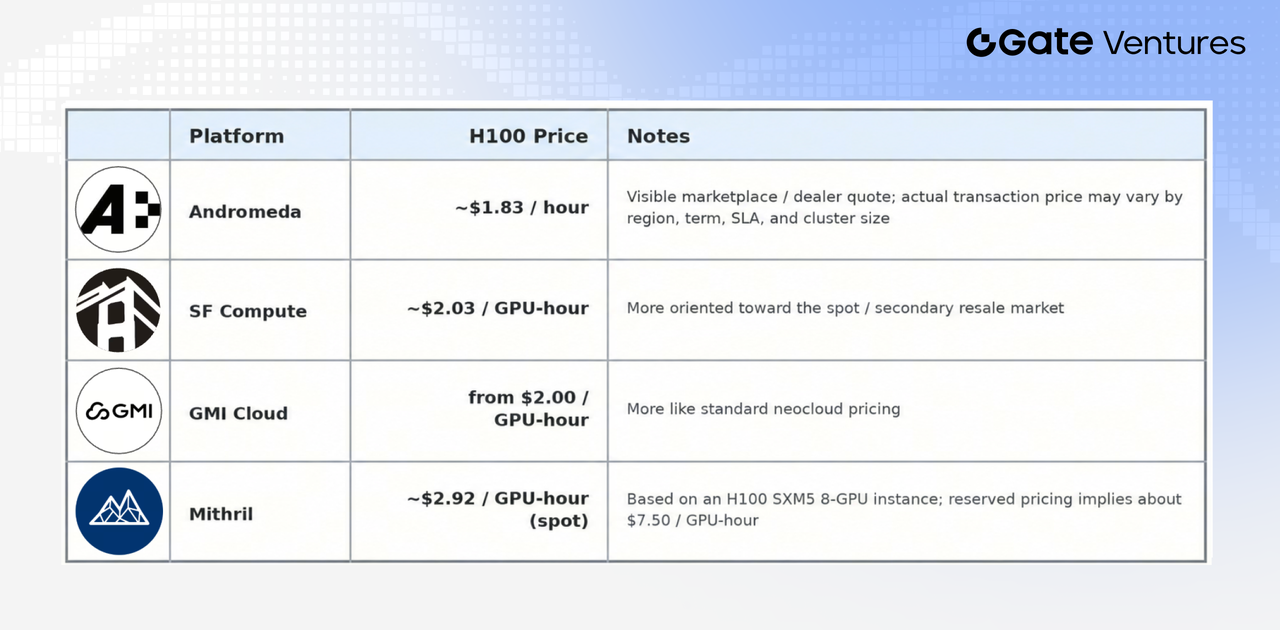
Is There Already a Compute Price Discovery Market?
Currently, most compute trading is still OTC/bilateral and highly customized. Public quotes are improving market transparency, but mainly serve as a starting point for price discovery—not as a unified trading price.
For H100, observable price ranges have emerged: Andromeda quotes around $1.83/hour, SF Compute averages $2.03/GPU-hour, GMI Cloud starts at $2.00/GPU-hour, and Mithril’s H100 SXM5 8-GPU instance spot price converts to about $2.92/GPU-hour.
This means public H100 prices generally fall in the $1.8–3.0/GPU-hour range. However, these prices aren’t directly comparable due to differing delivery conditions. GPU type, location, network connectivity, cluster size, rental term, SLA, and workload all significantly impact final transaction prices.
Thus, enterprises typically don’t buy an abstract "H100 hour," but a capacity contract designed around specific SKUs, regions, terms, cluster configurations, and delivery conditions. Web quotes make compute pricing visible, but the real trading core remains highly customized OTC contracts.
Ornn: Building the Index Layer for Compute Markets
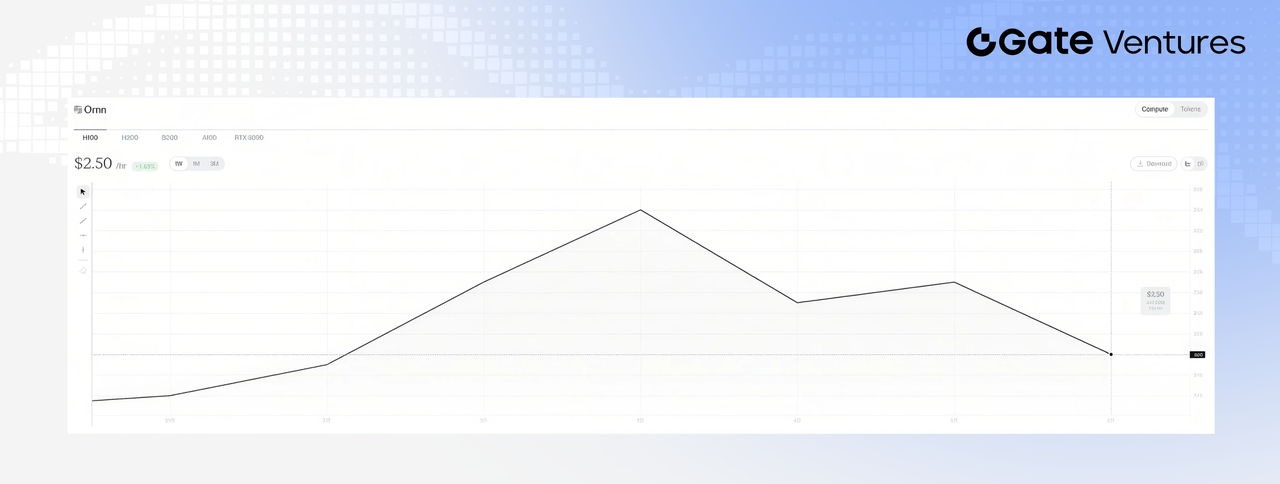
Source: Ornn
Ornn isn’t just selling compute—it’s building the price infrastructure for the compute financial market. Its Ornn Compute Price Index (OCPI) tracks real-time spot transaction prices for H100, H200, B200, B300, and organizes these into indices for pricing, hedging, and settlement. Ornn’s website calls OCPI the reference price for compute, used in compute derivatives market pricing, hedging, and settlement.
Ornn aims to be the "Platts/Argus/WTI-style benchmark" for compute: standardizing fragmented GPU rental prices, then enabling the market to trade forwards, futures, or perpetual contracts around this benchmark.
Ornn’s roadmap can be summarized in three steps:
First, establish the spot price index—OCPI.
Second, license OCPI to exchanges and derivatives platforms for contract settlement.
Third, build financial products around the index: futures, perps, hedging, and lending.
Architect: Bringing Perpetual Contract Structures to Institutional Compute Trading
Architect is a player focused on the compute derivatives trading venue. Founded by former FTX US president Brett Harrison, its institutional trading platform AX collaborates with Ornn to launch exchange contracts based on GPU rental and DRAM prices.
Mechanically, Architect doesn’t deliver real H100/H200 compute; instead, traders gain financial exposure to GPU rental and memory prices by trading contracts tracking the Ornn compute index. Its products resemble crypto market perpetual contracts: traders use margin to trade index-linked contracts, with contract prices anchored to underlying GPU rental prices via index and funding rate mechanisms.
Architect’s significance lies in introducing crypto-native perpetual contract mechanisms to a more institutional, regulated compute trading environment. Architect acts as the derivatives trading layer, while Ornn provides the index benchmark.
Lighter: On-Chain Perpetuals Enable Early Tradable Price Discovery
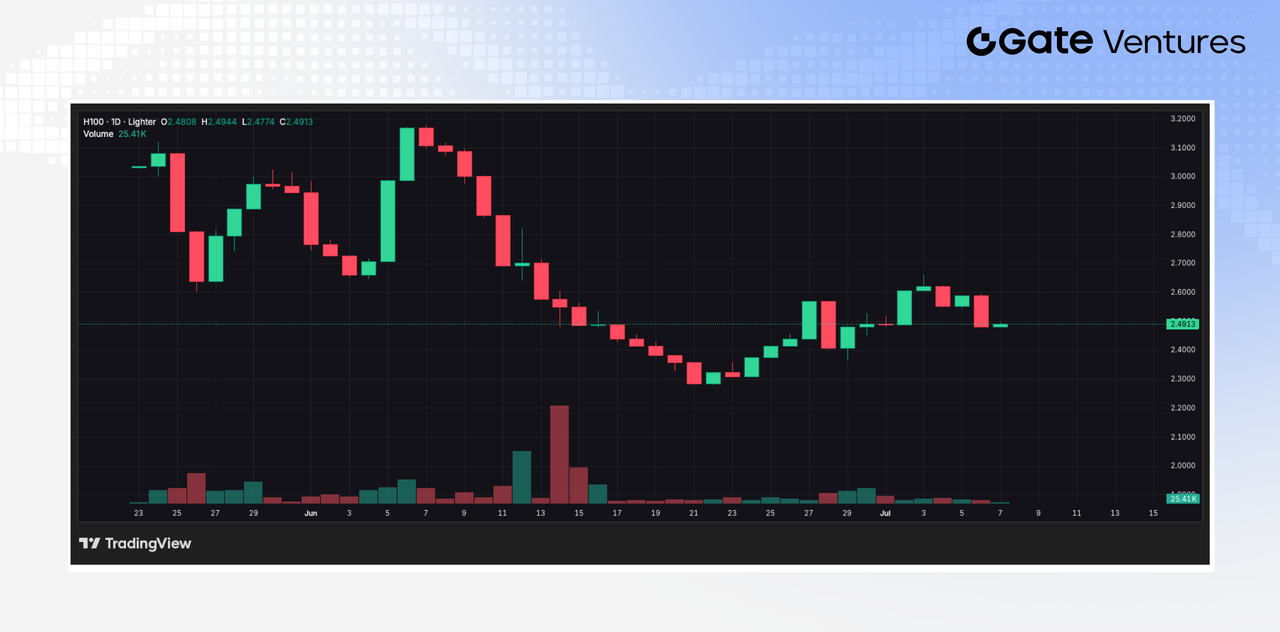
Lighter is more like an early on-chain compute perp venue. The platform has launched $H100, allowing users to trade H100 compute price exposure with up to 10x leverage; the product tracks the Ornn H100 Compute Price Index.
These products let the market form continuous, tradable on-chain price signals for GPU rental rates for the first time. While they don’t solve real GPU delivery or serve as the main channel for enterprise compute procurement, they offer early venues for speculation, hedging, and price discovery.
Mechanically, they’re similar to crypto market perpetuals: traders don’t physically settle H100 compute, but trade contracts tracking the H100 index, with contract prices anchored via index and funding rate mechanisms.
Advantages include fast launch, low participation barriers, and 24/7 trading. Drawbacks are potentially thin liquidity and basis risk compared to real enterprise-grade compute capacity contracts.
ICE × Ornn: Roadmap for a Regulated Futures Market
ICE follows the traditional, regulated exchange path. In May 2026, ICE announced plans to launch GPU compute futures contracts in partnership with Ornn, using the Ornn Compute Price Index as the underlying benchmark. ICE’s announcement specifies that OCPI tracks live-traded spot prices for H100, H200, B200, B300; contracts will be dollar-denominated, cash-settled, and await regulatory approval.
ICE’s mechanism differs from Lighter. Lighter is on-chain perpetuals, ideal for rapid price formation and speculative liquidity; ICE is a regulated futures market, better suited for institutional participation, clearing, risk management, and compliance hedging.
However, ICE contracts are cash-settled, not physically delivered. Traders don’t actually deliver or receive H100 capacity; profits and losses are settled based on indices like OCPI. This reduces delivery complexity, but contract success depends on whether the index is trustworthy, manipulation-resistant, and representative of real market prices.
Market Outlook
Three Key Directions to Watch
Institutionalization of OTC Desks
The endgame for compute markets may not be industry players trading futures directly on exchanges, but dealers handling customized industry needs and managing risk via indices, futures, or perpetuals. Over the next 12–24 months, it’s crucial to watch if players like Andromeda and SF Compute can evolve from "compute procurement platforms" to true "compute trading desks": handling SKU-level spot and reserved demand, while hedging inventory and basis risk in index markets. Whoever achieves this first could become the core intermediary of the compute market.
Closed Loop of Credit & Derivatives
If "GPU-backed financing + futures hedging" works, lenders can better manage GPU price volatility and residual value risk, reducing haircuts and financing costs. This will directly boost capital efficiency for AI infrastructure—one of the most important impacts of compute financialization on the real AI industry.
Formation of Price Benchmarks & Settlement Systems
For compute to become a truly tradable and financeable asset, credible price benchmarks and settlement mechanisms must emerge. Index providers like Ornn, Silicon Data, NATIVX, and trading venues like ICE, CME, Architect, Lighter are competing not just for a single product, but for the pricing power gateway to the future compute market.
Unresolved Issues
Regulatory Approval
CME, ICE, Architect, and related products still require regulatory approval. How compute will be classified—commodity, service, or a new type of tradable resource—remains unclear.
Underlying Spot Market Is Still Thin
Index credibility depends on the depth of real spot transactions. Currently, public spot and secondary markets are still in their early stages, with most compute trading locked in long-term contracts among hyperscalers, neoclouds, and AI companies. Insufficient underlying transactions may affect index representativeness and resistance to manipulation.
Cyclical Risk
If AI capital expenditure slows, spot liquidity may shrink before derivatives markets mature. Meanwhile, GPU rental rates have dropped significantly from their peak, and GPU residual values and depreciation curves lack sufficient historical data, further amplifying uncertainty in credit assessment and derivative pricing.
Reference
https://aethir.com/blog-posts/aethirs-2025-wrap-up-decentralized-gpu-cloud-milestones
https://siliconangle.com/2026/03/18/demand-gpu-startup-andromeda-raises-funding-1-5b-valuation/
https://x.com/0xfishylosopher/status/2071396211731599393?s=20
https://x.com/BrettHarrison/status/2072327852498797048?s=20
https://messari.io/report/state-of-akash-q1-2026-final
https://dashboard.ornnai.com/compute
https://app.lighter.xyz/trade/H100
About Gate Ventures
Gate Ventures is the venture capital arm of Gate, specializing in investments in decentralized infrastructure, ecosystems, and applications, with a mission to reshape the world for the Web 3.0 era. Gate Ventures partners with global industry leaders to empower innovative teams and startups, redefining how society and finance interact.
To learn more, visit: LinkedIn | X | Telegram | LinkedIn | Medium
Disclaimer :
This content does not constitute any invitation, solicitation, or advice. You should always seek independent professional advice before making any investment decisions. Please note that Gate Ventures may restrict or prohibit all or part of its services from restricted regions. For more information, please read the user agreement: https://www.gate.com/user-agreement.


