Summary
-
Energy supply risks in the Middle East pushed up oil prices, expectations for a Fed rate hike rose to 36%, and the 10-year U.S. Treasury yield once climbed to 4.70%. The crypto market as a whole showed strong resilience, with BTC basically flat and ETH maintaining positive returns.
-
BTC and ETH spot ETFs recorded combined net inflows of about USD 138 million, trading volume on the Gate TradFi platform remained at a high level, and U.S. equities again became the core allocation direction.
-
PancakeSwap trading volume overtook Uniswap, PumpSwap rebounded with the recovery in social-media Meme popularity, while Robinhood Chain drove rapid growth in tokenized stock and RWA trading, further dispersing DEX liquidity.
-
ETH LSTs, Aave lending, and capital in the Ethereum ecosystem continued to repair, while emerging chains such as Monad maintained growth. Protocol revenue continued to concentrate in high-frequency applications such as stablecoin issuance, Meme issuance, and trading platforms, and the industry's profitability further converged toward leading infrastructure.
-
BTC maintained an upward center amid high-level consolidation. OI pulled back after surging higher, and funding rates remained positive but gradually declined, showing that the market was still mainly dominated by bulls. Options volume expanded in pulses around the phase of price spikes, 25D Skew continued to repair, and demand for short-dated downside protection declined significantly.
-
DVOL remained in the low 36-38 range, and the market's pricing of future sharp volatility was still restrained. The options market was more inclined to trade high-level consolidation rather than bet on a one-way trend.
1. Market Focus Analysis
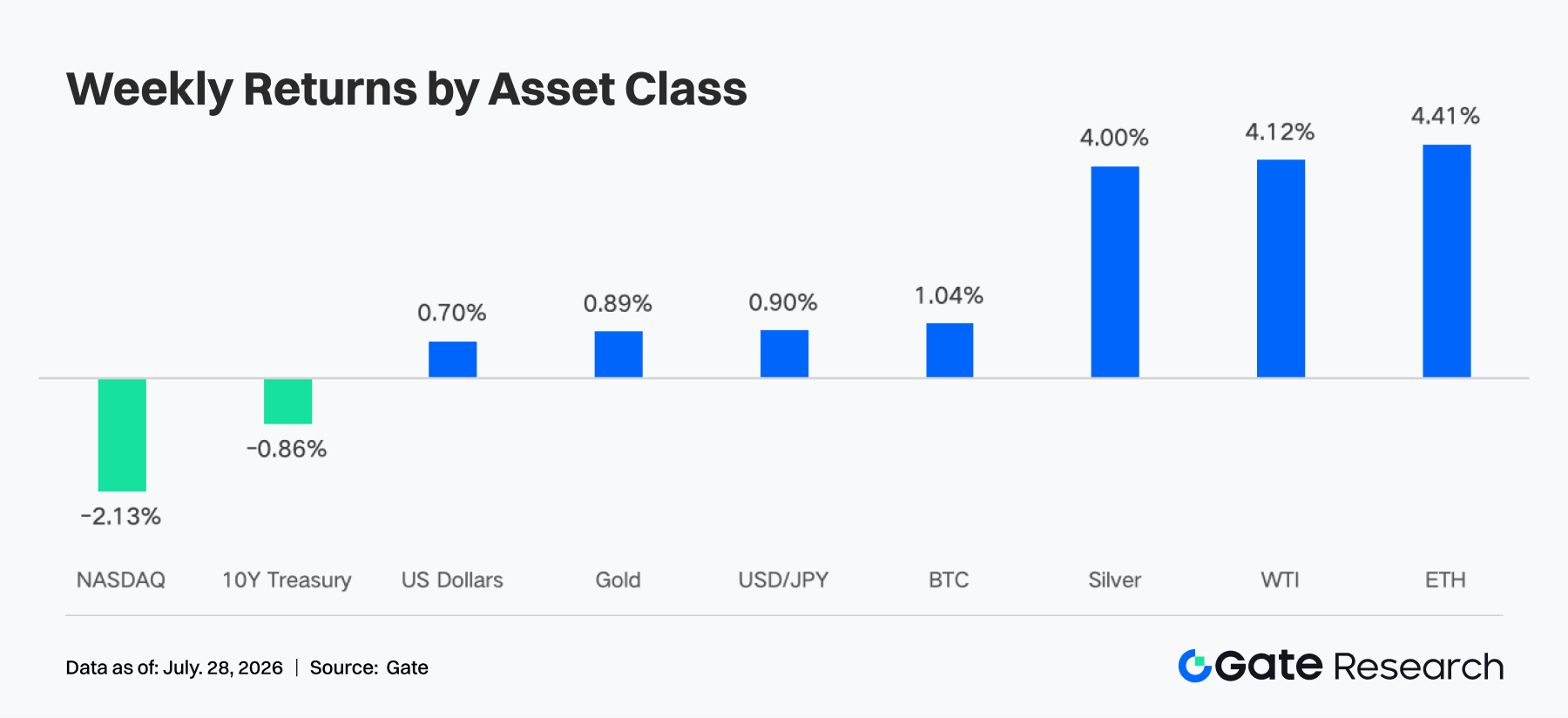
Last week (July 20 to July 26, 2026), the main market themes were jointly driven by Middle East energy supply risks, U.S. tariff policy, and earnings reports from major technology companies. Attacks on oil tankers in the Red Sea and restricted transport through the Strait of Hormuz once pushed Brent crude above USD 100, closing at USD 100.69 on Thursday, up 7% in a single day; although it fell back 3.88% to USD 96.78 on Friday, the energy price shock again lifted inflation and rate-hike expectations. Market pricing showed that the probability of a Fed rate hike at the next meeting rose from about 12% a week earlier to about 36%. The U.S. 10-year Treasury yield once rose to around 4.70% and was quoted at 4.679% on Friday; the 30-year yield was quoted at 5.163%, close to a high since 2007.
High interest rates and concerns over returns on AI investment jointly pressured growth stocks. Alphabet raised its full-year capital expenditure guidance, and AI-related investment in the second quarter nearly doubled year on year to about USD 45 billion. Tesla and Alphabet fell 14.5% and 7.1%, respectively, on Thursday. For the full week, the S&P 500 fell 0.6%, the Dow fell 0.4%, and the Nasdaq fell 2.1%. Risk assets were under valuation and liquidity pressure, but the crypto market was relatively resilient: BTC gave back most of its gains after rallying, while ETH maintained positive returns thanks to capital rotation. Overall, the oil-price shock and the rise in long-end yields limited valuation expansion in crypto assets, while the pullback in oil prices and the repair in risk sentiment over the weekend provided some support to the market.
2. Liquidity Analysis
2.1 Institutions quickly turned to profit-taking after oil prices and tech-stock volatility intensified
Last week, U.S. BTC spot ETFs recorded total net inflows of about USD 34 million, down 55.10% from USD 76 million in the previous week. Cumulative inflows from Monday to Wednesday reached USD 499 million, but combined outflows on Thursday and Friday totaled USD 465 million, showing that institutions quickly shifted to profit-taking after oil prices, interest rates, and tech-stock volatility intensified. At the product level, Grayscale Bitcoin Mini Trust (BTC) had the largest net inflow at about USD 86 million, while IBIT had the largest net outflow at about USD 96 million. Based on the previous base of about USD 77.7 billion, adjusted for coin price and net flows, total BTC ETF AUM was estimated at about USD 78.3 billion on July 24, up about 0.8% week on week.
ETH spot ETFs recorded total net inflows of about USD 104 million, down only 1.61% from USD 106 million in the previous week, marking the third consecutive week of net inflows. ETHA led with about USD 96 million, while FETH saw net outflows of about USD 6 million and was the weakest performer. ETH ETF total AUM was also estimated by proxy, rising from about USD 9.94 billion to about USD 10.1 billion, an increase of about 1.6%. Overall, BTC and ETH ETFs recorded combined net inflows of about USD 138 million, down about 23.9% week on week. Capital did not fully withdraw from crypto assets, but instead showed a clear preference for ETH, which has stronger price elasticity and a lower institutional allocation base, and institutional sentiment shifted from broad-based replenishment to structural selection.
2.2 TradFi Liquidity
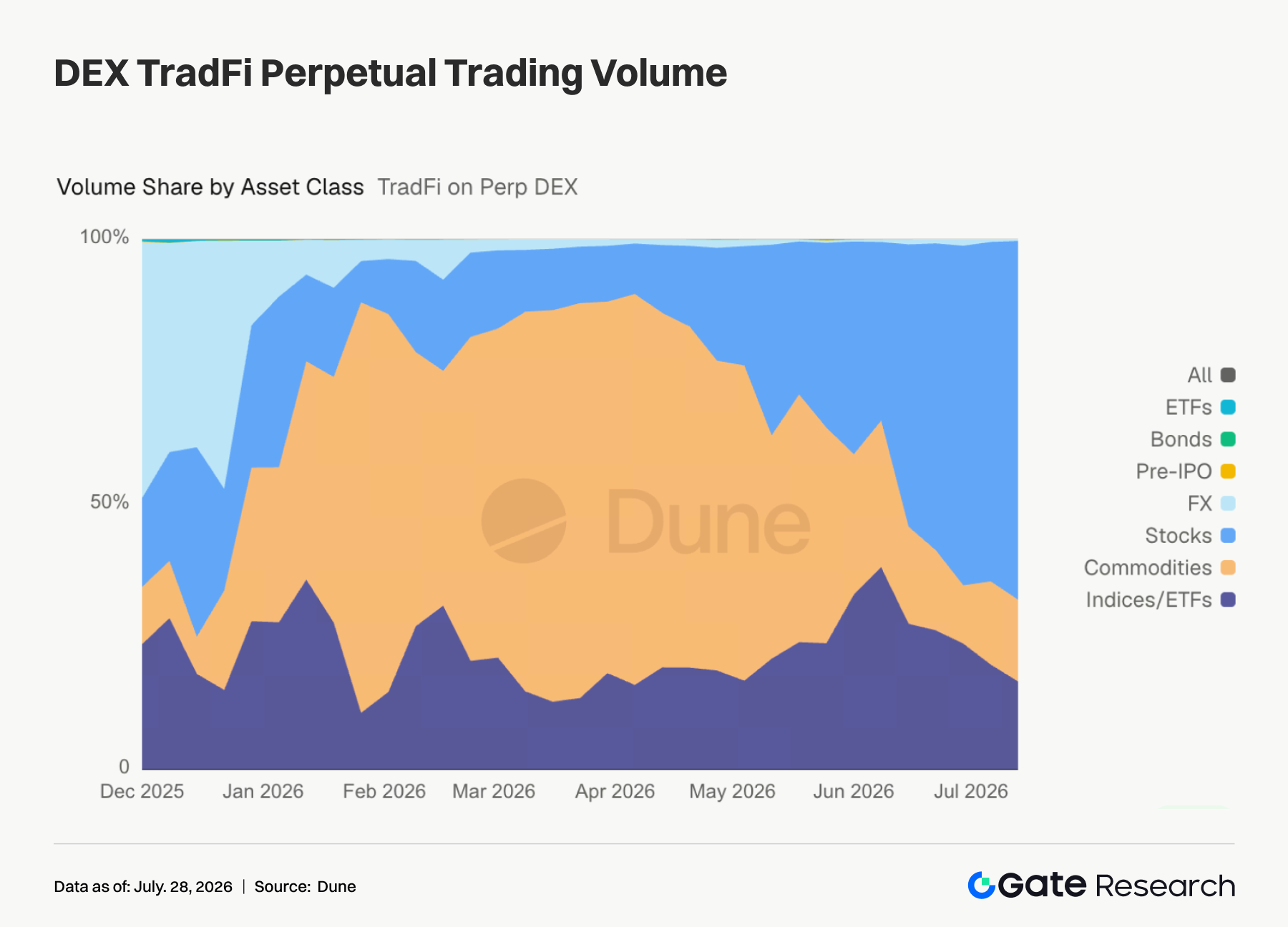
- TradFi Perp DEX: Over the past week, the TradFi trading structure across the entire Gate platform continued to concentrate toward equity assets. The share of equity trading volume climbed continuously from about 55% to nearly 70%, once again becoming the platform's most important TradFi trading category. The share of commodities, by contrast, fell back from about 35% to about 15%, showing a clear cooling of earlier hot themes. Index/ETF products maintained a stable share of about 15%-20%, forming the second tier of trading categories, while trading shares of other assets such as foreign exchange, bonds, Pre-IPO, and ETFs remained consistently low. Overall, capital is rotating back from phase-driven commodity trading into the equity market, and the focus of platform TradFi trading has once again returned to equity assets, with a more concentrated trading structure.
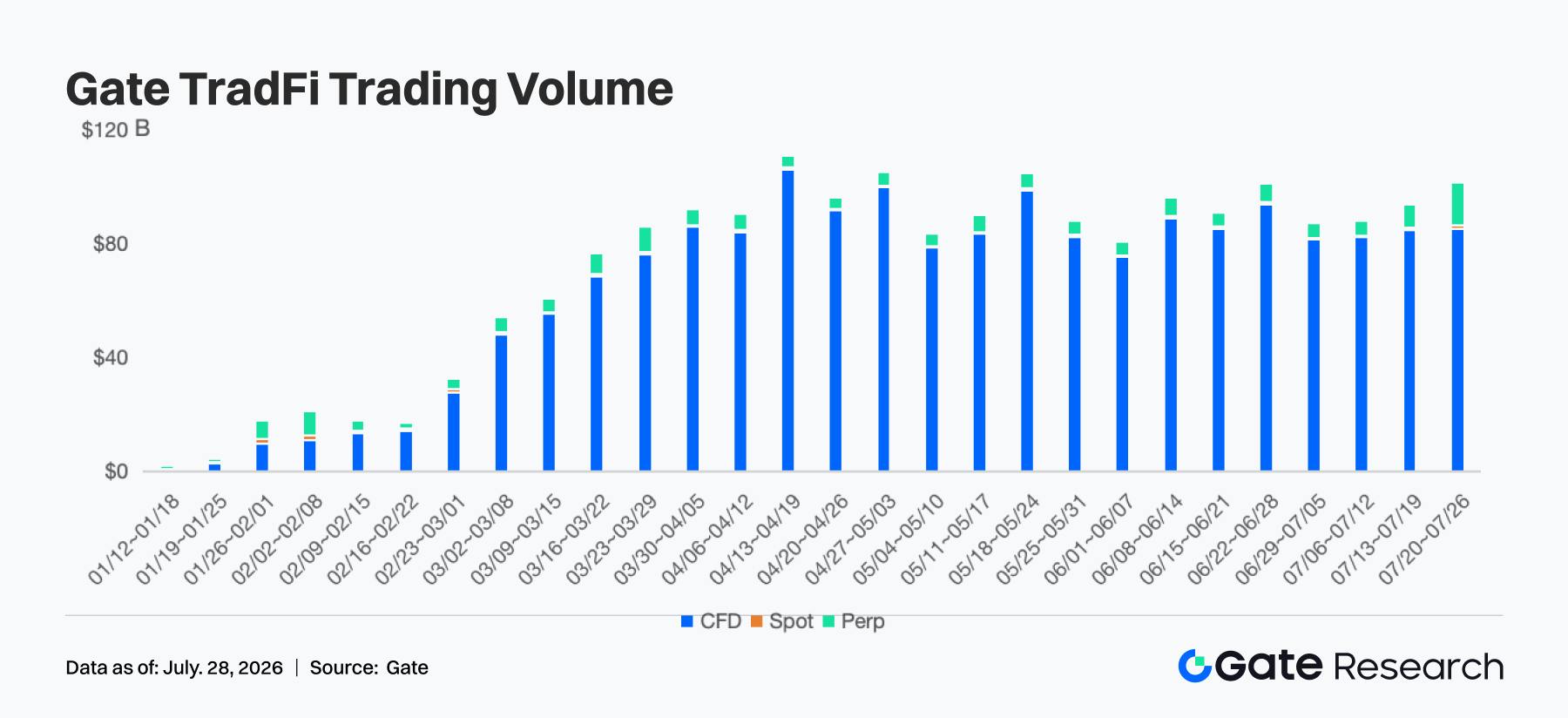
- Gate TradFi Trading Volume: Over the past week, Gate equity trading volume overall remained stable at a high level, with weekly turnover staying in the range of about USD 85 billion to USD 100 billion, showing a clear narrowing in volatility compared with earlier periods. Among this, CFDs remained the absolute main source of trading, while perpetual product volume rose slightly. Overall, against a backdrop of relatively stable market risk appetite, platform equity trading activity remained at a relatively high level.
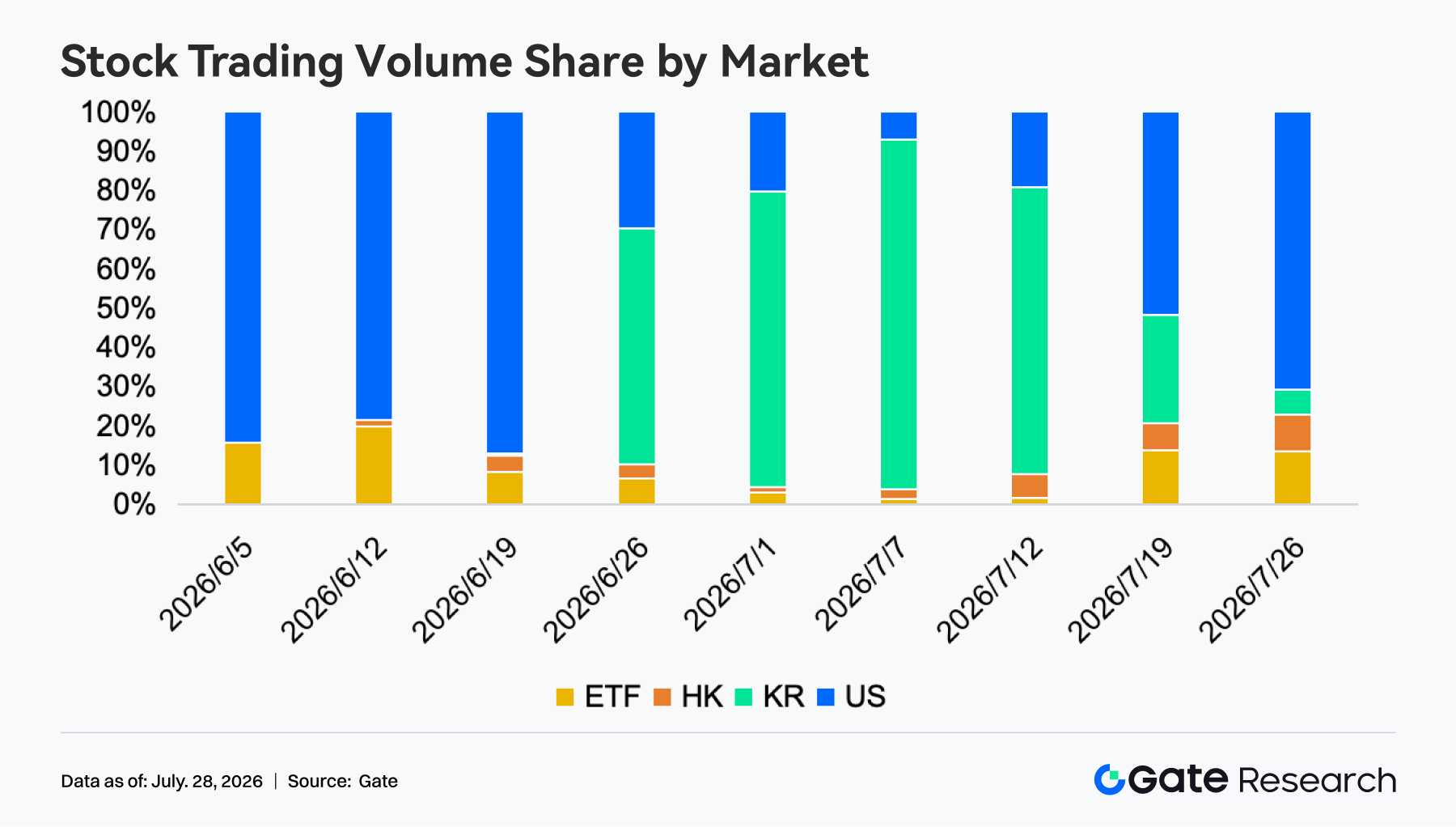
- Gate Equity Asset Trading Volume: Over the past week, the asset allocation structure of Gate equities adjusted significantly. U.S. equities remained the core of asset allocation, but their share quickly rebounded from about 52% to about 71%, once again becoming the absolute core market. The share of Korean equities, by contrast, dropped sharply from about 28% to about 7%, and the earlier concentrated allocation retreated significantly. At the same time, the shares of ETFs and Hong Kong equities both edged up to about 14% and 8%, showing that while maintaining U.S. equities as the core allocation, users also began to increase diversified allocations to ETFs and Hong Kong equities. The overall asset structure shifted back from an earlier bias toward the Korean market to a diversified allocation led by U.S. equities.
- TradFi Order Book Depth: We selected XAUT, which had the highest TradFi trading volume, to analyze its order book depth (Delta). Over the past week, XAUT order book liquidity remained generally strong. On July 21-22, bid-side depth once turned negative and the liquidity gap widened, corresponding to a brief price pullback to around USD 4,000. Buying interest then recovered quickly, with net liquidity turning positive again from July 22-24, accompanied by a price rebound to around USD 4,150. During July 25-27, order book depth remained positive and volatility narrowed. Although there was occasional short-term selling pressure, it was absorbed by new buy orders. Overall, XAUT showed strong bid-side absorption capacity over the past week, the liquidity environment continued to improve, and the price consolidated at high levels before ultimately stabilizing in the USD 4,080-4,100 range, with market sentiment still leaning bullish.
3. On-Chain Data Insights
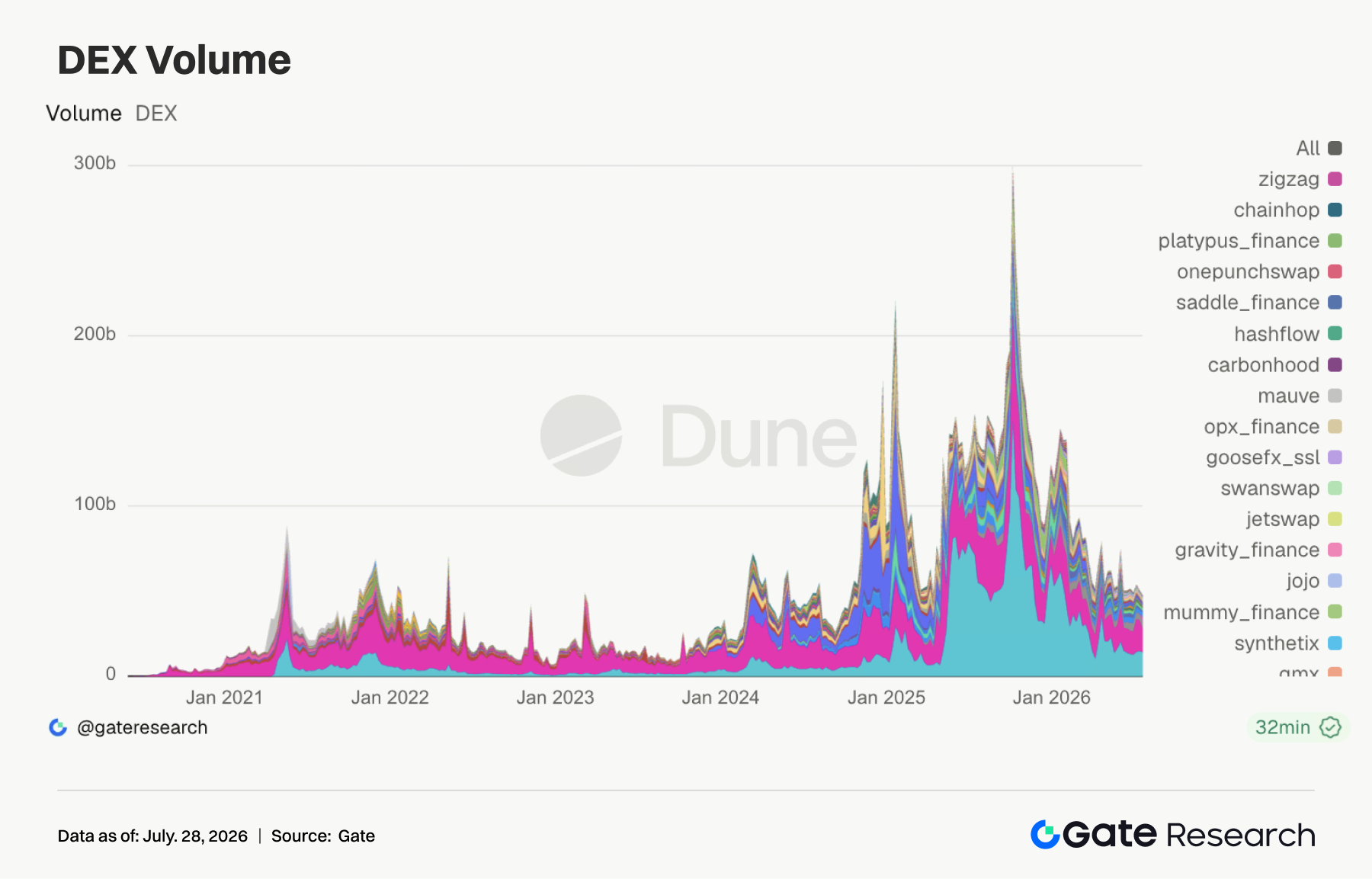
This week, PancakeSwap turnover reached about USD 14.27 billion, overtaking Uniswap's USD 13.69 billion. Uniswap declined significantly from the previous week, but its number of traders continued to rise to about 1.01 million. Meme attention brought by Robinhood Chain remained, but large transactions began to diverge. Over the past week, the RWA scale on Robinhood Chain grew rapidly, and tokenized stocks began to generate real trading, but mainstream on-chain trading was still dominated by Memes and stablecoins. At the same time, Native turnover jumped from about USD 447 million to USD 3.47 billion, related to routing demand for its RWA/equity trading pairs such as QQQB and NVDAon. PumpSwap turnover rose to about USD 3.86 billion, and the number of traders increased to about 1.64 million, as short-term Meme trading driven by social media became active again. However, Meteora, Raydium, and Whirlpool continued to pull back, and the Solana side did not form a full recovery.
3.2 Stablecoin supply moved sideways overall, and the focus of competition shifted to distribution channels and yield allocation
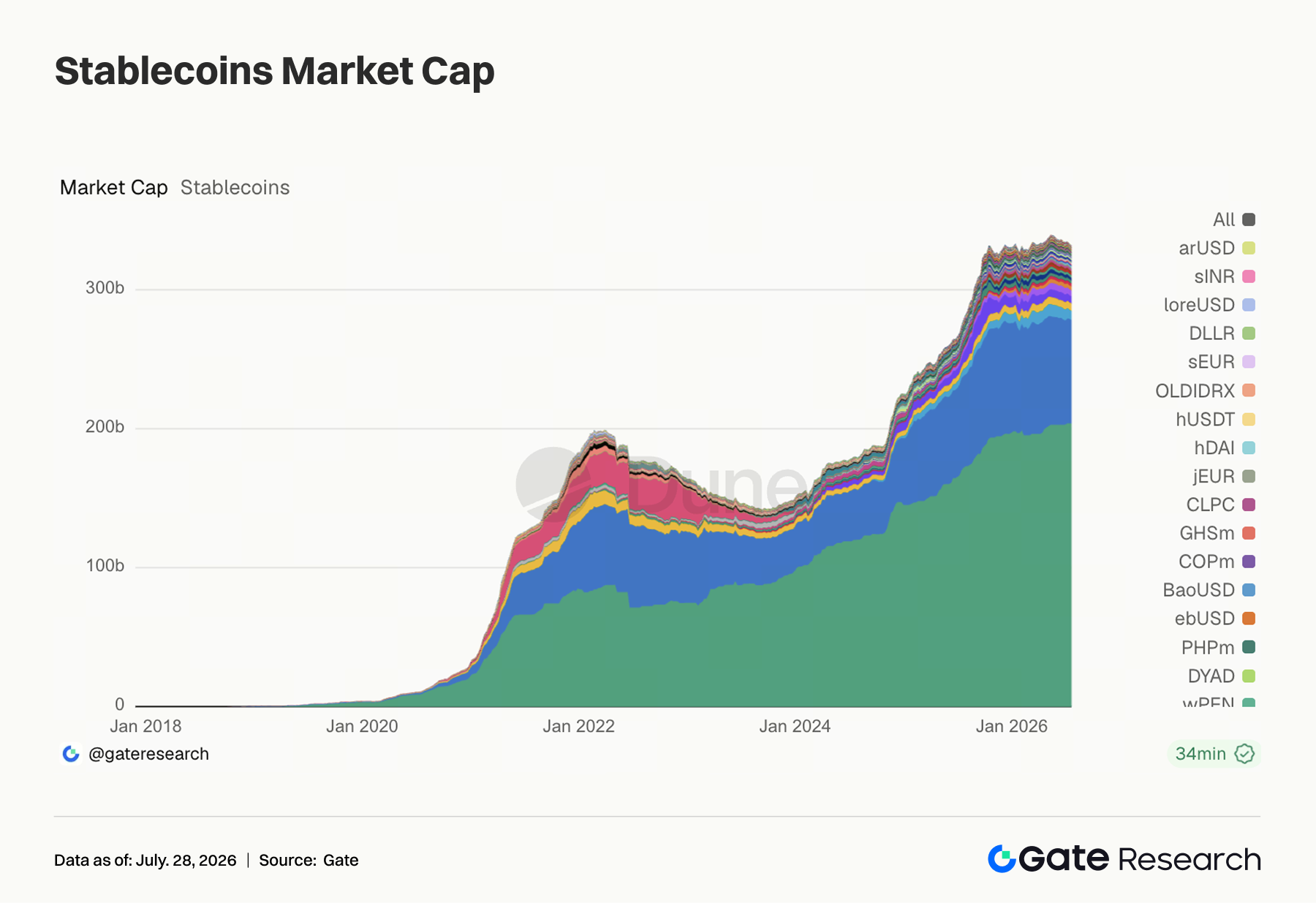
This week, USDT was basically flat, while USDC fell slightly from about USD 75.29 billion to USD 74.44 billion, and leading stablecoins did not see significant incremental growth. USDe, USD1, and PYUSD pulled back, and yield-bearing and branded stablecoins did not continue expanding in the short term. By contrast, USDG, USDGO, RLUSD, and GHO maintained growth, showing that new demand came from specific ecosystems and application scenarios. Over the past week, the focus of the stablecoin market was competition for distribution rights: the Visa Stablecoin Platform integrated Open USD, packaging stablecoin issuance, wallets, payments, and corporate treasury operations into an institutional product; at the same time, detailed rules under the U.S. GENIUS Act did not fully land on schedule, leaving compliant stablecoin issuance still in a waiting period for rules. No large amount of new U.S. dollar capital entered the market, and payment companies, brokers, and DeFi yield gateways are reallocating the channel value of stablecoins.
3.3 ETH LSTs continued to repair, while SOL and HYPE staking assets continued to cool
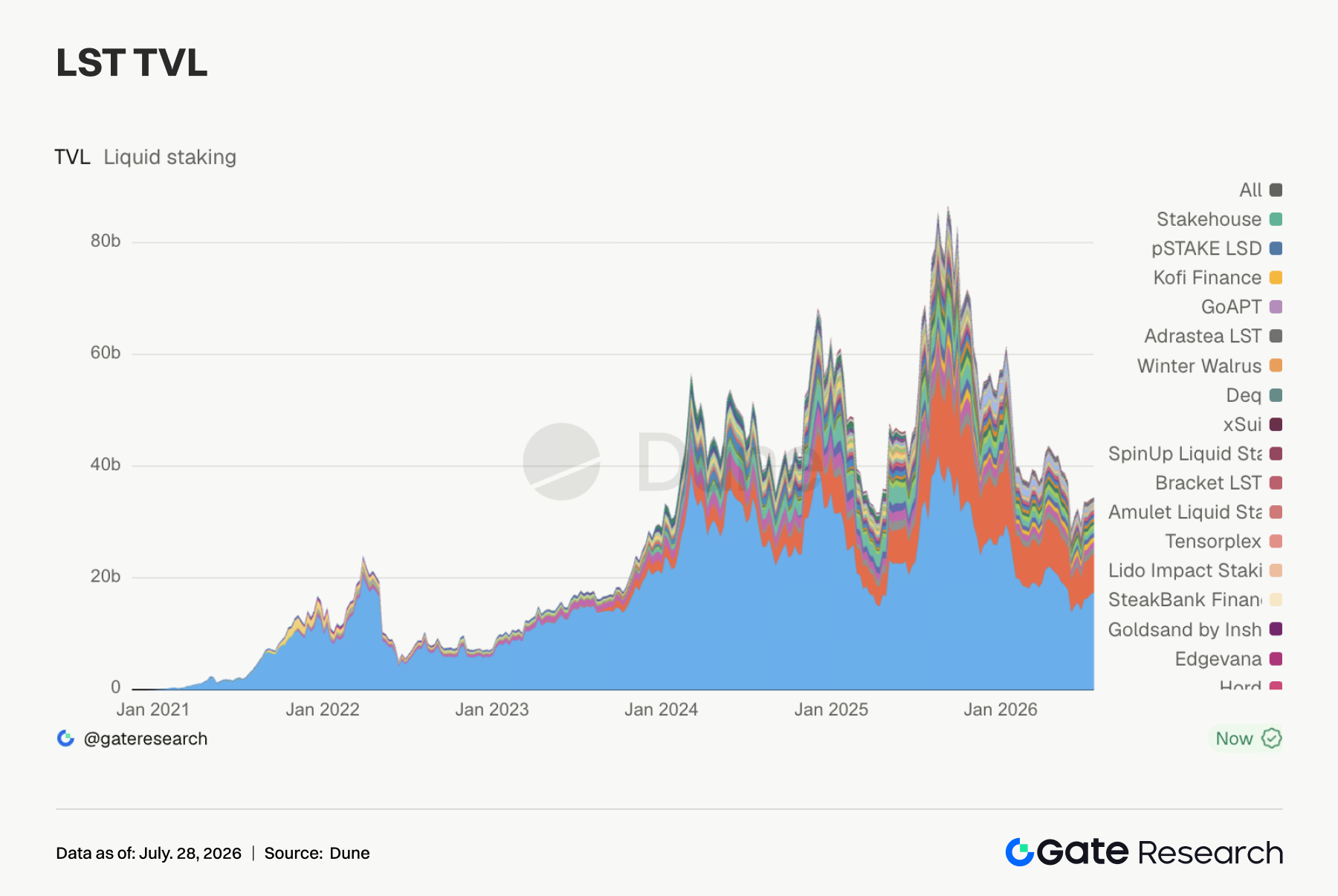
The LST sector continued to diverge. Lido TVL rose to about USD 17.5 billion, while Rocket Pool, StakeWise, Liquid Collective, and mETH Protocol all edged higher. ETH staking assets remained the core of capital preference. Catalysts behind this included the return of ETH ETF inflows, Robinhood Chain using ETH as gas and settlement asset, and RWA/stablecoin infrastructure once again developing around Ethereum. By contrast, SOL LSTs such as Sanctum, Jito, Jupiter Staked SOL, and Binance Staked SOL continued to decline slightly, while Kinetiq kHYPE and stHYPE also pulled back.
3.4 Aave lending was driven by Ethereum and Monad, and divergence among emerging chains widened further
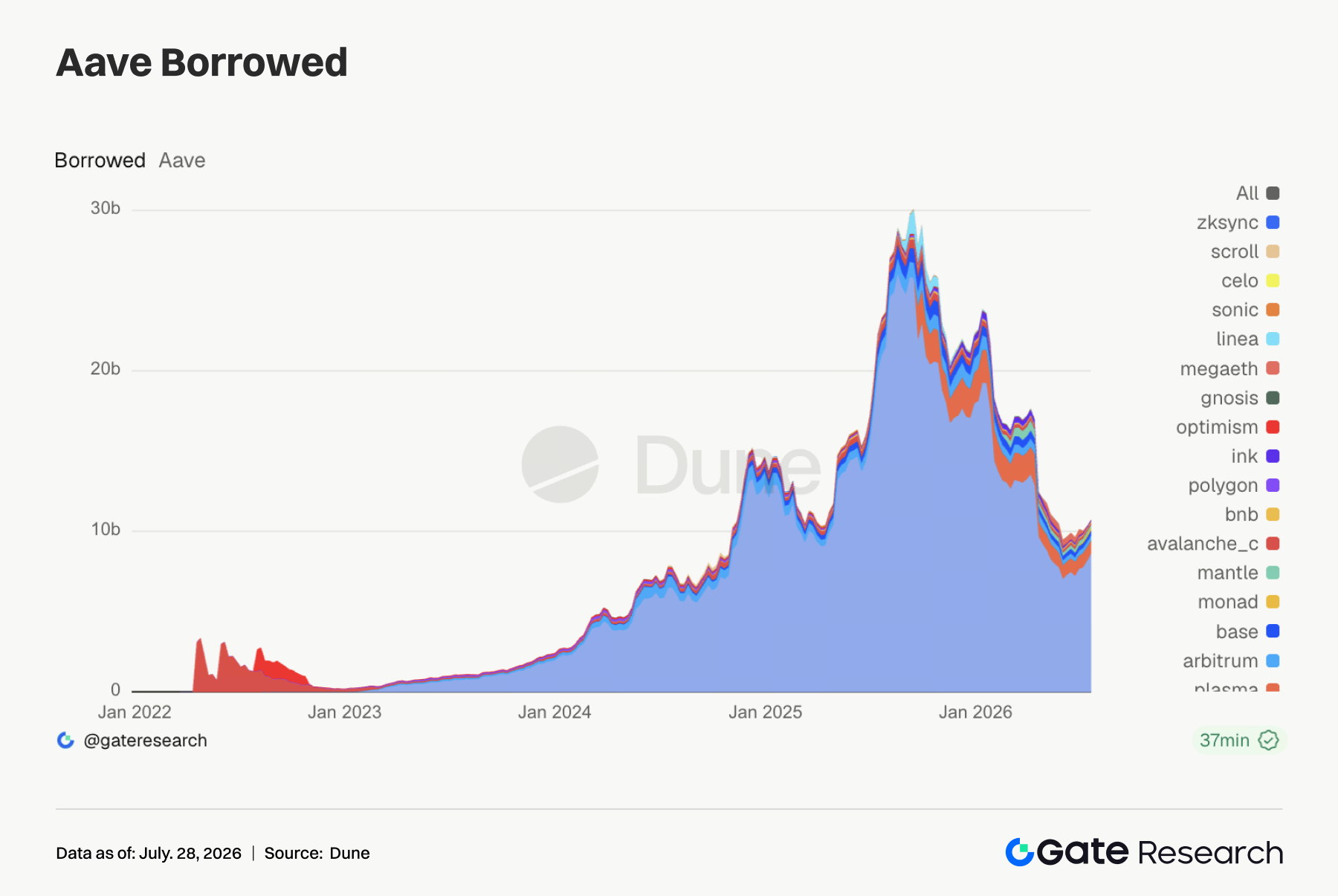
Aave borrowing balances continued to concentrate toward Ethereum, with borrowing scale in the Ethereum market rising to about USD 8.65 billion, up about 5.7% from the previous week. Borrowing balances on Monad rose to about USD 192 million, continuing rapid growth, which was related to the launch of Aave V3 on Monad, early deposit-and-borrow incentives, and expectations for liquidity on a new chain. Base rebounded slightly and Arbitrum was basically stable, while markets such as Plasma, Mantle, and MegaETH continued to pull back, with capital withdrawing from emerging chains with weaker incentives or higher uncertainty. Combined with competition from Robinhood Earn, Morpho, and Aave Stable Vaults, the current focus of the lending market is who can become the credit layer behind brokerages, wallets, and stablecoin yield products. Aave's core market remained steady, but the narrative around consumer-grade yield distribution is being increasingly captured by lighter vault models such as Morpho.
3.5 Aave rates remained restrained, and tail-end funding pressure in USDC had not completely disappeared
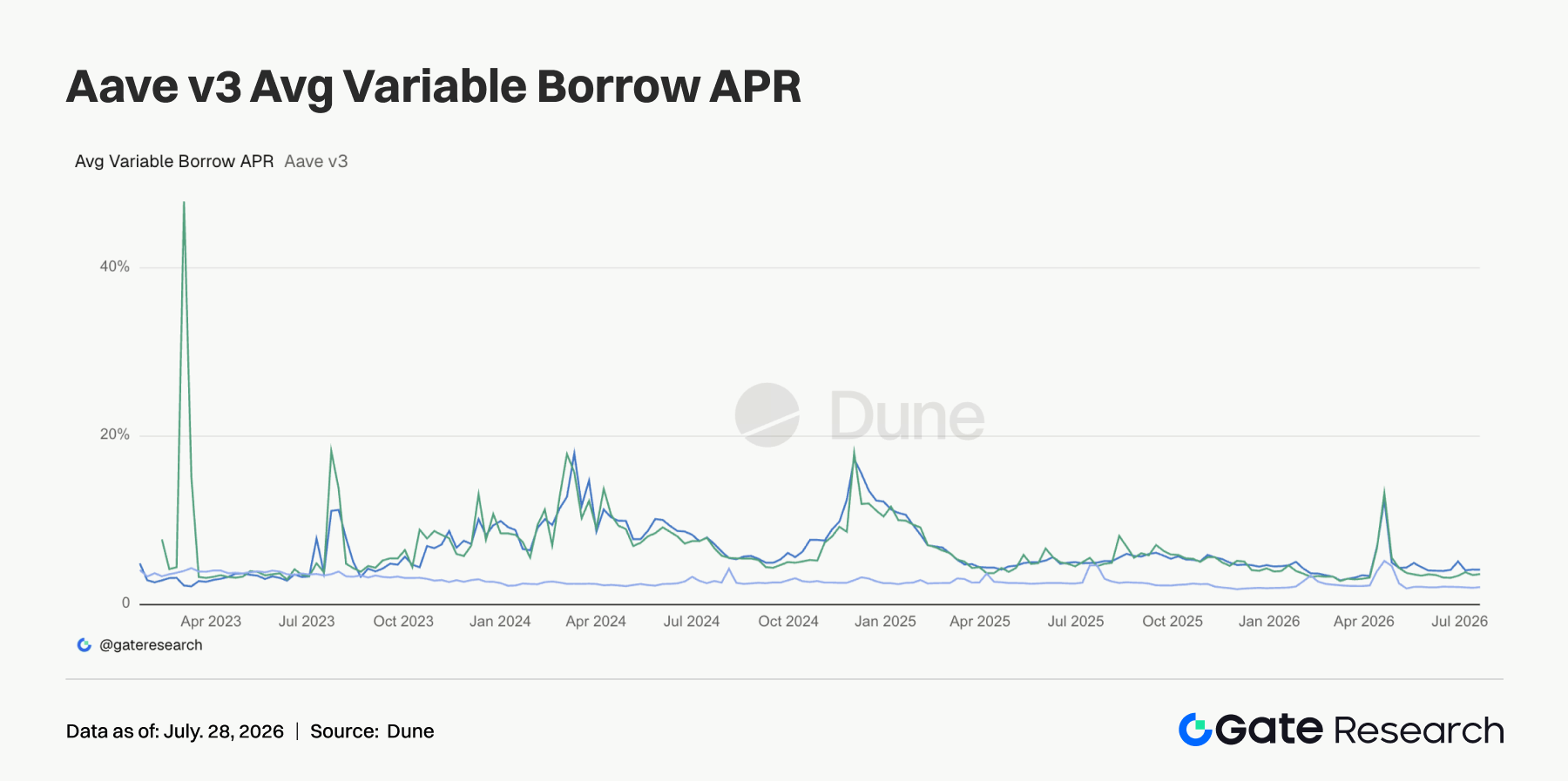
Rates in Aave's Ethereum main market were generally stable. The average borrowing rate for USDC was about 4.17%, close to the previous week, but the peak rate still reached about 13.7%, showing that USDC can still experience short-term funding tightness when hot trading concentrates. The average rate for USDT was about 3.64%, with tail-end volatility clearly below previous highs. The average rate for WETH rose to about 2.10%, but remained at a low level. Growth in borrowing balances did not bring a systemic rise in financing costs, indicating that leverage on the ETH side was not aggressive. The current environment looks more like institutions and arbitrage capital are rotating within core markets.
3.6 Protocol revenue structure diverged, with Pump rebounding while Hyperliquid cooled
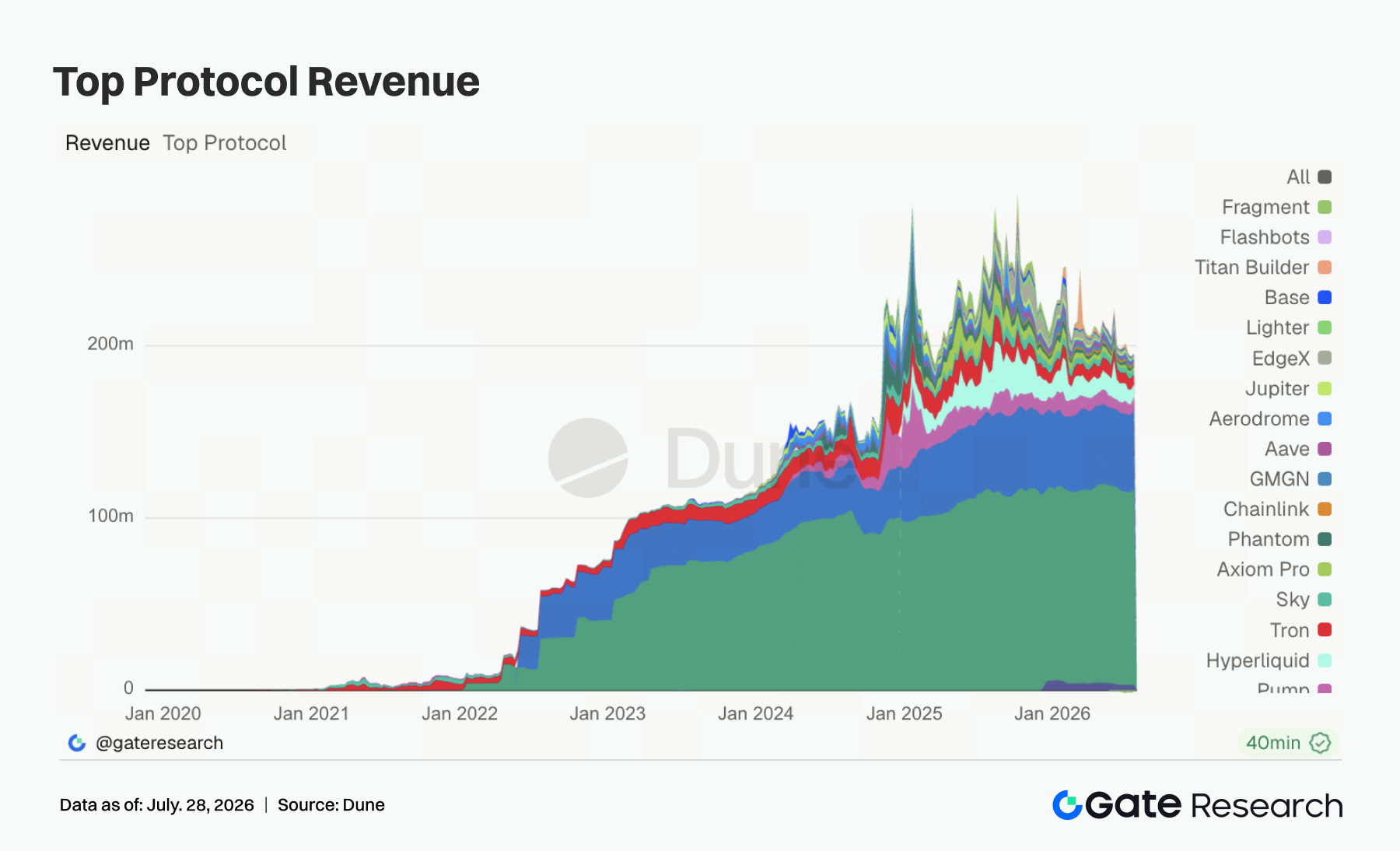
Tether and Circle recorded weekly revenue of about USD 114 million and USD 45.77 million, respectively, and stablecoin issuance remained the industry's revenue base. Pump revenue rose to about USD 7.78 million, surpassing Hyperliquid, which mutually confirmed the synchronous rebound in PumpSwap turnover and trader count, showing that Meme trading has not died completely, but has shifted from large-cap names to shorter-cycle launchpad and social-media hot spots. Hyperliquid revenue fell to about USD 7.37 million. On-chain TradFi perpetuals remained active, but the revenue elasticity of crypto-native perpetuals declined somewhat. Revenue at Axiom Pro, EdgeX, and Aave increased, while Base, Aerodrome, and Titan Builder declined. Overall, the areas that can truly accumulate revenue remain stablecoin issuance, Meme issuance and trading, and a small number of high-frequency derivatives gateways.
4. Derivatives Tracking
4.1 BTC prices maintained high-level consolidation, and OI pulled back after rising, showing leverage chase became more restrained
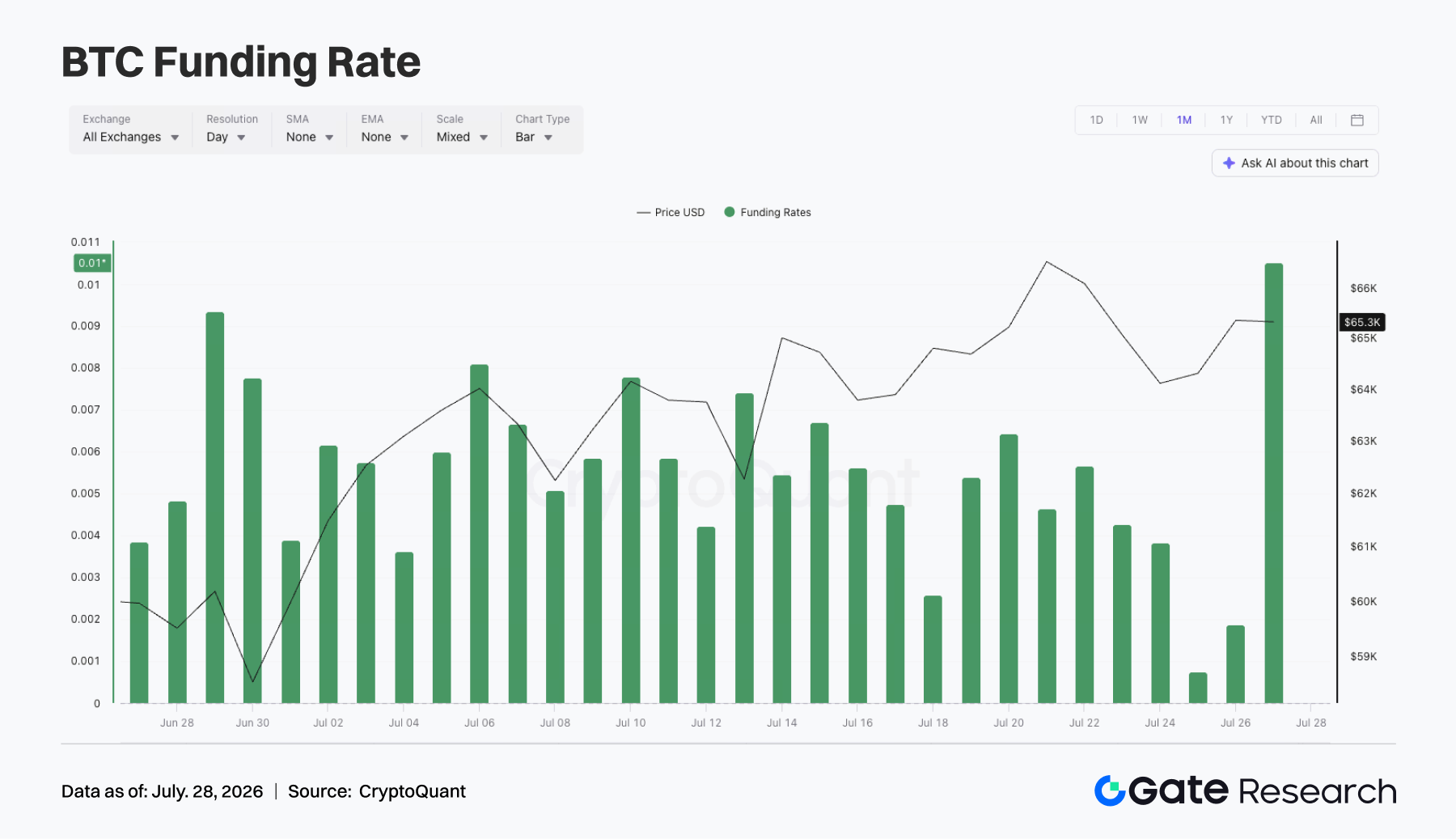
Last week, BTC prices overall maintained a high-level consolidation structure. At the beginning of the week, prices traded around USD 64,000 to USD 65,000, then once rose to around USD 66,000 from July 21 to July 22, before pulling back to around USD 64,000 and recovering above USD 65,000 again over the weekend. Overall, the price center moved further upward compared with the previous few weeks, but a continuous breakout had not yet formed. In terms of OI, there was a phase of sharp increase this week. Around July 20, OI was about USD 21.6 billion, then quickly rose with the price on July 21 to about USD 23.1 billion, a recent high. After that, OI fell back to around USD 22.0 billion and remained in the USD 22.2-22.5 billion range during the latter half of the week. High-level price consolidation together with OI surging and then falling back shows that leveraged capital once concentrated on breakout trades, but the momentum to chase higher did not continue expanding. Funding rates remained positive throughout the week, but overall moved from high to low. At the start of the week, funding rates were still around 0.005 to 0.006, then gradually declined, and around July 25 once approached neutral, indicating that long crowding eased somewhat. Even so, funding rates did not turn negative, showing that the market as a whole still leaned toward a bullish structure.
Taken together, the BTC derivatives market this week showed a combination of 'high-level price consolidation + high-level OI fluctuation + mildly positive funding rates.' Bulls still held the advantage, but willingness to chase higher with leverage became more restrained. If BTC subsequently stabilizes above USD 66,000, OI may expand again; if the price falls back below USD 64,000, attention should be paid to the retracement pressure on newly added long positions from the earlier period.
4.2 Options volume expanded in phases, and demand for short-term volatility trading was released in concentration
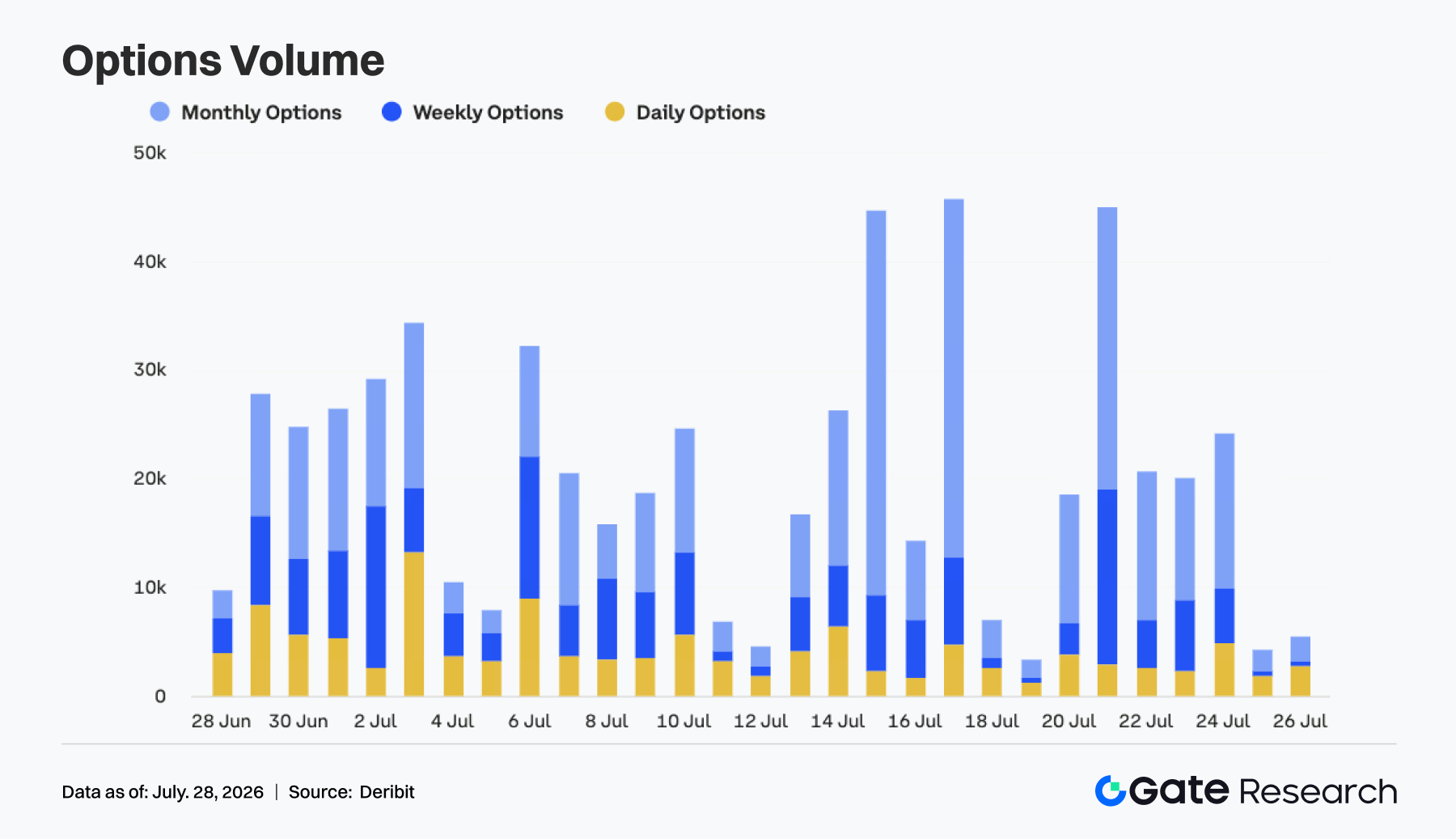
The options side showed obvious pulse-like volume expansion last week. On July 20, volume was about 18,000 contracts, then quickly rose to about 45,000 on July 21, the high for the week. From July 22 to July 24, volume fell back to the 20,000-24,000 range, and over the weekend further dropped to around 4,000-6,000. Structurally, monthly options remained the main source of turnover, especially contributing the main increment during the volume expansion on July 21, showing that the market was still mainly focused on medium-term position adjustments and risk management. Weekly options were also clearly active during the phase of price spikes, reflecting a simultaneous rise in demand for short-term directional trading. The share of daily options turnover was not high overall, but still contributed on some trading days, showing that the market used short-dated tools for temporary hedging and event trading during periods of high-level volatility. Volume fell back significantly over the weekend, indicating that the heat in short-term trading did not persist.
Overall, the options market this week did not show sustained panic-driven volume expansion, but instead saw concentrated position rotation around price tests to the upside and high-level consolidation. If BTC breaks above USD 66,000, options volume may expand again; if prices continue to move sideways, volume may remain in low-level fluctuation.
4.3 25D Skew repaired to a recent high, and protective demand declined significantly
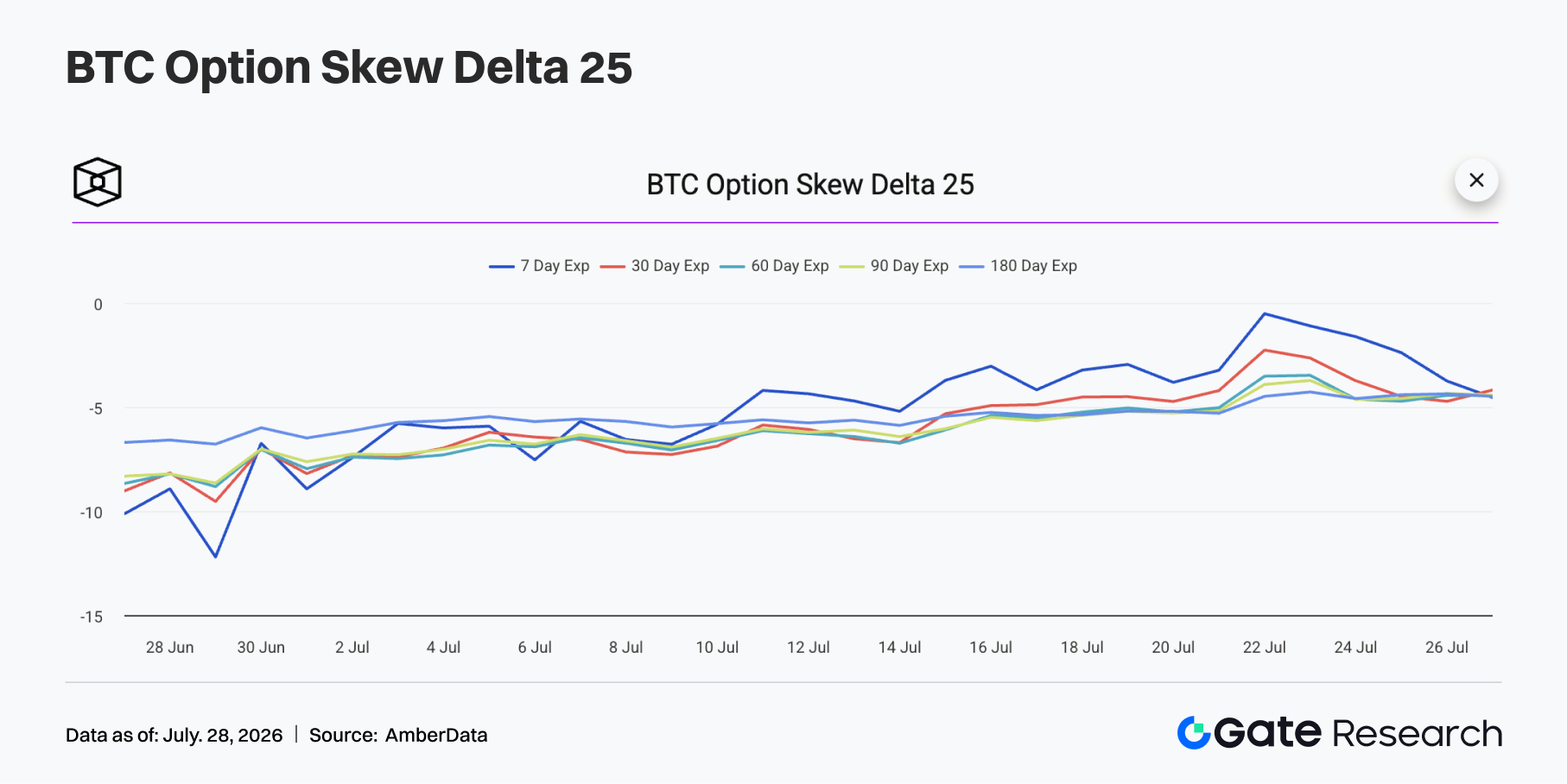
From the perspective of 25D Skew, BTC Skew across maturities overall continued its repair trend last week. At the beginning of the week, Skew across maturities was mostly around -5 to -6, still in negative territory, but had clearly improved from the deeply negative levels at the end of June and the beginning of July. From July 21 to July 22, 7D Skew once quickly repaired to near 0, the strongest level in the recent period, showing that the premium for short-dated downside protection fell sharply and market concern about sudden short-term declines eased significantly. 30D, 60D, 90D, and 180D Skew also repaired simultaneously, mostly rebounding to the -4 to -5 range. However, during the latter half of the week, 7D Skew fell back again to around -3 to -4, showing that after prices failed to sustain a breakout, short-term protective demand recovered somewhat. Medium- and long-dated Skew remained negative, indicating that although risk appetite improved, the market had not completely abandoned downside protection.
Overall, the Skew structure this week showed that defensive sentiment in the options market cooled significantly. If BTC continues to hold above USD 65,000, Skew is expected to move further toward the neutral range; if prices fall back below USD 64,000, short-dated protective demand may rise again.
4.4 DVOL rebounded slightly after low-level consolidation, while volatility pricing remained restrained
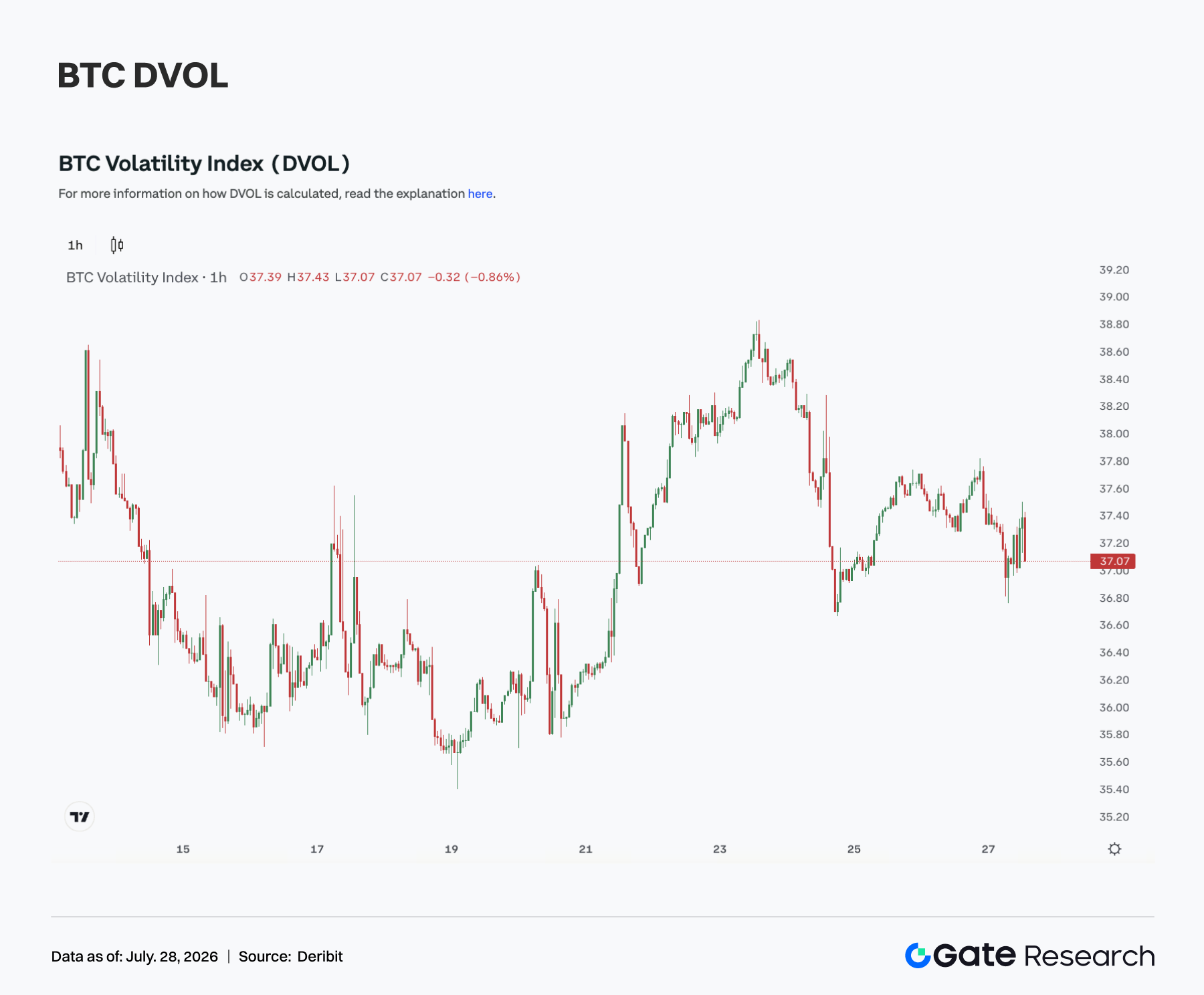
In terms of volatility, the BTC volatility index DVOL overall remained in low-level consolidation last week. At the beginning of the week, DVOL was around 36 to 37, then once rebounded to about 38.5 around July 23, reflecting some volatility repair driven by high-level price fluctuation and rising OI. However, from the perspective of the overall range, DVOL did not show obvious expansion. After July 24, DVOL fell back again to around 37, showing that the market's pricing of future sharp volatility remained relatively restrained. Compared with the level above 45 in late June, the current volatility risk premium remained in a clearly compressed state. Low-level DVOL operation and Skew repair mutually confirmed that overall risk appetite in the options market improved. The market is currently more inclined to price high-level consolidation rather than extreme directional volatility.
Overall, BTC is currently in a combined state of 'high-level price consolidation + Skew repair + low DVOL.' If prices break above USD 66,000, volatility may rise again from low levels; if prices continue moving sideways, DVOL may remain in the 36-38 range.
5. Outlook for This Week
Data Sources:
Gate Research is a comprehensive blockchain and cryptocurrency research platform that provides deep content for readers, including technical analysis, market insights, industry research, trend forecasting, and macroeconomic policy analysis.
Disclaimer
Investing in cryptocurrency markets involves high risk. Users are advised to conduct their own research and fully understand the nature of the assets and products before making any investment decisions. Gate is not responsible for any losses or damages arising from such decisions.