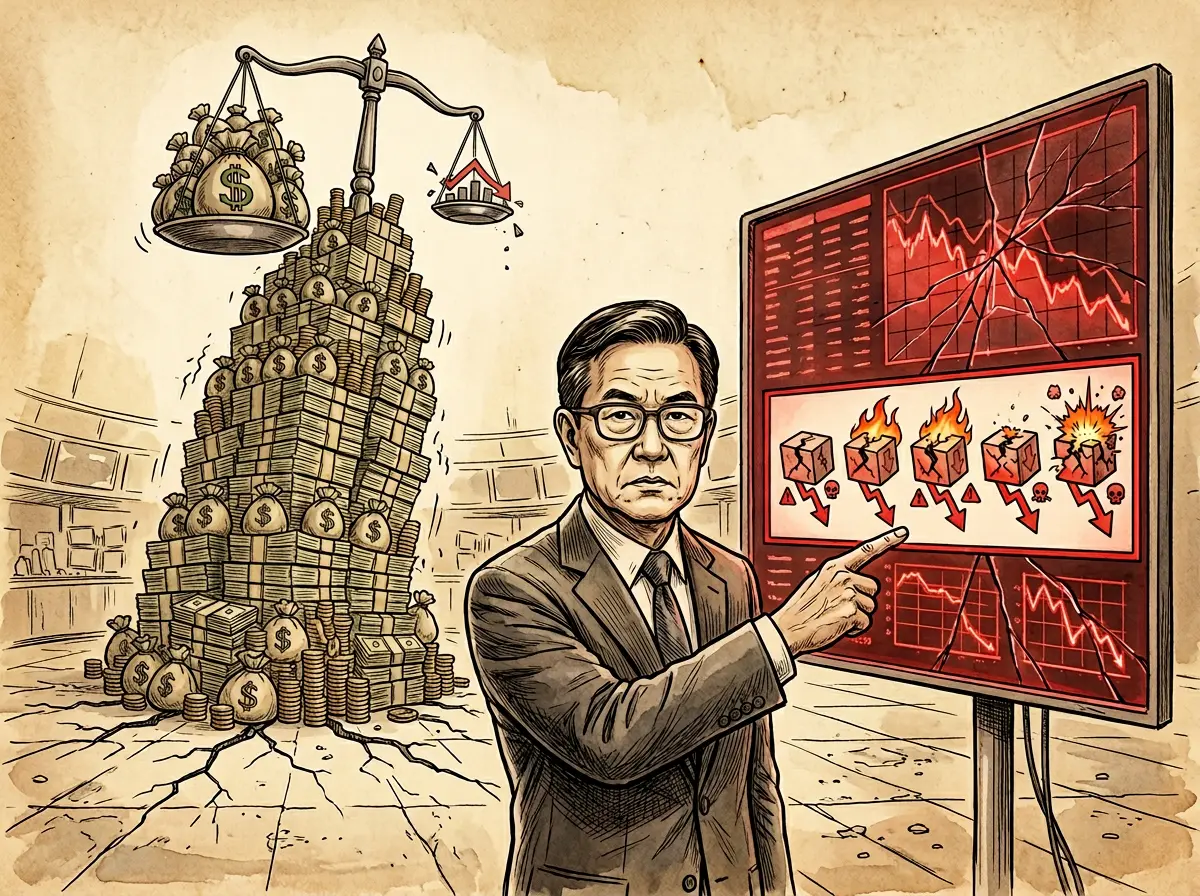
Taiwan stock index futures night session suffered a sharp drop on June 8, plunging by 3,006 points (-6.65%), closing at 42,220 points and setting the biggest single-day decline in history; Taiwan stock margin financing outstanding concentrated in the main markets reached 566.6 billion yuan, and the whole market (including over-the-counter) totaled 780 billion yuan, with both setting record highs. Wanbao Investment Consulting’s investment director, Cai Mingzhang, specifically pointed to avoiding Innolux, AU Optronics, Color Star, King Yuan Electronics, and Yuanta Taiwan 50 Bull 2.
The 5 High-Margin-Risk Stocks Named by Cai Mingzhang
Wanbao Investment Consulting’s investment director Cai Mingzhang suggested first avoiding stocks whose margin financing surged this year:
Innolux (3481): Panel stock, margin financing increases significantly
AU Optronics (2409): Panel stock, similarly high margin financing
Color Star (6116): Panel stock, notable increase in margin financing
King Yuan Electronics (6770): DRAM maker, with a relatively high margin financing ratio
Yuanta Taiwan 50 Bull 2 (00631R): A two-times leveraged ETF; Cai Mingzhang noted that many young investors pledge and add leverage to ETFs—once the market falls, the loss speed is doubled
Assessments by Analysts on Taiwan Stocks’ Outlook
Chen Yiguang, chairman of Fubon Investment Consulting, said the main reasons behind this decline are three: strong May non-farm employment data far above expectations sparked concerns about rate hikes; Broadcom’s guidance falling short of the market’s extremely high expectations triggered selling pressure in semiconductors; Taiwan stocks rose 7,203 points in April and another 5,806 points in May—together more than 13,000 points—so a pullback after an extended rally.
Chen Yiguang estimated that on Monday’s open, investors will face multiple selling pressures such as stop-loss selling, panic selling, self-liquidation of margin positions, program trading, and ETFs triggering “many-sellers-ahead” effects, and reminded retail investors not to rashly “catch falling knives.” Taishin Investment Consulting’s analysis said this time looks more like sector rotation rather than the full-scale panic of the 2000 bubble burst—“U.S. stocks are overheated but not in a bubble.” Yuanta Securities Investment Trust Fund manager Wang Weizhe said foreign investors’ short positions in Taiwan index futures exceed 69,000 contracts and remain at a high level; he advised keeping funding flexibility, buying on dips but not chasing higher prices.
U.S. Key Data and Four Indicators to Watch for a Potential Bottoming
U.S. May non-farm payrolls added 172,000 jobs (driven by large hiring by the food and beverage industry due to the 2026 World Cup effect). The strong employment data raises the threshold for Fed rate cuts, and the market expects a potential rate hike of 1 notch by year-end.
Chen Yiguang listed four indicators to watch for a bottom in Taiwan stocks: the yield on the U.S. 10-year Treasury note must not break above the May 19 high of 4.66% (currently around 4.55%); Taiwan stocks’ margin financing outstanding must decline by about 50 to 80 billion yuan (a 10-15% decrease); foreign investors’ open short positions in Taiwan index futures from the current roughly 70,000 contracts must drop to below 50,000; and the TWD exchange rate should stabilize and stop falling.
Common Questions
Why did Cai Mingzhang specifically warn about panel stocks and leveraged ETFs?
Cai Mingzhang explained that these stocks saw a large increase in margin financing this year; once the market falls, the maintenance margin ratio decreases, which can trigger forced top-ups by brokers or margin call liquidation selling pressure. Leveraged ETFs (such as 00631R) have a two-times amplification effect: for any amount the market falls, the loss is also doubled. That makes de-leveraging the first step.
What risk does a Taiwan stock margin financing outstanding of 78 billion yuan—an all-time high—imply?
Cai Mingzhang said that the current situation is similar to the period before the 2007 subprime crisis, when investors had not de-leveraged in time and later the global financial crisis erupted. He said that the best remedy right now is “de-leveraging.” If margin financing outstanding cannot be reduced by 160 to 240 billion yuan over the medium term, the risk of a genuine financial crisis breaking out in 2027 will rise (Cai Mingzhang’s personal analysis and assessment).
What is the basis for Chen Yiguang’s estimate that Monday’s open could drop by 2,000 points?
Chen Yiguang explained that on Monday, Taiwan stocks at the open will face multiple waves of selling pressure at the same time, including stop-loss selling pressure, panic selling pressure, self-liquidation of margin positions, program trading, ETFs’ “many-sellers-ahead” effects, and foreign investors taking advantage of the situation. Based on this, he personally estimates that a 2,000-point drop at the open is the “minimum expectation,” and the decline may break below the monthly moving average at around 43,030 points. He also expects a sudden rebound after a crash, but reminded that “a rebound does not mean the situation is stabilized.”


