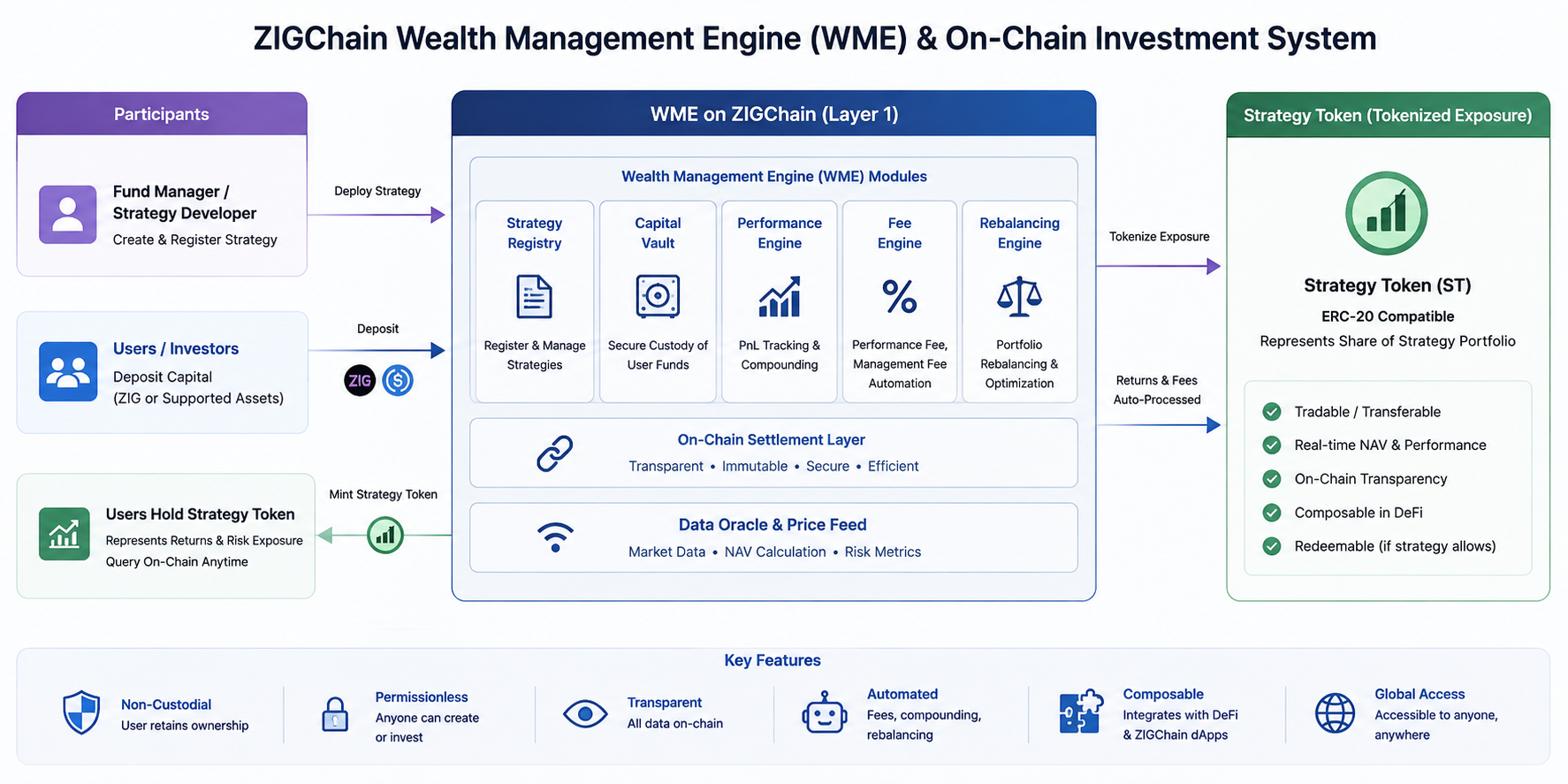
ZIGChain is a Layer 1 public blockchain built on the Cosmos SDK, purpose-built for on-chain wealth management. It adopts a Tendermint BFT PoS consensus mechanism and supports a dual smart contract environment—EVM (Solidity) and CosmWasm (Rust). What sets it apart is its chain-level Wealth Management Engine (WME) module, alongside custom DeFi modules like Token Factory and Exchange Module. These components embed delegated investing, strategy tokenization, and fee routing directly into the consensus layer, instead of relying on fragmented application-layer assembly on general-purpose blockchains.
Amid the rapid rise of RWA and compliant on-chain finance, most public blockchains still operate on a "general execution layer + application layer self-built logic" model. Strategic custody, performance tracking, fee distribution, and compliance interfaces—essential for wealth management—often require manual assembly across multiple protocols and bridges, resulting in high development costs, complex audits, and fragmented user experiences. ZIGChain embeds the Wealth Management Engine (WME) as a native Layer 1 module, enabling investment strategy creation, capital custody, and tokenization within a single consensus environment. With a transaction finality of roughly 3 seconds and low gas fees, ZIGChain positions itself as a "dedicated wealth management infrastructure" rather than a general-purpose computing platform.
This article explores ZIGChain's full technology stack, how Layer 1 supports wealth management protocols, the implementation logic of WME and on-chain investment systems, Validator and Delegation mechanisms, DeFi/RWA ecosystem integration, differences from traditional platforms, current challenges, and future technical directions.
ZIGChain's technology stack is structured in four layers: Consensus Layer, Module Layer, Smart Contract Layer, and Interoperability Layer.
Consensus Layer
ZIGChain uses CometBFT (formerly Tendermint) with a Byzantine Fault Tolerance (BFT) Proof-of-Stake (PoS) mechanism. Validators stake ZIG tokens to produce blocks and verify transactions, while Delegators delegate ZIG to validators to help secure the network. The block time is roughly 3.23 seconds, and transaction finality typically occurs within 5 seconds, meeting the low-latency demands of financial applications. In December 2025, ZIGChain's PoS mechanism received Shariah certification from Amanie Advisors, classifying validators as "investment agents (Wakala bil Istithmar)" under the compliance framework, with rewards following profit-sharing rather than fixed-interest logic.
Beyond standard Cosmos SDK modules (Staking, Governance, Mint, Distribution, Slashing, Bank, etc.), ZIGChain integrates the following custom chain-level modules:
Delegated investment, strategy tokenization, and Profit Sharing 3.5 architecture
Each module can charge a ModFee (module fee) in ZIG, which can be used for buyback and burn or ecosystem reinvestment through governance, linking on-chain economic activity to native token demand.
Smart Contract Layer
EVM: Integrated via evmOS, supports Solidity contract deployment, reducing migration costs for Ethereum developers.
CosmWasm: Based on the Cosmos x/wasm module, supports Rust smart contracts and can interact with IBC and native chain modules. The Factory Module works with CosmWasm contracts for token creation.
Interoperability Layer
IBC (Inter-Blockchain Communication): Connects to other Cosmos ecosystem chains, accessing cross-chain liquidity and DeFi services.
Cross-Chain Bridge: Supports migration of ZIG from ERC-20/BEP-20 to the mainnet native chain and asset interchange with other EVM networks.
Developer Tools: The official ZIGChain JS SDK (based on cosmos-kit) supports mainnet/testnet configuration, wallet connections, Token Factory frontend integration, and complex transaction broadcasting. The CLI tool zigchaind handles node operations and contract deployment.
On June 25, 2025 (Genesis Day), ZIGChain's mainnet Beta went live (chain-id: zigchain-1), with over a dozen native applications already deployed during the testnet phase, laying the groundwork for production.
How Layer 1 Supports Wealth Management Protocols
General-purpose Layer 1 blockchains provide basic "consensus + execution + storage" capabilities, leaving wealth management protocols to implement strategic custody, performance accounting, fee routing, and compliance interfaces on their own. As an application-specific chain, ZIGChain pre-integrates wealth management primitives at Layer 1, reducing development and integration costs for upper-layer protocols.
Modular Upgradable Architecture: Cosmos SDK's modular design allows chain-level functions to be upgraded independently without hard forking the network. WME, Token Factory, and the Exchange Module can iterate parameters and logic through governance proposals, adapting to regulatory changes and new asset types.
Native Gas and ModFee Economy: All on-chain wealth management operations (strategy deployment, capital deposits, token minting, fee settlements) are paid in ZIG for gas. Module-level ModFee incorporates protocol usage fees into the chain's economic cycle, directly linking Layer 1 revenue to wealth management activity.
Dual-Track Smart Contract Environment:
Fund managers and TradFi integrators can deploy EVM contracts in Solidity, leveraging existing Ethereum tools.
Protocols needing deep Cosmos module interaction can use CosmWasm to directly call Bank, Staking, and WME modules.
Performance and Cost: The ~3-second block time and low gas fees make high-frequency strategy adjustments, batch fee settlements, and concurrent user deposits feasible on-chain. For complex wealth management logic, gas costs are significantly lower than on Ethereum mainnet.
Compliance-Ready Features: ZIGChain's architecture incorporates the Shariah compliance framework from the design stage (PoS certified in December 2025) and supports MiCAR whitepaper disclosures. Partnerships with institutions like Fireblocks provide custody-grade security for CeDeFi institutional flows, allowing licensed entities to access on-chain modules compliantly.
Zignaly platform's over 600,000 users and more than 150 fund managers provided years of operational insights that shaped ZIGChain Layer 1. The technical architecture is not a collection of theoretical modules but the on-chain realization of wealth management logic validated through live trading.
How the Wealth Module and On-Chain Investment System Work
ZIGChain's Wealth Management Engine (WME) is the core of the on-chain investment system, evolving from the Zignaly Profit-Sharing ecosystem into the native Profit Sharing 3.5 protocol architecture. WME is not a single smart contract but a modular investment framework embedded in Layer 1, handling strategy creation, capital custody, tokenization, and fee automation.
Typical Operation Flow:
Fund Manager/Strategy Developer → Register/Deploy Strategy in WME Module
↓
User Deposits Capital (ZIG or other supported assets) → Receives Strategy Token
User Holds Strategy Token → Represents Corresponding Returns and Risk Exposure, Queryable On-Chain at Any Time
Strategy Token is WME's key abstraction: it tokenizes institutional-grade portfolio exposure. Users don't need to manually execute each Swap, Stake, or Rebalance. Strategy tokens can be traded on the Exchange Module or used as collateral in lending protocols like Permapod, enabling composability.
WME Integration with Ecosystem dApps
WME acts as a unified protocol layer, integrating the following services into tokenizable investment strategy entry points:
Fireblocks: Institutional-grade CeDeFi custody and settlement
Through a single WME deposit, users have their funds managed transparently on-chain by a wealth manager, accessing multi-protocol capabilities without cross-bridging or manual protocol-switching.
ModFee and Value Routing
ModFee generated by WME module usage is settled in ZIG and can be directed toward buyback/burn or ecosystem incentives through governance, directly linking on-chain investment activity to the ZIG economic model.
Validator and Delegation Mechanisms Explained
ZIGChain's network security relies on a Tendermint BFT PoS system jointly maintained by Validators and Delegators, forming the trusted foundation for on-chain wealth management infrastructure.
Validator
Runs a full node, validates transactions, proposes and confirms blocks.
Must self-stake ZIG and attract delegators to increase total delegated stake.
Ranked by total stake (self-staked + delegated) to enter the active validator set.
Earns income from block rewards, gas fees, and Foundation Stake subsidies; deducts Commission and distributes the remainder to delegators.
Must maintain high availability. Double-signing results in a 5% slash and removal from the active set; prolonged downtime results in a 0.01% slash.
Delegator
Holds ZIG without running a node; delegates tokens to chosen validators.
Shares validator rewards while bearing the validator's slashing risk.
When selecting a validator, should consider: commission rate, uptime, slashing history, self-stake ratio, and governance stance.
Can delegate ZIG to multiple validators to reduce single points of risk.
Staking Process
Select a validator via ZIGChain Hub (web interface), CLI, or compatible wallet.
Delegate a specified amount of ZIG; tokens enter a Bonded state.
Staking rewards accumulate automatically.
Undelegating triggers a 21-day unbonding period during which tokens are locked and earn no rewards.
Governance Linkage
Staked ZIG is tied to on-chain governance voting weight. Delegators inherit the validator's governance vote by default or can choose validators with aligned governance positions, giving network security participants a voice in protocol decisions like WME parameters and ModFee routing.
Shariah-Compliant Staking
The Shariah certification obtained in December 2025 classifies the Validator mechanism as Wakala bil Istithmar (Islamic investment agency model), making PoS Staking compliant with Islamic financial principles at the consensus level—not as a post-hoc wrapper on a single product. This has structural significance for institutional delegation and Middle East market access.
Liquid Staking Expansion
Valdora Finance's stZIG solution: users deposit ZIG into the Staker contract and receive a liquidity token, stZIG (a Token Factory native denom). stZIG can be traded on Oroswap and used as collateral on Permapod, while the underlying Ledger contract distributes ZIG across multiple validators, automatically compounding staking rewards and reflecting them in the stZIG exchange ratio.
How ZIGChain Supports DeFi and RWA Ecosystems
ZIGChain's DeFi and RWA ecosystems are built around WME and chain-level modules to create a composable circular wealth engine, with protocols interoperating natively on the same Layer 1 without cross-chain bridges.
AI conversational DEX, on-chain Swap and liquidity
Permapod
Native lending based on Mars Protocol smart contract, audited by Halborn
Nawa Finance
Shariah-compliant DeFi Aggregator
Memes.Fun
Token launch platform; WME strategies can compose Meme assets
Typical Composable Path:
ZIG → Stake on Valdora for stZIG → Use stZIG as collateral on Permapod to borrow stablecoins → Trade on Oroswap or redeposit into Nawa Vault → Returns managed uniformly via WME strategy tokenization.
RWA Ecosystem
Zamanat (launched by Disrupt.com): Shariah-compliant RWA tokenization platform, supporting tokenization of real estate and other assets.
RWA Lending Engine (launched November 2025, in partnership with Apex Group): Enables real estate and private credit as on-chain loan collateral.
Partnerships with Apex Group (managing trillions in assets), Beehive (DFSA-regulated SME financing platform), Taurus, Circle, and others.
Fireblocks provides institutional-grade custody and CeDeFi settlement.
In September 2025, ZIG published a MiCAR compliance whitepaper, providing a technical disclosure framework for EU market access.
Cross-Chain and Liquidity
IBC connects to the Cosmos ecosystem. evmOS integration provides EVM equivalence with IBC interoperability. The cross-chain bridge supports ZIG migration from Ethereum/BSC to mainnet, enhancing native liquidity depth.
ZIGChain vs. Traditional Asset Management Platforms
Dimension
Traditional Asset Management Platforms
ZIGChain
Architecture
Centralized server + database ledger
Layer 1 public chain + chain-level WME module
Strategy Execution
Platform internal system, not user-auditable
On-chain verifiable, transparent strategy rules and fee paths
Asset Custody
Platform or third-party custodian
User self-custody wallet + optional Fireblocks institutional custody
ZIGChain doesn't simply "migrate TradFi products on-chain." Through WME, it embeds strategy tokenization, fee automation, and module-level composability into the infrastructure layer, allowing retail users to participate in institutional-grade investments via strategy tokens while retaining on-chain audit and governance capabilities.
Compared to general-purpose L1s like Ethereum and Solana, ZIGChain trades some "maximum ecosystem breadth" for native wealth management vertical modules and Zignaly live-trading verification. Compared to RWA protocols like Ondo and Centrifuge, ZIGChain offers a complete L1 + WME, not just a single asset tokenization pipeline.
Challenges Facing the Wealth Management Public Blockchain Track
Regulatory and Compliance Fragmentation: RWA tokenization, on-chain funds, and staking products face widely varying rules across jurisdictions. Shariah and MiCAR certifications are significant steps forward, but global institutional adoption still requires market-by-market compliance implementation.
Off-Chain Mapping Risks of RWAs: The legal relationship, custody arrangements, and liquidation mechanisms between on-chain tokens and real-world assets (real estate, private credit) depend on off-chain structures. Technical architecture alone cannot eliminate credit and counterparty risks.
Ecosystem Scale and Liquidity: ZIGChain's DeFi TVL is still early in its mainnet Beta phase (primarily driven by protocols like Valdora). Compared to mature ecosystems like Ethereum, there is a gap in liquidity depth and developer numbers.
User Experience Barriers: Wallet management, the 21-day unbonding period, gas payments, and slashing risks remain obstacles for TradFi users. WME's strategy token abstraction reduces operational complexity, but basic Web3 knowledge is still required.
General-Purpose L1 Competition: Ethereum L2s, Solana, and others are also advancing RWA and DeFi integration. A wealth management-specific L1 must continuously prove its differentiated value in vertical depth.
Modular Complexity: Coordinating multiple modules (WME, Token Factory, Exchange Module) requires a strong understanding of Cosmos SDK and ZIGChain's custom interfaces. Documentation and SDKs are still being refined (the WME official documentation is marked "coming soon").
Mainnet Maturity: The mainnet Beta launched in June 2025, with the Validator network, cross-chain bridge, and Hub deployed in phases. Stability and audit coverage for production-grade institutional workloads will take time to validate.
Deepened IBC and EVM Interoperability: evmOS integration enables direct interaction between Solidity contracts and IBC protocols, expanding the cross-chain liquidity funnel.
Modular Upgrade Mechanism: Cosmos SDK allows independent upgrades of WME, Exchange Module, adapting to new asset types and regulatory requirements.
Compliance Programmable Layer: A programmable compliance system integrated with licensed entities, supporting KYC/AML and conditional access for on-chain strategies.
AI and DeFAI: The $25 million DeFAI Innovation Fund (Disrupt.com & DWF Labs) drives AI-powered strategies and the evolution of conversational interfaces like Oroswap.
Long-Term Vision
ZIGChain co-founder Abdul Rafay Gadit states the goal is for transactions to finalize in under five seconds, with low fees and modular upgradeability—continuous optimization in performance, cost, and upgradability so that on-chain wealth management infrastructure can support institutional-grade workloads while remaining accessible to retail users.
If RWA and compliant on-chain finance continue to expand, ZIGChain—as a specialized L1 with native WME, dual-track contracts, and IBC/EVM interoperability—has the opportunity to build a differentiated technical moat in the vertical track. Conversely, ecosystem adoption speed, regulatory clarity, and general-purpose L1 competition remain key variables.
Summary
ZIGChain's technical architecture uses Cosmos SDK + Tendermint BFT PoS as its consensus foundation, WME, Token Factory, and Exchange Module as chain-level wealth management primitives, EVM + CosmWasm dual-track smart contracts to support multiple developer ecosystems, and IBC + evmOS + cross-chain bridges for interoperability and liquidity access. The on-chain investment system through WME integrates strategy tokenization, fee automation, and multi-protocol composability into a single Layer 1, allowing users to participate in institutional-grade investments via strategy tokens. The Validator/Delegation mechanism ensures network security and governance participation through a Shariah-certified PoS model.
Unlike the "execution layer + application assembly" model of general-purpose public chains, ZIGChain pre-integrates wealth management modules at Layer 1, reducing protocol development costs and enhancing on-chain auditability. Compared to centralized platforms, it preserves user asset sovereignty and open composability. In its current mainnet Beta stage, the DeFi/RWA ecosystem (Valdora, Permapod, Zamanat, RWA Lending Engine, etc.) has formed a nascent circular wealth engine. However, regulatory fragmentation, off-chain RWA mapping, ecosystem scale, and user experience remain industry-wide challenges. To understand ZIGChain's technical architecture, one must examine its module layer design, WME strategy token logic, Validator economic and security models, and the composable paths of DeFi/RWA protocols—this is the core framework for evaluating it as on-chain wealth management infrastructure.
Author: Max
Disclaimer
* The information is not intended to be and does not constitute financial advice or any other recommendation of any sort offered or endorsed by Gate.
* This article may not be reproduced, transmitted or copied without referencing Gate. Contravention is an infringement of Copyright Act and may be subject to legal action.
Solana faces both opportunities and challenges in its development. Recently, severe network congestion has led to a high transaction failure rate and increased fees. Consequently, some have suggested using Layer 2 and appchain technologies to address this issue. This article explores the feasibility of this strategy.
Sui is a PoS L1 blockchain with a novel architecture whose object-centric model enables parallelization of transactions through verifier level scaling. In this research paper the unique features of the Sui blockchain will be introduced, the economic prospects of SUI tokens will be presented, and it will be explained how investors can learn about which dApps are driving the use of the chain through the Sui application campaign.
This article introduces the technical principles, framework, and applications of Zero-Knowledge (ZK) technology, covering aspects from privacy, identity (ID), decentralized exchanges (DEX), to oracles.
Tronscan is a blockchain explorer that goes beyond the basics, offering wallet management, token tracking, smart contract insights, and governance participation. By 2025, it has evolved with enhanced security features, expanded analytics, cross-chain integration, and improved mobile experience. The platform now includes advanced biometric authentication, real-time transaction monitoring, and a comprehensive DeFi dashboard. Developers benefit from AI-powered smart contract analysis and improved testing environments, while users enjoy a unified multi-chain portfolio view and gesture-based navigation on mobile devices.