XRP Price Prediction: Bullish Fundamentals Could Fuel Rebound Toward $3.65, Is Pullback a Buy Opportunity?

Beginner
Quick Reads
Last Updated 2026-03-29 23:44:45
Reading Time: 1m
XRP has built solid support around the $2.8 mark. Now trading at approximately $3, it looks poised to challenge its historical peak at $3.65.

Ripple Ranks Among the World’s Most Valuable Private Companies

CB Insights’ latest data shows that Ripple has joined the ranks of the world’s most valuable private companies, boasting a valuation exceeding $15 billion and holding the 23rd position globally—just behind giants like SpaceX. This achievement underscores Ripple’s leading role in blockchain payments. It also further strengthens the value proposition of its native token, XRP.

Among the top 50 most valuable private companies in the United States, blockchain firms have secured a notable presence, with names such as OpenSea, Bitmain, and KuCoin represented. Ripple’s leadership among these enterprises stands out.

XRP Technicals Show Renewed Strength

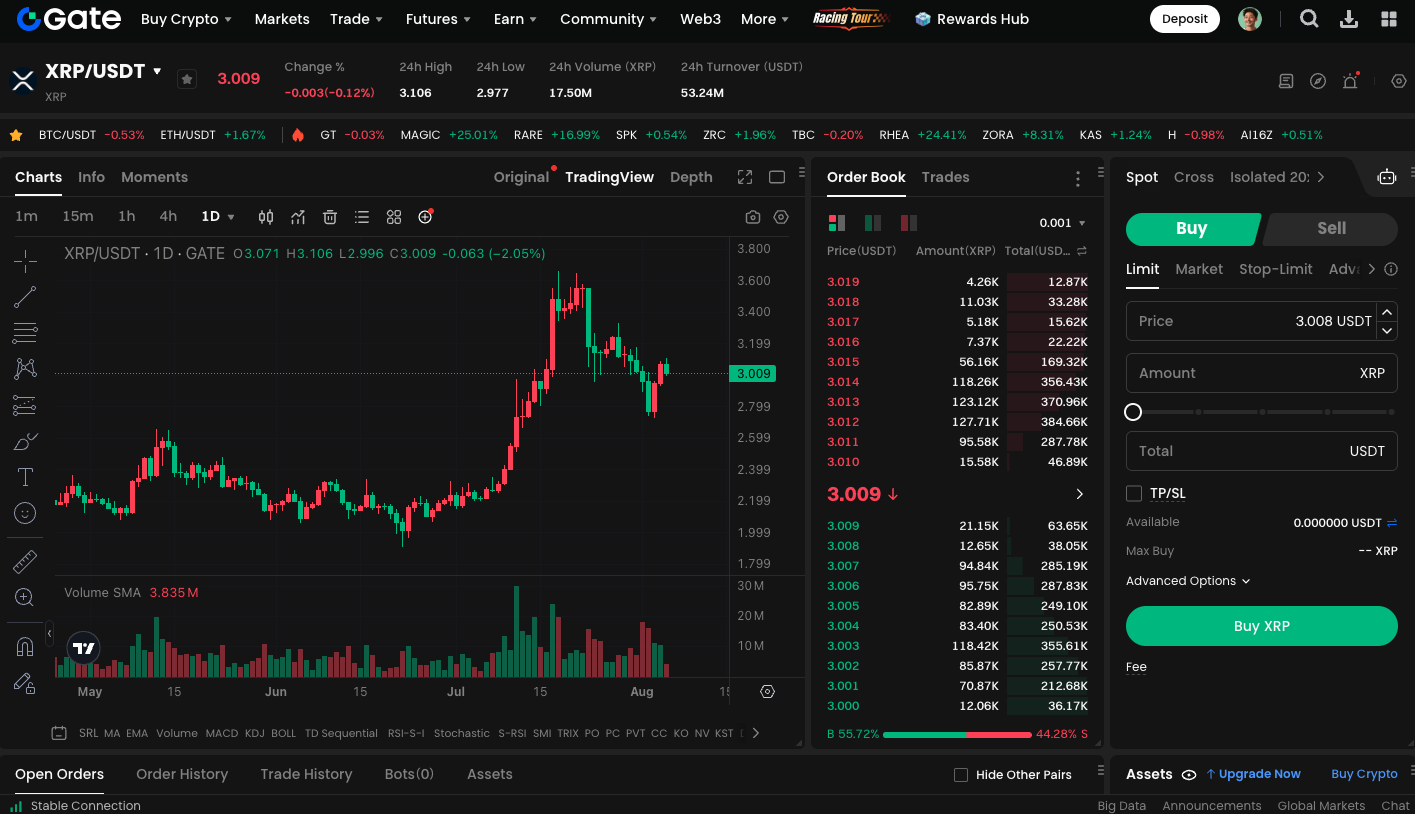
Technical analysis of the XRP/USDT daily chart reveals that after setting a recent high followed by a sharp pullback, XRP has steadily regained lost ground, establishing solid support near $2.8. Its current price is consolidating around $3, with room to move toward its historic peak at $3.65.

The Relative Strength Index (RSI) exhibits a pattern of progressively higher lows and highs, signaling increasing momentum. If XRP can break past initial resistance at $3.15, it may next test the crucial supply zone between $3.25 and $3.4. A daily close above $3.55 could pave the way for a renewed rally. Conversely, should the $2.8 support level give way, XRP may retreat to the $2.5–$2.6 range, which could draw in new buyers and provide a base for a potential rebound.

XRPL Decentralized Infrastructure Receives Another Upgrade

Ripple’s Chief Technology Officer, David Schwartz, recently announced he has personally returned to supporting the XRP Ledger (XRPL) infrastructure. At a New York data center, he deployed a high-spec server node featuring an AMD 9950X processor, 256GB of RAM, and a 10Gbps network connection, which is now fully synced with XRPL.

Schwartz designed this node to serve as a stable validator node and infrastructure hub, with select resources made available to public nodes and key validators. He emphasized that this is not a testing platform, but a robust system engineered to support the long-term stability of XRPL operations. This move should bolster community confidence in the XRP ecosystem.

You can access XRP spot trading here: https://www.gate.com/trade/XRP_USDT
Summary

While XRP faces short-term volatility, a combination of bullish catalysts—including Ripple’s substantial valuation, improving technicals, and enhanced decentralized infrastructure—means the market outlook is turning more optimistic. If XRP holds the $2.8 level and breaks through $3.15, it could once again attempt the historic high at $3.65. A pullback to lower ranges may give medium- and long-term investors an attractive entry point.

Author: Allen
Disclaimer
* The information is not intended to be and does not constitute financial advice or any other recommendation of any sort offered or endorsed by Gate.
* This article may not be reproduced, transmitted or copied without referencing Gate. Contravention is an infringement of Copyright Act and may be subject to legal action.

Related Articles

AI-Native Settlement Layers: How United Stables Is Building the Next Financial Rail
Beginner

AI-Native Settlement Layers: How United Stables Is Building the Next Financial Rail

Stablecoins were originally designed as dollar substitutes within exchanges, primarily used for asset pricing and trade settlement. As on-chain financial ecosystems have matured, their role has expanded beyond simple payments to include collateral assets, cross-chain liquidity mediums, and unified settlement units. In particular, as AI systems and automated agents begin to participate directly in economic activity, demand has risen sharply for programmable value units capable of instant settlement. This shift is pushing stablecoins toward the role of foundational financial infrastructure.
2026-03-25 03:16:17
The ve(3,3) Flywheel Explained: How AERO Tokenomics Powers Aerodrome’s DeFi Economy
Beginner

The ve(3,3) Flywheel Explained: How AERO Tokenomics Powers Aerodrome’s DeFi Economy

In the competition for DeFi liquidity, high-inflation mining alone is no longer enough to build lasting advantages. Aerodrome applies the ve(3,3) economic model to redesign token emissions, voting mechanisms, and revenue distribution, creating a liquidity flywheel centered on governance and cash flow. This article examines AERO tokenomics, the veAERO locking mechanism, and protocol revenue models to explain how Aerodrome builds a sustainable DeFi economic system.
2026-03-25 06:41:58
Aerodrome Tokenomics: How ve(3,3) Powers Base's Most Profitable DEX
Beginner

Aerodrome Tokenomics: How ve(3,3) Powers Base's Most Profitable DEX

AERO is the native token of Aerodrome Finance, a core decentralized exchange and liquidity protocol in the Base ecosystem. It is primarily used for liquidity incentives and ecosystem operations. veAERO is a governance NFT that users receive by locking AERO, representing both voting power and the right to share protocol revenue. Through a dual track structure of AERO as a utility token and veAERO as a governance credential, Aerodrome separates liquidity usage value from long term governance power, allowing participants to act as liquidity providers, governance decision makers, and revenue sharers within the same system.
2026-03-25 06:40:31
How Does PAXG Work? In-Depth Overview of the Physical Gold Tokenization Mechanism
Beginner

How Does PAXG Work? In-Depth Overview of the Physical Gold Tokenization Mechanism

PAXG (Pax Gold) is a tokenized asset backed by physical gold, issued by the fintech company Paxos and traded on the Ethereum blockchain as an ERC-20 token. The core concept is to tokenize physical gold on-chain, with each PAXG token representing ownership of a certain amount of gold. This structure enables investors to hold and trade gold in the form of a digital asset.
2026-03-24 19:12:51
How is the price of PAXG determined? Pegging mechanism, trading depth, and influencing factors
Beginner

How is the price of PAXG determined? Pegging mechanism, trading depth, and influencing factors

PAXG (Pax Gold) is a tokenized asset backed by physical gold reserves, launched by fintech firm Paxos and issued as an ERC-20 token on the Ethereum blockchain. The core concept is to digitally represent real-world gold assets, allowing investors to hold and trade gold via the blockchain network. Because each PAXG token corresponds to a specific quantity of physical gold, its price is theoretically expected to closely track the global gold market.
2026-03-24 19:11:40
DePIN Identity Network and Real World Applications: How Humanity Protocol Brings on-chain Identity Into the Physical World
Beginner

DePIN Identity Network and Real World Applications: How Humanity Protocol Brings on-chain Identity Into the Physical World

Most Web3 identity systems remain confined to on-chain environments and struggle to achieve meaningful adoption in real world settings. Through a DePIN architecture and physical verification hardware, Humanity Protocol aims to bring decentralized identity into access control systems, hospitality, public services, and offline events, allowing on-chain identity to function not just as a digital credential, but as foundational infrastructure for real world access.
2026-03-25 07:40:53





