As the global consumer goods industry transitions into a digital-first competitive landscape, the traditional growth model—reliant on brand, distribution channels, and scale—is evolving. Consumer demand is becoming increasingly personalized, market changes are accelerating, and food and beverage companies must forecast demand more accurately and adapt product strategies more rapidly. The advancement of AI technology is enabling organizations to shift from experience-driven to data-driven operations.
From an industry perspective, PepsiCo's AI strategy is not only an internal efficiency tool but also a benchmark for digital transformation across the consumer goods sector. By integrating artificial intelligence into supply chain management, smart manufacturing, product innovation, and consumer engagement, PepsiCo is working to build a more agile, efficient, and intelligent global consumer ecosystem.
Why Is PepsiCo Doubling Down on AI?
The food and beverage industry may appear stable, but it faces complex, rapidly evolving market dynamics. Consumer preferences are shifting, health trends are intensifying, retail channels are digitizing at speed, and global supply chains are impacted by costs, logistics, and geopolitical factors. For a global enterprise like PepsiCo, traditional operations are no longer sufficient to manage such massive data volumes. The company must simultaneously oversee demand across multiple countries, millions of sales endpoints, intricate supply networks, and extensive consumer feedback.
AI technology empowers companies to process these complex data sets and uncover actionable patterns. By analyzing historical sales, seasonal fluctuations, consumer behavior, and market trends, AI models enable businesses to forecast demand and optimize production plans.
In recent years, PepsiCo has advanced its digital strategy by leveraging data platforms, automation, and AI tools to enhance decision-making efficiency. The objective is not merely to increase technology investment, but to fundamentally transform the operational logic of a traditional consumer goods enterprise through AI.
Meanwhile, the rapid rise of Generative AI is opening new opportunities for the consumer sector—from automated marketing content and consumer insights to internal productivity gains, AI is becoming a core driver of enterprise competitiveness.
How AI Optimizes Supply Chains and Demand Forecasting
Supply chain management is a cornerstone of PepsiCo’s AI strategy. One of the greatest challenges for global food and beverage enterprises is accurately forecasting consumer demand. Underestimating demand leads to stockouts; overproduction results in inventory waste.
Historically, companies relied on past sales data and manual expertise to plan production. With the accelerating pace of market change, this approach can no longer meet the demands of global operations.
AI can analyze vast datasets—sales records, weather patterns, holidays, regional consumption trends, and the impact of marketing campaigns—to deliver precise demand forecasts.
For example, beverage demand typically surges during hot summers, while sports drinks and snacks see increased consumption during major sporting events. AI systems can synthesize multidimensional data to proactively adjust supply chain planning.
For PepsiCo, predictive analytics help optimize raw material sourcing, production scheduling, and logistics, driving greater supply chain efficiency.
Additionally, AI supports inventory management. By monitoring real-time sales trends, the company can adjust inventory levels more responsively, reducing supply chain waste.
As global markets become more complex, intelligent supply chains are essential for large consumer companies to sustain their competitive edge.
How Digitalization Enhances Manufacturing Efficiency
Beyond supply chain optimization, AI and automation are redefining PepsiCo’s manufacturing processes. Food and beverage production involves standardized workflows—raw material handling, processing, quality control, and packaging logistics. Digital technologies enable enterprises to boost production efficiency while maintaining product quality.
Smart manufacturing systems allow real-time monitoring of equipment, predictive maintenance, and reduced downtime. Traditionally, equipment failures required manual inspection; AI-driven predictive analytics can detect anomalies early and schedule maintenance, enhancing plant operations. Computer vision technology further improves quality control, with AI-powered cameras swiftly identifying packaging defects and product irregularities for faster, more accurate inspections.
For a global leader like PepsiCo, digital transformation in manufacturing not only cuts operational costs but also ensures consistent standards across regional facilities.
With continued advances in industrial automation, the food manufacturing sector is moving toward intelligent factories—where AI becomes the backbone connecting equipment, supply chains, and consumer demand.
How AI Drives Product Innovation and Marketing
Competition in food and beverage is fierce, and speed to market with new products is a critical differentiator. Traditionally, new product development relied on market research, consumer surveys, and R&D expertise. Today, AI enables companies to detect shifts in consumer preferences from vast data sources.
By analyzing social media conversations, e-commerce reviews, consumer feedback, and sales data, AI uncovers emerging trends. Recent years have seen surging demand for health foods, low-sugar beverages, high-protein products, and functional drinks. AI helps companies identify these shifts more quickly and guide R&D strategy.
In marketing, AI is transforming brand-consumer engagement. Traditional advertising targets broad audiences, while AI enables highly personalized marketing based on interests, purchasing behavior, and usage patterns. For instance, younger consumers may prioritize innovative flavors and brand culture, while health-focused buyers are more concerned with nutritional value.
Data analytics allow PepsiCo to optimize marketing content and enhance brand communication. Generative AI further accelerates content creation, market analysis, and operational efficiency.
How PepsiCo Leverages Data to Enhance Consumer Experience
In the digital age, consumer experience is a decisive factor for brand competitiveness. While food and beverage companies once relied on retail channels to reach consumers, e-commerce, social media, and digital marketing now provide rich consumer data.
PepsiCo can analyze this data to understand preferences—purchasing habits, taste evolution, and regional characteristics. By examining market-specific data, the company can identify local product preferences and tailor offerings accordingly.
Digital tools also enable more direct consumer relationships. Where brands once depended on advertising, they now build long-term engagement through online platforms, loyalty programs, and digital marketing initiatives.
This shift marks a transition from "selling products" to "understanding consumers." The stronger a company’s data capabilities, the faster it can respond to market shifts.
How PepsiCo and Coca-Cola Differ in Digital Strategy
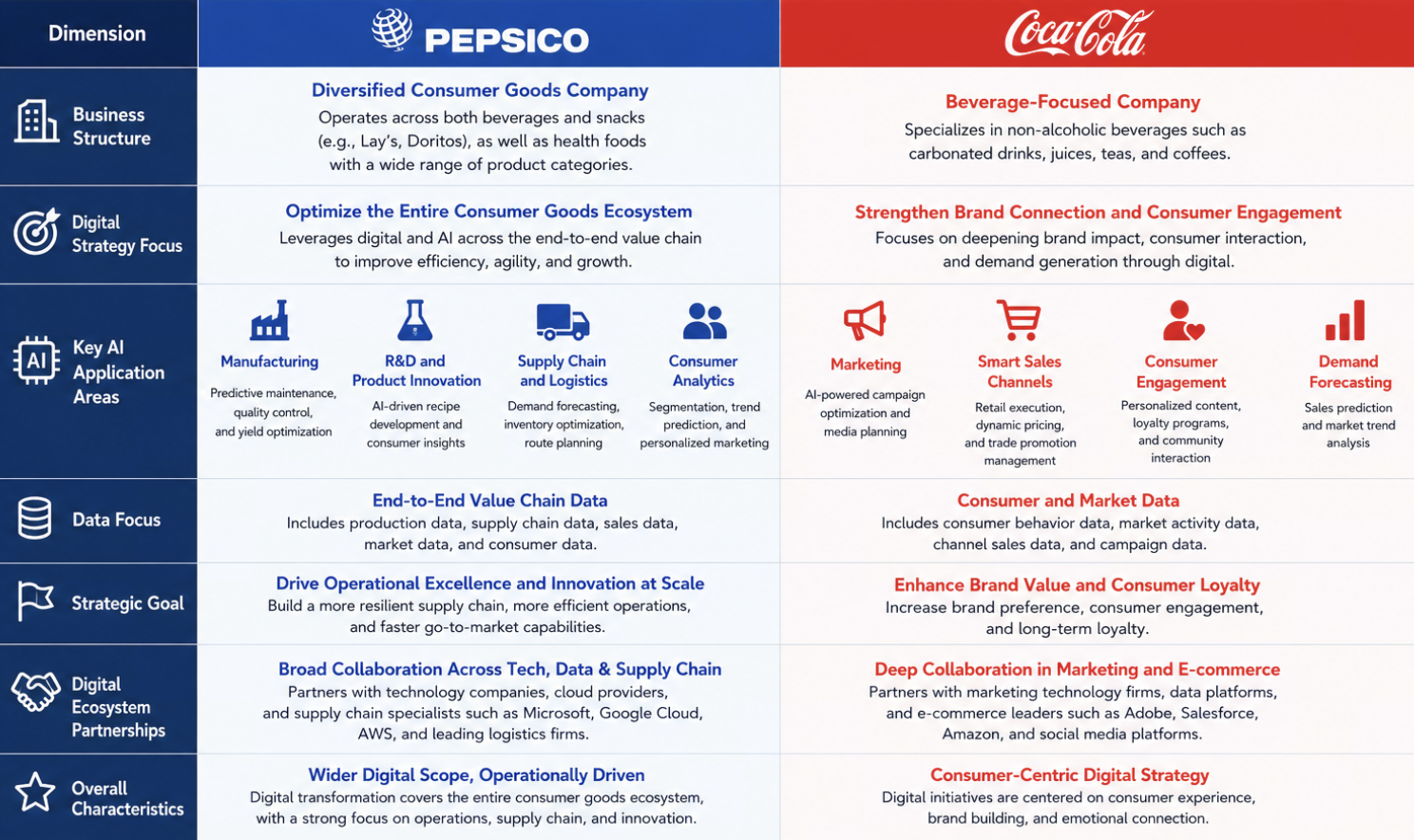
PepsiCo and Coca-Cola are both global beverage giants, but their digital strategies differ.
Coca-Cola focuses its digital transformation on the beverage ecosystem—consumer marketing, smart sales channels, and brand digital operations.
PepsiCo, with both food and beverage businesses, takes a broader approach. It must manage beverage supply chains and snack brands like Lay’s and Doritos, so its AI applications span manufacturing, food R&D, logistics, and consumer analytics.
Strategically, Coca-Cola emphasizes brand connection and consumer interaction, while PepsiCo prioritizes optimizing the entire consumer goods ecosystem through digital technology.
Both companies leverage AI to boost competitiveness, but their business structures shape distinct digital priorities.
What Challenges Does AI Face in the Consumer Goods Industry?
Despite the opportunities, AI adoption in consumer goods faces real challenges.
Data quality: AI models require large volumes of accurate data, but global enterprises source data from diverse markets, channels, and systems. Poor data integration can limit AI effectiveness.
Technology investment: Building AI systems demands significant capital—for infrastructure, talent, and ongoing maintenance. Large enterprises may gain long-term advantages, but for smaller firms, the barriers to AI transformation remain high.
Consumer privacy: As companies collect more consumer data, safeguarding privacy is critical. Balancing data utilization with privacy protection is a pressing concern.
AI also cannot fully replace human judgment. Market trends, brand value, and consumer sentiment still require analysis that blends data with human expertise.
The Future of PepsiCo’s AI Strategy
Looking ahead, PepsiCo’s AI strategy will likely deepen across several dimensions:
- AI will further integrate into supply chains, from demand forecasting to logistics optimization, automating more operational processes.
- Generative AI will become a key internal tool, supporting knowledge management, market analysis, content creation, and business decision-making.
- AI will drive increasingly personalized consumer experiences. As demand segments, companies must leverage data to deliver tailored products and services.
- Sustainability will emerge as a core direction for AI, using smart supply chains to reduce resource waste and data analytics to optimize energy consumption.
For PepsiCo, AI is not a stand-alone technology investment—it’s a foundational capability for long-term transformation.
Conclusion
PepsiCo’s ongoing investment in AI signals a new era of digital competition in the global consumer goods industry.
From supply chain forecasting and smart manufacturing to product innovation and consumer engagement, AI is reshaping how food and beverage companies operate. For global leaders like PepsiCo, technology is now as critical a competitive factor as brand, distribution, and scale.
As AI technology matures, competition among consumer goods enterprises will increasingly hinge on data capabilities, operational efficiency, and consumer insight—not just products and market share.
PepsiCo’s AI strategy illustrates how traditional consumer businesses can leverage new technology to drive transformation, highlighting the industry’s long-term shift from economies of scale to intelligent ecosystems.