Layer2 Is Becoming Ethereum’s New Core
Over the past few years, Ethereum's development path has grown increasingly clear. Because the main chain itself faces physical and technical limitations in performance and scalability, the Ethereum community has pushed forward a rollup-centric roadmap—gradually shifting the bulk of transactions and application activity to Layer2 networks.
Under this architecture, DeFi, on-chain gaming, NFTs, and social applications will likely operate primarily within the Layer2 ecosystem, while the Ethereum main chain takes on the roles of security layer, settlement layer, and data availability layer. This design enables large transaction volumes to be computed and executed on Layer2, boosting network efficiency and lowering costs. As a result, Layer2 is no longer just a supplementary scaling solution—it's becoming a core infrastructure of the Ethereum ecosystem.
With Layer2's rising importance, a new question has drawn market attention: If Layer2 itself is overly centralized, could it undermine the decentralization and security of the entire Ethereum ecosystem?
Why Is Layer2 Governance Gaining Attention?
Many Layer2 solutions claim to be decentralized, but in practice, centralization issues often persist. For example, some Layer2 sequencers are still controlled by a single team, upgrade permissions are highly concentrated, security councils hold excessive power, and even the proof system may not be fully open.
Although built on Ethereum, Layer2 networks still face potential risks such as single points of failure, network censorship, permission abuse, and forced upgrades. This is why the Ethereum community has increasingly focused on credible neutrality: the more critical an infrastructure becomes, the less it should be controlled by a single company or a small group.
For Layer2, the market now looks beyond TPS, gas fees, or transaction speed. The key questions are: Are these networks transparent enough? Are governance mechanisms sound? Are core permissions truly moving toward decentralization? This explains why many Layer2 projects now emphasize open-source governance, community participation, and foundation-led management.
Why Did Linea Choose the Linux Foundation?
 (Source: lfdecentralizedtrust)
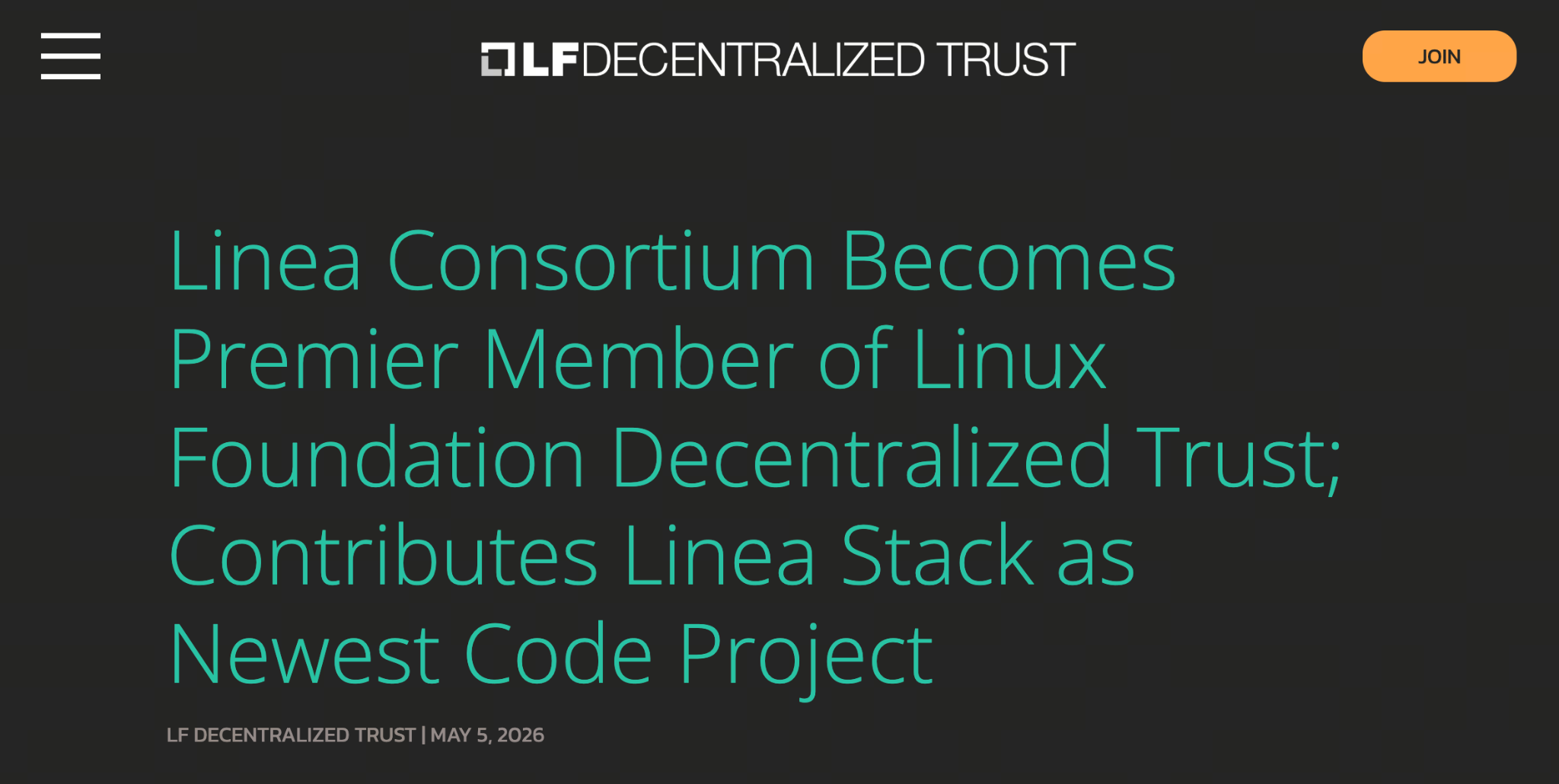
Linea is entrusting Lineth to the Linux Foundation Decentralized Trust (LFDT) primarily to establish a more neutral governance framework.
The Linux Foundation has long played a key role in the open-source world, overseeing major infrastructures such as:
- Linux
- Kubernetes
- Hyperledger
All of these are tied to foundation-based governance.
The core idea is to ensure that technological development does not rely solely on a single company. So Linea's move is not just about open-sourcing technology—it's about making Layer2 infrastructure a public good.
Open-Sourcing Lineth Doesn't Mean Full Decentralization
Although Linea has gradually open-sourced Lineth's core technology stack, the network has not yet achieved full decentralization. Key components like the sequencer, prover, upgrade permissions, and the Security Council are still under the core team's control. In other words, the network's operation remains heavily dependent on the official team.
That's why some Layer2 analysis platforms still classify Linea as Stage 0. The network has some openness and transparency, but core control is not fully distributed, and there's still a gap to true credible neutrality. In short, open-sourcing Lineth represents a step toward decentralization, not the final state. It signals a gradual transition in governance models and technical architecture, not a completed endpoint.
Why Has Stage Become a Key Metric for Layer2?
In recent years, the Layer2 ecosystem has used the Stage system to evaluate decentralization levels. The goal is to transparently show whether a Layer2 truly offers credible neutrality and how dependent it is on a single team.
Simply put, Stage 0 means the network still heavily relies on team control; Stage 1 indicates some core permissions have started to decentralize; Stage 2 approaches a mature Layer2 governed entirely by smart contracts and permissionless mechanisms. However, many current Layer2 networks are still at Stage 0 or Stage 1. Fully decentralized Layer2 is technically highly challenging.
For ZK Rollups, this involves complex proof systems, efficient sequencer architectures, and security governance. Every aspect requires balancing efficiency, security, and decentralization. So the entire Layer2 market is still in a gradual evolution and transition phase, not fully mature.
The True Significance of Lineth for the Ethereum Ecosystem
Linea's Lineth project may have implications beyond Linea itself—it reflects a broader shift in the direction of Ethereum Layer2 development.
In the past, the market focused on performance metrics like TPS, gas costs, and transaction speed. Competition revolved around who could offer the fastest, cheapest scaling solution. But as the Layer2 ecosystem matures, the market is realizing that the real infrastructure competition goes beyond performance—it includes governance credibility and permission distribution. People are now asking: Who actually controls the network? Who holds upgrade power? Is the core technology transparent enough? Can the community genuinely participate in governance?
This shift shows that Layer2 is evolving from an early-stage technology race into a more mature infrastructure competition. The larger the assets and applications a network carries, the more critical governance, permissions, and credibility become.
Open-Source Governance May Become a Future Trend
Linea placing Lineth under the Linux Foundation could also influence other Layer2 projects. As Layer2 carries more assets, DeFi protocols, and on-chain applications, the market will naturally demand higher transparency and credibility. In the future, projects will be judged by their open-source level, foundation governance model, neutral technical architecture, and whether the community truly has a voice.
For large-scale infrastructure, the market's biggest fear is not the technology itself, but the risk of a single company gaining excessive control. As Layer2 becomes a core part of Ethereum, credible neutrality will likely become a key competitive differentiator. Lineth may seem like just an open-source project, but it reflects a fundamental rethinking of governance across the Layer2 ecosystem. The market is realizing that truly long-lasting infrastructure requires not only high performance but also a transparent, trustworthy, and community-maintained governance structure.
Summary
Linea's Lineth project represents more than code openness—it marks a significant shift in Layer2 governance. By leveraging the Linux Foundation's governance framework, Linea aims to enhance technical transparency, ecosystem participation, long-term sustainability, and credible neutrality.
Although the network itself has not yet fully decentralized, Lineth sends a clear signal: the Layer2 ecosystem recognizes that governance will be a key competitive arena going forward. And this change may be one of the important signs that the Ethereum Rollup era is gradually maturing.







