As the AI industry gradually moves beyond purely software-based models and into the physical world, robotics, autonomous devices, and automation systems are becoming major fronts in the next wave of technological competition. From humanoid robotics to autonomous machines, more AI systems are gaining the ability to interact with real-world environments. At the same time, Physical AI is increasingly becoming an important point of convergence for Web3, DePIN, and the on-chain representation of real-world assets.
The emergence of XMAQUINA reflects an attempt to bring the robotics industry together with blockchain infrastructure.
What Is XMAQUINA?
As a Web3 ecosystem built around the machine economy, XMAQUINA aims to use DAOs and on-chain capital markets to give robotic assets, Physical AI, and automation infrastructure more open ways to collaborate and raise capital.
In the traditional robotics industry, most capital allocation, equipment operations, and technology development are led by a small number of institutions, making it difficult for ordinary users to participate directly. Through the Robotics Capital Markets (RCM) protocol and its DAO governance structure, XMAQUINA moves part of the industry’s resources and decision-making logic on-chain.
This model is not limited to governance tokens and community voting. It also involves on-chain coordination of robotic assets, capital deployment, and ecosystem collaboration. The ecosystem’s core governance token, DEUS, is used for governance, proposals, and protocol coordination, while xDEUS serves as the staked governance credential used in ecosystem decision-making.
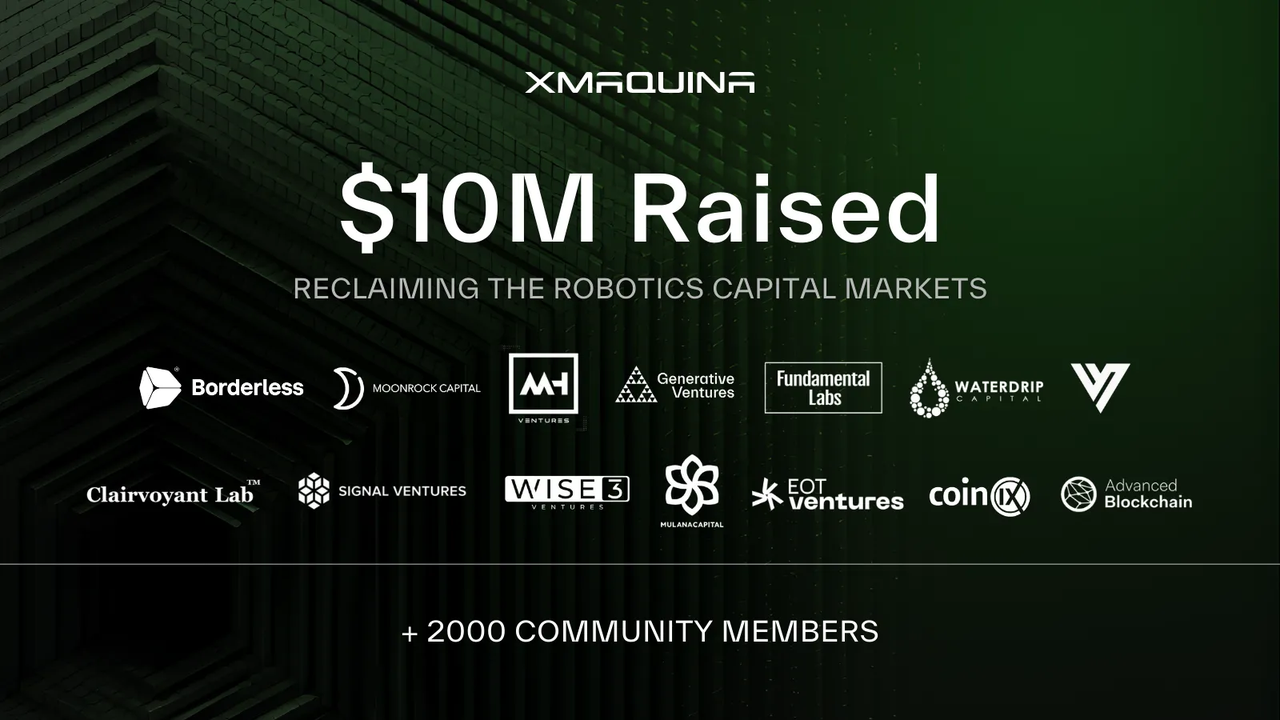
In December 2025, XMAQUINA announced the completion of a funding round, with participating investors including Borderless Capital, Waterdrip Capital, vVv, Clairvoyant Labs, Arkstream Capital, LD Capital, KuCoin Ventures, and other investment institutions.
How Does XMAQUINA DAO Work?
XMAQUINA’s governance structure is centered on a DAO, or decentralized autonomous organization. The DAO’s core role is to coordinate treasury funds, protocol upgrades, and ecosystem resources through community voting and on-chain governance.
In XMAQUINA, DEUS holders can stake their tokens to receive xDEUS and then participate more directly in the governance process. xDEUS is typically used for proposal voting, SubDAO decisions, and ecosystem governance.
The DAO’s governance scope includes:
-
Treasury fund management
-
Proposals related to Robotics Capital Markets
-
SubDAO coordination
-
Ecosystem partnerships and capital allocation
-
Protocol upgrades and adjustments to governance parameters
This structure differs clearly from the centralized management model used by traditional robotics companies. Traditional models usually rely on boards of directors and institutional investors to make decisions, while XMAQUINA seeks to create a more open model of collaboration through community governance.
In addition, the SubDAO mechanism allows the ecosystem to expand around different robotics-related directions, such as autonomous machines, robotics infrastructure, and Physical AI protocols.
What Is the DEUS Token Used For?
DEUS is the core governance token in the XMAQUINA ecosystem. It is used to coordinate DAO governance, protocol voting, and the allocation of ecosystem resources.
Its main functions include:
| Function |
Description |
| Governance |
Participate in DAO proposals and voting |
| Staking |
Users can stake DEUS to receive xDEUS |
| Protocol coordination |
Used for ecosystem governance and resource allocation |
| Treasury management |
Participate in decisions on capital deployment |
| SubDAO governance |
Coordinate different ecosystem modules |
After staking DEUS, users can receive xDEUS. xDEUS usually represents governance weight and is used to participate in the protocol governance process.
This structure is similar to governance models used by some DeFi protocols, but XMAQUINA’s focus is not limited to financial protocols. It extends further into the robotics economy and Physical AI infrastructure.
What Is Robotics Capital Markets (RCM)?
Robotics Capital Markets (RCM) is the concept of robotics capital markets proposed by XMAQUINA. Its core goal is to establish an on-chain capital coordination mechanism for robotic assets and automation infrastructure.
In the traditional robotics industry, capital is often relatively illiquid, and the financing process tends to be closed. Robotic equipment, automation systems, and AI infrastructure often require long-term investment and depend heavily on institutional capital.
RCM attempts to create a new financing and liquidity model for robotic assets through on-chain governance and tokenized structures.
This mechanism may involve:
-
On-chain coordination of robotic assets
-
DAO-driven capital allocation
-
Community-governed financing
-
Collaboration around automation infrastructure
-
Open markets for the robotics economy
The concept of RCM also highlights how XMAQUINA differs from traditional DeFi projects. Its focus is not merely on trading digital assets, but on connecting the real-world robotics economy with on-chain capital systems.
How Is XMAQUINA Different from Traditional AI or DePIN Projects?
Although XMAQUINA overlaps with areas such as AI, DePIN, and RWA, its core positioning remains centered on the robotics economy and Physical AI.
Here are several key differences:
| Dimension |
XMAQUINA |
Ordinary AI Projects |
DePIN Projects |
| Core focus |
Physical AI and the robotics economy |
AI software and models |
Decentralized infrastructure |
| Asset type |
Robots and automation equipment |
Data or model services |
Network resources |
| Governance structure |
DAO + xDEUS |
Team-led |
Node network |
| Capital model |
Robotics Capital Markets |
Token incentives |
Infrastructure incentives |
| Real-world connection |
High |
Medium |
High |
Compared with traditional AI projects, XMAQUINA places greater emphasis on real-world equipment and robotics networks. Compared with DePIN projects, it focuses more specifically on robotics capital markets and the Physical AI ecosystem.
Potential Use Cases of XMAQUINA
As Physical AI and the robotics industry continue to develop, XMAQUINA’s potential use cases are gradually expanding.
They include:
-
Collaborative networks for autonomous machines
-
AI-driven robotics economies
-
Decentralized robotics governance
-
On-chain robotic assets
-
Physical AI infrastructure
-
DAO-driven automation networks
-
Machine economy protocol layers
These directions are still at an early stage, but they also represent a new exploration of how Web3 and the robotics industry can converge.
Conclusion
As a Web3 ecosystem built around the robotics economy, Physical AI, and DAO governance, XMAQUINA uses DEUS, xDEUS, and the Robotics Capital Markets (RCM) protocol to explore the creation of an open robotics capital market and machine economy network.
Although the robotics economy and on-chain capital markets are still in their early stages, this model has already begun to explore new possibilities for financing, governance, and collaboration in the robotics industry.
FAQs
What Is the DEUS Token Used For?
DEUS is XMAQUINA’s governance token. It is used for DAO voting, treasury management, protocol governance, and coordination of ecosystem resources.
What Is the Difference Between xDEUS and DEUS?
DEUS is the base governance token, while xDEUS is typically the governance credential users receive after staking DEUS. It is used to participate in governance and voting.
What Is Physical AI?
Physical AI refers to AI systems that can interact with the real world, including robots, autonomous devices, industrial automation systems, and intelligent machines.
Both XMAQUINA and DePIN emphasize on-chain collaboration for real-world infrastructure, but XMAQUINA focuses more on the robotics economy, Physical AI, and robotics capital markets.