URA's core premise is that nuclear power generation depends heavily on uranium supply, and uranium itself carries distinct energy-cycle characteristics. When the global energy mix, nuclear power demand, or uranium prices shift, URA tends to simultaneously reflect the market volatility of the nuclear energy supply chain.
As the global energy transition accelerates, nuclear energy is once again a central topic in energy markets. Unlike traditional fossil fuels, nuclear power provides stable baseload electricity, which is why uranium miners and the broader nuclear supply chain are drawing renewed market interest.

The core function of a uranium ETF is to provide a centralized way for the market to track changes in the nuclear energy supply chain and uranium resource markets. Rather than investing directly in a single mining company, the ETF structure enables exposure to multiple countries and diverse uranium-related businesses.
From a supply chain standpoint, the nuclear industry encompasses uranium mining, uranium enrichment, nuclear fuel processing, power plant construction, and power generation. URA's holdings are typically concentrated in upstream uranium mining assets and select nuclear fuel companies.
The key difference between nuclear and traditional energy is that nuclear plants require a long-term, stable fuel supply. This makes uranium not just a mining commodity but a critical component of global energy security.
When global nuclear power demand rises, the profitability of uranium miners usually comes into sharper focus—this is a major source of URA's price volatility.
URA is essentially a sector-specific thematic ETF that allocates assets across the global uranium and nuclear energy supply chain. The fund manager adjusts holdings in various uranium and nuclear companies according to index rules.
Unlike traditional actively managed funds, URA is more of an index-tracking tool. Its goal is not to pick a single star company but to reflect the overall market performance of the uranium mining sector.
Structurally, URA typically includes:
This diversified structure means URA is influenced not only by uranium prices but also by global nuclear policy and broader energy market dynamics.
URA’s holdings structure is generally built around the world’s major uranium resource companies. Regions like Canada, Kazakhstan, and Australia, which host large uranium deposits, tend to have a higher representation in the ETF.
Large uranium miners, with mature operations and reliable long-term supply capabilities, usually carry significant weight in the fund.
At the same time, some nuclear fuel processors and nuclear technology companies may also be included in URA’s holdings. This makes URA more than a pure mining ETF—it functions as a complete nuclear energy supply chain ETF.
Because the uranium market is relatively small, URA’s sector concentration is typically higher than that of conventional energy ETFs.
The global uranium supply chain is essentially a nuclear fuel supply system. First, uranium miners extract natural uranium ore and perform initial processing.
The uranium then moves to enrichment and fuel manufacturing to produce the assemblies needed for nuclear reactors. Finally, nuclear power plants use the fuel for long-term electricity generation.
Compared to oil markets, the nuclear fuel market relies more heavily on long-term contracts and stable supply. Because nuclear plants must operate continuously for extended periods, fuel procurement cycles are typically long.
This long-term supply structure makes the uranium industry inherently cyclical and heavily influenced by policy.
Uranium is the primary energy source for the nuclear power industry. Reactors release energy through uranium fission to generate electricity.
Compared to coal and natural gas, nuclear power offers high stability and relatively low carbon emissions. That is why, amid the global energy transition, nuclear energy has become a key focus once again.
Nuclear plant construction cycles are long, so the market keeps a steady eye on uranium reserves and fuel supply security.
When multiple countries renew their commitments to nuclear power, the market simultaneously watches for growth in uranium demand—this is a major reason URA attracts widespread attention.
The uranium price is one of the most critical variables for URA. Since the ETF holds a large weight in uranium miners, rising uranium prices typically boost profit expectations for those companies.
When uranium prices climb, the market revalues uranium resources, pushing up valuations of related firms.
On the flip side, the uranium market is relatively small, so price swings tend to be larger than those in traditional energy commodities.
This high volatility makes URA prone to significant price moves during nuclear energy cycles.
| Influencing Factor | Primary Impact on URA |
|---|---|
| Uranium price increase | Lifts miner profit expectations |
| Nuclear power demand growth | Increases uranium demand |
| Energy crisis | Raises nuclear energy's profile |
| Policy & regulatory changes | Affects nuclear development outlook |
| Global interest rate changes | Affects energy asset valuations |
Because the nuclear industry is shaped by both energy policy and resource cycles, URA's performance tends to carry strong macroeconomic characteristics.
The global energy transition is driving diversification of the energy mix. In addition to solar and wind, nuclear energy has re-entered the center of global energy discussions.
While renewables are growing quickly, wind and solar face intermittency issues, leaving some countries reliant on stable baseload power to support the grid.
Nuclear power can deliver continuous, stable electricity, prompting several countries to expand nuclear investment and reactor construction.
These developments suggest the uranium market may be entering a long-term demand growth phase, and URA is consequently gaining more attention.
The key difference between URA and gold ETFs is that gold is primarily a safe-haven asset, whereas URA is more of an energy resource asset.
Compared to traditional oil ETFs, URA has a smaller market size and is more dependent on policy and nuclear power demand.
In terms of volatility, URA typically fluctuates more than large energy ETFs because the uranium market is highly concentrated, making it sensitive to supply changes.
URA also contrasts sharply with clean energy ETFs. Clean energy ETFs emphasize electric vehicles, batteries, and renewable equipment, while URA focuses on nuclear energy and uranium supply.
URA, as a uranium-themed ETF traded on U.S. exchanges, can typically be accessed through platforms that support U.S. stock trading. Traditionally, users would open an overseas securities account to participate in the U.S. equity market.

Recently, the China Securities Regulatory Commission reiterated that overseas institutions may not illegally offer account opening and trading services within China, and set a remediation period for existing business. As a result, some online brokerages have adjusted their U.S. stock-related services.
This shift has led more users to reevaluate their U.S. stock trading channels and explore alternatives. Besides traditional securities trading, some platforms now offer CFDs, synthetic assets, or on-chain stock proxies linked to U.S. stocks.
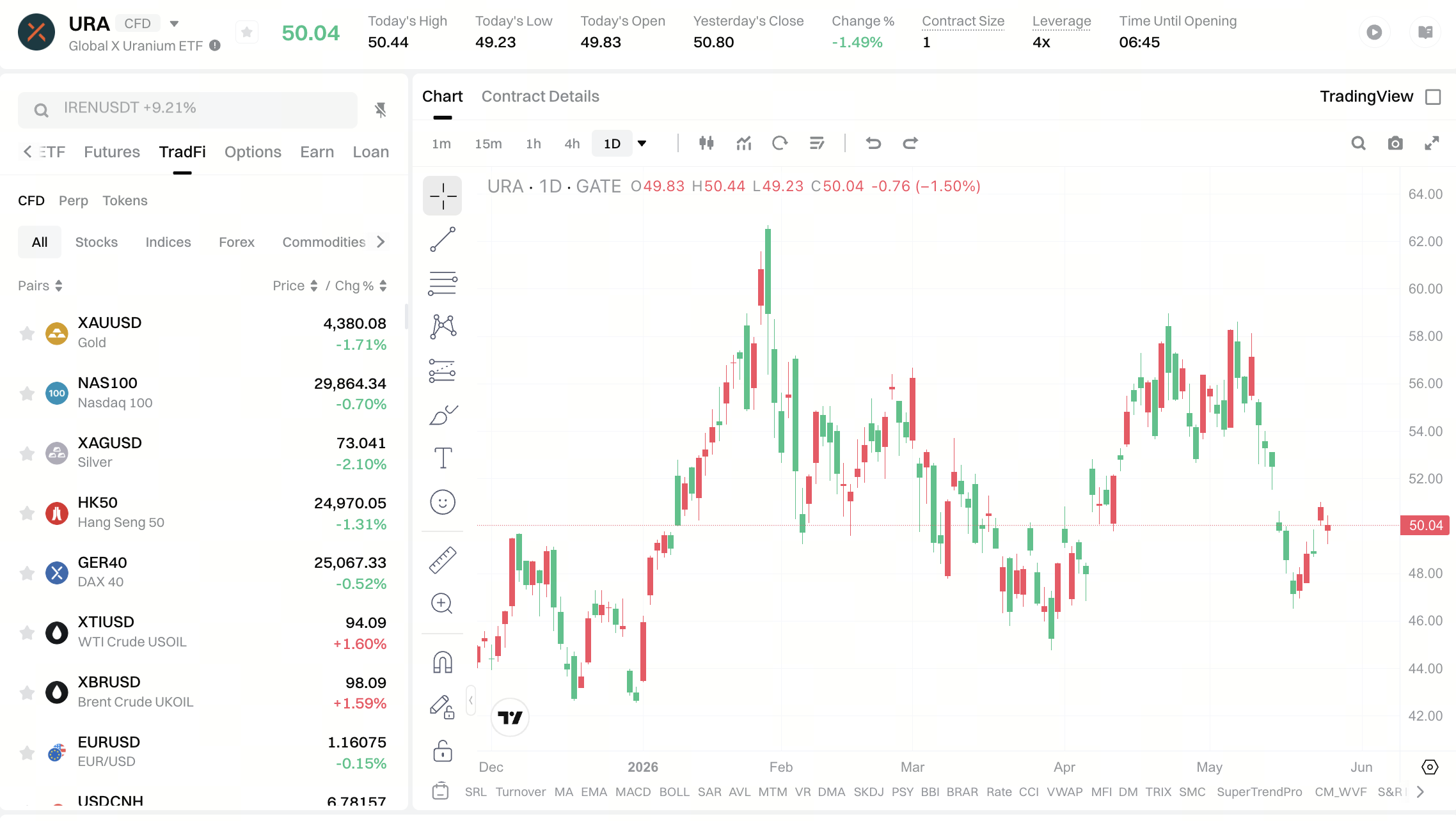
Gate CFD, offered by certain digital asset platforms, now covers some global market assets including ETFs. For some users, this means they can access overseas ETF CFDs—including products tracking URA—on the same platform without needing a separate securities account.
However, different jurisdictions have different regulatory requirements for U.S. stock ETF and derivatives trading. Before trading URA or related products, users should carefully review platform compliance, product structure, leverage risks, and regional restrictions.
URA is one of the key thematic ETFs tracking the global nuclear energy and uranium market. Its core logic revolves around the nuclear supply chain, uranium resource availability, and the global energy transition.
Compared to traditional energy ETFs, URA is more sensitive to uranium prices, nuclear policy, and energy security issues, giving it pronounced resource-cycle and policy-driven characteristics.
As the global energy structure continues to evolve, the nuclear supply chain represented by URA is becoming an increasingly important part of the world energy landscape.
URA is a uranium-themed ETF launched by Global X. It invests primarily in global uranium mining companies and firms tied to the nuclear energy supply chain.
Because URA's core holdings are largely uranium miners, a rise in uranium prices tends to improve their profitability outlook and drive the ETF higher.
URA is more of a nuclear energy resource ETF than a traditional clean energy ETF. It focuses specifically on nuclear power and the uranium market.
Nuclear plants generate electricity by using uranium fission to release energy, making uranium the industry's essential fuel source.
URA tracks uranium resources and the nuclear supply chain, whereas oil ETFs focus on crude oil, natural gas, and traditional energy markets.
URA can typically be traded on platforms that support U.S. stocks. Some platforms also offer CFDs or derivatives linked to U.S. stock ETFs.