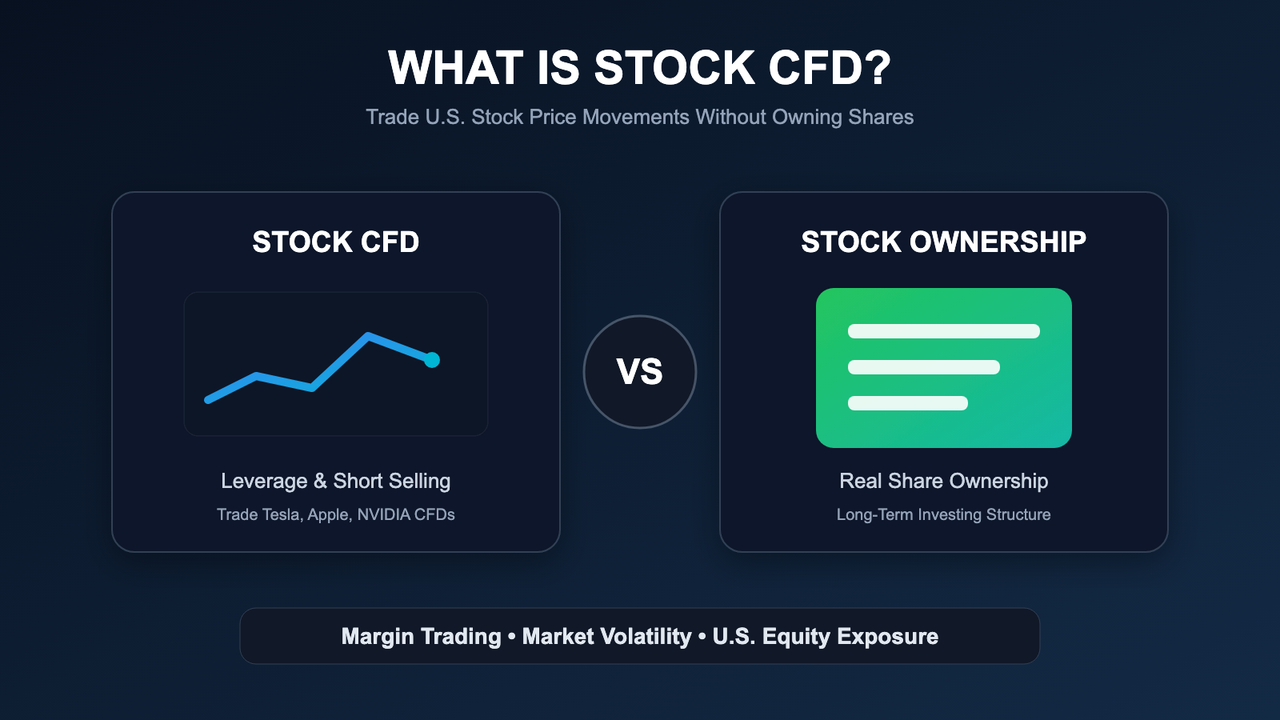
As global online trading platforms have developed, stock CFDs have become an important part of the retail derivatives market. Among them, U.S. stock CFDs are one of the most common types, because the U.S. stock market includes many highly liquid and widely followed companies, such as Apple, Microsoft, NVIDIA, and Tesla.
Compared with traditional stock investing, stock CFDs focus more on trading price movements themselves rather than holding stock assets for the long term. As a result, they are widely used in short term trading, trend trading, and market risk hedging.
The U.S. stock market is one of the world’s most liquid and actively traded equity markets, so many CFD platforms offer U.S. stock CFD products.
For example, traders can use CFDs to participate in the price movements of popular technology stocks such as:
Apple
NVIDIA
Tesla
Microsoft
Amazon
Because these companies attract strong market attention and often show notable volatility, U.S. stock CFDs tend to have high trading activity.
In addition, compared with traditional securities accounts, U.S. stock CFDs usually have lower entry barriers, more flexible leverage, support for short selling, and a more convenient way to access global markets. For these reasons, they attract the attention of some short term traders.
The core logic of stock CFDs is “settlement by price difference”.
For example, if a trader believes NVIDIA’s share price will rise, they may open a long CFD position at USD 100. If the price rises to USD 110 and the trader closes the position, the theoretical profit comes from the USD 10 price difference.
Throughout this process, the trader does not actually hold NVIDIA shares. They are only participating in the stock’s price movement.
If the trader believes a U.S. stock will fall, they can also open a short position directly. If the price then declines and the position is closed, the trader may likewise gain from the price difference.
This is one of the key differences between stock CFDs and traditional stock trading.
Traditional U.S. stock trading usually involves ownership of actual shares. After buying a stock, investors usually own the corresponding asset and may receive shareholder rights, such as dividends or voting rights.
Stock CFDs, by contrast, are derivatives. Traders do not actually own the shares.
The main differences between the two lie in their trading structure and risk model.
| Comparison Dimension | Stock CFD | Traditional U.S. Stock Trading |
|---|---|---|
| Holds actual shares | No | Yes |
| Supports leverage | Usually yes | Partially supported |
| Supports short selling | Yes | Restricted in some markets |
| Has shareholder rights | Usually no | Yes |
| Core logic | Settlement by price difference | Share ownership trading |
Compared with long term investing, U.S. stock CFDs are more focused on short term market volatility trading.
Stock CFDs usually use a margin trading model.
For example, with 5x leverage, a trader may only need to provide USD 1,000 in margin to open a U.S. stock CFD position worth USD 5,000.
The leverage calculation logic can usually be expressed as:
Leverage can improve capital efficiency, but it also amplifies both potential gains and the risk of losses caused by market movements.
Because U.S. stocks themselves can fluctuate significantly around earnings releases, macroeconomic data, or changes in market sentiment, leverage risk is especially important in the stock CFD market.
Stock CFDs are essentially based on price movements, so traders can participate in both rising and falling markets.
For example, if a trader believes Tesla’s share price may fall, they can open a short CFD position directly. If the share price declines and the position is closed, the trader may earn the price difference.
Compared with short selling through securities lending in traditional stock markets, the short selling process for stock CFDs is usually simpler. This is why they are widely used in short term trading and market risk hedging.
In the highly volatile U.S. stock market, the short selling mechanism is also one of the main reasons the CFD market remains active.
The main trading costs of stock CFDs usually include spreads, trading fees, and overnight financing fees.
The spread is the difference between the buying price and the selling price, and it is also an important source of revenue for some platforms.
If traders hold U.S. stock CFD positions for a long period, they usually also incur overnight financing fees, because leveraged trading essentially involves the cost of using capital.
For short term traders, spreads are usually more important; for users who hold positions longer, financing fees may have a noticeable impact on overall returns.
Stock CFDs are high risk leveraged derivatives, and their risks mainly come from price volatility and the amplifying effect of leverage.
Using U.S. stock CFDs as an example, when highly volatile stocks such as NVIDIA or Tesla move sharply around earnings announcements, account profits and losses may change quickly.
In addition, stock CFDs may also involve:
Forced liquidation risk
Liquidity risk
Market gap risk
Financing cost risk
Platform risk
Especially under high leverage, even a relatively small price movement may cause account equity to decline rapidly.
Stock CFDs give global users a way to participate in international stock markets without holding actual shares.
For some traders, U.S. stock CFDs can be used for:
Short term trading
Leveraged market participation
Short selling
Trend trading
Market risk hedging
At the same time, stock CFDs have also encouraged closer integration between traditional stock markets and online derivatives trading systems, making it easier for global users to participate in U.S. stock price movements.
As financial derivatives settled based on changes in stock prices, stock CFDs allow traders to participate in market volatility without holding actual shares.
Using U.S. stock CFDs as an example, traders can use leverage and short selling mechanisms to participate in the price movements of popular stocks such as Apple, NVIDIA, or Tesla without actually holding the corresponding shares.
Compared with traditional stock investing, stock CFDs place greater emphasis on price movements and short term trading. However, they also involve higher risks, including forced liquidation, amplified leveraged losses, and financing fee risk.
No. Stock CFDs are derivatives settled by price difference, and no transfer of actual share ownership takes place during the trading process.
They usually include popular U.S. listed companies such as Apple, Microsoft, NVIDIA, Tesla, and Amazon.
Because CFDs are essentially based on price movements, users can participate in both rising and falling markets.
Traditional stock trading involves ownership of actual shares, while stock CFDs are settled only based on price differences.
Because stock CFDs are usually used with leverage, price movements may amplify changes in account profits and losses.
Because long term positions usually generate overnight financing fees, stock CFDs are more commonly used for medium and short term trading scenarios.