Distributed energy and AI infrastructure are becoming new areas of discussion in the crypto market. As the number of solar panels, electric vehicles, and home energy storage devices continues to grow, more projects are exploring how onchain systems can coordinate real world energy networks.
Traditional energy systems mainly rely on centralized power generation and unified dispatching. But as the number of edge devices increases, energy supply and demand become more complex. For this reason, onchain coordination structures are gradually becoming part of the broader discussion around energy infrastructure.
Discussions around Starpower usually involve several areas, including DePIN, energy aggregation, device coordination, AI energy demand, and onchain incentive mechanisms. Together, these components form the logic behind Starpower’s energy network.

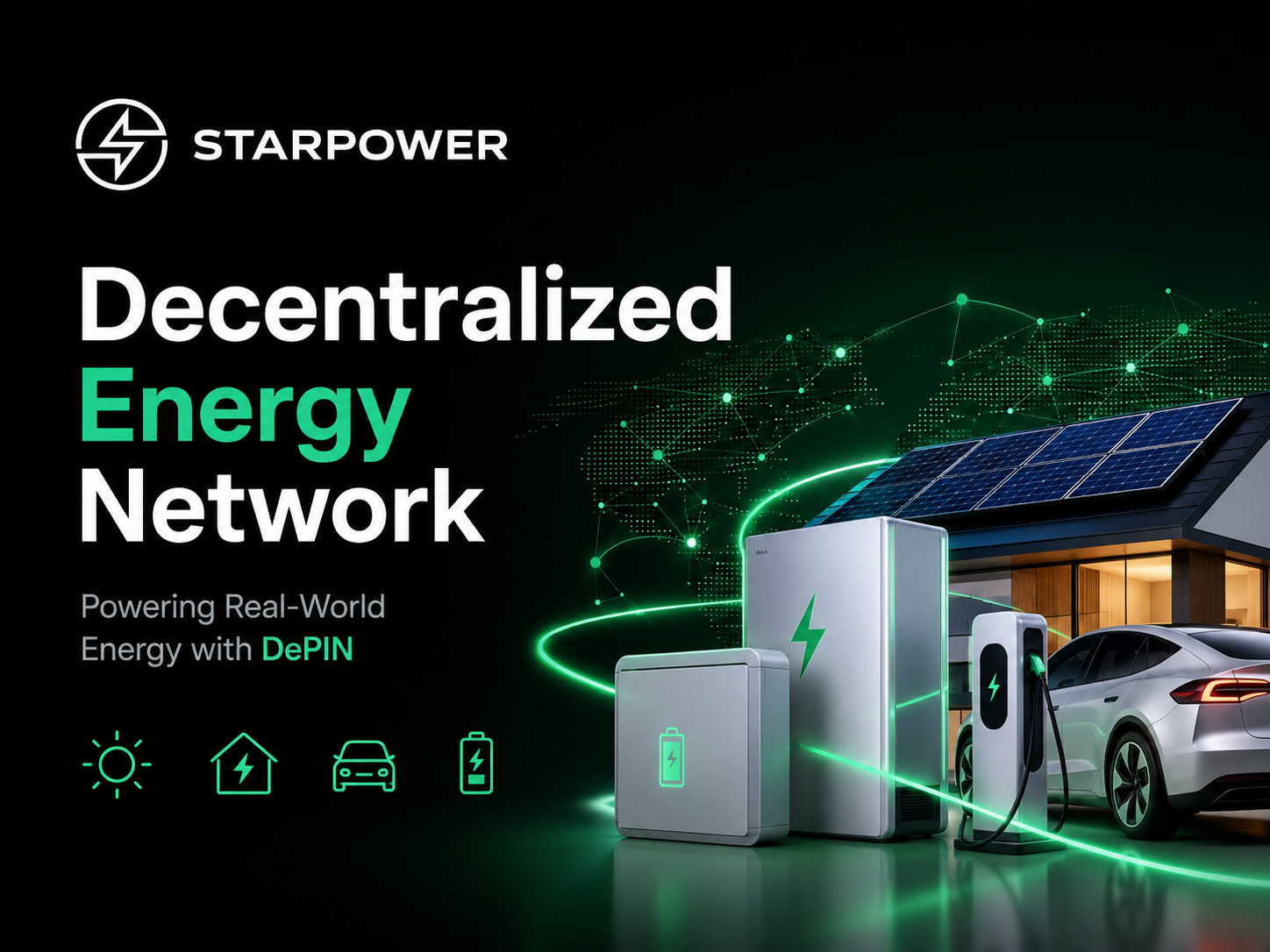
As a distributed energy coordination network, Starpower continuously processes energy data from solar power systems, electric vehicles, and home energy devices, while coordinating supply and demand across different nodes.
Structurally, Starpower is closer to an energy coordination layer than a traditional energy trading platform. Its main focus is improving coordination efficiency among different devices.
Starpower connects real world energy devices to a unified network. Once different devices join the network, the system continuously analyzes energy status, node load, and changes in energy demand.
This mechanism means household energy devices are no longer only energy consumers. Solar power systems, electric vehicles, and home batteries can all become energy nodes within the network.
Only after real world devices are connected to an onchain network can a blockchain system obtain real energy data. The core role of DePIN is to connect physical infrastructure with digital networks.
Starpower uses a DePIN architecture to manage solar power systems, electric vehicles, and home energy devices. Different devices enter the network as independent nodes and continuously synchronize their energy status and operating data.
Structurally, a DePIN network places greater emphasis on node autonomy. The onchain system analyzes changes in supply and demand based on energy status, then coordinates energy collaboration among different devices.
| Module | Role |
|---|---|
| Solar devices | Provide energy input |
| Home batteries | Store energy |
| Electric vehicles | Participate in energy dispatch |
| Onchain system | Process energy data |
| DePIN network | Coordinate node operation |
This structure means Starpower can use an onchain system to coordinate real world energy devices. Compared with traditional energy systems, DePIN is better suited to managing collaboration among large numbers of edge devices.
Traditional energy systems have long relied on centralized power generation and unified dispatching. However, as renewable energy devices increase, the logic of energy coordination is beginning to change.
Starpower builds a decentralized energy network through a device aggregation mechanism. Solar power systems, batteries, and electric vehicles in different regions can jointly form a distributed energy system.
First, users need to connect their energy devices to the Starpower network. Then, the onchain system synchronizes device status and energy data. Next, the system analyzes changes in supply and demand across the network. Finally, the network coordinates energy allocation among different devices.
The core focus of Starpower is not directly producing energy, but improving coordination among devices. As the number of edge devices increases, energy coordination efficiency becomes more important.
Unlike traditional energy structures, decentralized energy networks place greater emphasis on device autonomy. Part of the energy coordination function can gradually shift from centralized institutions to distributed device networks.
The STAR token is used to connect device incentives, node participation, and energy coordination mechanisms within the Starpower network. The onchain incentive structure is an important part of keeping a DePIN network running.

Starpower’s energy network requires large numbers of devices to continuously upload data, so the system needs to incentivize node participation through the STAR token. Device operation, data synchronization, and network coordination may all involve onchain incentive logic.
Structurally, STAR is more like a coordination asset within network operations, rather than simply a standard trading token. Different device nodes may earn rewards by uploading energy data, while network participants may also use STAR to participate in system governance.
| STAR Role | Corresponding Scenario |
|---|---|
| Node incentives | Devices participating in the network |
| Data rewards | Uploading energy data |
| Network coordination | Energy collaboration mechanism |
| Governance participation | Community governance |
This mechanism means STAR is directly connected to network operations. The number of devices, demand for energy coordination, and scale of node participation may all affect how STAR is used within the system.
Solar power and home energy storage devices have long operated in a relatively isolated manner, which can affect energy utilization efficiency. A lack of unified coordination among devices can also increase energy fluctuations.
Starpower uses an onchain coordination system to connect solar power, batteries, and home devices. Once devices are connected, the network processes energy status and device data in a unified way.
First, home devices upload real time energy status to the network. Then, the system analyzes energy loads across different devices. Next, the onchain coordination module adjusts energy allocation among devices. Finally, different devices can form a local energy collaboration structure.
This mechanism means home devices can not only consume energy, but also participate in energy coordination. Home batteries can store excess energy, while electric vehicles can also become mobile energy nodes.
From an application perspective, Starpower focuses on improving the utilization efficiency of distributed energy and reducing the impact of energy fluctuations.
Renewable energy often fluctuates significantly, which means energy supply is not always stable. Solar and wind power are both affected by weather and usage scenarios.
Starpower’s energy aggregation mechanism continuously coordinates different energy nodes and balances energy supply and demand. The onchain system processes device data in real time.
First, energy nodes synchronize device status and energy data. Then, the system analyzes changes in energy supply and demand across different regions. Next, energy storage devices and electric vehicles participate in energy coordination. Finally, the network dynamically adjusts energy allocation.
| Mechanism | Role |
|---|---|
| Data upload | Obtain device status |
| Network analysis | Determine supply and demand changes |
| Storage coordination | Balance energy fluctuations |
| Device dispatch | Optimize energy use |
At its core, Starpower’s energy aggregation mechanism depends on real time data coordination. Compared with traditional energy systems, an onchain structure can improve data transparency and coordination efficiency among devices.
Energy aggregation capability directly affects network operating efficiency. As the number of nodes increases, the system’s data processing capacity also becomes more important.
AI computing is rapidly increasing energy consumption. GPU servers, AI model training, and data centers all require substantial electricity.
Traditional energy systems are mainly designed around stable power supply, but the growth of energy demand from AI infrastructure is increasing pressure on energy dispatch. As a result, distributed energy networks are receiving more attention.
One of Starpower’s key focuses is using edge energy devices to ease pressure on centralized energy systems. Home batteries, electric vehicles, and solar power devices may all become supplementary energy nodes.
Structurally, the AI industry requires more flexible energy coordination. Distributed energy networks can improve energy dispatch efficiency through multiple energy nodes.
This shift means energy infrastructure is gradually becoming digitized. Onchain coordination systems may become an important part of future energy networks.
Traditional energy systems usually rely on large scale power generation facilities and centralized dispatching. As a result, users are more often energy consumers than participants in the energy network.
Starpower places greater emphasis on collaboration among distributed devices. Solar power systems, electric vehicles, and home batteries can all become energy nodes within the network.
In traditional energy systems, data coordination is mainly handled by centralized institutions. Starpower uses an onchain structure to process energy data and device collaboration logic.
| Comparison Dimension | Starpower | Traditional Energy System |
|---|---|---|
| Network structure | Distributed | Centralized |
| Node role | Users can participate | Users mainly consume energy |
| Data coordination | Onchain system | Centralized dispatch |
| Energy source | Multi node devices | Large scale power generation facilities |
This difference means the two systems are suited to different scenarios. Traditional energy systems are better suited to stable power supply, while distributed networks place greater emphasis on flexible coordination.
Starpower’s goal is not to replace traditional energy systems, but to improve energy collaboration efficiency among edge devices.
Distributed energy networks need to handle large numbers of real world devices, which makes scaling relatively difficult. Device compatibility, node stability, and data accuracy can all affect network operation.
One important challenge for Starpower is how to unify different device standards. Energy devices from different manufacturers may use different interfaces and data structures.
From a governance perspective, energy networks also need to address permission management and data privacy. The onchain system must coordinate device authorization, node identity, and data access control.
As the number of nodes increases, the system also needs to handle greater data coordination pressure. Energy aggregation efficiency directly affects the stability of network operations.
This issue shows that DePIN energy networks are still in an early stage. Onchain coordination capability and compatibility with real world devices will determine how efficiently the network can scale in the future.
Starpower is a DePIN network protocol built around distributed energy coordination. It is designed to connect solar power systems, electric vehicles, home batteries, and energy devices.
The core direction of Starpower is to use an onchain system to aggregate real world energy nodes and coordinate energy supply and demand. Compared with traditional energy systems, Starpower places greater emphasis on device collaboration and distributed coordination.
The STAR token supports device incentives, node participation, energy coordination, and other functions, while forming a connection with the overall operating structure of the network.
Starpower is a distributed energy network protocol built on a DePIN architecture. It is designed to aggregate solar power, electric vehicles, home batteries, and household energy devices, while coordinating the supply and demand of renewable energy.
The STAR token is mainly used for node incentives, energy data rewards, network coordination, and governance participation. It also serves as the onchain incentive mechanism within the Starpower network.
Starpower first connects energy devices and synchronizes energy data. It then uses an onchain coordination system to analyze supply and demand changes, before coordinating energy allocation and operating status among different devices.
DePIN is used to connect real world energy devices with the onchain network. Through a DePIN architecture, Starpower manages solar power systems, electric vehicles, and energy storage devices, enabling coordinated operation among them.
Traditional energy systems mainly rely on centralized power generation and unified dispatching. Starpower places greater emphasis on distributed device participation, onchain data coordination, and the autonomy of energy nodes.
AI training and data centers consume large amounts of electricity, so energy systems need more flexible coordination capabilities. Distributed energy networks can use edge devices to ease pressure on centralized energy systems.