What is Spark (SPK) — The Rising Star of Decentralized Finance

Beginner
Quick Reads
Last Updated 2026-03-29 22:16:51
Reading Time: 1m
Spark utilizes a modular design to offer a variety of application frameworks, such as yield farming, decentralized lending, and DAO governance models. The platform also plans to support deployment across multiple blockchains, including Ethereum, Arbitrum, and Polygon.

Preface

In the crypto space, whenever a new token or protocol launches, the community immediately scrutinizes whether it has real substance and a compelling narrative. Spark (SPK) is a decentralized finance (DeFi) project that has recently drawn significant attention—not just another hype-driven token, but a project that represents ongoing exploration and implementation of open finance in Web3.

What Is Spark?

Spark (token symbol: SPK) is a community-driven DeFi ecosystem built for resilience, transparency, and decentralized governance. Its main goal is to disrupt centralized financial institutions’ monopoly over capital and trust. SPK powers the platform’s liquidity, governance, and incentive mechanisms and serves as the essential value hub for the ecosystem.

Unlike some DeFi protocols that focus on a single use case, Spark aims to build a diverse, modular application framework. It encompasses yield farming, decentralized lending, and DAO governance models.

Core Functional Modules

  • Modular Architecture: Spark’s modular design enables developers and the community to create custom features as needed, much like building with DeFi “legos.”
  • Decentralized Governance: The platform is governed by a DAO, giving all participants the ability to shape protocol development through voting, which reflects Web3 decentralization principles.
  • Multi-Chain Support: SPK will support multi-chain deployment, ensuring seamless interactions and expanded use cases across Ethereum, Arbitrum, Polygon, and more.

Tokenomics and Distribution

Spark has set a fixed total supply, which it distributes as follows:

  • Community Liquidity Incentives: 45%
  • Founding Team and Advisors: 20% (vested annually)
  • Ecosystem Fund and Partners: 15%
  • Public Sale/IDO: 10%
  • DAO Treasury: 10%

This structure ensures the community remains in control, while providing ample resources for the platform’s long-term growth.

Core Utilities of the SPK Token

  1. Governance
    SPK holders can propose and vote on changes, shaping platform upgrades, fee structures, liquidity pool allocations, and more.
  2. Incentives
    Liquidity providers can stake SPK to earn rewards, incentivizing the community to maintain stable liquidity across the platform.
  3. Payments
    Certain DeFi modules or cross-chain transactions may require SPK as part of gas or settlement fees.

Advantages and Potential

  1. Challenging Financial Monopolies
    SPK promotes open, permissionless financial protocols, enabling trustless interactions and reducing the barriers and control traditionally held by legacy financial institutions.
  2. Innovative Yield Models
    From stable yield strategies to novel liquidity pool designs, SPK aims to improve capital efficiency and help manage risk.
  3. DAO-Driven Innovation
    Looking ahead, SPK governance enables proposals for new features, such as NFT-collateralized lending, on-chain insurance, and more modular applications.

Risks and Considerations

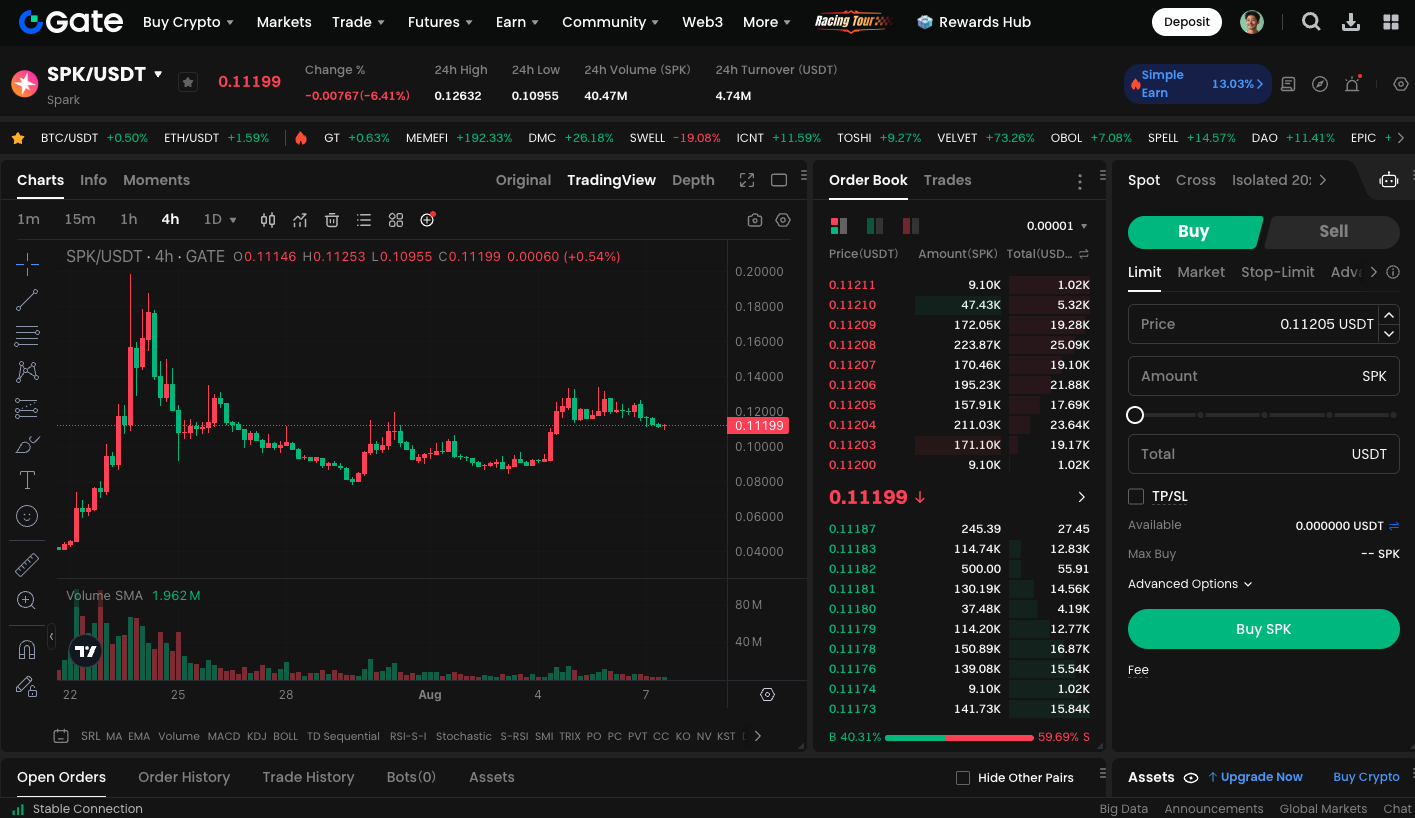
While SPK’s architecture is promising, investors should note that the project remains in an early stage. Governance and security are still developing, and there are potential risks related to its smart contracts and cross-chain bridges. SPK’s price can be highly volatile. Investors should assess their risk tolerance before participating.

https://www.gate.com/trade/SPK_USDT
Conclusion

As a new DeFi protocol, Spark (SPK) showcases a strong commitment to decentralization and modular innovation. As the DeFi ecosystem continues to evolve, Spark may play a significant role in the next wave of financial transformation.

Author: Allen
Disclaimer
* The information is not intended to be and does not constitute financial advice or any other recommendation of any sort offered or endorsed by Gate.
* This article may not be reproduced, transmitted or copied without referencing Gate. Contravention is an infringement of Copyright Act and may be subject to legal action.

Related Articles

AI-Native Settlement Layers: How United Stables Is Building the Next Financial Rail
Beginner

AI-Native Settlement Layers: How United Stables Is Building the Next Financial Rail

Stablecoins were originally designed as dollar substitutes within exchanges, primarily used for asset pricing and trade settlement. As on-chain financial ecosystems have matured, their role has expanded beyond simple payments to include collateral assets, cross-chain liquidity mediums, and unified settlement units. In particular, as AI systems and automated agents begin to participate directly in economic activity, demand has risen sharply for programmable value units capable of instant settlement. This shift is pushing stablecoins toward the role of foundational financial infrastructure.
2026-03-25 03:16:17
The ve(3,3) Flywheel Explained: How AERO Tokenomics Powers Aerodrome’s DeFi Economy
Beginner

The ve(3,3) Flywheel Explained: How AERO Tokenomics Powers Aerodrome’s DeFi Economy

In the competition for DeFi liquidity, high-inflation mining alone is no longer enough to build lasting advantages. Aerodrome applies the ve(3,3) economic model to redesign token emissions, voting mechanisms, and revenue distribution, creating a liquidity flywheel centered on governance and cash flow. This article examines AERO tokenomics, the veAERO locking mechanism, and protocol revenue models to explain how Aerodrome builds a sustainable DeFi economic system.
2026-03-25 06:41:58
Aerodrome Tokenomics: How ve(3,3) Powers Base's Most Profitable DEX
Beginner

Aerodrome Tokenomics: How ve(3,3) Powers Base's Most Profitable DEX

AERO is the native token of Aerodrome Finance, a core decentralized exchange and liquidity protocol in the Base ecosystem. It is primarily used for liquidity incentives and ecosystem operations. veAERO is a governance NFT that users receive by locking AERO, representing both voting power and the right to share protocol revenue. Through a dual track structure of AERO as a utility token and veAERO as a governance credential, Aerodrome separates liquidity usage value from long term governance power, allowing participants to act as liquidity providers, governance decision makers, and revenue sharers within the same system.
2026-03-25 06:40:31
How Does PAXG Work? In-Depth Overview of the Physical Gold Tokenization Mechanism
Beginner

How Does PAXG Work? In-Depth Overview of the Physical Gold Tokenization Mechanism

PAXG (Pax Gold) is a tokenized asset backed by physical gold, issued by the fintech company Paxos and traded on the Ethereum blockchain as an ERC-20 token. The core concept is to tokenize physical gold on-chain, with each PAXG token representing ownership of a certain amount of gold. This structure enables investors to hold and trade gold in the form of a digital asset.
2026-03-24 19:12:51
How is the price of PAXG determined? Pegging mechanism, trading depth, and influencing factors
Beginner

How is the price of PAXG determined? Pegging mechanism, trading depth, and influencing factors

PAXG (Pax Gold) is a tokenized asset backed by physical gold reserves, launched by fintech firm Paxos and issued as an ERC-20 token on the Ethereum blockchain. The core concept is to digitally represent real-world gold assets, allowing investors to hold and trade gold via the blockchain network. Because each PAXG token corresponds to a specific quantity of physical gold, its price is theoretically expected to closely track the global gold market.
2026-03-24 19:11:40
DePIN Identity Network and Real World Applications: How Humanity Protocol Brings on-chain Identity Into the Physical World
Beginner

DePIN Identity Network and Real World Applications: How Humanity Protocol Brings on-chain Identity Into the Physical World

Most Web3 identity systems remain confined to on-chain environments and struggle to achieve meaningful adoption in real world settings. Through a DePIN architecture and physical verification hardware, Humanity Protocol aims to bring decentralized identity into access control systems, hospitality, public services, and offline events, allowing on-chain identity to function not just as a digital credential, but as foundational infrastructure for real world access.
2026-03-25 07:40:53





