The semiconductor industry has long been viewed as critical infrastructure for the technology sector. As a result, changes in demand for AI chips, GPUs, servers, and data centers often have a direct impact on semiconductor index volatility. SOXS price performance is also closely tied to the chip industry cycle.
Because SOXS is a highly volatile leveraged ETF, its performance is not only affected by the direction of the underlying index, but also by market sentiment, daily rebalancing, volatility, and short term capital flows. SOXS is better understood as a short term trading instrument rather than a long term allocation asset.

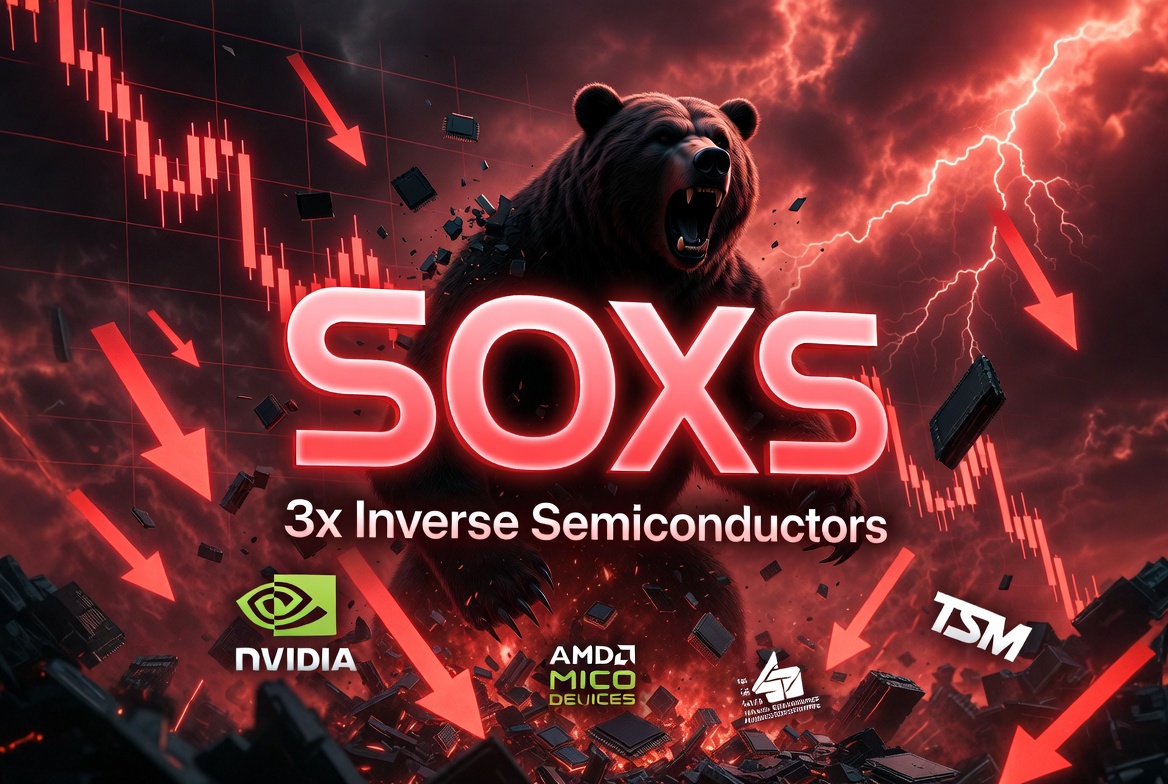
SOXS is designed to amplify single day returns when the semiconductor index declines. It typically tracks an index related to the semiconductor industry and targets three times the inverse daily return.
Structurally, SOXS does not directly short any single chip company. Instead, it builds short exposure to the index through swaps, futures, and other financial derivatives. When the semiconductor sector falls, SOXS should theoretically rise.
The core objective of SOXS is to deliver three times the inverse daily return of a semiconductor index. Therefore, if the index falls by 1% in a single day, SOXS could theoretically rise by about 3%.
This structure means SOXS is focused more on short term market volatility than on long term holding logic. Because daily returns are recalculated continuously, its long term net asset value may differ from what users intuitively expect.
SOXS moves inversely to the semiconductor index because the ETF itself is built around a short return structure.
Semiconductor indexes are usually composed of large chip companies, including GPU, CPU, wafer manufacturing, and semiconductor equipment firms. As a result, AI chip demand, the server market, and the broader technology cycle can all affect index performance.
First, when the semiconductor sector declines, the inverse derivative structure of SOXS generates gains accordingly. The larger the index decline, the more pronounced the theoretical rise in SOXS tends to be.
Next, the fund manager uses financial derivatives to maintain the target leverage ratio. The sharper the market movement, the more frequent rebalancing usually becomes.
Then, market panic may further amplify capital flows. When the technology sector experiences a sharp pullback, SOXS trading volume often rises noticeably.
Ultimately, the price of SOXS forms a clear inverse relationship with the semiconductor index.
The 3x leverage mechanism of SOXS is essentially a financial structure that amplifies the daily return movement of the index.
First, the fund uses derivatives to create market exposure that exceeds its net asset value. This leverage structure allows the ETF to magnify market volatility.
Next, when the semiconductor index falls, SOXS expands its inverse gains accordingly. The greater the index decline, the more obvious the theoretical rise in SOXS tends to be.
The table below shows the theoretical return structure of SOXS:
| Daily Change in Semiconductor Index | Theoretical Change in SOXS |
|---|---|
| -1% | 0.03 |
| -2% | 0.06 |
| 0.01 | -3% |
| 0.02 | -6% |
This structure means both the returns and risks of SOXS are amplified at the same time.
From a trading logic perspective, SOXS is more suitable for short term, high volatility markets than for long term trend positions.
The daily rebalancing mechanism of SOXS continuously affects the ETF’s long term net asset value structure.
First, the return target of SOXS is three times the inverse return on a “single day,” not the long term cumulative return. For that reason, the fund needs to reset its leverage ratio every day.
After the market closes, the fund recalculates its net asset value and derivative positions. The greater the index volatility, the more obvious the rebalancing pressure usually becomes.
In addition, a continuously choppy market may lead to compounding drift. Even if the index does not change much over the long run, the net asset value of SOXS may gradually erode.
This phenomenon is often referred to as volatility decay. In highly volatile markets, the long term net asset value of leveraged ETFs often diverges from what users might intuitively expect.
Therefore, SOXS is better suited to short term risk trading than to long term asset allocation.
The key difference between SOXS and ordinary semiconductor ETFs lies in the direction of returns and the risk structure.
Ordinary semiconductor ETFs are usually used to track the long term growth of the chip industry. Expansion in AI, servers, and the semiconductor sector generally supports gains in ordinary ETFs.
SOXS, by contrast, is an inverse leveraged ETF. When the semiconductor sector declines, SOXS can theoretically generate amplified gains.
The table below shows the main differences between the two types of ETFs:
| Type | Ordinary Semiconductor ETF | SOXS |
|---|---|---|
| Return Direction | Long | Inverse |
| Leverage Structure | None | 3x |
| Risk Level | Moderate | High |
| Main Use | Long Term Allocation | Short Term Trading |
This structure means SOXS places greater emphasis on volatility trading and risk hedging.
SOXS carries a higher level of risk than ordinary ETFs because leverage, inverse returns, and a highly volatile industry are layered together.
The semiconductor industry itself is highly cyclical. The AI boom, changes in chip inventories, and global technology demand can all affect industry volatility.
First, 3x leverage amplifies market movements. Even a small rise in the index may lead to a significant loss in SOXS.
Next, the daily rebalancing mechanism may cause long term net asset value erosion. In a frequently fluctuating market, the net asset value of SOXS may gradually decline.
In addition, market panic can further amplify price swings. When funds flow in or out rapidly, SOXS usually fluctuates much more sharply than ordinary ETFs.
This structure means SOXS is more suitable for short term trading scenarios where investors have a high tolerance for risk.
SOXS is mainly used during chip sector pullbacks, high volatility markets, and periods of technology risk hedging.
Some traders use SOXS to hedge semiconductor stock risk. When AI chip or GPU companies experience sharp pullbacks, SOXS can theoretically generate inverse returns.
Short term volatility trading is another important use case for SOXS. During periods of high volatility in the technology sector, the price sensitivity of SOXS often increases significantly.
Some institutional traders also use SOXS to manage market risk exposure. When the semiconductor industry enters a correction cycle, SOXS trading volume often rises quickly.
At the same time, some multi asset trading platforms have begun offering CFD products related to U.S. stock ETFs. Products such as Gate CFD, launched by Gate, are gradually expanding the coverage of digital asset platforms into overseas ETFs and leveraged asset markets.
However, it is important to note that SOXS is already a highly volatile leveraged ETF. If it is further combined with a CFD leverage structure, the overall risk usually rises as well.
As a leveraged inverse ETF in the U.S. market, SOXS can usually be traded through securities platforms that support U.S. stock trading. Under the traditional model, users typically access such ETF products through overseas brokerage accounts.
Recently, the China Securities Regulatory Commission further emphasized that overseas institutions must not illegally provide account opening or trading services within mainland China, while also promoting rectification of existing business. As a result, some internet brokerage platforms have adjusted their U.S. stock business.
This change has led many users to refocus on trading channels and alternative methods for U.S. stock ETFs. In addition to traditional securities accounts, some platforms have started offering stock CFDs, ETF CFDs, or on chain derivative assets.
Under the CFD model, users usually do not directly hold the actual ETF. Instead, they track market fluctuations through price contracts. Some digital asset platforms have also begun expanding trading services related to U.S. stock ETFs.
At the same time, products such as Gate CFD, launched by Gate, are gradually expanding digital asset platforms’ coverage of overseas ETFs and global market assets. Beyond crypto assets, users can also gain exposure to certain overseas ETF derivative markets, including SOXS.
However, it is important to note that leveraged ETFs are already highly volatile. If they are combined with CFDs or additional leverage structures, market risk usually increases further.
SOXS is a leveraged ETF that seeks to deliver three times the inverse daily return of a semiconductor index. It is mainly used for trading chip sector pullbacks, hedging market risk, and managing short term volatility.
The core structure of SOXS is built on inverse returns, leverage amplification, and daily rebalancing, which means its risk is usually higher than that of ordinary ETFs.
Because the semiconductor industry itself is highly volatile, SOXS is better suited to short term trading scenarios than to long term asset allocation.
SOXS is a 3x leveraged inverse semiconductor ETF that aims to deliver three times the inverse daily return of a semiconductor index.
SOXS uses financial derivatives to create short index exposure, so when the semiconductor index falls, SOXS can theoretically rise.
3x leverage means that when the semiconductor index falls by 1% in a single day, SOXS could theoretically rise by about 3%.
SOXS is affected by daily rebalancing and compounding drift, which may lead to long term net asset value erosion in highly volatile environments.
Ordinary semiconductor ETFs usually track the long term growth of the industry, while SOXS is more of a short term inverse leveraged trading instrument.