Robinhood Chain is frequently described as the foundational infrastructure bridging the retail user entry point with the on-chain execution layer, with the goal of delivering an “internet-like seamless” account experience alongside “publicly verifiable” transaction records within a unified system. Unlike public chains that focus only on throughput, this approach prioritizes the continuity of the user journey—from fiat onramps and asset custody to cross-chain flows. In the broader context of digital asset infrastructure evolution, Robinhood Chain’s significance lies in placing usability, auditability, and compliance processes on equal footing as core design constraints.
What Is Robinhood Chain? What Role Does It Play in the Robinhood Product Ecosystem?
Robinhood Chain serves as the on-chain capability layer within the Robinhood product ecosystem: the application layer continues to provide familiar account, portfolio, and trading interfaces, while the on-chain layer handles transaction execution, asset state recording, and verifiable settlement. This positioning means it is neither a mere wallet plugin nor a standalone “tech demo chain” separate from the product suite.
For users, Robinhood Chain functions as a closed loop that unifies traditionally siloed modules: account management, asset minting or mapping, transfers, cross-chain operations, and risk control events are all traceable within a single data flow. The account and transaction mechanisms built around this flow directly impact confirmation speed, fee structure, and the operational complexity faced by everyday users.
How Does Robinhood Chain Work? What Are Its Core Technical Architecture and Account Model?
Robinhood Chain typically adopts a layered architecture: “product account layer + on-chain execution layer + clearing and settlement layer + cross-chain layer.” The account layer lowers the barrier for key management, the execution layer handles state changes, the clearing and settlement layer ensures verifiable bookkeeping, and the cross-chain layer manages external asset flows.
| Architecture Layer |
Main Responsibilities |
Direct User Impact |
| Account Abstraction Layer |
Unified signature, recovery, and permission policies |
Reduces friction from complex recovery phrases and multiple signatures |
| Execution Layer |
Transaction packaging, state updates, fee metering |
Improves confirmation stability and predictability |
| Clearing, Settlement, and Data Availability Layer |
Retains verifiable records and audit trails |
Enhances transparency and traceability |
| Cross-Chain and Gateway Layer |
Asset mapping, bridging, redemption processes |
Determines efficiency and cost of asset movement on and off chain |
This layered approach signals that Robinhood Chain’s value is not just about “on-chain TPS,” but about integrating account experience, execution performance, and audit readability as equal engineering priorities. A weakness at any layer can impact both user experience and risk management.
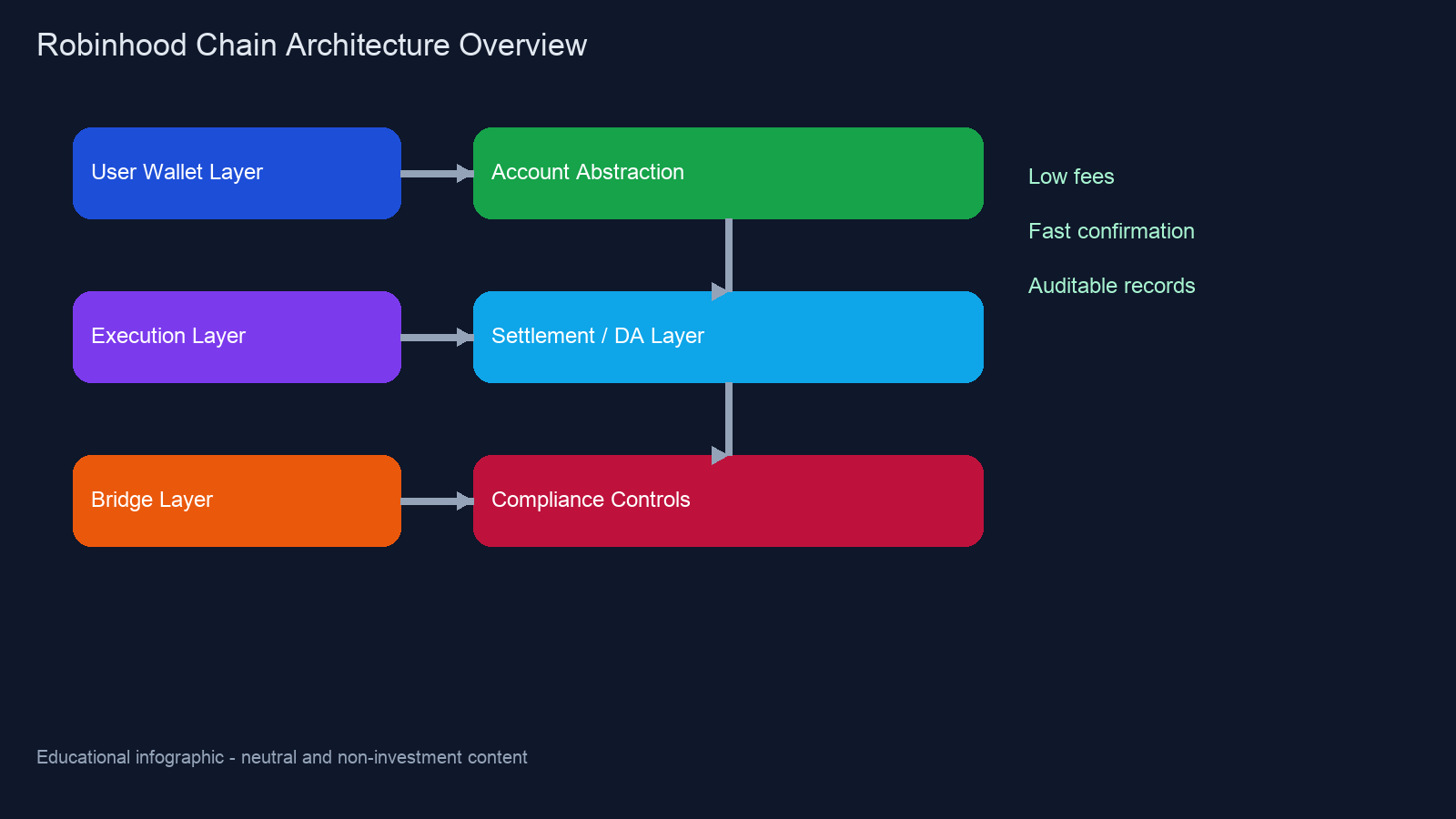
Robinhood Chain layered architecture and transaction lifecycle overview.
How Is Robinhood Chain Different from Ethereum Mainnet, L2s, or Other Consumer-Focused Public Chains?
Robinhood Chain’s core distinction from Ethereum mainnet lies in its objectives: Ethereum mainnet is designed as a general-purpose decentralized settlement layer, while Robinhood Chain emphasizes a seamless experience for consumer applications. Compared to typical L2s, differences are most evident in user onboarding, compliance and risk management processes, and the depth of product integration.
For a side-by-side comparison, focus on four dimensions: user onboarding, fee perception, asset pathways, and risk management interfaces. The differences between Robinhood Chain, Base, and Arbitrum across these areas offer a more intuitive framework for non-technical users.
| Comparison Dimension |
Robinhood Chain (Consumer-Oriented) |
Ethereum Mainnet / General L2 (General-Oriented) |
| Entry Design |
Prioritizes consistent account experience |
Prioritizes protocol neutrality and broad access |
| Fee Perception |
Aims to minimize complex fee decisions |
Users need stronger on-chain operational awareness |
| Risk Management and Compliance Interfaces |
Closely integrated with platform processes |
Typically implemented by individual applications |
| Product Narrative |
Usability first, then scalability |
Openness first, then productization |
This comparison isn’t about “which is better,” but about “which is better suited for a given use case.” For high-frequency consumer interaction, consistency in the productized chain flow is often critical; for highly open protocol composability, the flexibility of a general-purpose public chain stands out.
How Are Assets Issued, Transferred, and Bridged on Robinhood Chain?
Throughout the asset lifecycle, Robinhood Chain typically covers four stages: issuance or mapping, on-chain transfer, cross-chain channel exchange, and settlement confirmation on the target chain. Each stage demands state consistency and traceability; opacity at any step increases operational and audit costs.
The issuance stage requires clear asset standards, permission boundaries, and redemption paths; the transfer stage focuses on confirmation times and failure rollback mechanisms; the cross-chain stage depends on bridging and proof mechanisms; and the settlement stage requires reconciliation between system and on-chain ledgers. For users, the key criteria are: “Is the asset origin verifiable? Is the pathway auditable? Is failure handling predictable?”
What Real-World Applications Can Robinhood Chain Support?
Robinhood Chain’s application potential is concentrated in “low-friction asset interaction” and “verifiable financial processes.” The former emphasizes payments, transfers, and daily fund management; the latter focuses on how on-chain records support audit, reconciliation, and automation.
For more granular ecosystem opportunities, see ecosystem and application opportunities, spanning wallets, payment routing, on-chain accounting, and developer middleware.
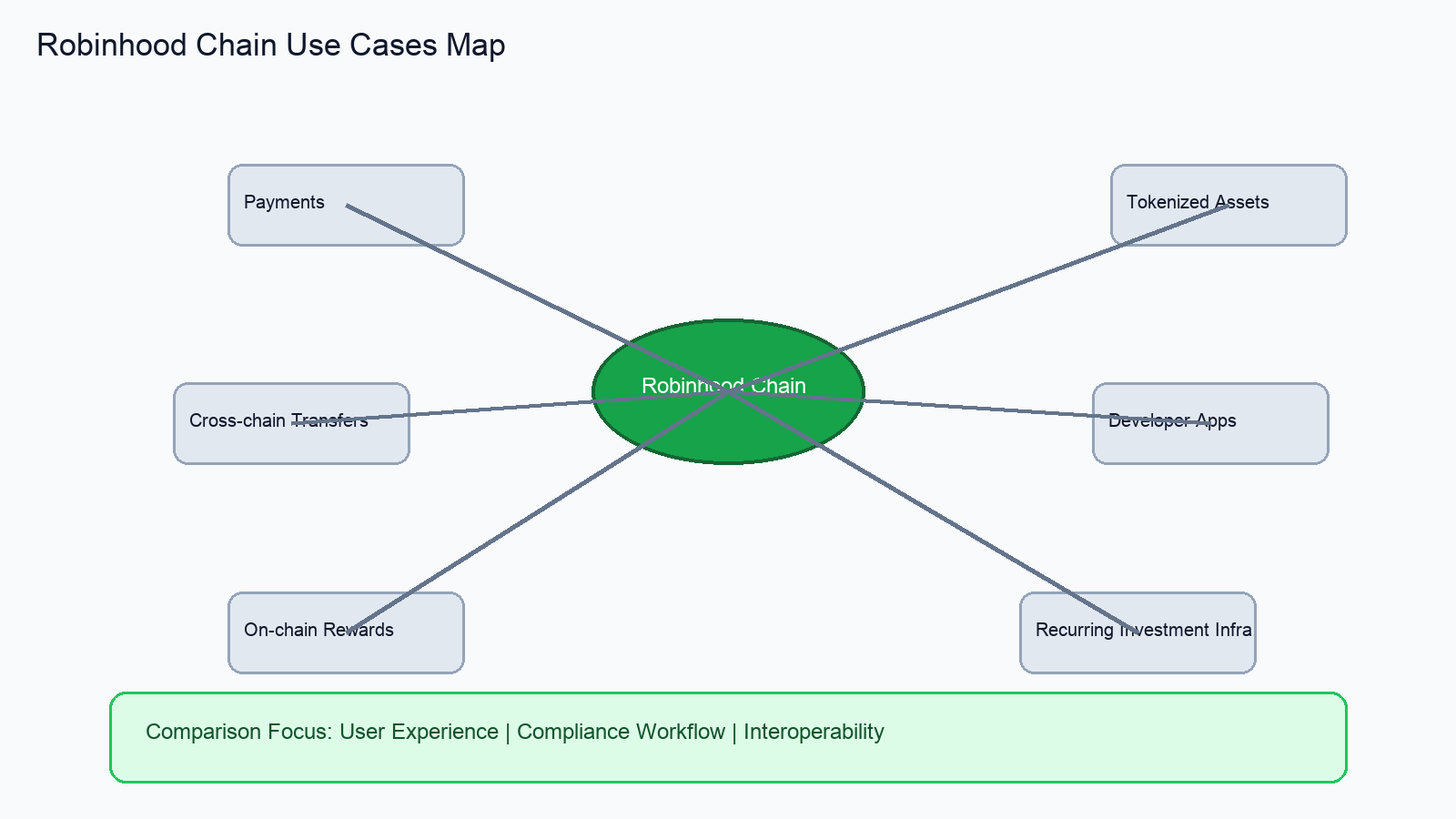
Key application scenarios and capability mapping for Robinhood Chain.
What Are the Advantages, Risks, and Limitations of Using Robinhood Chain?
Robinhood Chain’s advantages include unified entry, streamlined processes, and clear audit trails. For users, the most tangible benefits are less platform switching, reduced cognitive load for on-chain operations, and easier pinpointing of where issues arise.
Risks and limitations are also clear: account abstraction and platform-driven design introduce some centralization; cross-chain bridges and asset mapping add technical and operational risks; and limited ecosystem openness may restrict composability with external apps. These issues should be systematically evaluated alongside security, compliance, and transparency trade-offs.
How Can Developers Build on Robinhood Chain?
For developers, the focus is threefold: first, understand the account model and permissions; second, confirm the execution environment and contract compatibility; third, design business processes aligned with platform risk management. Unlike merely “deploying contracts,” this approach emphasizes application lifecycle management.
A practical development workflow includes: defining the business state machine, integrating wallet and signature strategies, deploying and testing key contracts, connecting asset gateways and cross-chain routing, and designing rollback and monitoring alerts for exceptions. For user-facing apps, interaction and risk strategies should be integrated from the outset—not patched in after launch.
Summary
Robinhood Chain’s value lies in “merging consumer-grade entry points and on-chain verifiable processes into a unified infrastructure.” The goal isn’t to replace all public chains, but to optimize accounts, execution, clearing, settlement, and cross-chain coordination for real user journeys. To assess its long-term viability, focus on whether transparency, stability, ecosystem openness, and risk mitigation remain consistently verifiable.
FAQ
What Is Robinhood Chain?
Robinhood Chain is on-chain infrastructure tailored for consumer digital asset services. Its goal is to lower barriers to account and transaction operations while retaining verifiable on-chain records. The core focus is balancing usability, auditability, and asset transfer efficiency.
Why Is Robinhood Building Its Own Blockchain?
The main reasons are to unify account experience, asset management, transaction execution, and compliance processes within a single traceable flow. This reduces reconciliation costs and operational friction from fragmented systems. For the platform, it also streamlines risk management interfaces and product iteration.
What Is the Relationship Between Robinhood Chain and Ethereum?
They are not substitutes but play complementary roles. Ethereum is focused on general-purpose public settlement and open ecosystems, while Robinhood Chain is tailored to consumer-facing, productized flows. Asset and application interoperability depends on specific cross-chain and compatibility strategies.
How Does Robinhood Chain Differ from Base?
Both serve consumer scenarios, but differ in product entry, account design, and risk integration depth. Base focuses on expanding within the general L2 ecosystem, while Robinhood Chain emphasizes integration within its own product suite. When comparing, prioritize account experience, asset pathways, and composability.
How Are Assets Deposited and Withdrawn on Robinhood Chain?
Asset flows typically occur via gateways or bridges, with key steps including source verification, mapping rule confirmation, cross-chain proofs, and settlement on the target chain. Safe usage depends on verifying official pathways and asset standards. Traceable transaction records and clear failure handling are equally critical.







