Prediction markets are becoming an important information coordination tool in the AI era. As AI Agents begin taking part in finance, content generation, trading, and autonomous decision-making, traditional internet data systems are increasingly unable to meet AI’s need for real-time probabilities, collective consensus, and dynamic forecasting. Against this backdrop, on-chain prediction markets are evolving from simple betting applications into information infrastructure for the AI-native economy.
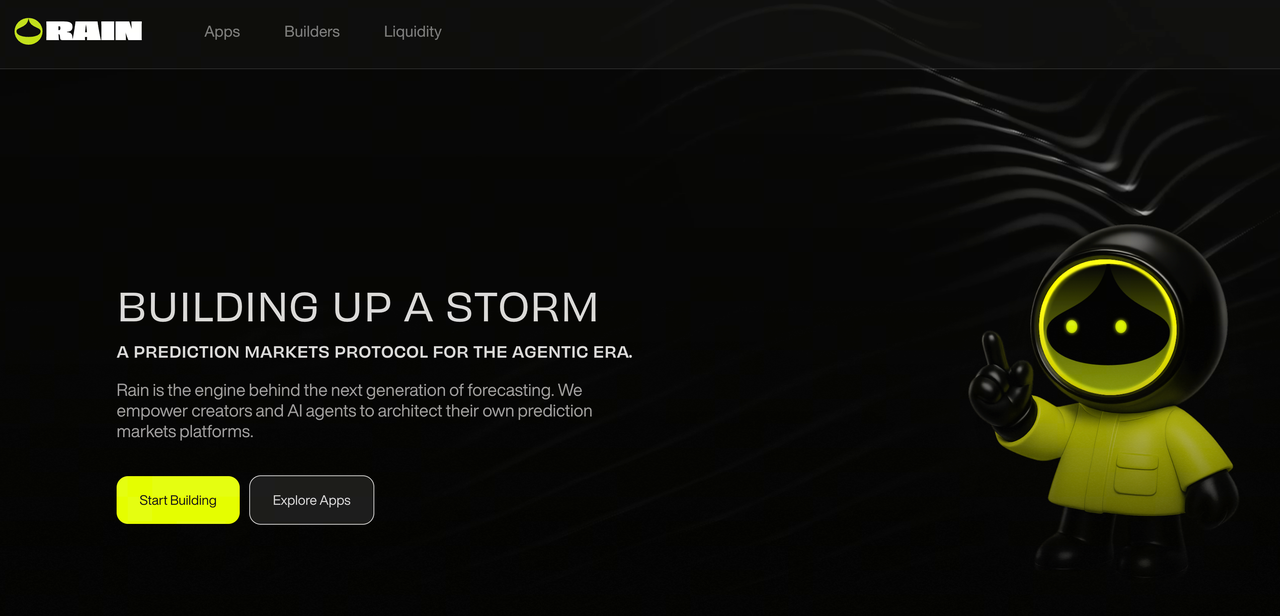
Rain Protocol emerged from this trend. It is not just a prediction market platform, but a prediction market protocol layer designed for developers, creators, and AI Agents. Rain aims to let anyone quickly build their own prediction market products on top of its infrastructure, while enabling AI Agents to participate natively in forecasting, trading, and market coordination.
As a decentralized prediction market infrastructure protocol, Rain Protocol allows developers, AI Agents, and content creators to build their own prediction market applications.
Unlike traditional prediction market projects, Rain is more focused on the underlying protocol and developer platform than on a single consumer application. Its core goal is to provide AI Agents with native prediction market interfaces while supporting modular market creation, Forecasting Infrastructure, and the growth of the Creator Economy ecosystem.
Rain is positioned more like an infrastructure layer for prediction markets, aiming to make it possible for anyone to deploy their own prediction market platform as easily as building a website.
One of the core capabilities of AI Agents is decision-making, and high-quality decisions depend on real-time information and probability forecasts.
Traditional AI systems usually rely on static datasets or centralized APIs, but these sources often suffer from update delays, limited market validation, and difficulty quantifying probabilities. Prediction markets, by contrast, use real-money incentives to help participants form dynamic probability consensus around future events.
For AI Agents, this means access to more reliable forecasting signals, more timely information feedback, and data sources driven by collective intelligence. Rain aims to open these capabilities directly to AI Agents, allowing AI not only to consume information but also to become an active participant in prediction markets.
Rain’s architecture is mainly composed of a prediction market engine, AI Agent interfaces, liquidity mechanisms, and settlement systems.
Developers or creators can use Rain to create a wide range of prediction markets, such as AI industry forecasts, crypto asset price trend forecasts, sports event markets, DAO governance predictions, and Meme trend event markets. Rain provides modular deployment tools that make prediction market creation more standardized and scalable.
One of Rain’s key features is native support for AI Agents. AI Agents can automatically create prediction markets, execute trades, obtain real-time probability data, and make follow-up decisions based on prediction outcomes. This means future AI systems may not only analyze information, but also participate directly in market coordination.
For outcome verification, Rain combines on-chain Oracles, external data sources, and community verification mechanisms to ensure that prediction results are transparent and credible.
At the same time, the protocol also needs sufficient liquidity and participation. As a result, it typically designs market rewards, liquidity incentives, fee distribution, and ecosystem reward mechanisms to improve market depth and forecasting accuracy.
Compared with traditional prediction market platforms, Rain places more emphasis on AI-native design and composability.
Traditional prediction market platforms are often single applications, while Rain is closer to a developer platform and protocol layer. Developers can freely build their own prediction market products and connect them to AI Agent systems.
Rain also has stronger Creator Economy characteristics. Content creators, community operators, and even AI Agents themselves can create dedicated prediction markets and build independent economic ecosystems around specific topics.
This composability makes it easier for Rain to integrate into the future Agent Economy and InfoFi landscape.
The biggest difference between Rain and other prediction market projects such as Polymarket lies in Rain’s positioning as an infrastructure protocol.
Polymarket is more of a prediction market product for everyday users, while Rain places greater emphasis on AI Agent integration, developer tools, composable markets, and Autonomous Markets.
Put simply, Polymarket is more like a prediction market application, while Rain is more like a prediction market operating system.
Although prediction markets have significant potential, Rain still faces issues such as regulation, Oracle security, insufficient liquidity, and market manipulation.
Because prediction markets may involve gambling or financial regulation in some countries and regions, the protocol’s future development will still need to address compliance challenges. In addition, once AI Agents begin participating in markets automatically, they may also introduce risks related to misinformation and market manipulation.
For this reason, building a transparent, secure, and sustainable prediction market ecosystem will be critical to Rain’s long-term development.
Rain Protocol is not only a prediction platform, but also an infrastructure layer that allows AI Agents, developers, and creators to build a prediction economy together. As the Agentic Economy, InfoFi, and autonomous AI networks continue to develop, prediction markets may become a core coordination mechanism for the future internet, and Rain aims to serve as the underlying engine of that system.
Rain places greater emphasis on AI-native support, developer tools, and composability, while traditional prediction markets are usually more focused on a single consumer-facing application.
Prediction markets can provide AI with real-time probability information, collective consensus, and market-based forecasting signals, helping AI make higher-quality decisions.
Rain sits at the intersection of AI and Crypto, especially in narratives related to AI Agents, InfoFi, and the Forecasting Economy.