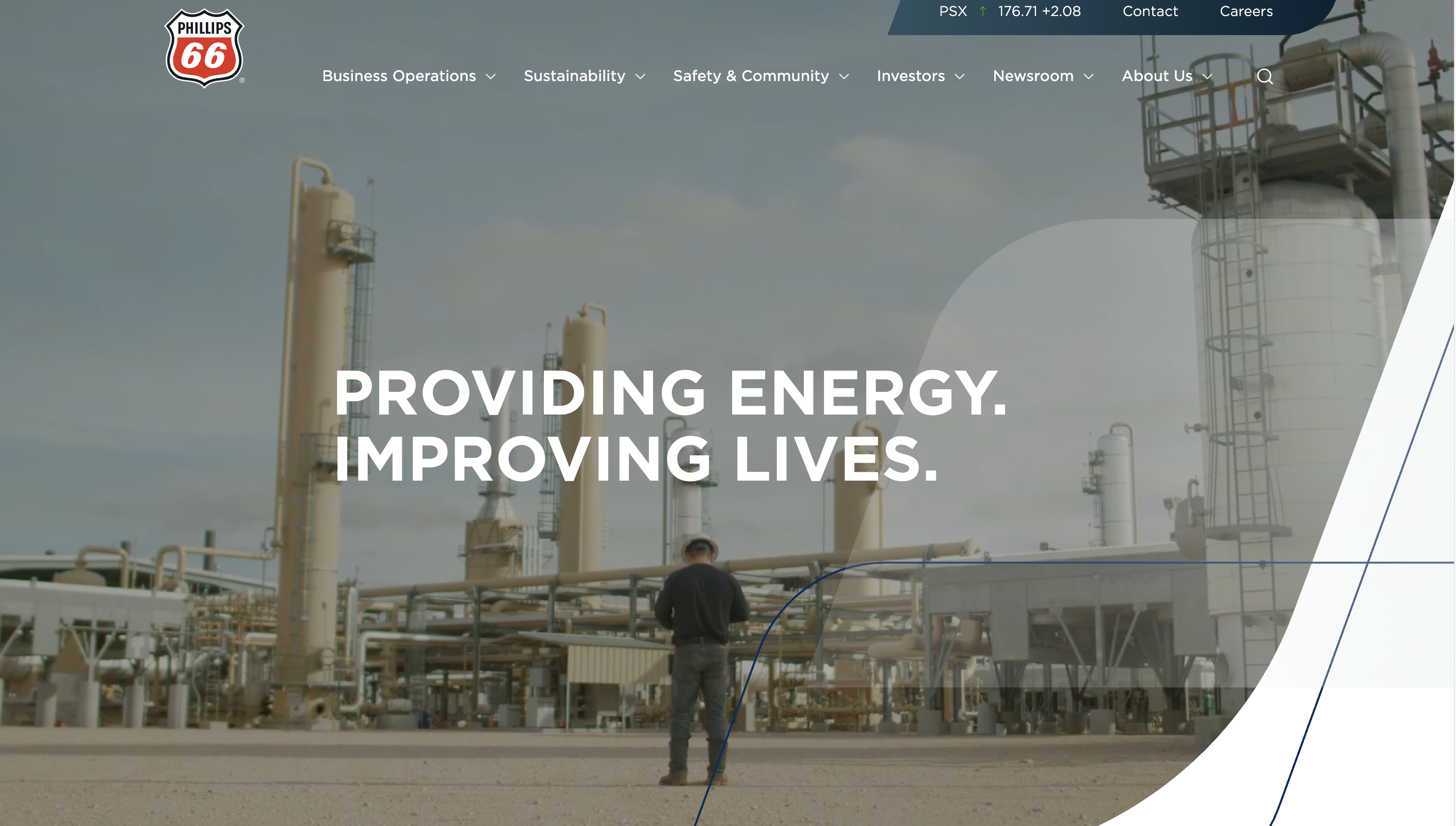
Phillips 66 was spun off from ConocoPhillips in 2012 and is listed on the New York Stock Exchange under the ticker PSX. Through a highly integrated value chain, the company holds competitive advantages in refining capacity, pipeline networks, and finished product sales.
Phillips 66 operates approximately 11 to 13 refineries with a total crude processing capacity exceeding 2 million barrels per day, along with an extensive midstream infrastructure and chemical joint venture. Its operations span the U.S. and European markets, producing gasoline, diesel, jet fuel, lubricants, and renewable fuels.
Source: phillips66.com
What Is PSX (Phillips 66)
Phillips 66's core business is centered on the downstream energy sector, setting it apart from upstream exploration and production companies. The company primarily processes crude oil into a range of finished products, transports and distributes them through its midstream network, and also participates in chemicals and renewable energy. This downstream focus provides relative stability amid crude oil price volatility, as profitability depends more on refining margins than on crude extraction.
As an independent downstream energy provider, Phillips 66 carries forward the long heritage of the Phillips brand and holds a key position in global product supply and logistics. The company emphasizes operational efficiency and shareholder returns, reducing costs and optimizing product flows through integrated operations.
Phillips 66 positions itself as a provider of safe and reliable energy while actively pursuing low-carbon solutions in line with the global energy transition. With over 12,000 employees, the company is committed to balancing conventional energy with emerging sources.
Phillips 66's Business Structure and Key Segments
Phillips 66's operations are divided into five core segments: Refining, Midstream, Chemicals, Marketing and Specialties, and Renewable Fuels. The Refining segment is the largest revenue driver, operating multiple refineries that produce gasoline, distillates, and jet fuel. The Midstream segment handles the transportation, storage, and fractionation of crude oil, finished products, and natural gas liquids.
The Chemicals segment produces petrochemicals and plastics through the CPChem joint venture with Chevron. The Marketing segment sells finished products through branded gas stations and wholesale networks. The Renewable Fuels segment focuses on renewable diesel and sustainable aviation fuel. These segments work in close synergy, forming a complete value chain that boosts overall efficiency.
The company's structure leverages integration to reduce transaction costs through internal synergies and withstand cyclical downturns. This setup enables Phillips 66 to generate stable cash flow across diverse market conditions.
PSX's Role in the Global Refining Industry
Phillips 66 is one of the world's leading independent refiners, with significant capacity in the U.S. and Europe. Its refining business emphasizes high-complexity plants that process heavy crude into high-value clean products, securing a critical role in global product supply. The company continuously optimizes capacity utilization and pursues renewable fuel co-processing at select refineries.
In 2025, the company's refineries maintained high average utilization rates, with a substantial share of clean product output. This allows Phillips 66 to provide steady supply amid fluctuations in global demand, especially in jet fuel and transportation fuels.
Through technology upgrades and asset optimization, Phillips 66 steadily improves refining efficiency and explores new growth avenues amid the energy transition. Its role extends beyond production; it serves as a key node connecting upstream crude supply with downstream consumption.
Key Differences Between Phillips 66 and ExxonMobil, Chevron
The primary difference lies in business focus. ExxonMobil and Chevron are highly integrated majors with large-scale upstream exploration and production, while Phillips 66 is almost entirely downstream in refining, midstream, and marketing. This makes Phillips 66's earnings more directly tied to refining margins.
In terms of capital returns, Phillips 66 emphasizes high dividends and share buybacks focused on shareholder returns, whereas the integrated majors must balance upstream and downstream capital allocation. Phillips 66 has a smaller asset base but greater operational flexibility, allowing quicker responses to downstream demand changes.
In the value chain, Phillips 66 invests more in midstream and downstream infrastructure, while its competitors hold advantages in upstream resource control. This positioning makes Phillips 66 stand out during periods of expanding refining margins.
PSX's stock price is primarily influenced by refining margins, global crude oil prices, product demand, geopolitical events, and macroeconomic cycles. When crack spreads widen, the company's profits typically surge. Seasonal demand—such as the summer driving season and winter heating oil—also drives performance swings.
Other key factors include operational efficiency, currency fluctuations, and regulatory changes. Investors also monitor cash flow, dividend policy, and capital spending plans. These elements together create the cyclical pattern of PSX's stock.
The macroeconomic environment heavily impacts product consumption. Economic slowdowns may depress demand, while energy transition policies could reshape long-term profitability. The company mitigates external pressures through cost control and asset optimization.
PSX's Main Revenue Sources and Business Model
Phillips 66 generates revenue primarily from refining product sales, midstream transportation services, chemical products, and marketing operations. The Refining segment contributes the largest share, followed by Marketing and Specialties. The company operates an integrated business model that reduces costs and optimizes product flows through internal synergies.
This model supports a sustained high-return strategy, including dividends and buybacks. In 2025, the company continues to rely on its Midstream and Chemicals segments for stable cash flow that offsets the Refining segment's cyclicality.
The business model leverages scale and operational efficiency, enhancing overall profitability through technology investments and asset consolidation. This structure helps the company stay competitive across different oil price environments.
PSX's Position in the Midstream and Downstream Value Chain
Phillips 66 has a well-established presence in the midstream and downstream value chain, with over 15,000 miles of pipelines, numerous terminals, and storage facilities. The midstream business links upstream crude supply with downstream refining and sales, creating an efficient logistics network that strengthens risk resilience.
The company continues to invest in midstream assets, including natural gas liquids processing and transportation facilities, to optimize the overall value chain. This infrastructure also supports the transition to renewable fuels.
Through midstream and downstream integration, Phillips 66 better manages supply chain risks and gains a competitive edge in regional markets—a key foundation of its long-term strength.
Investors can purchase PSX stock through mainstream brokerage platforms that support U.S. equity trading, typically by buying NYSE:PSX shares directly. However, recent regulatory tightening on cross-border securities services in some regions has led to adjustments from brokers like Futu and Tiger, making it difficult for many users to open accounts or trade U.S. stocks.
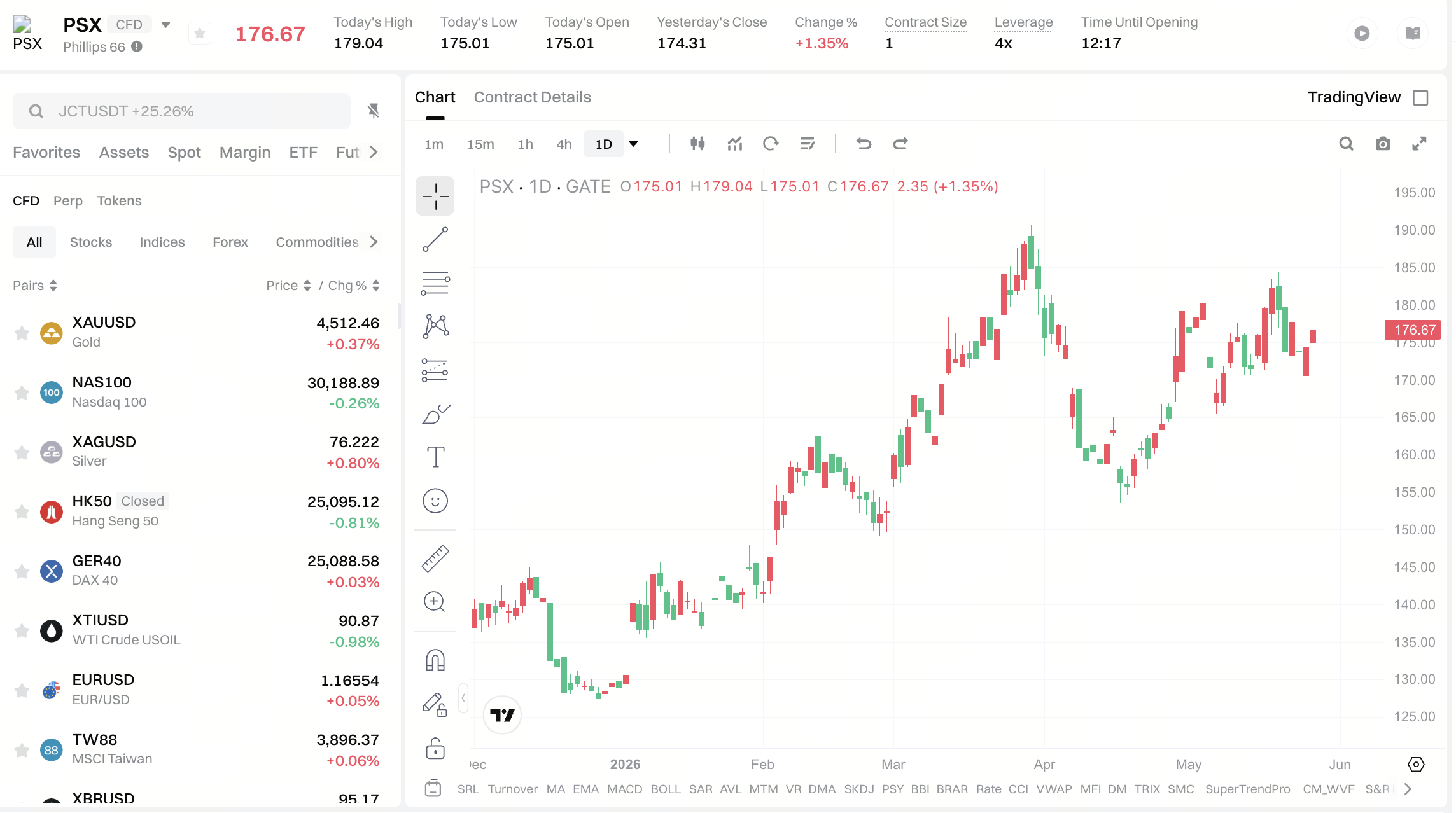
Against this backdrop, CFD (Contract for Difference) trading has emerged as a popular alternative. CFDs allow tracking PSX price movements without holding the underlying shares, offering flexibility and leverage—ideal for investors seeking exposure to U.S. energy sector volatility.
Gate TradFi, a one-stop trading platform, offers Gate CFDs on U.S. energy stocks like PSX, enabling users to manage digital assets and traditional energy positions from a single account. Compared to conventional U.S. stock accounts, it serves users in more regions globally and provides a more flexible trading approach.
By trading PSX through Gate CFD, investors can easily track Phillips 66's stock price while benefiting from unified fund management and risk control tools. Before participating, carefully evaluate the platform's compliance, leverage risks, spread costs, and local regulatory requirements, and choose a model that matches your risk tolerance.
This diversification of trading channels offers users seeking exposure to international energy assets like PSX more flexibility, particularly amid the shifting cross-border securities landscape.
PSX's Energy Transition and Sustainability Strategy
Phillips 66 is advancing renewable fuel projects as part of the energy transition, including converting some refineries to or co-processing renewable diesel and sustainable aviation fuel. The company is also investing in low-carbon technologies and hydrogen while maintaining stable conventional energy supplies.
The sustainability strategy emphasizes safe operations, carbon intensity reduction, and community responsibility. Through projects like the Rodeo Renewable Energy Complex, the company is gradually increasing its share of renewable products.
Phillips 66 aims to meet current energy demands while supporting a long-term low-carbon transition, achieving balanced growth through innovation and capital allocation. This strategy prepares the company for future energy market shifts.
PSX's Advantages and Risks
Phillips 66's advantages include cost efficiency from integrated operations, attractive dividends, robust midstream infrastructure, and refining complexity. The company boasts stable cash flow and clear shareholder return policies, giving it a strong competitive edge in the downstream market.
Risks include cyclical refining margin volatility, geopolitical disruptions to crude supply, asset stranding from the energy transition, and stringent environmental regulations. These factors may impact short-term performance.
The company mitigates risk through business diversification and continuous optimization while maintaining financial discipline to support long-term growth. This balanced approach is its core competitive strength.
Summary
PSX (Phillips 66), a downstream-focused energy company, holds a significant position in the global refining and finished product market. Its business structure, value chain positioning, and energy transition efforts combine to create a unique competitive advantage. By understanding its pricing, revenue model, and investment pathways, investors can better assess the company's role in the energy landscape.
FAQ
What is the main business of PSX (Phillips 66)?
Phillips 66 primarily engages in crude oil refining, petroleum product transportation, marketing, and petrochemicals, with a focus on the downstream energy sector.
What is the biggest difference between Phillips 66 and ExxonMobil?
Phillips 66 is almost entirely downstream, while ExxonMobil has extensive upstream exploration and production assets.
How can I buy PSX stock?
Open an account with a brokerage that supports U.S. stock trading, such as eToro or Webull, and purchase NYSE:PSX shares directly.
What factors most affect PSX's stock price?
Refining margins, global oil price movements, product demand, and the company's dividend policy are the primary drivers.
What is Phillips 66 doing in the energy transition?
The company is advancing renewable diesel and sustainable aviation fuel projects and investing in low-carbon technologies to support the transition.