As blockchain applications continue to scale, the Ethereum mainnet faces rising transaction costs and network congestion. Layer 2 scaling solutions have gradually become an important path for improving blockchain performance, while Rollup technology has become one of the most widely adopted scaling architectures today. However, building a new Rollup network still requires complex development, maintenance, and upgrade work, which raises the barrier to innovation in blockchain infrastructure.
OP Stack emerged as a modular development framework in this context. As a key piece of infrastructure in the Optimism ecosystem, OP Stack provides developers with standardized components and an open architecture, making it more efficient to build Layer 2 networks.
What Is OP Stack?
OP Stack is an open source modular blockchain development framework launched by Optimism to help developers build Ethereum compatible Layer 2 networks.
Unlike traditional blockchains, which often need to be redesigned from the ground up, OP Stack provides a set of standardized components that allow developers to quickly build Rollup networks compatible with the Ethereum Virtual Machine, or EVM.
At its core, OP Stack is not a standalone blockchain. It is a toolkit for building blockchains. Development teams can choose and combine different modules based on their needs, creating Layer 2 networks with their own brands, governance systems, and economic models.
OP Mainnet itself is also one of the networks built on OP Stack.
What Core Modules Make Up OP Stack?
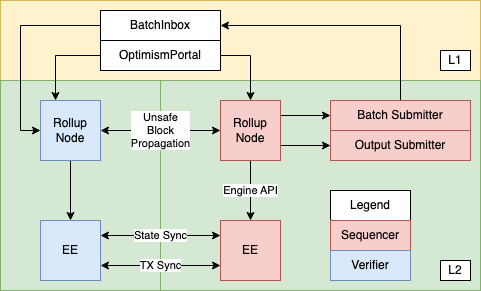
OP Stack uses a layered design, with each module responsible for a different function.
Execution Layer
The execution layer processes user transactions and runs smart contracts. Solidity contracts and EVM applications familiar to developers mainly operate on this layer, so the vast majority of Ethereum applications can migrate directly to OP Stack based networks.
Settlement Layer
The settlement layer handles final transaction confirmation. Most OP Stack networks currently use Ethereum as the settlement layer, relying on the Ethereum mainnet for final security.
Sequencing Layer
The sequencing layer receives and orders user transactions. The Sequencer batches large numbers of transactions and submits them to Layer 1, reducing transaction costs and improving processing efficiency.
Data Availability Layer
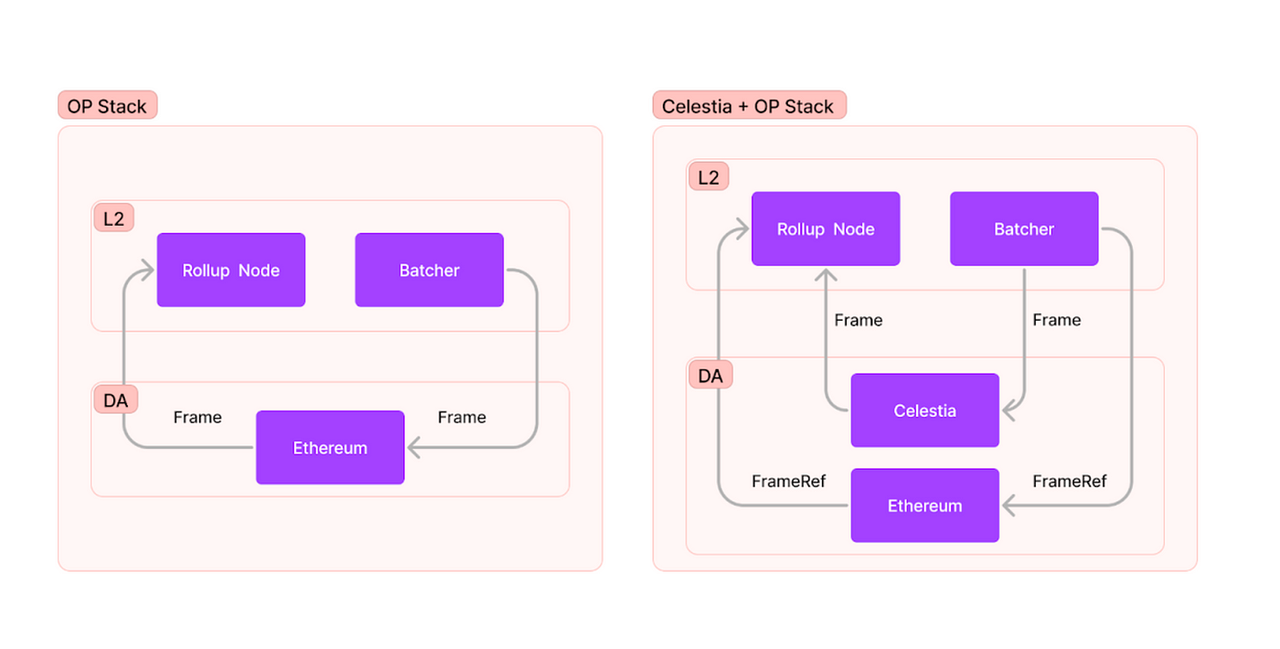
The data availability layer stores transaction data. By making transaction information publicly available, the network allows participants to verify state changes and conduct independent audits.
Governance Layer
The governance layer handles protocol upgrades, parameter adjustments, and ecosystem management. Different OP Stack based networks may adopt their own governance mechanisms, while also participating in broader Superchain collaborative governance.
How Does OP Stack Support Rollup Network Operations?
One of OP Stack’s design goals is to provide unified infrastructure for Rollup networks.
After a user initiates a transaction, the Sequencer orders and executes the transaction, then generates new state data. This data is then compressed and sent to Ethereum for storage and settlement.
Throughout the process, the user submits the transaction, the Sequencer executes it, a state update is generated, Rollup data is uploaded to Ethereum, and final confirmation is completed.
This model inherits Ethereum’s security while significantly reducing on-chain execution costs. For that reason, OP Stack is widely seen as important infrastructure for building Optimistic Rollup networks.
How Is OP Stack Different From Other Blockchain Development Frameworks?
As modular blockchains have developed, several development frameworks have entered the market.
OP Stack vs Cosmos SDK
Cosmos SDK is mainly used to build independent sovereign blockchains. Networks built with Cosmos SDK usually have their own validator sets and consensus mechanisms, while OP Stack networks typically rely on Ethereum for final settlement and security.
OP Stack vs Polygon CDK
Polygon CDK supports developers in creating Layer 2 networks based on zero knowledge proofs, or ZK proofs. By comparison, OP Stack is currently built mainly around the Optimistic Rollup architecture.
OP Stack vs Arbitrum Orbit
Arbitrum Orbit also allows developers to create customized Layer 2 or Layer 3 networks. Both frameworks emphasize standardized scaling, but OP Stack places greater emphasis on unified collaboration and shared upgrade mechanisms within the Superchain ecosystem.
| Dimension |
OP Stack |
Cosmos SDK |
Polygon CDK |
Arbitrum Orbit |
| Core Positioning |
Layer 2 framework |
Sovereign chain framework |
ZK Rollup framework |
Rollup framework |
| Security Source |
Ethereum |
Own validators |
Ethereum |
Ethereum |
| Modularity |
High |
High |
High |
High |
| Superchain Collaboration |
Supported |
Not applicable |
Partially supported |
Partially supported |
| EVM Compatibility |
Native support |
Optional |
Native support |
Native support |
What Is the Relationship Between OP Stack and the Superchain?
OP Stack is the technical foundation of the Superchain.
The Superchain is not a standalone blockchain. It is a collaborative ecosystem made up of multiple networks that follow OP Stack standards.
Because all member chains use the same technical framework, they can support unified upgrade mechanisms, shared developer tools, standardized cross chain interactions, and stronger ecosystem compatibility.
This model is similar to open protocol standards on the internet. Different websites operate independently, but they can still connect through shared protocols. OP Stack provides the standardized foundation for the Superchain.
Which Projects Are Using OP Stack?
OP Stack has become one of the most widely adopted Layer 2 development frameworks today.
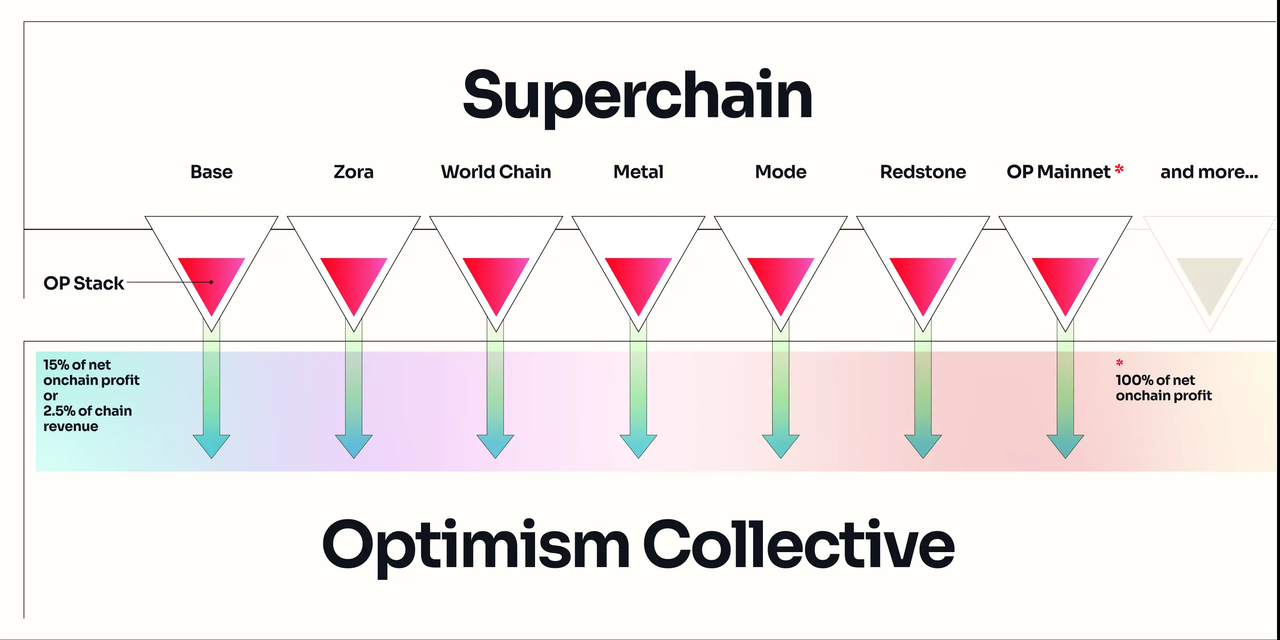
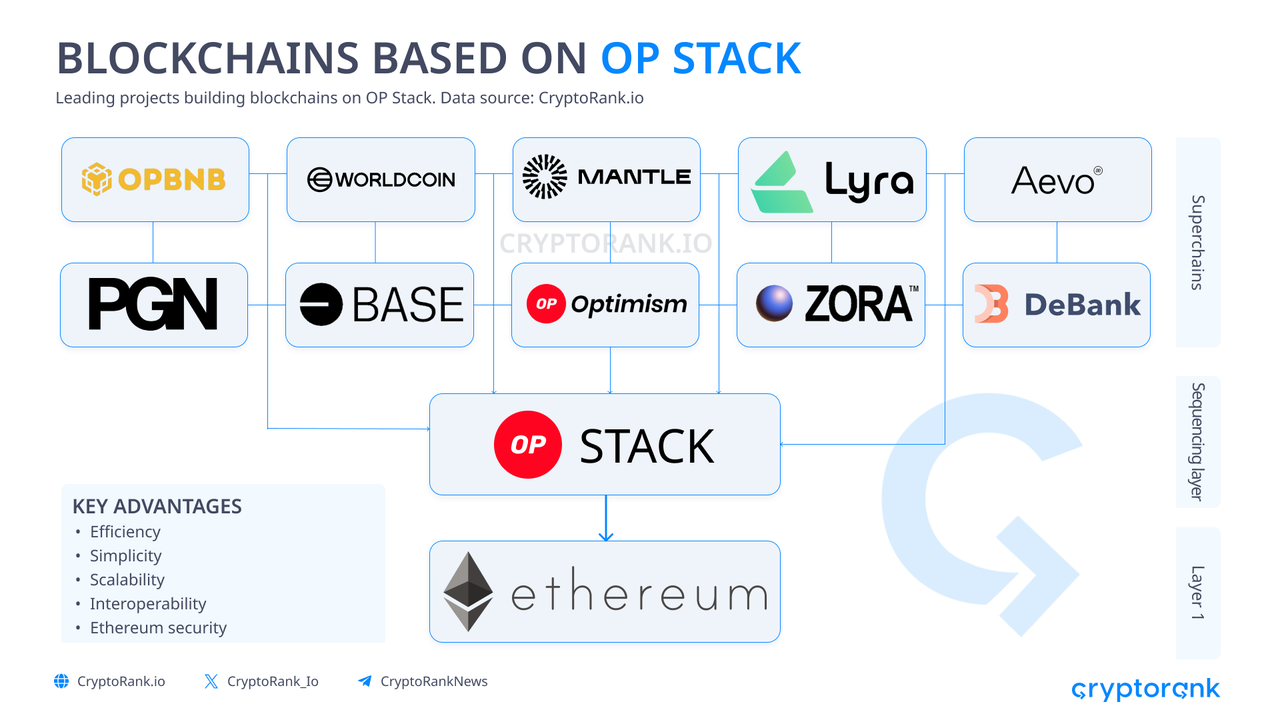
OP Mainnet
The Layer 2 network officially operated by Optimism.
Base
A Layer 2 network launched by Coinbase and currently an important part of the Superchain ecosystem.
World Chain
A blockchain network launched by the World project and built with OP Stack.
Ink
A Layer 2 network launched by Kraken, also built on the OP Stack architecture.
As more projects join the Superchain, OP Stack’s ecosystem influence continues to grow.
What Challenges Does OP Stack Face?
Although OP Stack has developed rapidly, it still faces several challenges.
Competition in the modular blockchain space is intense, with frameworks such as Polygon CDK, Arbitrum Orbit, and zkSync Hyperchains all competing for developer resources.
At the same time, liquidity fragmentation and inconsistent user experiences still exist across different Layer 2 networks.
As the Superchain continues to expand, cross chain governance coordination, standard upgrades, and ecosystem balance will also become important long term challenges.
Conclusion
OP Stack is a modular blockchain development framework launched by Optimism. Through standardized components, it helps developers quickly build Ethereum compatible Layer 2 networks. Its core architecture covers the execution layer, settlement layer, sequencing layer, data availability layer, and governance layer, making Rollup network development more modular and standardized.
As the technical foundation of the Superchain ecosystem, OP Stack has already been adopted by multiple projects, including OP Mainnet, Base, World Chain, and Ink. As modular blockchains gradually become an industry trend, OP Stack is helping Layer 2 networks evolve from standalone scaling solutions into an open, collaborative ecosystem.
FAQs
What Is the Relationship Between OP Stack and Optimism?
Optimism is the name of the Layer 2 network and ecosystem, while OP Stack is the modular development framework launched by Optimism. The Optimism mainnet itself is also built on OP Stack.
Can OP Stack Only Be Used for the Optimism Network?
No. Any development team can use OP Stack to create its own Layer 2 network. Projects such as Base, World Chain, and Ink are all built with OP Stack.
Why Does OP Stack Emphasize Modularity?
Modular design allows different functional layers to be optimized and upgraded independently. This improves scalability and reduces the complexity of building and maintaining blockchain networks.
What Is the Difference Between the Superchain and OP Stack?
The Superchain is a collaborative ecosystem made up of multiple networks that use OP Stack, while OP Stack is the underlying technical framework that supports those networks.