Traditional DAO governance usually relies on token voting to determine the outcome of proposals, but this model is often affected by low participation, emotional decision making, and governance inefficiency. MetaDAO attempts to use market prices to reflect governance expectations, making “trading” rather than “voting” the center of the decision making process.
Structurally, MetaDAO is built around Futarchy, decision markets, Treasury management, the STAMP financing mechanism, and the META token system. Its goal is to build a more market oriented governance system on chain.
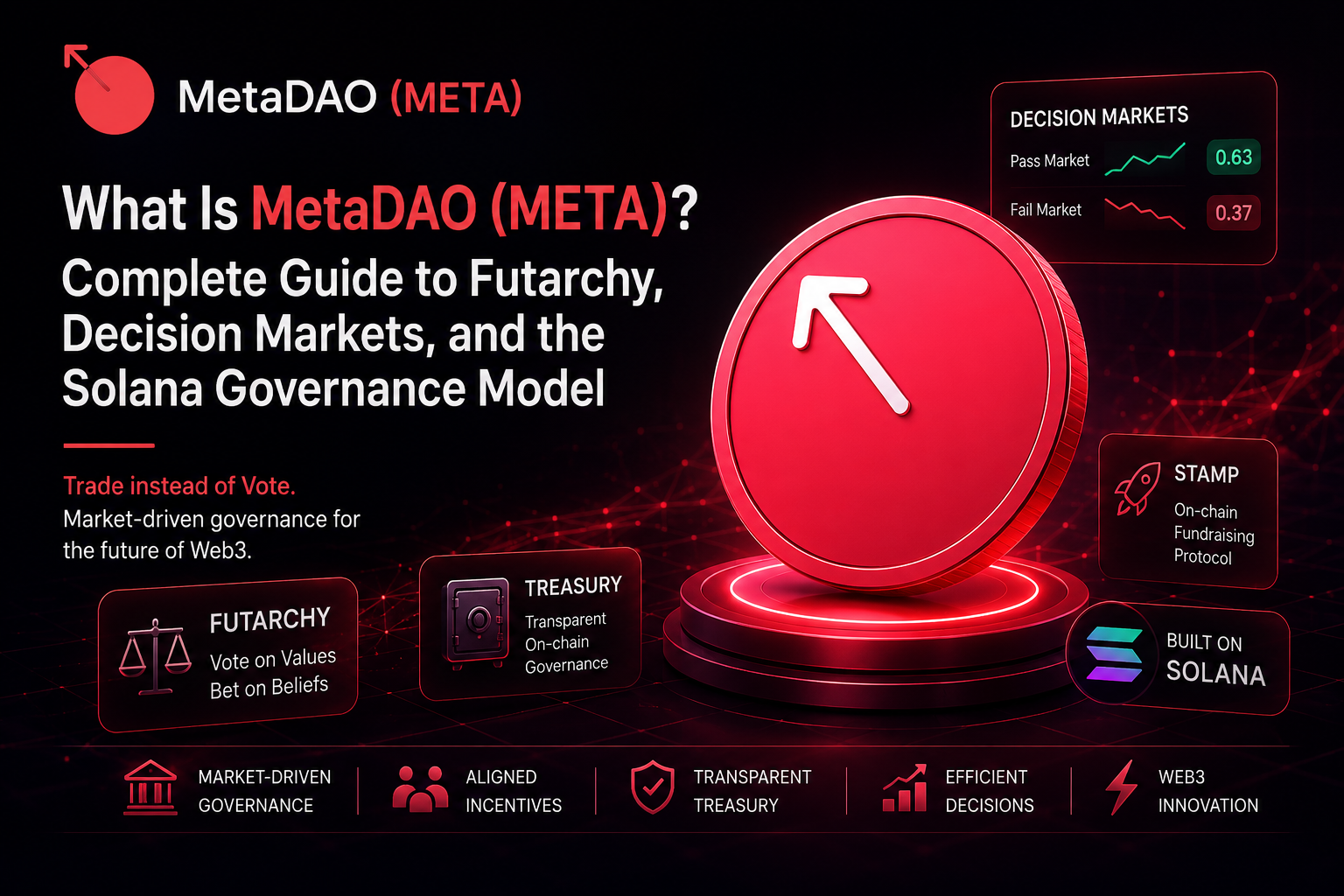
MetaDAO can be understood as an on chain governance protocol built on Futarchy theory. Its main goal is to use market behavior to determine the outcome of DAO proposals, rather than relying on traditional voting mechanisms. The core idea proposed by the project is “Trade instead of Vote,” meaning token voting is replaced by trading markets.
In terms of how it works, MetaDAO is deployed on the Solana network and builds its governance system around decision markets. First, community members submit governance proposals. The system then creates markets for different possible outcomes of each proposal. Users trade in these markets to express their expectations about the proposal’s result. Finally, market prices determine whether the proposal will be executed.
The importance of this mechanism lies in its shift from “expressing opinions” to “price discovery.” For DAO governance, market prices are treated as signals that may better reflect real expectations, rather than simply representing voting power determined by token holdings.
Futarchy is the core governance theory behind MetaDAO. In essence, it uses market predictions to determine the direction of governance. In simple terms, Futarchy does not ask participants to vote directly. Instead, it lets the market judge which proposal is more valuable through price competition.
In MetaDAO, the process begins when the community submits a governance proposal. The system then creates two types of markets around that proposal, corresponding to whether the proposal passes or fails. Traders participate based on their expectations of future outcomes. Finally, the system uses mechanisms such as price, liquidity, and TWAP to determine the direction of proposal execution.
MetaDAO’s documentation notes that the core idea of Futarchy comes from “Vote on values, bet on beliefs,” meaning the community decides the goals, while the market decides how to achieve them.
The importance of this structure is that Futarchy attempts to bind governance outcomes to market incentives. Participants who judge incorrectly bear an economic cost, while those who judge correctly may earn returns. This makes the governance process closer to a prediction market than traditional voting.
How Decision Markets Replace Traditional DAO Voting
Decision markets are the core execution layer of MetaDAO’s governance mechanism. Their main function is to turn governance proposals into tradable markets. The key point is that market prices are no longer just tools for valuing assets. They become governance signals.
Mechanically, the system first creates two markets for a proposal: Proposal Pass and Proposal Fail. Users then trade based on their judgment of the proposal’s outcome. As trading continues, market prices gradually form expectations about the governance result. Finally, the protocol decides whether to execute the proposal based on TWAP and market outcomes.
| Comparison Dimension |
MetaDAO Decision Markets |
Traditional DAO Voting |
| Governance method |
Market trading |
Token voting |
| Core signal |
Market price |
Vote count |
| Participation cost |
Requires taking trading risk |
Usually risk free |
| Outcome formation |
Price discovery |
Vote tallying |
| Incentive logic |
Correct judgment can generate returns |
Voting power determines influence |
This comparison shows that MetaDAO places greater emphasis on economic incentives and price discovery, while traditional DAOs focus more on token weighted influence. As a result, governance participants are no longer merely expressing opinions. They must also bear market risk for their own judgment.
The META token is the core functional asset in MetaDAO’s governance system. Its main roles include governance participation, Treasury management, market incentives, and protocol control. At its core, it connects decision markets with the DAO governance structure.
Structurally, META holders can first participate in protocol governance and the proposal process. Decision markets then form price signals around proposals. Treasury management and resource allocation are affected by governance outcomes. Finally, META token holders participate in adjusting the direction of the protocol through both markets and governance.
The official documentation states that META does not have a fixed hard cap, and new issuance must be completed through governance proposals and market decisions. The protocol’s mint authority is controlled by the governance program, rather than directly managed by a centralized team.
The importance of this mechanism is that changes in META supply are tied to the governance process. Compared with a fixed supply model, MetaDAO places more emphasis on managing protocol resources and token issuance through market mechanisms.
MetaDAO’s Treasury management mechanism is built on Futarchy and decision markets. Its core purpose is to use market judgment to determine whether Treasury funds should be used.
In the governance process, community members first submit proposals involving the Treasury, such as ecosystem grants, team expenses, or market incentives. The system then creates the relevant decision markets. Traders trade around the expected proposal outcome, forming market prices. Finally, the protocol decides whether the Treasury should carry out the funding operation based on market results.
The importance of this structure is that control over the Treasury no longer depends entirely on token holder voting. Instead, it introduces a market constraint mechanism. For DAOs, this design attempts to reduce resource allocation problems caused by emotional governance and costless voting.
How the STAMP Financing Mechanism Works
STAMP is an on chain financing mechanism proposed by MetaDAO. Its goal is to create a more market driven project launch process within the Solana ecosystem. It can be understood as a system that integrates financing, Ownership Coin, and Treasury management into the same governance framework.
In terms of process, a project first creates a financing structure through STAMP. The system then issues an Ownership Coin and opens it for market trading. The Treasury receives the corresponding funds and governance control. Finally, the project’s later resource allocation, issuance, and governance actions can continue to be managed through Futarchy decision markets.
MetaDAO’s documentation states that STAMP combines ICO, Treasury, and Futarchy mechanisms, while emphasizing that funds raised on chain should still remain subject to governance constraints.
The importance of this mechanism is that it tries to connect fundraising with long term governance, rather than merely completing a one time token sale.
What Are the Main Use Cases of MetaDAO
MetaDAO’s main use cases include DAO governance, Treasury management, on chain financing, and decision markets. Its core value lies in replacing inefficient voting processes in traditional governance with market mechanisms.
In practical use cases, DAOs can first use Futarchy to manage Treasuries and governance proposals. Projects can then complete on chain financing through STAMP. Ownership Coin and decision markets provide the protocol with an ongoing governance mechanism. Finally, market prices become an important basis for resource allocation.
The importance of this structure is that MetaDAO is not simply a governance tool. It is an on chain governance framework built around market based decision making. Its applications are mainly concentrated in protocol ecosystems that require ongoing resource management and long term governance.
The core difference between MetaDAO and traditional DAOs is that the governance mechanism shifts from “token voting” to “market trading.”
| Comparison Dimension |
MetaDAO |
Traditional DAO |
| Core governance logic |
Futarchy |
Token Voting |
| Decision making method |
Market price |
Vote count |
| Governance incentives |
Trading returns and risk |
Token holding weight |
| Treasury management |
Market constraints |
Community voting |
| Basis for proposal execution |
TWAP and market outcomes |
Voting approval rate |
Based on this comparison, traditional DAOs rely more heavily on the number of token holders and voting participation, while MetaDAO places greater emphasis on market signals and economic incentives. As a result, governance participants must take on real market risk, rather than simply casting low cost votes.
MetaDAO’s advantage lies in using Futarchy and decision markets to improve governance efficiency while introducing market incentives into the DAO decision making process. Its core value is that governance outcomes no longer depend entirely on token quantity, but rely more on market judgment.
Structurally, market participants must take trading risk, so governance outcomes may come closer to real expectations. At the same time, Treasury management and financing processes can operate within the same governance framework.
Its potential limitations mainly include insufficient market liquidity, higher barriers to governance participation, and the possibility that decision markets may be influenced by short term sentiment. If market depth is insufficient, prices may not truly reflect long term governance value.
Conclusion
MetaDAO is a Solana based Futarchy governance protocol. Its core mechanisms include decision markets, Treasury management, the STAMP financing system, and the META token governance structure. Through Proposal Pass and Proposal Fail markets, MetaDAO attempts to replace traditional DAO voting with price discovery.
Overall, MetaDAO’s core innovation is binding governance to market incentives, requiring participants to express expectations through trading and take on risk. Its development direction is focused on DAO governance, Treasury management, and on chain financing.
FAQs
MetaDAO is a Solana based Futarchy governance protocol that uses decision markets and market prices to replace traditional DAO voting mechanisms.
Futarchy is a mechanism that uses markets to predict governance outcomes. In MetaDAO, proposal results are formed through market trading and prices, rather than being decided by direct voting.
The META token is mainly used for governance participation, Treasury management, market incentives, and protocol control. It is also related to the token issuance mechanism.
Traditional DAOs mainly rely on token voting, while MetaDAO places greater emphasis on market trading and price discovery, using Futarchy to determine the direction of governance.
What Is STAMP
STAMP is an on chain financing mechanism proposed by MetaDAO. It is used to combine Ownership Coin, Treasury, and Futarchy for project fundraising and ongoing governance.







