In the global internet industry, Meta has long held a dominant position. Billions of users rely on Meta's platforms daily to access information, build social networks, consume content, and conduct business. This massive user base not only gives Meta a core competitive edge but also provides rich data and real-world applications for its advertising and AI initiatives.
In recent years, with the rapid rise of generative AI, Meta has begun channeling more resources into large language model (LLM) development and AI infrastructure. Unlike its earlier growth model, which was driven primarily by social media and advertising, Meta is now evolving into a dual-identity company—a "social platform + AI platform."
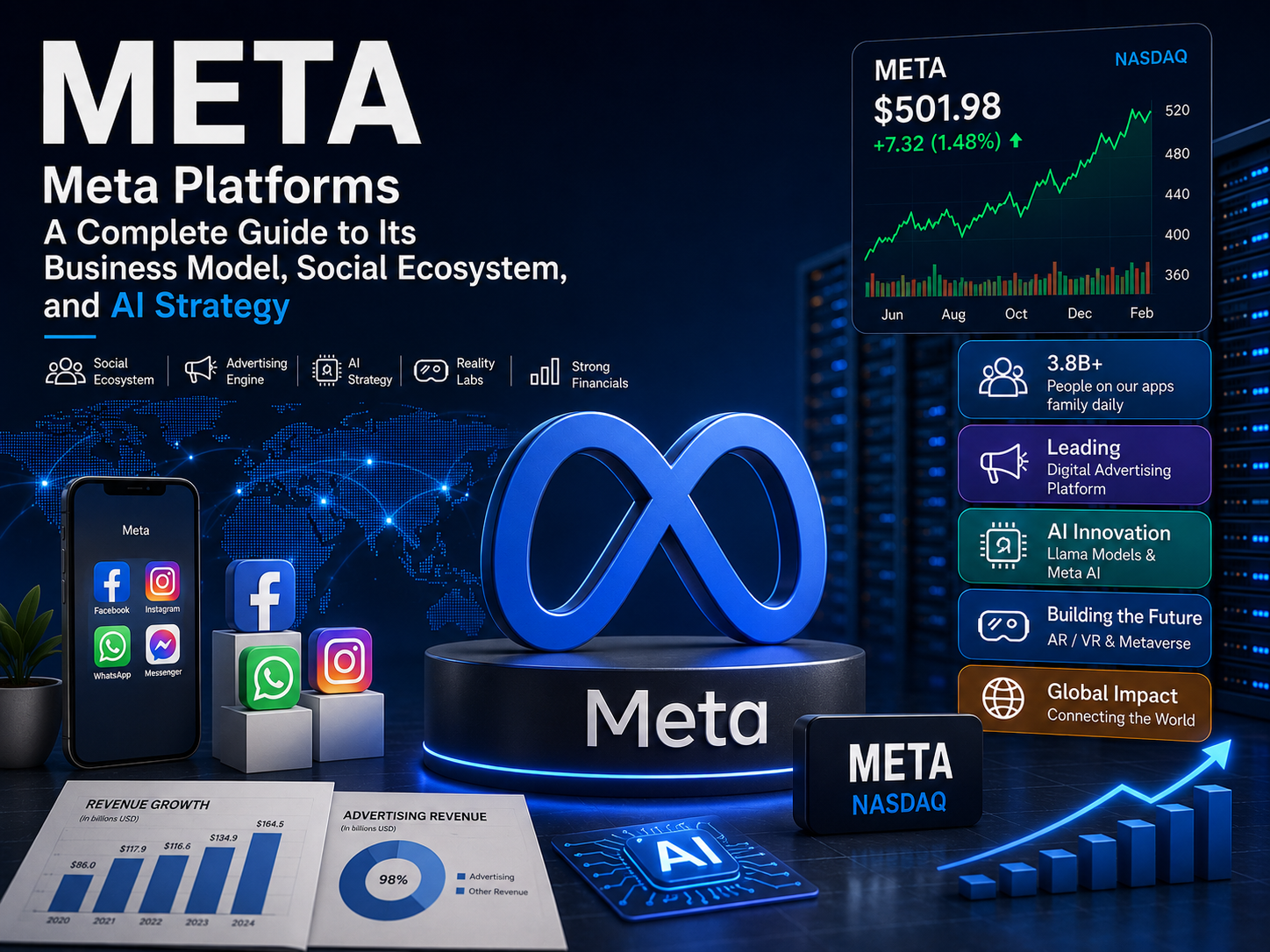
Meta Platforms is one of the world's largest social media conglomerates. The company built its foundation around Facebook as its core product, then expanded its ecosystem through strategic acquisitions like Instagram and WhatsApp, creating a network that spans social networking, content distribution, instant messaging, and digital advertising.
Meta's business model combines free services with advertising monetization. Users can access Facebook or Instagram at no cost, while advertisers pay to reach Meta's global audience.
Meta's primary business segments include:
| Business Segment |
Key Products |
| Social Platforms |
Facebook |
| Photos & Short Video |
Instagram |
| Instant Messaging |
WhatsApp, Messenger |
| Advertising |
Meta Ads |
| AI |
Meta AI, Llama |
| Virtual Reality |
Reality Labs |
Meta stands out in the global internet landscape because its social network spans all age groups and regions. This network effect continuously draws users, creators, and advertisers into its ecosystem.
Meta's Development History and Market Position
Originally founded as Facebook by Mark Zuckerberg in 2004, the company started as a campus social network before expanding worldwide.
As its user base grew, Facebook commercialized through advertising. Later, Meta expanded its ecosystem through a series of strategic acquisitions, most notably Instagram and WhatsApp.
Meta's development can be divided into several phases:
| Phase |
Core Focus |
| Social Network Era |
Facebook Expansion |
| Mobile Internet Era |
Instagram Growth |
| Platform Ecosystem Era |
WhatsApp & Advertising |
| AI & Metaverse Era |
AI & Reality Labs |
In 2021, the company rebranded from Facebook to Meta Platforms. This wasn't just a brand change—it signaled a strategic shift from a pure social media company to a broader technology platform.
Today, Meta is a major force in the global digital advertising market and a key player in generative AI.
Meta's core strength lies in its massive social platform ecosystem. Facebook, Instagram, WhatsApp, and Messenger together form a network that connects social interaction, content sharing, and instant communication.
The value of Meta's platform stems largely from network effects. As the user base grows, content becomes richer, which in turn attracts more advertisers, creating a virtuous cycle.
Meta's social ecosystem involves three key participants:
-
Regular users
-
Content creators
-
Advertisers
Users produce content, creators drive traffic, and advertisers buy exposure. This triangle fuels platform growth.
Meta's recommendation engine personalizes content delivery based on user interests and behaviors, increasing time spent on the platform and engagement. This data-driven content model has become a cornerstone of modern social media.
The vast social ecosystem also provides a fertile testing ground for Meta's AI products, allowing rapid iteration and rollout of new features and services.
Advertising is Meta's most critical revenue stream and the bedrock of its valuation.
With billions of active users, Meta offers advertisers unrivaled digital reach. Businesses run ads on Facebook and Instagram to connect with their target audiences.
Meta's advertising edge lies in its precise targeting. The ad system leverages user interests, behaviors, and interaction history to optimize ad matching and performance.
Meta's advertising offerings include:
| Ad Format |
Use Case |
| Feed Ads |
Facebook & Instagram |
| Reels Ads |
Short-form video |
| Brand Ads |
Brand awareness |
| Conversion Ads |
E-commerce sales |
Advertising isn't just about revenue size—it's also about profit margins. Ad business typically generates higher margins than operating the social platforms themselves, making it the engine of Meta's long-term growth.
Artificial intelligence is now central to Meta's strategy. Unlike some tech companies that rely heavily on external partnerships, Meta emphasizes open-source models and in-house R&D.
Meta's AI strategy focuses on several key areas:
-
Llama large language model
-
Meta AI assistant
-
AI-powered recommendation systems
-
AI-driven ad optimization
-
AI infrastructure development
The Llama series is Meta's flagship AI project. Rather than keeping models fully closed, Meta opts for openness to encourage developers and enterprises to build on its ecosystem.
AI's importance to Meta goes beyond just competition—it enhances existing operations. Recommendation algorithms, ad delivery, and content moderation all rely heavily on AI.
As Meta invests more in AI infrastructure, the market is beginning to recognize it not just as a social media company, but as a major AI platform player.
While Meta, Google, and TikTok are all internet platforms, their business models and growth strategies are distinct.
Google's core is search and advertising; TikTok thrives on short-video content; Meta's strength lies in its comprehensive social network effect across multiple platforms.
| Comparison Aspect |
Meta |
Google |
TikTok |
| Core Business |
Social Platforms |
Search & Advertising |
Short Video |
| Main Revenue |
Advertising |
Advertising & Cloud Services |
Advertising |
| User Relationship |
Social Network |
Search Intent |
Content Consumption |
| AI Strategy |
Llama Ecosystem |
Gemini Ecosystem |
Content Recommendation |
Meta's uniqueness comes from combining social relationships with content recommendation. Unlike platforms that rely solely on search or short video, Meta builds a more complete user ecosystem through multiple products.
This ecosystem advantage forms the foundation for Meta's competitiveness in both advertising and AI.
Meta's products are widely used across personal social networking, content creation, business marketing, and commercial communication.
Everyday users turn to Facebook and Instagram for news, sharing life updates, and community engagement. Businesses, meanwhile, rely on Meta's platforms for brand marketing and customer management.
Primary use cases include:
-
Social interaction
-
Content distribution
-
Digital marketing
-
Brand promotion
-
Online commerce
-
AI assistant services
WhatsApp is also increasingly used by businesses for customer service and communication. With the integration of AI features, Meta's platforms are expanding from traditional social networks into smart assistants and enterprise services.
This expansion helps Meta continuously grow its ecosystem influence.
META is a key name in the U.S. tech stock market. Through the Gate TradFi product suite, users can access global stock-related markets, including META.
Users can choose from spot stocks, CFDs, or other derivative instruments based on their needs.
| Product Type |
Characteristics |
| Spot Tokens |
Hold the underlying asset |
| CFD Products |
Track stock price movements |
| Derivative Products |
Support two-way trading |
For those tracking META's price moves, CFD products allow participation in price fluctuations without directly owning the stock.
Keep in mind that CFDs and other leveraged products are derivatives with risk-return profiles different from traditional stock holdings. Always understand the product rules and risk management requirements before trading.
Meta's biggest strengths lie in its massive user base and mature advertising ecosystem. Facebook, Instagram, and WhatsApp together form one of the world's most influential social networks.
Key advantages include:
However, Meta also faces notable challenges.
Key limitations:
-
Heavy reliance on advertising revenue
-
Increasing global regulatory scrutiny
-
Intensified social media competition
-
High AI infrastructure costs
As the tech industry moves into the AI era, Meta must balance maintaining advertising growth with continuous investment in AI and infrastructure to stay competitive.
Summary
META is the stock ticker for Meta Platforms. Meta has evolved from a single social media company into a diversified tech giant spanning social networks, digital advertising, instant messaging, and AI.
Facebook, Instagram, and WhatsApp remain its core ecosystem, while advertising continues to be the primary revenue driver. With generative AI accelerating, Meta is strengthening its AI position through products like Llama and Meta AI.
Long-term, its market standing and growth will depend on the interplay between its social ecosystem, advertising strength, and AI strategy.
FAQ
What is META?
META is the stock ticker for Meta Platforms, Inc., one of the world's largest social media companies, owning platforms such as Facebook, Instagram, and WhatsApp.
How does Meta make money?
Meta primarily generates revenue from digital advertising. Advertisers run campaigns on Facebook, Instagram, and other platforms to reach their target audiences.
What is Meta AI?
Meta AI is Meta's artificial intelligence product line, including the Meta AI assistant, the Llama large language model, and various AI services and tools.
How is Meta different from Google?
Meta focuses on social networks and advertising ecosystems, while Google centers on search engines, advertising, and cloud computing services.
What makes the Llama model unique?
Llama is Meta's series of large language models, known for its open ecosystem approach, enabling developers and enterprises to innovate and deploy based on the models.
How can I trade META stock on Gate?
Users can trade META through Gate's TradFi products, including spot stocks, CFDs, and other stock-related trading instruments.