The growth of new energy vehicles, energy storage systems, and AI data centers is continuing to drive global battery demand. Because lithium resources are an important raw material for lithium batteries, lithium mining companies, battery manufacturers, and new energy value chain companies have gradually become major areas of focus in capital markets.
From an industry structure perspective, what LIT represents is not only a new energy ETF, but also the long term demand logic created by the global energy transition for lithium resources and battery supply chains. As the new energy vehicle market continues to expand, the importance of the lithium battery value chain is also rising.
What Is LIT (Global X Lithium Battery ETF)?
LIT’s core positioning is to track the market performance of companies related to the global lithium battery value chain. Compared with a single stock, LIT uses an ETF structure to cover multiple parts of the industry, including lithium mining, battery materials, battery manufacturing, and the new energy value chain.
Structurally, LIT is closer to a “new energy supply chain ETF.” This is because its holdings include not only lithium resource companies, but also battery manufacturers and new energy materials companies.
This structure means LIT’s volatility is affected not only by lithium prices, but also by the new energy vehicle market, battery demand, and changes in global energy policy.
At its core, LIT’s market logic reflects how dependent the global new energy industry is on lithium resources and energy storage systems.
Why LIT Focuses on the Lithium Battery and New Energy Value Chain
LIT focuses on the lithium battery value chain mainly because lithium batteries have become essential infrastructure for the new energy industry. Whether in new energy vehicles, energy storage systems, or mobile electronic devices, lithium batteries are one of the core energy components.
Traditional energy systems have long depended on oil and fossil fuels, while the new energy market places greater emphasis on power storage and battery systems. As a result, lithium resources have gradually become an important industrial raw material in the new energy era.
From an industry structure perspective, growth in new energy vehicle sales usually drives battery demand at the same time. As battery demand expands, lithium mining, battery material processing, and battery manufacturing markets also tend to benefit.
This linkage has helped the lithium resource value chain develop into a complete market system, while LIT attempts to track changes in this value chain through an ETF structure.
LIT’s holdings structure usually centers on lithium resources and the lithium battery value chain. Compared with traditional index ETFs, LIT places more emphasis on industry themes and value chain coverage.
First, LIT allocates assets to lithium mining companies. These companies are mainly responsible for lithium resource extraction and raw material supply. LIT may also cover battery materials companies and battery manufacturers. Some companies in the new energy vehicle value chain may also be included in the ETF’s holdings.
The table below shows the common value chain structure of LIT:
| Value Chain Stage |
Main Function |
| Lithium mining companies |
Provide lithium resources |
| Materials companies |
Process battery materials |
| Battery manufacturers |
Produce lithium batteries |
| New energy companies |
Apply battery systems |
This structure means LIT does not simply track lithium prices. Instead, it reflects market changes across the entire lithium battery value chain.
What Role Do Lithium Resource Companies Play in LIT?
Lithium resource companies are usually an important part of LIT because lithium is a key raw material in lithium battery production. After the new energy vehicle and energy storage markets expand, market demand for lithium resources usually grows at the same time.
The business model of lithium mining companies mainly revolves around lithium resource extraction, refining, and supply. When lithium prices rise, the profitability of some lithium mining companies often improves significantly, so related stocks may affect LIT’s volatility.
From a value chain perspective, lithium resources sit upstream in the new energy industry. Battery manufacturers need a stable supply of lithium resources, so the lithium mining market directly affects the cost structure of the entire new energy value chain.
This mechanism means changes in global lithium resource supply and demand usually have a direct impact on LIT’s market performance.
How Battery Manufacturers Affect LIT’s Volatility
Battery manufacturers are another important component of LIT. Compared with lithium mining companies, which depend more on resource prices, battery manufacturers place greater emphasis on technology, production capacity, and downstream customer demand.
As the new energy vehicle market grows, automakers usually need large quantities of lithium batteries to support production. As a result, battery company revenue is closely linked to industry demand.
At the same time, the development of the energy storage market also increases battery demand. Large scale energy storage systems, home storage, and new energy grids all depend on lithium batteries to store energy.
This structure means LIT’s volatility comes not only from lithium prices, but also from changes in global battery demand and the pace of new energy market expansion.
The new energy vehicle market is one of the key factors affecting LIT’s volatility. Because new energy vehicle production depends heavily on lithium batteries, growth in new energy vehicle sales usually drives demand across the lithium resource and battery value chain.
From an industry process perspective, new energy vehicle companies need to purchase power batteries. Power battery production then requires large amounts of lithium resources and battery materials. As a result, changes in new energy vehicle sales often influence profitability expectations across the entire value chain.
At the same time, global energy transition policies also affect the development of the new energy vehicle market. After some countries promote wider adoption of new energy vehicles, demand across the lithium resource and battery value chain usually expands as well.
This linkage has gradually made the new energy vehicle market one of the important variables affecting LIT’s performance.
How LIT Differs from Traditional New Energy ETFs
The main difference between LIT and traditional new energy ETFs lies in their industry focus. Traditional new energy ETFs usually cover multiple areas such as solar power, wind power, power grids, and new energy equipment, while LIT focuses more on the lithium battery value chain.
From an industry structure perspective, traditional new energy ETFs are closer to “broad energy transition ETFs.” By contrast, LIT is more focused on lithium resources, battery materials, and energy storage systems.
At the same time, LIT is usually more sensitive to lithium prices and the new energy vehicle market. This is because changes in lithium resource supply and demand directly affect value chain profitability and market expectations.
This structure means LIT’s industry concentration is usually higher than that of broad based new energy ETFs, so its volatility may also be more pronounced.
As a new energy themed ETF listed in the U.S. market, LIT can usually be traded through securities platforms that support U.S. stock trading. Under the traditional model, users generally need an overseas securities account to participate in the U.S. ETF market.
Recently, some regions have further strengthened regulation of cross border securities services, and some internet brokerages have adjusted their U.S. stock related services. As a result, more users are starting to look at alternative trading methods beyond ETFs.
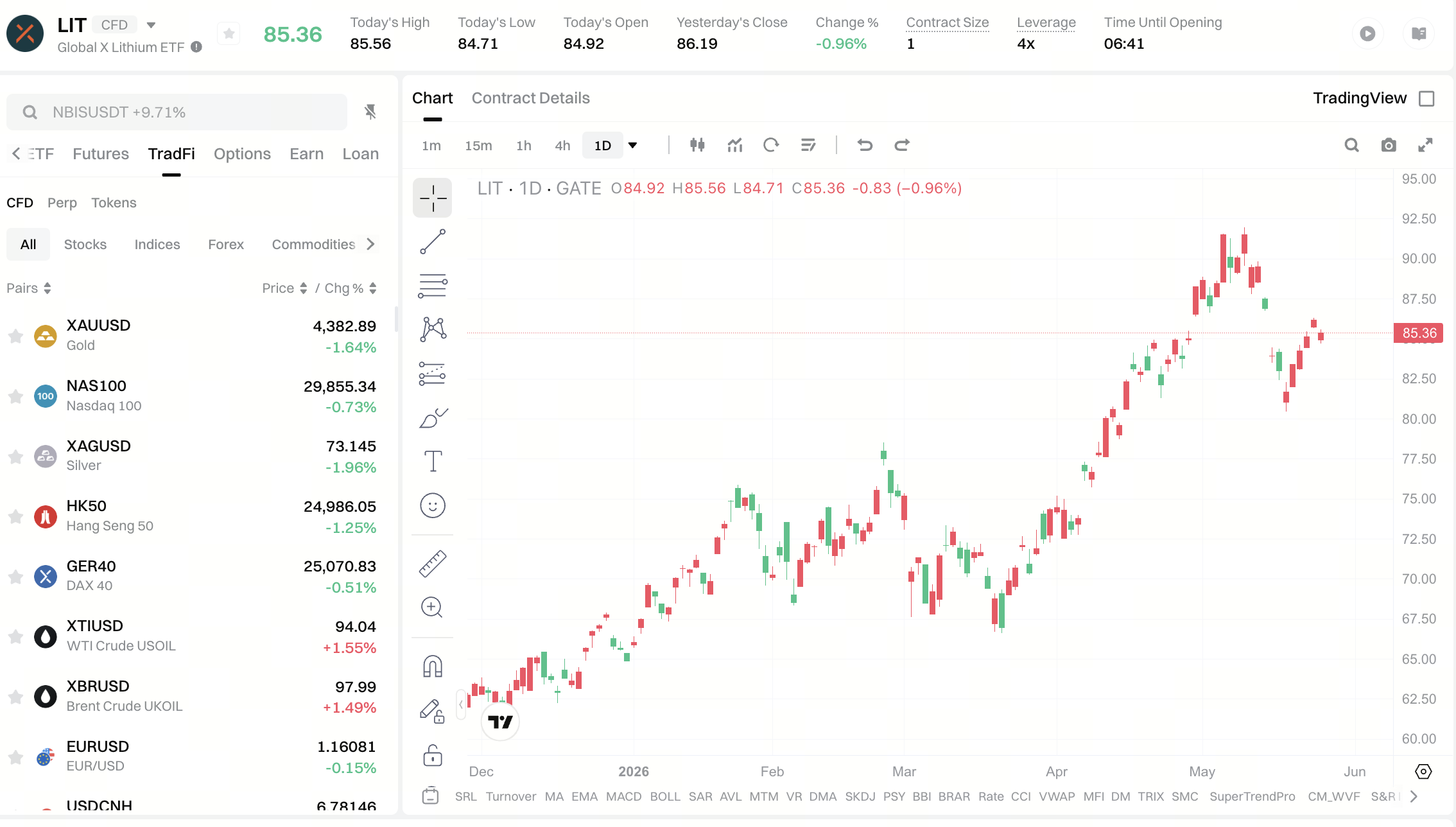
In addition to traditional securities trading, some platforms have also begun offering CFD products or on chain asset products related to U.S. ETFs. The CFD model usually tracks ETF price movements through price contracts rather than directly holding the ETF itself.
At the same time, some digital asset platforms are also expanding products related to traditional financial markets. For example, products such as Gate CFD have begun covering selected global market assets, including ETFs, allowing users to follow both digital assets and selected overseas market price movements on the same platform.
Before participating in LIT or related ETF products, users generally need to pay close attention to:
-
Platform compliance scope
-
Differences between ETFs and CFDs
-
Leverage risk
-
Liquidity
-
Regional regulatory restrictions
Different regions have different rules for ETFs, derivatives, and cross border securities trading, so the services actually available may vary.
What Are LIT’s Advantages and Risks?
LIT’s main advantage is that it can cover lithium resources, battery manufacturing, and the new energy value chain through a single ETF structure. Compared with investing in a single company, ETFs can usually reduce individual stock volatility risk.
At the same time, LIT can also help the market observe broader changes in the new energy value chain. New energy vehicle sales, lithium prices, and changes in the energy storage market usually all affect LIT’s performance.
However, LIT also has relatively high industry concentration. If lithium prices fall, new energy vehicle demand slows, or competition in the battery industry intensifies, the profitability of related companies may be affected.
In addition, the new energy industry itself is relatively volatile, so LIT’s market volatility is usually higher than that of some traditional broad based ETFs.
Conclusion
LIT (Global X Lithium Battery ETF) is a thematic ETF focused on lithium resources, battery manufacturing, and the new energy value chain. Its market performance is usually affected by lithium prices, new energy vehicle sales, and global energy transition trends.
Compared with traditional new energy ETFs, LIT places greater emphasis on the lithium battery value chain and energy storage systems, making it more sensitive to changes in the new energy vehicle and battery markets.
As the new energy market continues to expand, lithium resources, battery manufacturing, and the energy storage industry are becoming increasingly important, while LIT has become one of the key tools for observing the new energy value chain.
FAQs
What Is the LIT ETF?
LIT is a thematic ETF that mainly invests in companies in lithium resources, battery manufacturing, and the new energy value chain. It is used to track the market performance of the global lithium battery industry.
Why Is LIT Affected by the New Energy Vehicle Market?
New energy vehicle production requires large numbers of power batteries, and power batteries depend on lithium resources. As a result, growth in new energy vehicle sales usually increases demand across the lithium value chain.
How Is LIT Different from Ordinary New Energy ETFs?
LIT focuses more on lithium resources and the battery value chain, while ordinary new energy ETFs usually cover broader areas such as solar power, wind power, power grids, and new energy equipment.
Does LIT Directly Invest in Lithium Mining Companies?
LIT usually holds shares in some lithium mining companies because lithium resources are an important raw material source for the new energy battery value chain.
How Can Investors Buy the LIT ETF?
LIT can usually be purchased through platforms that support U.S. stock trading. Some platforms may also offer ETF CFDs or related derivative products, but regulatory rules may differ across regions.