What Is Kalshi?
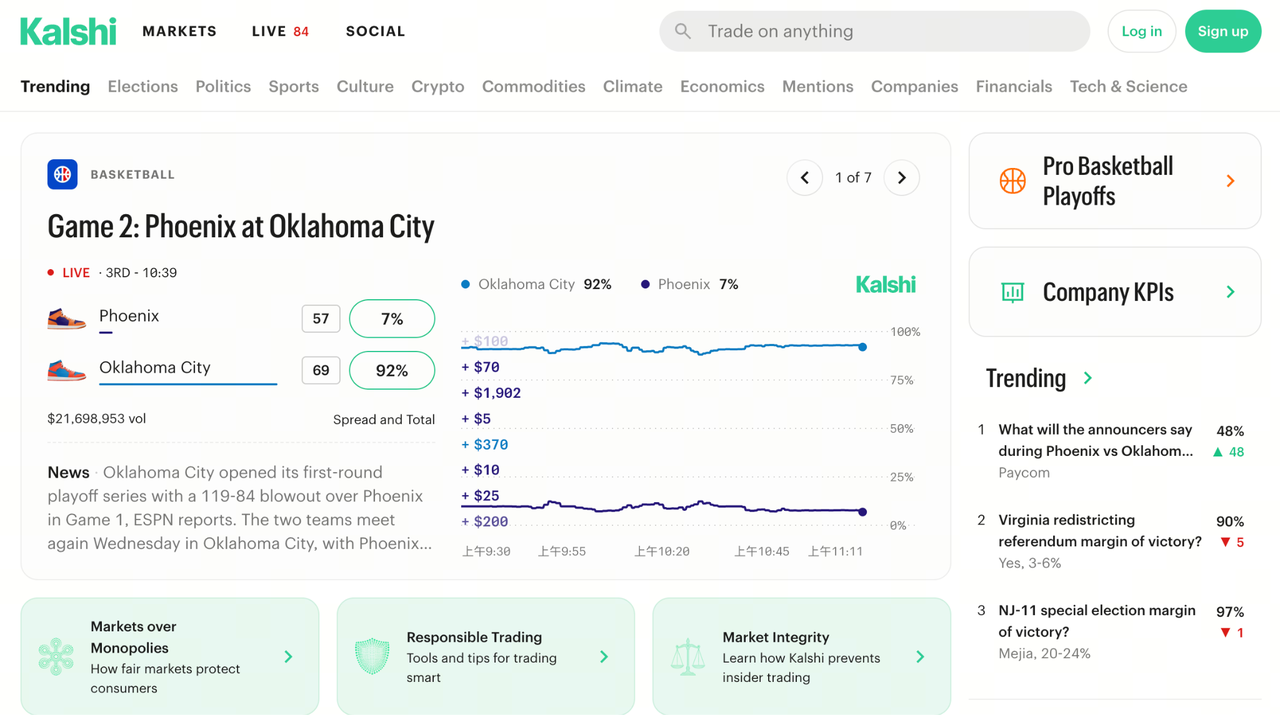
Kalshi is a regulated US-based prediction market platform that enables users to trade on the outcomes of a wide range of events, including inflation data, interest rate decisions, election results, sports events, and even weather changes. It operates similarly to event contracts, where participants purchase Yes or No contracts and realize returns or losses based on the final outcome. Kalshi’s core value lies in converting the collective judgment of market participants into quantifiable probability signals, making it a key tool for gauging market expectations and risk sentiment. As prediction markets gain traction, Kalshi is emerging as a significant platform bridging traditional finance and innovative trading models.
Kalshi Launches Commodities Prediction Section
(Source: Kalshi)
Recently, Kalshi introduced the Commodities Hub, a dedicated section that allows users to predict price movements for commodities like oil and gold. Rather than direct commodity trading, these markets utilize event-based contracts, enabling users to speculate on whether prices will be above or below a predetermined target range.
Oracle Technology: Pyth as the Price Reference

(Source: CoinMarketCap)
To guarantee the accuracy of market outcomes, Kalshi has partnered with Pyth Network as its primary price data provider.
Pyth’s functions include:
- Delivering real-time price information
- Serving as the resolution source for market settlement
- Supporting a wide range of asset classes
Pyth aggregates data from over 125 institutions, including exchanges and market makers, to provide integrated, real-time price feeds.
How Does the Commodities Prediction Market Work?
On Kalshi’s commodities market, users can engage in predictions such as:
- Whether crude oil prices will surpass a specific threshold
- Whether lithium or soybean prices will decline
- Whether gold will break through a certain price range
These trades are typically structured as Yes/No binary outcomes.
Why Is Real-Time Data Essential for Markets?
Traditional commodity markets like the Chicago Mercantile Exchange operate on fixed trading hours and are not available 24/7. In contrast, geopolitical events can unfold at any moment, market news circulates around the clock, and price volatility never ceases. Therefore, platforms like Pyth that deliver continuous, real-time data enable markets to react instantly to new developments.
Impact of Cryptographic Technology
Blockchain and cryptographic technologies are reshaping trading paradigms, for example:
- Hyperliquid offers perpetual futures with no expiration date
- Prediction markets allow users to engage with price movements in novel ways
These innovations remove the temporal and structural limitations of traditional exchanges.
Intensifying Market Competition
The prediction market landscape is highly competitive, with players like Kalshi, Polymarket (which also integrates oracle technology), and other DeFi and derivative platforms. Competition extends beyond user acquisition and market share to encompass data sources and valuation methodologies.
Regulatory Challenges Persist
In the United States, prediction markets continue to face multi-layered regulatory scrutiny:
- The Commodity Futures Trading Commission (CFTC) regards them as subject to federal oversight
- Certain state governments question whether such platforms constitute gambling
Additionally, legislative proposals have emerged aiming to restrict specific types of prediction markets, such as those related to sports contracts.
Summary
Kalshi integrates commodity markets with prediction mechanisms and leverages Pyth to deliver real-time data, offering a participation model distinct from traditional exchanges. As market demand and technology evolve, these data-driven predictive financial instruments are likely to play an increasingly pivotal role in the financial landscape.







