As digital assets gradually move into the mainstream financial system, Bitcoin is no longer just a standalone asset within the crypto market. More banks, fund managers, pension institutions, and wealth management platforms are beginning to view Bitcoin as part of an alternative asset allocation strategy, while spot Bitcoin ETFs have become an important bridge between traditional finance and the crypto market.
Against this backdrop, IBIT has become one of the most closely watched digital asset products in global capital markets. Compared with buying Bitcoin directly, IBIT allows investors to access the market through familiar securities accounts while retaining the advantages of an ETF product in regulation, custody, and trading convenience.

What Is IBIT, or the iShares Bitcoin Trust?
IBIT is a spot Bitcoin ETF launched by iShares, a BlackRock brand. The product is designed primarily to track the spot market price of Bitcoin, with real Bitcoin held as the underlying asset supporting the value of the ETF shares.
Unlike traditional equity ETFs, IBIT does not invest in company stocks, bonds, or index constituents. Its core asset is actual Bitcoin, so changes in its net asset value are usually highly correlated with the market price of Bitcoin. When Bitcoin rises, IBIT’s market price typically moves higher as well; when Bitcoin falls, IBIT faces similar volatility.
The launch of IBIT is widely seen as an important milestone in the entry of digital assets into the traditional financial system. In the past, most institutional investors found it difficult to hold Bitcoin directly because of regulatory, custody, and compliance requirements. The ETF structure gives institutional capital a more familiar way to participate, one that fits better within traditional investment frameworks.
From a market positioning perspective, IBIT is not a new crypto asset in itself. It is a financial instrument that packages Bitcoin into a traditional securities product. Investors buy ETF shares, but those shares are backed by Bitcoin held within a regulated custody framework.
How Spot Bitcoin ETFs Work
The core logic of a spot Bitcoin ETF is “asset holding plus share mapping.” The ETF manager purchases and holds real Bitcoin, uses those assets as the fund’s reserves, and then issues a corresponding number of ETF shares to the market.
When market demand for the ETF increases, authorized participants can submit cash to the fund and create new ETF shares. The fund then uses the capital to purchase more Bitcoin, helping maintain the relationship between assets and outstanding shares. When market demand declines, some ETF shares may be redeemed.
This mechanism allows the ETF’s net asset value to remain anchored to the value of the underlying Bitcoin over the long term. Although the market price may temporarily trade at a premium or discount because of supply and demand, the ETF creation and redemption mechanism usually helps pull the price back toward net asset value.
For traditional investors, the greatest value of a spot Bitcoin ETF lies in simplifying access. Investors do not need to learn how to manage on-chain wallets, store private keys, or handle digital asset custody. They can gain exposure to the Bitcoin market through a securities account.
How IBIT Tracks the Price of Bitcoin
IBIT’s price is based on the value of the Bitcoin assets it holds. The fund manager calculates the daily net asset value, or NAV, based on the size of its holdings and market prices, and this becomes an important reference point for ETF pricing.
Because IBIT holds real Bitcoin, its long-term performance generally moves in line with the Bitcoin spot market. The ETF does not use futures contracts or derivatives to simulate price movements. Instead, it relies directly on its underlying assets to track Bitcoin’s price.
That said, IBIT and Bitcoin will not have exactly the same price movement at every trading moment. Securities markets and crypto markets differ in trading hours, liquidity conditions, and the structure of market participants, so the ETF price may deviate slightly at times.
Even so, the ETF creation and redemption mechanism usually prevents this gap from widening for long. Over time, IBIT’s performance is driven mainly by changes in Bitcoin’s price, not by active market direction calls from the fund manager.
IBIT’s Role in the Bitcoin Market
IBIT has become one of the key entry points for traditional financial capital into the Bitcoin market. For many institutional investors, an ETF is better aligned with existing investment processes and regulatory requirements than buying Bitcoin directly.
Within traditional asset allocation systems, Bitcoin has long faced challenges around custody, auditing, and compliance. The emergence of spot ETFs has reduced these barriers, making it easier for pension funds, family offices, insurance institutions, and wealth management platforms to access the digital asset market.
As ETF assets grow, IBIT’s capital flows are also beginning to affect the broader Bitcoin ecosystem. Large inflows usually mean the fund needs to purchase more Bitcoin reserves, and this demand may influence the market’s supply and demand structure.
For this reason, IBIT is not only an investment tool, but also an important bridge between traditional capital and the digital asset market. Its development also reflects the broader trend of Bitcoin becoming integrated into the global financial system.
Why Institutional Capital Is Paying Attention to IBIT
One of the main reasons institutional investors pay attention to IBIT is that it gives them a way to gain digital asset exposure while staying within a traditional investment framework. Compared with holding Bitcoin directly, an ETF product can be more easily incorporated into existing portfolio management systems.
Many large institutions have strict requirements for risk control, asset custody, and compliance review. Spot Bitcoin ETFs provide a standardized securities structure, allowing institutions to complete asset allocation through familiar procedures.
At the same time, some market participants increasingly view Bitcoin as an alternative asset class. Certain institutions believe Bitcoin has characteristics that differ from traditional stocks and bonds, which may help diversify portfolio structures.
As the digital asset market continues to mature, institutional interest in Bitcoin has gradually moved beyond early exploration and toward formal asset allocation. IBIT is one of the key vehicles behind this shift.
How IBIT Differs from Holding Bitcoin Directly
Although IBIT is highly correlated with the price of Bitcoin, buying IBIT is not the same as directly owning Bitcoin. Investors hold ETF shares, not the on-chain digital asset itself.
Holding Bitcoin directly means investors control the on-chain asset. They can transfer it freely, store it themselves, or participate in certain blockchain ecosystem activities. IBIT only provides price exposure and does not give investors actual control over the underlying Bitcoin.
On the other hand, IBIT has a clear advantage in operational convenience. Investors do not need to manage private keys or use a crypto wallet to participate in the market. For users who are accustomed to traditional securities trading, this model is often easier to accept.
The two approaches serve different needs. Direct holding places more emphasis on asset ownership, while an ETF places more emphasis on compliant investing and convenient participation through traditional markets.
| Dimension |
IBIT |
Direct Bitcoin Holding |
| Holding form |
ETF shares |
BTC asset |
| Private key management |
Not required |
Self-managed |
| On-chain use |
Not supported |
Supported |
| Securities account trading |
Supported |
Not supported |
| Compliant investment framework |
Relatively high |
Varies by region |
How IBIT Differs from Other Bitcoin ETFs
Although there are multiple spot Bitcoin ETFs on the market, differences remain among products. Assets under management, fee structures, liquidity levels, and brand influence are all important factors watched by the market.
One of IBIT’s advantages is that it is backed by one of the world’s largest asset managers, giving it strong competitiveness in institutional client coverage, market promotion, and product recognition.
At the same time, different ETF products may adopt different fee strategies. Expense ratios directly affect the cost of long-term holding, so they are also an important factor when investors compare products.
From a market competition perspective, ETF managers are all competing for inflows from institutional and retail investors. Liquidity, trading convenience, and brand trust often become the main areas of competition.
What Factors Affect IBIT Price Volatility?
The most direct factor affecting IBIT is the market price of Bitcoin. Because the ETF’s underlying asset is real Bitcoin, BTC price increases and decreases are usually reflected directly in changes in the ETF’s net asset value.
Beyond Bitcoin’s price itself, the scale of institutional inflows is another important factor. When demand for spot Bitcoin ETFs rises, inflows may improve market sentiment and drive growth in ETF assets.
The macroeconomic environment can also affect IBIT’s performance. Changes in interest rates, dollar liquidity, inflation expectations, and global risk appetite all influence investor demand for alternative assets.
In addition, digital asset regulation, shifts in market sentiment, and major events in the crypto industry may also affect the degree of ETF price volatility in the short term.
As a spot Bitcoin ETF listed in the U.S. market, IBIT can usually be bought and sold through securities accounts that support U.S. stock trading. Under the traditional model, investors need to open a brokerage account and trade IBIT ETF shares through the U.S. securities market.
As digital assets and traditional financial markets gradually converge, more trading tools linked to Bitcoin prices have also emerged. For example, some platforms offer CFD, or contract for difference, products linked to ETFs or related asset prices, allowing users to participate in price movements without directly holding ETF shares.
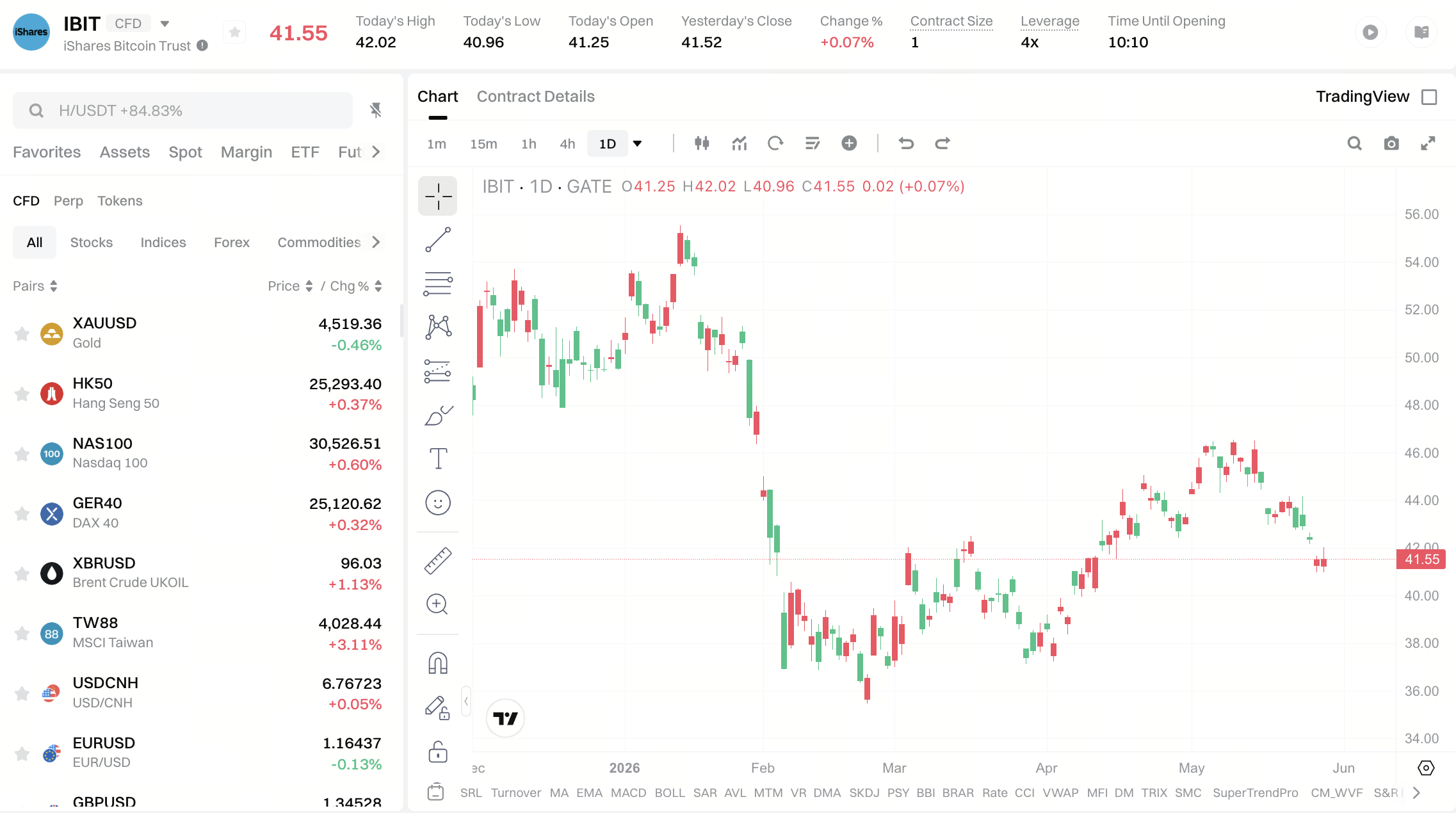
At the same time, digital asset trading platforms have begun expanding their coverage of TradFi, or Traditional Finance, assets. Taking Gate TradFi as an example, users can follow crypto asset markets while also accessing products related to traditional financial assets such as stocks, ETFs, indices, and commodities within the same platform ecosystem. Some markets also provide Gate CFD products, allowing users to participate in price movement trading for related assets through digital asset accounts, which may improve the efficiency of cross-market asset allocation and management.
Regardless of how investors participate in the market, they should fully understand the product structure, trading rules, liquidity characteristics, and regulatory requirements in their region. ETFs, CFDs, and digital asset products differ in trading mechanisms, risk levels, and suitable use cases, so understanding product features is an important prerequisite for market participation.
IBIT’s Advantages and Limitations
IBIT’s biggest advantage is that it lowers the barrier for traditional investors to enter the Bitcoin market. The ETF structure allows investors to trade through familiar securities accounts and obtain market exposure within a regulated framework.
From an institutional perspective, IBIT addresses long-standing issues in digital asset custody, compliance, and auditing, making it easier to include within traditional portfolio management systems.
However, IBIT also has certain limitations. Investors do not gain control over the underlying Bitcoin and cannot participate in on-chain ecosystem activities. For users who want to use digital assets for transfers, payments, or on-chain interactions, an ETF cannot replace holding real BTC.
In addition, ETFs are still subject to securities market trading hours, while the Bitcoin market operates around the clock. As a result, short-term price deviations may appear between the two during extreme market conditions.
Conclusion
IBIT is one of the most representative spot Bitcoin ETFs in traditional financial markets. Its core value lies in providing investors with Bitcoin price exposure through an ETF structure. IBIT connects digital assets with the traditional securities system, allowing both institutional and individual investors to participate in the Bitcoin market within a familiar market environment.
As the spot Bitcoin ETF market continues to develop, IBIT has gradually become an important window for observing institutional capital flows, the regulatory evolution of digital assets, and the growing convergence between TradFi and crypto.
FAQs
What Is IBIT?
IBIT is a spot Bitcoin ETF launched by iShares, a BlackRock brand. It tracks BTC market price performance by holding real Bitcoin assets.
Does IBIT Directly Hold Bitcoin?
Yes. IBIT is a spot Bitcoin ETF, and the fund holds real Bitcoin as the underlying asset supporting the value of its ETF shares.
How Is IBIT Different from Buying BTC?
Buying BTC gives investors ownership of a digital asset, while buying IBIT gives investors ETF shares. IBIT is better suited to traditional securities account investment scenarios.
Does IBIT Fully Track Bitcoin’s Price?
IBIT’s long-term performance is usually highly correlated with Bitcoin’s price, but slight short-term deviations may occur because of factors such as trading hours and market liquidity.
Why Are Institutions Interested in IBIT?
IBIT provides a compliant, standardized, and easier-to-manage way to invest in Bitcoin, allowing institutions to allocate digital assets within a traditional financial framework.
Some market platforms offer CFD products linked to Bitcoin ETFs or related assets. Users can participate in price movements without directly holding the ETF, but they need to pay close attention to leverage and risk management.